Honda Pilot Battery Light: What It Actually Means
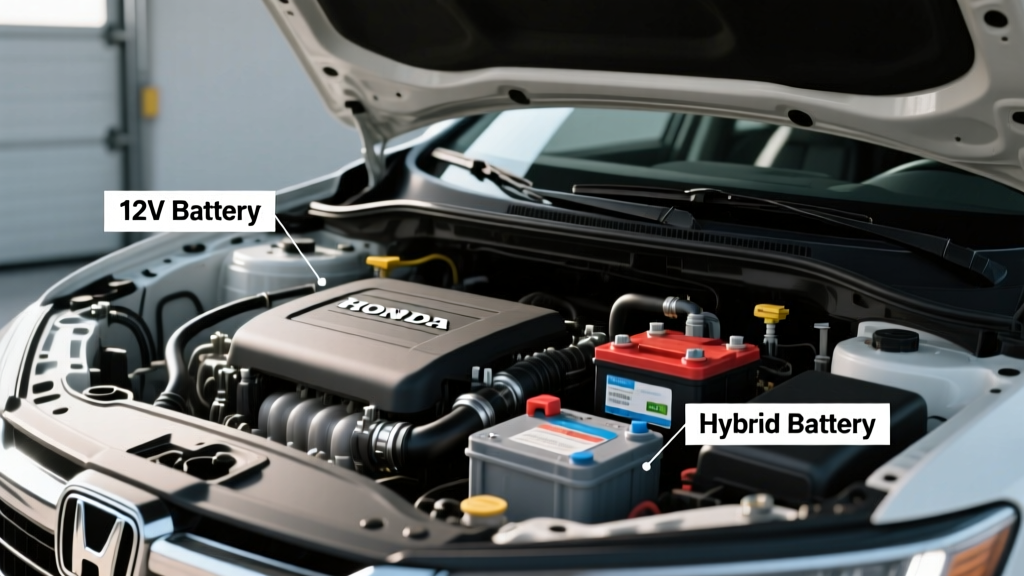
If you're seeing a Honda Pilot battery light illuminate on your dashboard, the first thing to understand is which battery the warning refers to. The Honda Pilot, through the 2025 and 2026 model years, uses a conventional 12-volt auxiliary battery to power electronics, starter motor (on non-hybrid trims), and onboard computers. This is entirely separate from the high-voltage traction batteries found in Honda's electrified lineup — the CR-V Hybrid, Accord Hybrid, and the upcoming all-electric Prologue-based SUVs.
A battery warning light in a gas-powered Pilot typically signals one of three issues:
- 12V battery degradation: The standard lead-acid or AGM 12V battery is failing to hold charge (typical lifespan: 3–5 years)
- Alternator malfunction: The alternator isn't charging the 12V system properly, causing voltage drops below ~12.4V at idle
- Parasitic drain or loose connections: Corroded terminals or an accessory drawing current while the vehicle is off
For Honda Pilot Hybrid owners (expected in upcoming model years as Honda expands its electrified powertrain across the lineup), a separate high-voltage system warning would appear as a different indicator — typically a yellow or red car-with-exclamation icon, not the standard battery symbol. This article addresses both scenarios and then provides a comprehensive guide to high-voltage EV battery technology for buyers considering Honda's growing electrified lineup or any modern BEV/PHEV.
12V Battery Issues in the Honda Pilot: Diagnosis and Fixes
The Honda Pilot's 12V battery is typically a Group 35 or Group 48 AGM unit, rated around 60–70 Ah. When the battery light comes on while driving, the alternator circuit is the most common culprit. Here's a diagnostic sequence:
- Check voltage at idle: With the engine running, a healthy system reads 13.8–14.4V at the battery terminals. Below 13.2V indicates alternator trouble.
- Inspect terminals: Corrosion (white/green crust) on posts creates resistance. Clean with a wire brush and terminal protector spray.
- Load test the 12V battery: Most auto parts stores perform this free. A battery reading below 9.6V under load needs replacement.
- Check for parasitic draw: With the vehicle off and doors closed, current draw should be under 50 milliamps. Higher readings indicate a module staying awake.
Replacement cost for a Pilot 12V battery ranges from $150–$280 for the part, plus $30–$60 in labor if professionally installed. This is routine maintenance, comparable to replacing wiper blades or cabin air filters, and is not covered under Honda's powertrain warranty.
EV and Hybrid Traction Batteries: Chemistry Explained
For buyers evaluating Honda's electrified vehicles — the CR-V Hybrid (1.3 kWh battery), the Accord Hybrid (1.3 kWh), or the all-electric Honda Prologue (85 kWh usable, Honda Prologue specs) — understanding battery chemistry is essential for predicting longevity, charging behavior, and real-world range.
Two dominant chemistries power modern EVs and PHEVs:
| Attribute | LFP (Lithium Iron Phosphate) | NMC/NCA (Nickel Manganese Cobalt / Nickel Cobalt Aluminum) |
|---|---|---|
| Energy density | ~160–180 Wh/kg (lower) | ~220–300 Wh/kg (higher) |
| Cycle life | 3,000–5,000+ full cycles to 80% SoH | 1,000–2,500 full cycles to 80% SoH |
| Cold-weather performance | Weaker below 32°F; slower charging, ~15–25% range loss in freezing temps | Better cold tolerance; ~10–20% range loss in freezing temps |
| Thermal stability | Excellent — highly resistant to thermal runaway | Good — requires more active thermal management |
| Cost per kWh | ~$80–$100/kWh (lower; no cobalt/nickel) | ~$110–$140/kWh (higher; commodity-sensitive) |
| Optimal daily SoC | Can charge to 100% daily without significant degradation | Best kept 20–80% for daily use; 100% for road trips only |
| Common in | Tesla Model 3/Y RWD, Ford Mustang Mach-E Select, BYD models | Tesla Long Range, Hyundai Ioniq 5/6, Honda Prologue, most long-range BEVs |
The Honda Prologue uses an NMC-based Ultium battery (shared architecture with GM), prioritizing energy density to deliver its EPA-estimated 296 miles of range in FWD trims. Honda's hybrid models use much smaller lithium-ion packs (1.0–1.3 kWh) that experience minimal stress because they're buffered heavily and rarely cycled deeply.
How Long Do EV Batteries Actually Last?
Real-world degradation data from fleet studies and owner reports consistently shows that modern EV batteries outlast most owners' time with the vehicle. Here's what the data shows:
| Timeframe / Mileage | Typical Capacity Retention | Source / Notes |
|---|---|---|
| Year 1 / 15,000 mi | 95–98% | Initial formation loss; steepest part of the curve |
| Year 3 / 45,000 mi | 90–95% | Geotab fleet study of 10,000+ EVs across brands |
| Year 5 / 75,000 mi | 87–93% | Varies by chemistry; LFP holds better at high cycle counts |
| Year 8 / 120,000 mi | 82–90% | Within federal warranty threshold (see below) |
| Year 10 / 150,000 mi | 78–88% | Most packs still functional; reduced range, not failure |
The critical insight: degradation is not linear. Most capacity loss occurs in the first 12–18 months (formation cycle losses and SEI layer growth), then the curve flattens significantly. A battery reaching 85% State of Health (SoH) at 100,000 miles is likely to remain above 75% at 200,000 miles under similar usage patterns.
For context, a Honda Prologue with 296 mi EPA range that degrades to 85% SoH after 5 years still delivers ~252 miles — more than adequate for the average American's 37-mile daily commute (fueleconomy.gov).
Battery Warranty Terms: What's Covered
Federal law mandates that EV and PHEV batteries carry a minimum warranty of 8 years / 100,000 miles (10 years / 150,000 miles in California Air Resources Board states). Here's how major manufacturers structure their coverage:
| Manufacturer | Warranty Term | Capacity Threshold | What Triggers a Claim |
|---|---|---|---|
| Honda (Prologue) | 8 yr / 100,000 mi | Below ~70% SoH | Capacity falls below threshold; module or pack replacement |
| Tesla (Model 3/Y LFP) | 8 yr / 100,000 mi | Below 70% SoH | Measured via BMS; covered repair or replacement |
| Tesla (Long Range) | 8 yr / 120,000 mi | Below 70% SoH | Higher mileage threshold on NMC packs |
| Hyundai / Kia | 10 yr / 100,000 mi | Below 70% SoH | Industry-leading term length |
| GM (Ultium-based) | 8 yr / 100,000 mi | Below 70% SoH (varies by model) | Modular design allows single-module replacement |
| Ford | 8 yr / 100,000 mi | Below 70% SoH | Diagnostic scan confirms capacity loss |
The warranty covers defects and abnormal degradation — not damage from accidents, flooding, or unauthorized modifications. If your battery drops below the stated threshold within the warranty period, the manufacturer replaces or repairs it at no cost. In practice, warranty claims are rare: Tesla's 2023 Impact Report showed less than 1% of Model S/X packs replaced under warranty across the fleet's lifetime.
EV Battery Replacement Costs: When and How Much
Out-of-warranty battery replacement is the scenario that generates the most anxiety. Here are actual cost ranges based on 2025–2026 service data:
| Vehicle / Battery Size | Battery Cost (Part) | Labor | Total Estimate |
|---|---|---|---|
| Honda Prologue (85 kWh) | $12,000–$16,000 | $1,500–$3,000 | $13,500–$19,000 |
| Tesla Model 3 RWD (60 kWh LFP) | $8,000–$11,000 | $1,000–$2,000 | $9,000–$13,000 |
| Tesla Model Y LR (75 kWh NMC) | $10,000–$14,000 | $1,500–$2,500 | $11,500–$16,500 |
| Hyundai Ioniq 5 (77.4 kWh) | $11,000–$15,000 | $1,500–$2,500 | $12,500–$17,500 |
| Chev. Bolt EV/EUV (65 kWh) | $9,000–$12,000 | $1,000–$2,000 | $10,000–$14,000 |
Important context: battery pack prices have fallen roughly 10–15% per year over the past decade and are projected to continue declining. By the time a 2026 EV reaches out-of-warranty age (~2034+), replacement costs will likely be significantly lower. Additionally, many manufacturers now offer modular replacement — swapping only degraded modules rather than the entire pack — reducing costs by 40–60%.
Most EV batteries will never need replacement during typical ownership. Data from NHTSA and fleet operators shows the vast majority of packs retain sufficient capacity to remain in service for 15+ years.
Maximizing Battery Health: What Actually Works
Battery longevity is influenced by daily habits more than most owners realize. Here's a practical care checklist based on manufacturer guidance and fleet longevity data:
- Daily charging limit: Set to 80% for NMC/NCA batteries; LFP can charge to 100% regularly. Reserve 100% charges for road trips.
- Avoid deep discharge: Don't routinely run below 10–15% SoC. The battery management system (BMS) maintains a buffer, but repeated near-zero states accelerate wear.
- DC fast charging: Occasional use is fine. Daily DCFC (especially at 250+ kW) increases thermal stress. Use Level 2 (7–19 kW) for routine charging.
- Precondition before fast charging: Navigate to a charger using the vehicle's built-in routing (Tesla, Hyundai, Ford). This warms the battery to optimal temperature (~77–95°F), enabling faster charging and reducing lithium plating risk.
- Extreme heat storage: If parking in 100°F+ heat for extended periods, keep SoC at 50–60%. High SoC + high temperature is the worst combination for calendar degradation.
- Extreme cold: Plug in when possible in sub-freezing weather. The BMS uses grid power to maintain battery temperature rather than consuming range.
- Long-term storage: If leaving an EV unused for weeks, set SoC to ~50% and leave it plugged in with a charge limit. Avoid storing at 100% or below 20%.
How to Check Your Battery's State of Health (SoH)
Most modern EVs provide SoH data through one of these methods:
- In-vehicle display: Tesla shows battery health in the Service menu (Software → Service → Battery Health). Hyundai/Kia includes it in the EV settings. Honda Prologue displays it via the HondaLink app.
- OBD-II scan tools: Devices like the OBDeleven or dedicated EV apps (e.g., TeslaFi, Tessie, ABRP with OBD dongle) read the BMS directly for precise SoH percentage.
- Dealer diagnostic: Any authorized service center can run a full battery health report showing individual cell voltages, internal resistance, and total capacity vs. original.
- Manual calculation: Charge to 100%, note the displayed range, and compare to the original EPA figure adjusted for the BMS buffer. This is approximate but directionally useful.
Emerging Battery Technologies: What's on the Horizon
Several next-generation technologies are in development that could reshape EV battery longevity, cost, and performance. These are not currently available in production vehicles as of early 2026, but timelines are becoming clearer:
- Solid-state batteries: Replace the liquid electrolyte with a solid material, potentially doubling energy density and eliminating thermal runaway risk. Toyota has announced pilot production for 2027–2028, with limited deployment in luxury models first. Mass-market availability is projected for 2030+. Samsung SDI and QuantumScape are also in advanced testing stages.
- Silicon-dominant anodes: Replace graphite anodes with silicon, increasing energy density by 20–40%. Companies like Sila Nanotechnologies and Group14 are supplying early production cells. Expected in premium EVs by 2027–2028.
- Sodium-ion batteries: Use abundant sodium instead of lithium, reducing cost dramatically (~$40–60/kWh projected). Lower energy density limits them to shorter-range city EVs and stationary storage. CATL has begun production in China; US-market vehicles likely 2028+.
- LMFP (Lithium Manganese Iron Phosphate): An evolution of LFP adding manganese for ~15–20% higher energy density while retaining LFP's safety and cycle-life advantages. Expected to appear in mid-range EVs by 2027.
For buyers today, current NMC and LFP chemistries are mature, well-understood, and backed by extensive warranty coverage. Waiting for solid-state is not a practical strategy — current batteries already deliver 200,000+ mile service life with proper care.
Frequently Asked Questions
How long do EV batteries last in years and miles?
Modern EV batteries (2020+ production) typically last 15–20 years and 200,000+ miles before reaching 70–80% of original capacity. Fleet data from Geotab, spanning over 10,000 vehicles, shows average annual degradation of approximately 1.8–2.3% per year under normal use. Most batteries will outlast the vehicle's body and interior.
How much does an EV battery cost to replace?
Full pack replacement ranges from $9,000–$19,000 depending on capacity and vehicle. However, modular repairs (replacing individual degraded modules) cost $2,000–$6,000. Prices continue declining ~10–15% annually. Most owners will never pay for a replacement because the battery outlasts their ownership period or is covered under the 8-year/100,000-mile federal warranty.
What does the EV battery warranty cover?
Federal law requires a minimum 8-year/100,000-mile warranty (10/150,000 in CARB states) covering defects and abnormal degradation below ~70% State of Health. This includes parts and labor for repair or replacement. It does not cover accident damage, unauthorized modifications, or normal wear that remains above the threshold. Check your specific manufacturer's terms, as some (Hyundai/Kia) offer 10-year coverage.
LFP vs. NMC — which battery chemistry is better?
Neither is universally better; it depends on your use case. Choose LFP if you want maximum cycle life, can charge to 100% daily, live in a mild climate, and prioritize lower cost. Choose NMC/NCA if you need maximum range per charge, regularly drive in cold weather, or want faster DC charging speeds in winter. For most buyers, the vehicle's overall package matters more than chemistry alone.
Does frequent DC fast charging damage the battery?
Occasional DC fast charging (1–2 times per week) has minimal impact on modern batteries with active thermal management. However, exclusive reliance on DCFC — particularly at 250+ kW rates — increases thermal cycling stress and can accelerate degradation by 1–3% over the battery's lifetime compared to primarily Level 2 charging. Use Level 2 (home or workplace) for daily needs and reserve DCFC for road trips.
Why did my Honda Pilot battery light come on?
In a gas-powered Honda Pilot, the battery warning light indicates a 12V charging system issue — most commonly a failing alternator, degraded 12V battery (typical lifespan 3–5 years), corroded terminals, or a loose serpentine belt. This is unrelated to any high-voltage battery system. Have the 12V battery load-tested and the alternator output checked (should read 13.8–14.4V at idle) at any auto parts store or service center.