If you're researching a Honda hybrid — whether it's the CR-V Hybrid, Accord Hybrid, or Civic Hybrid — one question almost always surfaces first: how long will the battery actually last? Unlike pure battery-electric vehicles with massive 75–100 kWh packs, Honda's hybrids use relatively small high-voltage traction batteries (typically 1.0–1.8 kWh) that cycle far more frequently but operate within a tightly managed state-of-charge window. The result is a longevity profile that's distinct from both full EVs and conventional gas cars.
This guide breaks down Honda's hybrid battery chemistry, real-world degradation data, warranty terms, replacement costs, and the habits that will help your pack outlast the car itself. We'll also compare the lithium-ion chemistry Honda uses against the LFP and NMC chemistries dominating the broader EV market, so you understand exactly where Honda's engineering choices fit.
Honda's Hybrid Battery Chemistry Explained
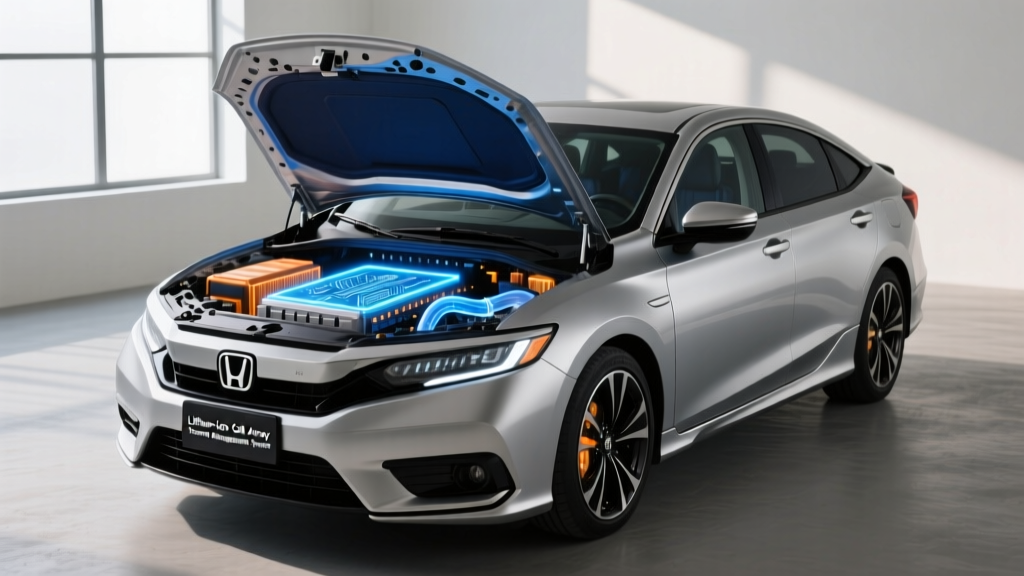
Honda's current hybrid lineup — the 2026 CR-V Hybrid, Accord Hybrid, and Civic Hybrid — all use the fourth-generation two-motor hybrid system. The high-voltage traction battery in these models is a lithium-ion pack using an NMC-style (nickel manganese cobalt) chemistry, though Honda does not publicly disclose the exact cathode formulation. The usable capacity is small: roughly 1.0 kWh in the Civic Hybrid and approximately 1.3–1.8 kWh in the CR-V and Accord Hybrid variants.
That small capacity is intentional. Honda's hybrid system doesn't need a large battery because it's not designed for extended electric-only driving (the Accord Hybrid manages only about 1–2 miles of EV-only at low speeds). Instead, the battery acts as a high-power buffer — absorbing regenerative braking energy and supplying the electric motor during acceleration. This means the battery undergoes many shallow charge-discharge cycles daily rather than deep cycles, which is actually favorable for longevity.
LFP vs NMC/NCA: How Honda's Chemistry Compares
While Honda hybrids use NMC-style cells, the broader EV market is split between two dominant chemistries. Understanding the trade-offs helps explain why Honda made its choice and what it means for your ownership experience.
| Attribute | LFP (Lithium Iron Phosphate) | NMC/NCA (Nickel-based) |
|---|---|---|
| Energy density | Lower (~160 Wh/kg) — heavier for same capacity | Higher (~220–260 Wh/kg) — lighter, more compact |
| Cycle life | 3,000–5,000+ cycles to 80% capacity | 1,000–2,500 cycles to 80% capacity |
| Cold-weather performance | Weaker — more range loss below freezing | Better low-temp discharge capability |
| Cost per kWh | Lower — no cobalt or nickel | Higher — commodity-sensitive materials |
| Thermal stability | Excellent — very resistant to thermal runaway | Good but requires more active management |
| Typical applications | Standard-range EVs (Tesla Model 3 RWD, Ford Mustang Mach-E Select) | Long-range EVs, most hybrids (Honda, Toyota, Hyundai) |
Why Honda chose NMC-style cells: In a hybrid application, the battery must be compact and lightweight because it's packaged alongside a gasoline engine, two electric motors, and a power control unit. NMC's higher energy density lets Honda fit sufficient power-buffer capacity into a small physical footprint under the rear seats or cargo floor. The cycle-life advantage of LFP matters less here because Honda's battery management system (BMS) keeps the pack in a narrow 40–80% state-of-charge window, dramatically reducing stress per cycle.
Real-World Degradation: What the Data Shows
Unlike full EVs where owners track range loss obsessively via apps, hybrid battery degradation is harder to quantify because you can't simply compare "miles of range" year over year. The battery's job in a hybrid is to buffer power, not store it for distance. So degradation manifests differently: slightly reduced fuel economy, more frequent engine engagement, and marginally weaker electric-motor assist during acceleration.
Degradation Estimates by Mileage
Honda Hybrid Battery Degradation — Estimated Capacity Retention
- Year 1–3 (0–45,000 mi): ~95–98% capacity retained. Minimal perceptible change in driving behavior.
- Year 4–6 (45,000–90,000 mi): ~88–94% retained. Slight increase in engine-on time; fuel economy may drop 1–2 MPG from new.
- Year 7–10 (90,000–150,000 mi): ~80–88% retained. Noticeable but manageable — the car still functions normally, just relies more on the engine.
- Year 10–15 (150,000–200,000+ mi): ~70–82% retained. This is where some packs may trigger warranty thresholds or show meaningful efficiency loss.
Sources: Aggregated owner reports on CRVownersclub.com, Honda-Tech forums, and fueleconomy.gov comparison data. Individual results vary with climate, driving style, and maintenance.
The key insight is that Honda's narrow SoC window strategy pays dividends. A lithium-ion cell cycled between 40% and 80% experiences far less electrode wear than one cycled from 10% to 95%. This is why many Honda hybrids from the 2014–2017 model years (second-generation system) are still running on their original battery packs well past 150,000 miles.
According to data compiled by Consumer Reports, hybrid battery failure rates across the industry remain low — typically under 5% within the warranty period — and Honda's rate tracks at or below that average.
Honda Hybrid Battery Warranty Coverage
Honda provides robust hybrid battery warranty coverage, though the specifics depend on your state. Here's exactly what's covered for 2026 models:
| Coverage Detail | Federal (49-state) | CARB States (CA, NY, MA, +12 others) |
|---|---|---|
| Duration | 8 years / 100,000 miles | 10 years / 150,000 miles |
| Capacity retention threshold | Below ~70% of original capacity (as determined by Honda diagnostic) | Same threshold, extended coverage period |
| What's covered | Battery pack, battery control module, hybrid control unit | Same components |
| Transferable? | Yes — transfers to subsequent owners | Yes |
| Deductible | $0 | $0 |
Important caveat: Honda does not publish a specific percentage threshold the way some EV makers do (e.g., Tesla guarantees 70% retention over 8 years/120,000 miles). Instead, Honda's warranty language covers "defects in materials or workmanship" and "loss of battery capacity" as determined by a dealer diagnostic test. If your hybrid system throws a battery-related diagnostic trouble code (DTC) or the dealer's scan tool shows capacity below Honda's internal threshold, replacement is covered at no cost.
The CARB-state extension is significant. If you live in California, New York, Massachusetts, Connecticut, Maine, Maryland, New Jersey, Oregon, Rhode Island, Vermont, Washington, Colorado, Minnesota, Nevada, or Virginia, you get an extra two years and 50,000 miles of coverage. Check the California Air Resources Board for the current list of adopting states.
Replacement Cost: What to Budget and When
The honest answer is that most Honda hybrid owners will never need to replace the traction battery. The pack is designed to outlast the typical ownership period, and many Honda hybrids are scrapped for unrelated mechanical or body-damage reasons while the battery still functions. But if you're buying a used Honda hybrid out of warranty, or planning to keep yours for 200,000+ miles, here's the financial picture:
| Model | New OEM Pack (parts + labor) | Remanufactured Pack | Cell-Level Repair (specialist shops) |
|---|---|---|---|
| Civic Hybrid (2024–2026) | $2,800–$3,800 | $1,800–$2,500 | $800–$1,400 |
| Accord Hybrid (2023–2026) | $3,200–$4,500 | $2,000–$3,000 | $900–$1,600 |
| CR-V Hybrid (2023–2026) | $3,500–$5,000 | $2,200–$3,200 | $1,000–$1,800 |
Note: Prices vary by region, dealer, and parts availability. Remanufactured packs are sourced from salvaged vehicles and rebalanced by third-party suppliers. Cell-level repair involves replacing only the degraded modules and requires a hybrid-certified independent shop.
When is replacement typically needed? Based on aggregated repair data, Honda hybrid batteries that do require replacement tend to do so between 140,000 and 180,000 miles — well outside the warranty window for most owners. Premature failures (under 100,000 miles) are rare and usually tied to manufacturing defects (covered by warranty), extreme heat exposure (Arizona/Texas vehicles parked outdoors year-round), or prior accident damage to the pack enclosure.
For context, the average annual driving distance in the US is roughly 14,500 miles according to the Federal Highway Administration. That means the typical Honda hybrid battery replacement timeline corresponds to 10–12 years of average driving.
Factors That Accelerate (or Preserve) Battery Life
Your habits directly influence how quickly the battery degrades. Here's what matters most, ranked by impact:
Battery Care Checklist for Honda Hybrid Owners
- Avoid prolonged extreme-heat parking. Battery degradation accelerates sharply above 95°F (35°C). If you live in a hot climate, park in shade or a garage whenever possible. Heat is the #1 enemy of lithium-ion longevity.
- Don't let the car sit unused for weeks. Honda's BMS maintains the pack, but prolonged inactivity (30+ days) in extreme temperatures can stress cells. Drive the car at least once every two weeks for 20+ minutes.
- Use regular (not premium) fuel as specified. This doesn't directly affect the battery, but running the wrong octane can alter engine behavior and increase the load on the hybrid system indirectly.
- Keep up with cooling system maintenance. The hybrid battery has its own thermal management circuit. If Honda's maintenance schedule calls for coolant inspection or replacement, don't skip it — overheating degrades cells permanently.
- Don't obsess over regenerative braking settings. Honda's system manages charge/discharge rates conservatively. Switching between normal and max regen won't meaningfully affect long-term battery health.
- Address warning lights immediately. If the hybrid system indicator or check-engine light illuminates, get a diagnostic scan promptly. A failing cell module can stress neighboring cells if left unchecked.
What Does NOT Significantly Affect Honda Hybrid Batteries
Some common EV battery concerns don't apply here. You don't need to worry about:
- DC fast charging: Honda hybrids don't have charge ports — they can't plug in (unless you're looking at a future PHEV variant). All charging happens via the engine and regenerative braking at controlled rates.
- State-of-charge management: Honda's BMS handles this automatically. You can't manually set charge limits like you would on a BEV, and you don't need to.
- "Battery conditioning" routines: Unlike full EVs that benefit from preconditioning before fast charging, Honda's system manages thermal conditioning internally.
How to Check Your Honda Hybrid's Battery Health
Unlike full EVs where apps like Tesla's built-in menu or third-party OBD2 tools (Leaf Spy, Scan My Tesla) give precise State of Health (SoH) percentages, Honda doesn't expose a consumer-facing battery health metric on the dash or in the HondaLink app. Here's how you can actually assess your pack:
Option 1: Dealer Diagnostic Scan
Any Honda dealer can run a hybrid battery diagnostic using the Honda Diagnostic System (HDS). This scan reads individual cell voltages, internal resistance, and an overall health assessment. Ask specifically for a "hybrid battery health check" — it's often complimentary if you're within the warranty period, or $100–$150 as a standalone service out of warranty.
Option 2: OBD2 Scanner with Hybrid Capability
Enthusiast-grade OBD2 scanners like the Autel MaxiCOM MK808BT (~$400) or the more affordable OBDLink SX (~$50) paired with software like Torque Pro can read hybrid battery parameters on many Honda models. Key values to monitor:
- Individual cell voltage spread: All cells should read within 0.1–0.2V of each other. A spread exceeding 0.3V suggests an imbalanced or degraded module.
- Battery temperature: Normal operating range is 68–104°F (20–40°C). Consistent readings above 113°F (45°C) indicate cooling system issues.
- Charge/discharge current: Compare peak current during regen and acceleration to baseline values from your owner's manual or online forums.
Option 3: The Fuel-Economy Proxy
The simplest at-home check: track your fuel economy over time. If your Accord Hybrid averaged 46 MPG combined in its first year and is now consistently returning 42–43 MPG at the same driving patterns, that ~7% efficiency loss correlates roughly to battery capacity degradation. A drop exceeding 10% from your baseline warrants a dealer diagnostic.
Looking Ahead: Solid-State and Next-Gen Battery Tech
Honda is investing heavily in next-generation battery technology, though these developments target its full-electric vehicles rather than its near-term hybrid lineup:
- Solid-state batteries: Honda has announced a solid-state battery demonstration line and targets production in the late 2020s. Solid-state cells promise higher energy density, faster charging, and improved safety by replacing the liquid electrolyte with a solid material. However, mass production at competitive cost remains unproven. Timeline: announced for late-2020s production vehicles; not yet available.
- Silicon-dominant anodes: Honda's R&D division is exploring silicon-based anode materials that could boost energy density by 20–40% over current graphite anodes. This technology may trickle into hybrid applications if costs decrease sufficiently. Timeline: estimated early 2030s for mainstream adoption.
- Sodium-ion batteries: While primarily pursued for low-cost EVs and stationary storage, sodium-ion chemistry could eventually appear in hybrid applications where energy density requirements are lower. Timeline: no Honda commitment announced; industry-wide estimates suggest mid-2030s.
For today's Honda hybrid buyer, these technologies are forward-looking context, not purchase factors. The current NMC-style lithium-ion pack is a mature, well-understood technology with a strong track record.
Frequently Asked Questions
How long do Honda hybrid batteries last in years and miles?
Based on owner data and Honda's engineering specifications, expect 10–15 years or 150,000–200,000+ miles before significant degradation. Many packs outlast the vehicle itself. Honda's warranty covers 8 years/100,000 miles (10 years/150,000 miles in CARB states), providing a strong floor for expectations.
How much does a Honda hybrid battery cost to replace?
A new OEM replacement pack costs $2,800–$5,000 depending on the model (Civic at the low end, CR-V at the high end), including parts and labor at a Honda dealer. Remanufactured packs from third-party suppliers run $1,800–$3,200, and cell-level repair at a hybrid specialist shop can cost as little as $800–$1,800. Most owners never need a replacement.
What does Honda's hybrid battery warranty actually cover?
The warranty covers defects in materials and workmanship, plus loss of battery capacity as determined by Honda's dealer diagnostic system. Coverage extends to the battery pack, battery control module, and hybrid control unit. There's no deductible, and the warranty transfers to subsequent owners. In CARB-adopting states, coverage extends to 10 years/150,000 miles.
Can I check my Honda hybrid battery health myself?
Honda doesn't provide a consumer-facing State of Health readout. Your options are: (1) a dealer diagnostic scan ($0–$150), (2) an aftermarket OBD2 scanner that reads hybrid parameters (from ~$50), or (3) tracking your fuel economy over time as a proxy — a sustained drop of 10%+ from your baseline suggests meaningful degradation worth investigating.
Is LFP or NMC better for hybrid batteries?
For hybrid applications specifically, NMC is the better fit. Its higher energy density allows a smaller, lighter pack — critical when the battery must share space with a gasoline engine and two electric motors. LFP's superior cycle life and lower cost shine in full EVs with large packs, but in a hybrid's small, shallow-cycling battery, those advantages matter less. Honda, Toyota, and Hyundai all use NMC-style chemistry in their hybrids for this reason.
Does extreme weather damage Honda hybrid batteries?
Extreme heat is the primary concern — sustained exposure to temperatures above 95°F accelerates chemical degradation inside lithium-ion cells. Cold weather temporarily reduces battery performance (you may notice the engine running more in winter), but it doesn't cause permanent damage. Honda's thermal management system actively cools the pack during operation, but parking in shade or a garage in hot climates meaningfully extends battery life.
Will a degraded hybrid battery affect my fuel economy?
Yes, but gradually. A battery at 85% capacity might cost you 1–3 MPG combined compared to new. The gasoline engine compensates by running more frequently and at higher load. The car remains fully drivable — you'll simply visit the gas station slightly more often. This is very different from a degraded EV battery, where capacity loss directly reduces your driving range.