If you own or are considering a used Honda Accord Hybrid, one question almost always surfaces: what happens when the high-voltage traction battery ages out? The Honda Accord Hybrid battery replacement cost is a real consideration, but it's also one surrounded by misinformation. This guide gives you the exact numbers—replacement pricing, degradation data, warranty coverage, and the chemistry behind the pack—so you can budget accurately and make an informed purchase or ownership decision.
How the Honda Accord Hybrid Battery Works
The Honda Accord Hybrid uses a lithium-ion (Li-ion) high-voltage traction battery to power its electric motors in tandem with a 2.0-liter Atkinson-cycle gasoline engine. Unlike a pure battery-electric vehicle (BEV), the Accord Hybrid's battery pack is relatively small—typically around 1.3 kWh in recent model years (2023–2026). This pack isn't designed for long electric-only range; instead, it buffers energy for regenerative braking capture, assists during acceleration, and enables brief low-speed EV driving.
It's critical to distinguish this high-voltage traction battery from the standard 12V auxiliary battery under the hood. The 12V battery powers accessories, lights, and the computer systems—replacing it costs $150–$250 and is routine maintenance. The traction battery is the expensive, high-voltage component we're discussing here.
Honda Accord Hybrid Battery Chemistry vs. Full EV Options
| Attribute | Accord Hybrid (Li-ion NMC-type) | LFP (e.g., Tesla Model 3 RWD) | NMC/NCA (e.g., Hyundai Ioniq 5) |
|---|---|---|---|
| Energy Density | Moderate (small pack, weight-optimized) | Lower (~160 Wh/kg cell-level) | Higher (~250–300 Wh/kg cell-level) |
| Cycle Life | ~2,000–3,000 cycles | ~3,000–5,000+ cycles | ~1,500–2,500 cycles |
| Cold Performance | Good (small pack, managed by engine heat) | Reduced (LFP struggles below 32°F) | Better low-temp discharge |
| Cost per kWh | Moderate | Lowest (~$80–100/kWh cell) | Higher (~$110–140/kWh cell) |
| Typical Use Case | HEV/PHEV buffer | Standard-range BEVs | Long-range BEVs |
The Accord Hybrid's pack prioritizes cycle life and power delivery over raw energy storage—appropriate for a hybrid that charges and discharges hundreds of times per drive cycle.
How Long Do Honda Accord Hybrid Batteries Last?
Based on owner reports, dealership service data, and industry analysis, the Honda Accord Hybrid traction battery typically lasts 10 to 15 years or 150,000 to 200,000 miles before capacity loss becomes noticeable enough to affect fuel economy or performance. Many units outlive the vehicle itself.
Honda's hybrid system is relatively conservative in how it uses the battery. The car's battery management system (BMS) keeps the state of charge (SoC) within a narrow operating window—roughly 40% to 80%—which significantly reduces stress on the cells compared to a BEV that regularly cycles from 10% to 90%.
Typical Accord Hybrid Battery Degradation Curve
| Age / Mileage | Expected Capacity Retention | Real-World Impact |
|---|---|---|
| Year 1–3 / 0–45K mi | 97–100% | Imperceptible; full MPG rating maintained |
| Year 4–6 / 45K–90K mi | 92–97% | Minimal; perhaps 1–2 MPG drop in EV assist |
| Year 7–10 / 90K–150K mi | 85–92% | Slightly reduced regen capture; engine runs marginally more |
| Year 10–15 / 150K–200K+ mi | 70–85% | Noticeable MPG decline; possible check-engine or IMA warnings |
Data synthesized from fueleconomy.gov owner submissions, Honda service bulletins, and hybrid battery remanufacturer reports. Individual results vary based on climate, driving style, and maintenance.
Honda Accord Hybrid Battery Replacement Cost in 2026
When replacement becomes necessary—usually indicated by a dashboard warning light, a significant drop in observed MPG, or a dealership diagnostic showing cell imbalance—here's what to expect:
| Option | Cost Range (Parts + Labor) | Notes |
|---|---|---|
| New OEM Honda Pack | $3,000–$4,200 | Full new battery from Honda; typically 2–3 hours labor |
| Remanufactured / Refurbished Pack | $1,800–$2,800 | Rebuilt with tested cells; 1–3 year warranty typical |
| Used / Salvage Yard Pack | $800–$1,500 | Lowest cost but unknown SoH; risky without testing |
| Individual Cell Module Replacement | $400–$1,000 | Only if 1–2 modules are bad; requires specialist diagnostic |
The most common path for out-of-warranty Accord Hybrids is a remanufactured pack at $2,000–$2,800 installed. Independent hybrid specialists (shops that focus on Toyota and Honda hybrid service) often offer the best value, while Honda dealerships will quote the new OEM pack at the higher end.
For context: at an average of $2,500, the replacement cost works out to roughly 1.3 to 1.7 cents per mile over a 150,000–200,000-mile battery lifespan—far less than the cumulative fuel savings the hybrid system delivers over a conventional Accord.
What Does the Honda Hybrid Battery Warranty Cover?
Honda provides robust hybrid battery coverage, but the specifics matter:
| Coverage | Terms | Details |
|---|---|---|
| Hybrid Battery (standard states) | 8 years / 100,000 miles | Defects and excessive capacity loss |
| Hybrid Battery (CARB states*) | 10 years / 150,000 miles | Extended coverage in states following California emissions rules |
| Hybrid System Components | 8 years / 100,000 miles | Inverter, electric motors, BMS, related wiring |
| Capacity Retention Threshold | Typically ~60–70% | Honda defines "excessive" loss; exact threshold in warranty booklet |
*CARB states include CA, CO, CT, DE, ME, MD, MA, NJ, NY, OR, RI, VT, WA, and others adopting California emissions standards. Check your state's status and your specific warranty booklet for confirmation. Source: Honda Automobiles.
If your battery fails within warranty, Honda replaces it at no cost. The replacement battery (whether new or remanufactured by Honda) carries the remainder of the original warranty or a 12-month/12,000-mile parts warranty, whichever is longer.
Factors That Accelerate Hybrid Battery Degradation
While the Accord Hybrid's BMS does an excellent job protecting the pack, certain habits and conditions accelerate wear:
Battery Care Checklist for Accord Hybrid Owners
- Avoid prolonged high-SoC storage: Don't leave the car sitting for weeks at a time with the battery fully charged. The BMS manages this, but extended idle periods in hot weather add stress.
- Minimize extreme heat exposure: Parking in a garage or shade during summer reduces thermal load. Battery degradation roughly doubles for every 18°F (10°C) increase above 77°F ambient.
- Drive regularly: Hybrid batteries benefit from regular charge-discharge cycles. A car driven daily will often outlast one that sits for months.
- Don't ignore cooling system maintenance: The Accord Hybrid's battery has a dedicated cooling fan and air duct. Keep the rear-seat area vent (if equipped) unobstructed and have the cabin air filter replaced on schedule.
- Address warning lights immediately: An IMA (Integrated Motor Assist) light or check-engine light related to the hybrid system should be diagnosed promptly—delayed repairs can cascade into more expensive damage.
- Maintain the 12V battery: A weak 12V battery forces the high-voltage system to work harder during startup cycles. Replace the 12V every 4–5 years proactively.
How to Check Your Accord Hybrid Battery Health
Unlike some BEVs that display State of Health (SoH) on the infotainment screen, the Accord Hybrid doesn't provide a direct battery health readout to the driver. Here's how to assess it:
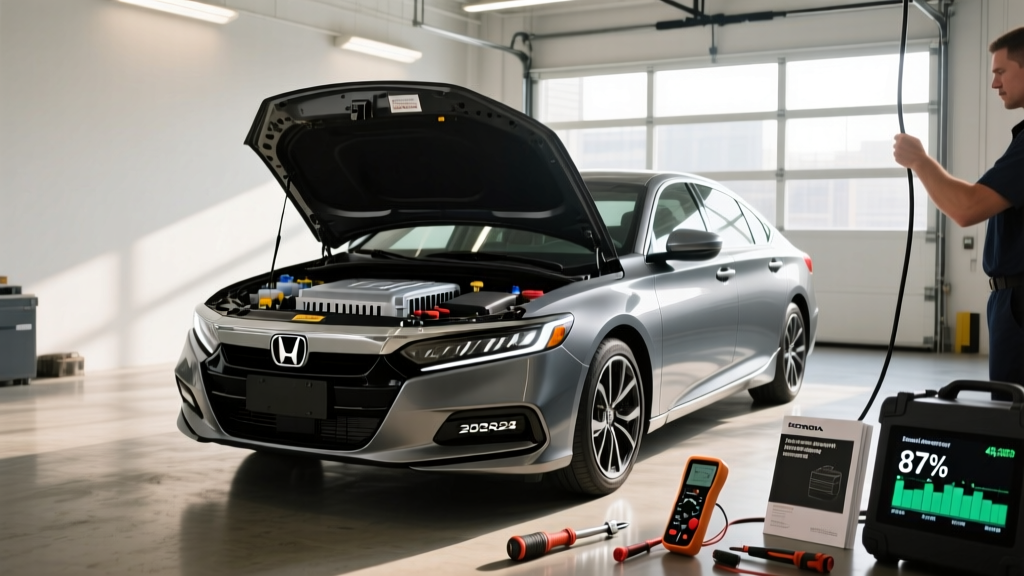
Dealership diagnostic scan: A Honda service center can pull the battery's internal data via the OBD-II port, showing individual module voltages, internal resistance, and calculated capacity. This is the gold standard—ask for it during routine service, especially as you approach 100,000 miles.
OBD-II scanner with hybrid capability: Tools like the OBDLink MX+ paired with apps such as Dr. Prius (originally developed for Toyota hybrids but compatible with some Honda protocols) or Hybrid Assistant can read battery voltage, current, and temperature in real time. While not a full SoH percentage, you can observe whether the battery charges and discharges symmetrically—a sign of healthy cells.
MPG tracking: The simplest method. Track your fuel economy over time using the trip computer or an app like fueleconomy.gov's My MPG feature. A gradual decline from the EPA-rated 48 MPG combined (2026 Accord Hybrid) to the low 40s over several years suggests normal aging; a sharp drop to the mid-30s signals a problem.
EV-mode availability: If the car's EV button (which enables short electric-only driving at low speeds) becomes less responsive or the engine kicks in more frequently during what used to be electric-capable driving, the battery's usable capacity has likely diminished.
Is the Honda Accord Hybrid Battery Replacement Worth It?
Decision Framework: Replace or Move On?
Replace the battery if:
- The rest of the car is in good condition (transmission, suspension, body)
- You're getting 40+ MPG even with some degradation—meaning the hybrid system still works, just less optimally
- A remanufactured pack at $2,000–$2,800 keeps you on the road for another 5–8 years at a fraction of a new-car payment
- You drive 12,000+ miles per year and the fuel savings justify the investment
Consider upgrading to a new vehicle if:
- The car has other major issues (transmission, structural rust, electrical gremlins)
- The total repair bill (battery + other needed work) exceeds $5,000
- You want to transition to a PHEV or BEV for greater electric driving capability
- The car is approaching 200,000+ miles and you prefer the warranty of a new vehicle
Looking Ahead: Solid-State and Next-Gen Battery Tech
Honda has announced a partnership with Solid Power and is developing its own all-solid-state battery (ASSB) technology, with a pilot production line operational as of 2025. Honda's stated goal is to introduce solid-state batteries in production vehicles by the late 2020s—likely in BEVs first, then potentially in next-generation hybrids.
Solid-state batteries promise higher energy density (potentially 400+ Wh/kg at the cell level), faster charging, and improved safety (no flammable liquid electrolyte). However, manufacturing costs remain high, and mass production at automotive scale is still 3–5 years away at minimum. For current Accord Hybrid owners, this technology won't affect your existing battery—it's relevant only if you're planning your next vehicle purchase in the 2028–2030 timeframe.
Honda is also investing in silicon-dominant anode technology, which could increase energy density by 20–40% over current graphite anodes. This is closer to commercialization and may appear in Honda hybrids within the next 2–3 model years as a pack-level upgrade—meaning smaller, lighter batteries delivering the same or better performance.
These are forward-looking developments based on Honda's published roadmap. Production timelines and vehicle availability are subject to change.
Frequently Asked Questions
How long do Honda Accord Hybrid batteries typically last?
Most Accord Hybrid traction batteries last 10–15 years or 150,000–200,000 miles before significant capacity loss. Many outlast the car itself, especially in moderate climates with regular driving.
How much does it cost to replace a Honda Accord Hybrid battery?
A new OEM battery costs $3,000–$4,200 installed. A remanufactured pack—the most common choice for out-of-warranty vehicles—runs $1,800–$2,800 installed. Used/salvage packs start around $800 but carry more risk.
Does Honda's warranty cover hybrid battery replacement?
Yes. Honda covers the hybrid battery for 8 years/100,000 miles in most states and 10 years/150,000 miles in CARB-emissions states. Coverage includes defects and excessive capacity loss (typically defined as dropping below ~60–70% of original capacity).
Can I replace the Accord Hybrid battery myself?
Technically possible for someone with high-voltage electrical training, but strongly discouraged. The pack operates at 200+ volts, and improper handling can cause severe injury or death. Professional installation by a Honda-certified technician or qualified hybrid specialist is the safe path.
Will a new battery restore my original fuel economy?
Yes. A fresh OEM or quality remanufactured battery should restore the Accord Hybrid's EPA-rated fuel economy (48 MPG combined for the 2026 model year), assuming no other mechanical issues are present.
Is the Accord Hybrid battery the same as a full EV battery?
No. The Accord Hybrid's ~1.3 kWh pack is far smaller than a BEV battery (typically 60–100 kWh). It functions as a power buffer for the hybrid system rather than the sole propulsion source. This means replacement costs are dramatically lower than BEV battery replacements ($2,500 vs. $10,000–$20,000+).
How do I maximize my Accord Hybrid battery's lifespan?
Drive regularly, avoid prolonged parking in extreme heat, keep the battery cooling vent unobstructed, maintain the 12V battery, and address any hybrid system warning lights promptly. The car's BMS handles most of the heavy lifting—your job is to avoid adding unnecessary thermal and calendar stress.