The Real Chemistry Behind High Performance Batteries for Cars
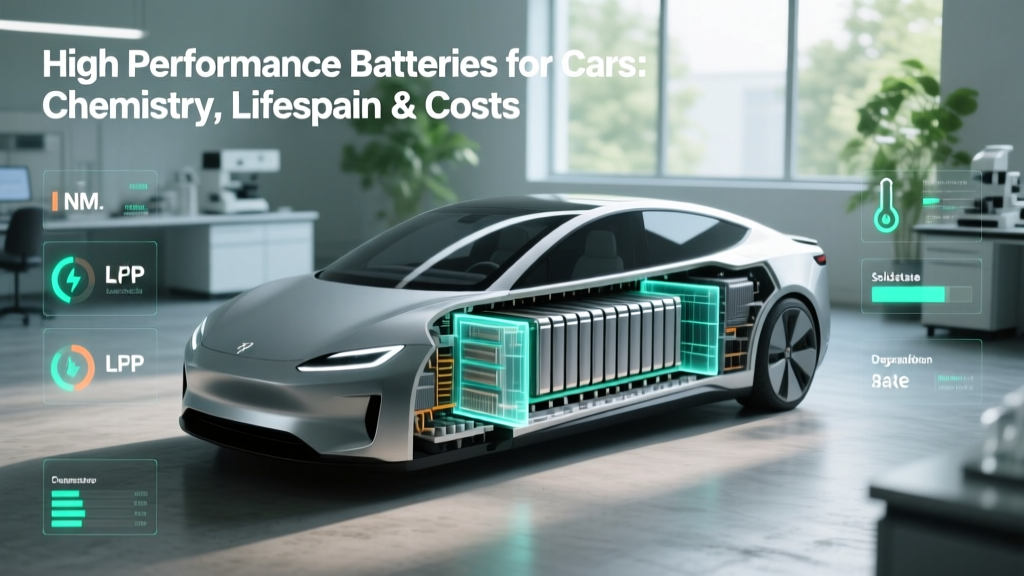
When automakers advertise a 350-mile range or a sub-3-second 0-60 time, the credit belongs to one component: the high-voltage traction battery. Modern EV packs are engineering marvels, but not all high performance batteries for cars are built the same. The two dominant chemistries in 2026 — NMC (nickel manganese cobalt) / NCA (nickel cobalt aluminum) and LFP (lithium iron phosphate) — make fundamentally different trade-offs between energy density, longevity, cold-weather behavior, and cost.
Understanding these differences is the single most important factor in choosing an EV that will serve you well for 10+ years. Below, we break down the chemistry, degradation reality, warranty protections, replacement economics, and daily habits that determine how long your pack actually lasts.
LFP vs NMC/NCA: Which Battery Chemistry Wins?
NMC and NCA chemistries dominate long-range and performance EVs. They pack more energy per kilogram, which translates to more miles without adding weight. LFP, meanwhile, trades some energy density for dramatically longer cycle life, lower cost, and better thermal stability. Tesla offers LFP in the Model 3 Standard Range, while the Model 3 Long Range uses NMC. BYD's Blade Battery is LFP. Ford's standard-range F-150 Lightning switched to LFP for 2025+.
| Attribute | LFP (LiFePO₄) | NMC / NCA |
|---|---|---|
| Energy density (cell-level) | 160–180 Wh/kg | 250–300 Wh/kg |
| Typical cycle life (80% SoH) | 3,000–5,000 cycles | 1,000–2,000 cycles |
| Cold-weather range loss (~20°F) | ~30–40% reduction | ~20–30% reduction |
| Peak DC fast-charge rate | Up to ~170 kW (typically lower) | Up to 250–350 kW |
| Thermal runaway risk | Very low | Low (requires active management) |
| Cobalt / nickel content | None | Yes — supply-chain and ESG concern |
| Cost per kWh (pack-level, est.) | ~$95–$115 | ~$125–$150 |
| Recommended daily SoC | 100% OK | 80% for daily; 100% for trips only |
| Best for | Daily commuting, fleet, budget trims | Long-range, performance, cold climates |
How Long Do EV Batteries Actually Last? Degradation Data
Every lithium-ion cell loses capacity over time and use. The question is how fast. Data aggregated from fleet telematics, owner reports, and Recurrent Auto's 15,000-vehicle dataset paints a consistent picture: modern EV batteries degrade far more slowly than early-2010s packs.
- Year 1 / 15,000 mi: ~95–97% SoH (initial formation loss)
- Year 3 / 45,000 mi: ~91–94% SoH
- Year 5 / 75,000 mi: ~88–92% SoH
- Year 8 / 120,000 mi: ~83–89% SoH
- Year 10 / 150,000 mi: ~80–86% SoH
LFP packs typically show even slower degradation, with many fleet vehicles retaining 92–95% SoH at 100,000 miles. Tesla's 2025 Impact Report stated that Model 3/Y packs retain ~88% capacity at 200,000 miles on average.
The degradation curve is not linear. Most packs lose 2–5% in the first year (calendar aging and initial cycling), then settle into a slow, roughly linear decline of 1–2% per year. A sudden "cliff" drop is rare in modern packs with active thermal management — it was more common in early air-cooled designs like the first-gen Nissan LEAF.
What Does the Battery Warranty Actually Cover?
Federal law mandates a minimum 8-year / 100,000-mile warranty on EV traction batteries (10 years / 150,000 miles in California and states adopting CARB standards). Most automakers match or exceed this baseline. The critical detail is the capacity-retention threshold — the SoH percentage below which the manufacturer must repair or replace the pack.
| Automaker | Duration | Mileage | Capacity Threshold |
|---|---|---|---|
| Tesla (Model 3/Y RWD — LFP) | 8 years | 120,000 mi | 70% SoH |
| Tesla (Model 3/Y LR/AWD — NMC) | 8 years | 120,000 mi | 70% SoH |
| Hyundai / Kia (E-GMP) | 10 years | 100,000 mi | 70% SoH |
| Ford (F-150 Lightning / Mustang Mach-E) | 8 years | 100,000 mi | 70% SoH |
| GM (Ultium platform) | 8 years | 100,000 mi | 70% SoH (60% for commercial) |
| Rivian (R1T / R1S) | 8 years | 175,000 mi | 70% SoH |
| BMW (iX / i4 / i7) | 8 years | 100,000 mi | 70% SoH |
Key nuance: the warranty covers defects and excessive degradation, not gradual capacity loss above the threshold. If your pack is at 72% SoH at year 7, you're within spec — even though you've lost 28% of your original range. Also, warranty claims typically result in a refurbished or remanufactured replacement pack, not a brand-new one. That's standard industry practice and generally restores the pack to ~85–90% SoH.
EV Battery Replacement Cost: What Owners Actually Pay
This is the number that generates the most anxiety — and the most misinformation. Let's ground it in data. Full pack replacement is rare. Most out-of-warranty service involves replacing individual modules or addressing BMS (battery management system) faults, not swapping the entire pack.
| Vehicle / Pack Size | Battery Cost (parts) | Labor | Total Estimate |
|---|---|---|---|
| Tesla Model 3 RWD (~57 kWh LFP) | $8,000–$10,000 | $1,500–$2,500 | $10,000–$12,500 |
| Tesla Model Y LR (~75 kWh NMC) | $12,000–$15,000 | $1,500–$2,500 | $13,500–$17,500 |
| Hyundai Ioniq 5 (~77 kWh NMC) | $11,000–$14,000 | $2,000–$3,000 | $13,000–$17,000 |
| Ford F-150 Lightning Ext. Range (~131 kWh) | $18,000–$24,000 | $2,500–$4,000 | $20,500–$28,000 |
| Chevrolet Silverado EV (~200 kWh) | $25,000–$35,000 | $3,000–$5,000 | $28,000–$40,000 |
| Module-level repair (most common) | $2,000–$6,000 | $1,000–$2,000 | $3,000–$8,000 |
Context matters: pack prices have fallen from ~$400/kWh in 2015 to roughly $120–$140/kWh at the pack level in 2026, per BloombergNEF tracking. And the vast majority of EV batteries never need replacement. Data from Recurrent Auto shows fewer than 2% of EVs in their dataset required a full pack swap — and nearly all of those were covered under warranty. The fear of a surprise $25,000 bill at year 6 is not supported by real-world failure rates.
Five Factors That Accelerate (or Preserve) Battery Health
High performance batteries for cars are engineered for durability, but physics still applies. Here's what actually moves the needle on longevity:
What Hurts Your Battery
- Frequent DC fast charging above 150 kW: High C-rates generate heat. Occasional road-trip fast charging is fine; doing it daily accelerates degradation by ~1–2% extra per year vs. Level 2 home charging.
- Sitting at 100% SoC for days: High voltage stresses NMC/NCA cathodes. If you charge to 100%, drive within a few hours. (LFP is exempt — charge to 100% freely for BMS calibration.)
- Deep discharges below 10%: Repeatedly draining the pack to near-empty increases internal resistance. The buffer protects you, but don't make a habit of it.
- Extreme heat exposure: Ambient temperatures above 100°F combined with high SoC are the worst-case scenario. Park in shade or a garage when possible.
- Skipping preconditioning: Fast-charging a cold battery (below ~50°F) without preconditioning causes lithium plating on the anode — permanent damage. Always use your car's navigation-routed preconditioning.
What Preserves Your Battery
- Daily charging to 80% (NMC/NCA) or 100% (LFP): Staying in the 20–80% window minimizes cathode stress.
- Level 2 home charging (7–11 kW): Gentle charge rates produce far less heat than DC fast charging.
- Active thermal management: All 2026 EVs from major manufacturers have liquid-cooled packs. This alone is the biggest longevity upgrade over early EVs.
- Moderate climates or garage parking: Avoiding temperature extremes — hot or cold — is the single best environmental factor.
- Software updates: OEMs regularly refine BMS algorithms to improve longevity. Keep your car updated.
How to Monitor Your Battery's State of Health (SoH)
Most EVs don't expose a granular SoH percentage on the dash, but there are several reliable ways to track your pack's condition:
- In-car energy app: Tesla, Hyundai, Ford, and GM vehicles show estimated range at full charge. If your 310-mile car now shows 280 miles at 100%, that's roughly 90% SoH.
- OBD-II diagnostic tools: Devices like the OBDeleven or apps such as LeafSpy (Nissan), Tessie (Tesla), and Car Scanner ELM OBD2 can read the BMS directly for precise SoH, cell voltage variance, and cycle count.
- Dealer diagnostic check: Request a battery health report during service visits. Most dealers can pull a detailed SoH printout.
- Third-party services: Recurrent Auto offers a free battery health report that compares your pack's degradation to a fleet of identical vehicles — useful for resale negotiations.
One practical tip: track your "miles at 100% SoC" every few months. A slow, steady decline of 3–5 miles per year is normal. A sudden drop of 15+ miles warrants a diagnostic check — it could indicate a failing module rather than normal aging.
What's Next: Solid-State, Silicon Anode, and Beyond
The next generation of high performance batteries for cars is being tested now, but realistic timelines matter.
- Solid-state batteries: Toyota has announced a 2027–2028 production timeline for solid-state cells promising 750+ km (WLTP) range and 10-minute fast charging. Nissan and Samsung SDI target similar windows. These will debut in limited, premium models before reaching mainstream pricing. As of 2026, no solid-state EV is available for purchase.
- Silicon-dominant anodes: Companies like Sila Nanotechnologies and Group14 are shipping silicon-carbon anode materials that boost energy density by 20–40% over graphite. Expect these in 2027–2028 model-year vehicles, likely starting in performance trims.
- Sodium-ion batteries: CATL and BYD are producing sodium-ion cells for lower-cost, shorter-range applications. These won't replace lithium in long-range EVs but could power budget city cars and energy storage.
- LMFP (lithium manganese iron phosphate): An evolution of LFP with ~15–20% higher energy density. CATL and Gotion are ramping production; expect LMFP in 2027 model-year vehicles from multiple brands.
For buyers shopping today, current NMC and LFP packs are mature, well-tested, and backed by extensive warranties. Waiting for solid-state means waiting 2–4 years for initial production — with early-adopter pricing and unproven long-term durability.
Frequently Asked Questions
How long do EV batteries last in years and miles?
Most modern EV batteries retain 80–90% of their original capacity at 150,000 miles or 10 years. Many will outlast the vehicle itself. Full pack replacement before 200,000 miles is statistically rare — under 2% in fleet data from Recurrent Auto.
How much does an EV battery cost to replace out of warranty?
Full pack replacement ranges from ~$10,000 for a 57 kWh LFP pack (Tesla Model 3 RWD) to $28,000–$40,000 for large packs like the Silverado EV's 200 kWh Ultium. However, most out-of-warranty repairs involve module replacement at $3,000–$8,000, not a full swap.
What does the federal battery warranty cover?
Federal law requires at minimum 8 years / 100,000 miles of coverage against defects and excessive degradation below a stated threshold (typically 70% SoH). In CARB states, the minimum is 10 years / 150,000 miles. Check your specific warranty booklet for the exact capacity threshold.
How do I check my EV battery health?
Monitor your estimated range at full charge over time, use an OBD-II app (Tessie, LeafSpy, Car Scanner) for precise SoH readings, or request a diagnostic report from your dealer. Third-party services like Recurrent Auto also offer free battery health comparisons.
Is LFP or NMC better for daily driving?
For daily commuting under 60 miles with home charging, LFP is generally the better choice: it tolerates 100% daily charging, has 2–3x the cycle life of NMC, and costs less. NMC wins when you need maximum range, fast DC charging speeds, or better cold-weather performance.
Does fast charging damage my EV battery?
Occasional DC fast charging (road trips, a few times per month) has minimal impact. Daily fast charging at 150+ kW can add ~1–2% extra annual degradation compared to Level 2 home charging. Always precondition the battery before fast charging, especially in cold weather, to prevent lithium plating.
Will solid-state batteries make current EVs obsolete?
Not in the near term. Solid-state production is expected to begin in limited volumes around 2027–2028, initially in premium vehicles at high prices. Current NMC and LFP packs will remain the mainstream standard through at least 2030. Today's EVs will not become obsolete — just as 2015 EVs with less range still serve owners well.