If you've been researching hybrid and electric vehicles, you've likely encountered the term HEV battery voltage range and wondered how a hybrid's battery pack compares to the high-voltage traction battery in a full electric vehicle. The short answer: they differ enormously in voltage, capacity, chemistry, and purpose — and understanding those differences is essential for anyone shopping for an electrified vehicle in 2026.
This guide covers the voltage architectures of conventional hybrids (HEVs), plug-in hybrids (PHEVs), and battery-electric vehicles (BEVs), then dives deep into the battery technology that underpins all of them — chemistry, degradation, warranties, replacement costs, and care strategies.
Understanding HEV Battery Voltage Range vs. EV Pack Voltage
A conventional hybrid electric vehicle (HEV) like the Toyota Prius or Honda Accord Hybrid uses a relatively small, low-voltage battery pack working alongside a gasoline engine. The HEV battery voltage range typically falls between 100V and 300V, depending on the model and generation. For context:
- Toyota Prius (2026): ~201.6V nominal lithium-ion pack, 1.0 kWh total capacity
- Honda Accord Hybrid: ~148V pack, approximately 1.3 kWh
- Toyota RAV4 Hybrid: ~244.8V, roughly 1.6 kWh
By contrast, a full battery-electric vehicle operates at significantly higher voltages and vastly greater energy capacity:
- Tesla Model Y (2026): ~350V nominal architecture, 75 kWh usable battery
- Hyundai Ioniq 5: ~697V nominal (800V-class architecture), 77.4 kWh usable
- Ford F-150 Lightning (extended range): ~370V, 131 kWh usable
The key distinction is purpose. An HEV battery provides brief bursts of electric assist and captures regenerative braking energy — it's never the sole propulsion source for more than a mile or two. A BEV battery must store enough energy for 200–400+ miles of driving, which demands far more cells, higher voltage, and much larger capacity measured in kilowatt-hours (kWh).
| Vehicle Type | Typical Voltage | Capacity (kWh) | Electric-Only Range | Chemistry |
|---|---|---|---|---|
| HEV (e.g., Prius) | 100–300V | 0.7–1.8 kWh | <1 mile | NMC lithium-ion |
| PHEV (e.g., RAV4 Prime) | 300–400V | 13–22 kWh | 25–45 miles | NMC lithium-ion |
| BEV (e.g., Model Y) | 350–800V | 50–131 kWh | 200–400+ miles | NMC or LFP |
Battery Chemistry: LFP vs. NMC Trade-Offs
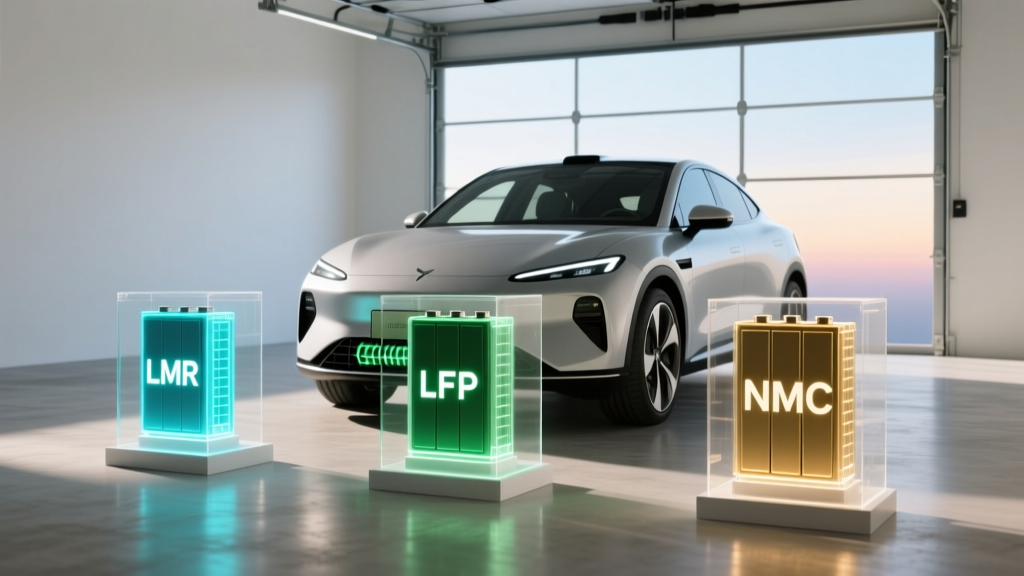
Whether you're looking at a PHEV or a BEV, the lithium-ion cells inside use one of two dominant cathode chemistries: NMC (Nickel Manganese Cobalt) or LFP (Lithium Iron Phosphate). Conventional HEVs almost universally use NMC due to its higher energy density in a compact package. For PHEVs and BEVs, the choice matters far more.
| Attribute | LFP (Lithium Iron Phosphate) | NMC / NCA (Nickel-based) |
|---|---|---|
| Energy Density | Lower (~160 Wh/kg cell-level) | Higher (~220–260 Wh/kg cell-level) |
| Cycle Life | 3,000–5,000+ cycles | 1,000–2,000 cycles |
| Cold-Weather Performance | Weaker; greater range loss below freezing | Better low-temp discharge capability |
| Cost per kWh | ~20–30% cheaper (no cobalt/nickel) | Higher due to critical mineral content |
| Thermal Stability | Excellent; lower thermal runaway risk | Good but requires more active management |
| State-of-Charge Recommendation | Can be charged to 100% daily | Best kept at 80–90% daily for longevity |
| Notable 2026 Applications | Tesla Model 3 RWD, Ford Mustang Mach-E Select (LFP option) | Hyundai Ioniq 5, Tesla Model Y LR, Rivian R1S |
Which is better? It depends on your usage pattern. LFP excels for daily commuters who charge to 100% regularly and want maximum cycle life at a lower cost. NMC delivers more range in a smaller, lighter package — critical for long-range models and cold-climate drivers. Neither is universally superior; the right choice depends on your priorities.
How Long Do EV Batteries Last? Degradation Data
The most persistent concern among EV shoppers is battery longevity. The data is reassuring: modern lithium-ion traction batteries are lasting significantly longer than early-generation packs, and most will outlive the vehicle they're installed in.
According to long-term fleet data and manufacturer disclosures, here's what typical degradation looks like for BEVs in 2026:
| Timeframe | Mileage | Typical Capacity Retention | Range Loss (300-mi EPA example) |
|---|---|---|---|
| Year 1 | ~12,000 mi | 95–98% | ~6–15 miles |
| Year 3 | ~36,000 mi | 91–95% | ~15–27 miles |
| Year 5 | ~60,000 mi | 88–93% | ~21–36 miles |
| Year 8 | ~96,000 mi | 83–90% | ~30–51 miles |
| Year 10 | ~120,000 mi | 78–87% | ~39–66 miles |
Source: Aggregated fleet data from Recurrent Auto and manufacturer warranty disclosures.
Several key patterns emerge:
- Early drop, then plateau: Most packs lose 2–5% in the first year as the solid electrolyte interphase (SEI) layer stabilizes, then degradation slows significantly.
- LFP degrades slower: Tesla's LFP-equipped Model 3 RWD fleets show ~3–5% loss at 100,000 miles, compared to 8–12% for comparable NMC packs.
- HEV batteries face different stress: Because HEV batteries stay in a narrow state-of-charge window (roughly 40–80%), they experience less calendar degradation but endure more frequent charge/discharge cycles. Toyota's hybrid battery packs routinely exceed 150,000 miles without replacement.
Battery Warranty Terms: What's Covered and for How Long
Federal law mandates that EV and hybrid battery warranties cover a minimum of 8 years / 100,000 miles (10 years / 150,000 miles in California Air Resources Board states). Most manufacturers meet or exceed this baseline. Here's how the major warranties compare:
| Manufacturer | Coverage Period | Capacity Threshold | Chemistry |
|---|---|---|---|
| Tesla (Model Y LR) | 8 yr / 120,000 mi | 70% retention | NMC |
| Tesla (Model 3 RWD) | 8 yr / 100,000 mi | 70% retention | LFP |
| Hyundai / Kia | 10 yr / 100,000 mi | 70% retention | NMC |
| Ford (Mach-E, F-150 Lightning) | 8 yr / 100,000 mi | 70% retention | NMC / LFP |
| Toyota (bZ4X) | 8 yr / 100,000 mi (10 yr / 150k in CARB states) | 70% retention | NMC |
| Toyota (Prius HEV hybrid battery) | 10 yr / 150,000 mi | Performance-based | NMC |
| Chevrolet (Equinox EV) | 8 yr / 100,000 mi | 60% retention | NMC (Ultium) |
What the warranty covers: If your battery's usable capacity drops below the stated threshold (typically 70% of original) within the warranty period, the manufacturer will repair or replace the pack at no cost. This covers abnormal degradation — not damage from accidents, misuse, or unauthorized modifications.
What it doesn't cover: Normal capacity loss above the threshold is considered expected wear. If your pack retains 72% capacity at year 9, you won't receive a replacement even though you've lost 28% of your original range. This is why understanding real-world degradation curves matters — most packs retain well above 70% at the 8-year mark.
EV Battery Replacement Cost: When and How Much
Let's address the concern directly: yes, a full traction battery replacement is expensive. But context is critical — most EV batteries never need replacement during the vehicle's usable life. Data from Recurrent Auto shows that as of 2025, fewer than 2% of EVs have required battery replacements outside of warranty claims, and the vast majority of those were early-generation models (2011–2015 Nissan Leaf, early Chevy Volt).
For the rare cases where out-of-warranty replacement is needed, here's the current cost landscape:
| Vehicle | Battery Size (kWh) | Replacement Cost (Parts + Labor) | Typical Replacement Trigger |
|---|---|---|---|
| Nissan Leaf (40 kWh) | 40 kWh | $6,500–$9,000 | 150,000+ mi or cell failure |
| Chevrolet Bolt EV | 65 kWh | $9,000–$14,000 | Post-recall, rare |
| Tesla Model 3 (NMC LR) | 75 kWh | $12,000–$16,000 | 200,000+ mi or damage |
| Hyundai Ioniq 5 | 77.4 kWh | $11,000–$15,000 | 200,000+ mi or damage |
| Ford F-150 Lightning (ER) | 131 kWh | $18,000–$25,000 | 200,000+ mi or damage |
| Toyota Prius (HEV) | 1.0 kWh | $2,000–$4,000 | 150,000–200,000 mi |
Note that HEV battery replacements are significantly cheaper because the packs are small. A Prius hybrid battery replacement runs $2,000–$4,000 — a fraction of a full BEV pack. And with Toyota's 10-year/150,000-mile hybrid battery warranty, most replacements are covered.
Prices are also trending downward. Battery cell costs fell below $100/kWh at the pack level for LFP chemistry in 2025, according to BloombergNEF, and refurbished/remanufactured packs are increasingly available at 40–60% of new-pack pricing.
Factors That Affect Battery Life (and What You Can Control)
Battery degradation isn't random — it's driven by identifiable electrochemical stressors. Here's what accelerates wear and what you can do about each:
What Hurts Battery Longevity
- Frequent DC fast charging above 150 kW: High C-rates generate heat and accelerate SEI layer growth. Occasional fast charging is fine; daily reliance on it adds up.
- Sustained 100% state of charge: Storing an NMC battery at full charge for days or weeks stresses the cathode. LFP is more tolerant of 100% SoC.
- Deep discharge below 10%: Repeatedly running the pack nearly empty causes copper dissolution in the anode current collector.
- Extreme heat exposure: Ambient temperatures above 95°F (35°C) combined with high SoC accelerate calendar degradation. This is why Arizona and Texas EVs show slightly faster degradation than Pacific Northwest vehicles.
- Cold-weather fast charging without preconditioning: Charging a cold battery at high power causes lithium plating on the anode, permanently reducing capacity.
What Extends Battery Life
- Keep daily SoC between 20–80% (NMC): This is the single most impactful habit. Most EVs let you set a charge limit in the app.
- Charge LFP to 100% at least weekly: LFP cells need periodic full charges for the battery management system (BMS) to accurately calibrate SoC.
- Use Level 2 home charging as your primary method: Gentle 7–11 kW charging generates minimal heat and is ideal for daily use.
- Precondition before fast charging: Most modern EVs do this automatically when you navigate to a charger. Confirm it's active in cold weather.
- Park in shade or a garage during summer: Reducing soak temperature by even 10°F meaningfully slows calendar degradation.
How to Check and Monitor Battery Health (SoH)
State of Health (SoH) is the metric that tells you what percentage of your battery's original capacity remains usable. Here's how to monitor it across different brands:
- Tesla: The in-car service menu (hold the model badge on the About screen) displays estimated range at 100% — compare this to the original EPA figure to estimate SoH. Third-party tools like TeslaFi or Scan My Tesla with an OBD-II adapter provide precise SoH percentages.
- Hyundai/Kia: The E-GMP platform displays battery health via the infotainment engineering menu (access varies by model year). Dealers can pull a detailed SoH report via the KDS diagnostic tool.
- Ford: The FordPass app shows estimated range. For precise SoH, a dealer diagnostic scan is required.
- General Motors (Ultium): The myChevrolet/myCadillac app provides battery health status. The on-screen diagnostics menu shows energy capacity.
- OBD-II scan tools: Universal options like the OBDLink MX+ paired with apps such as EVbatmon or LeafSpy (Nissan-specific) can read BMS data directly for most EVs.
When to be concerned: If your SoH drops below 85% within the first 3–4 years, or if you notice sudden range drops of 10%+ between software updates, schedule a dealer diagnostic. These can indicate a weak cell module that may be covered under warranty.
Emerging Battery Technology: Solid-State and Beyond
Several next-generation battery technologies are in advanced development, though none are available in production consumer vehicles as of 2026:
- Solid-state batteries: Toyota, Samsung SDI, and QuantumScape are targeting 2027–2029 production timelines. Promised benefits include 500+ mile range, 10-minute fast charging, and improved safety (no liquid electrolyte). These are announced/preliminary — no production vehicle currently uses solid-state cells.
- Silicon-dominant anodes: Companies like Sila Nanotechnologies and Group14 are replacing graphite anodes with silicon composites, boosting energy density by 20–40%. Mercedes-Benz's next-generation EQ platform is expected to incorporate silicon anode cells by 2027–2028.
- Sodium-ion batteries: CATL has begun producing sodium-ion cells for low-cost, short-range EVs in China. These offer lower energy density but dramatically lower cost and no lithium or cobalt. US-market availability is not yet confirmed.
For buyers shopping today, current lithium-ion technology is mature, reliable, and well-supported by warranties. Waiting for solid-state means waiting at minimum 2–3 years for limited production, likely at premium pricing.
Frequently Asked Questions
What is the HEV battery voltage range for a Toyota Prius?
The 2026 Toyota Prius uses a lithium-ion hybrid battery pack with a nominal voltage of approximately 201.6V and a total capacity of about 1.0 kWh. The operating voltage range during driving fluctuates between roughly 160V and 240V depending on state of charge and load.
How long do EV batteries last in years and miles?
Modern BEV batteries typically retain 83–90% of their original capacity at 8 years / 96,000 miles. Many packs continue operating with acceptable capacity beyond 150,000–200,000 miles. HEV batteries, kept in a narrow SoC window, routinely exceed 150,000 miles. LFP chemistry extends this further, with some fleets showing under 5% loss at 100,000 miles.
How much does it cost to replace an EV battery?
Out-of-warranty replacement costs range from $6,500 for a 40 kWh Nissan Leaf pack to $25,000 for a 131 kWh Ford F-150 Lightning pack. Most owners never pay this — fewer than 2% of modern EVs have required battery replacement, and those that do are typically covered under the 8-year/100,000-mile federal warranty mandate.
What does the EV battery warranty actually cover?
Federal law requires at least 8 years / 100,000 miles of coverage (10/150k in CARB states). The warranty guarantees your battery will retain at least 60–70% of original capacity (varies by manufacturer). If it falls below that threshold, the manufacturer repairs or replaces it free of charge. Normal degradation above the threshold is not covered.
LFP vs NMC — which battery chemistry should I choose?
Choose LFP if you want lower cost, longer cycle life (3,000–5,000+ cycles), can charge to 100% daily, and don't need maximum range. Choose NMC if you need the longest possible range per charge, drive frequently in cold climates, or prioritize lighter vehicle weight. Both chemistries are proven and well-supported by manufacturer warranties.
Can I check my EV battery health myself?
Yes. Most EVs provide estimated range figures that you can compare to the original EPA rating. For precise State of Health data, use an OBD-II adapter (such as OBDLink MX+) with a compatible app, or request a battery health report from your dealer during service visits.
Sources: fueleconomy.gov (EPA range and efficiency data), Recurrent Auto battery degradation research, manufacturer specification sheets for 2026 model-year vehicles.