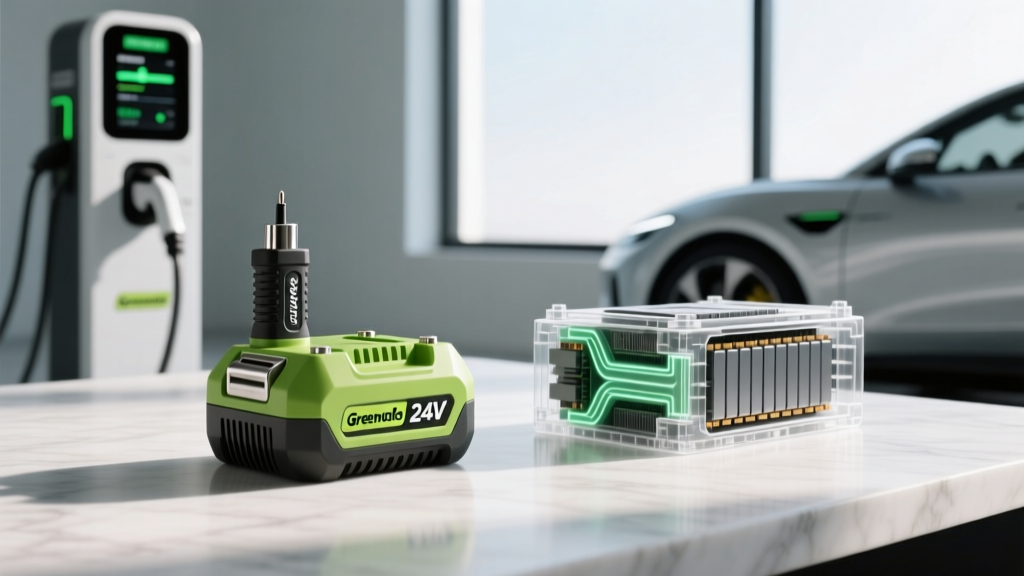
If you've ever swapped a Greenworks 24V battery and charger between a string trimmer and a leaf blower, you've already experienced the core principles that govern a $12,000 electric-vehicle traction battery — just at a radically different scale. The lithium-ion cells inside that compact 2.0 Ah or 4.0 Ah Greenworks pack obey the same electrochemistry, suffer the same degradation mechanisms, and benefit from the same care habits as the 60–100 kWh battery under the floor of a Tesla Model Y, Hyundai Ioniq 5, or Ford F-150 Lightning.
The difference is magnitude and engineering sophistication. A Greenworks G24 2.0 Ah pack stores roughly 43 watt-hours (Wh) of energy and costs about $40 to replace. A 2026 Chevrolet Equinox EV's Ultium battery stores 85,000 Wh (85 kWh), weighs over 900 pounds, and manages itself with a liquid-cooling loop, a dozen temperature sensors, and a battery-management system (BMS) that would fill a textbook. Yet both packs age for the same reasons: heat, high state of charge, and charge-discharge cycling.
This guide uses that parallel to explain everything a 2026 EV buyer or owner needs to know about battery chemistry, real-world degradation, warranty coverage, replacement costs, and daily habits that maximize longevity — whether you're maintaining a Greenworks 24V platform in the garage or a BEV in the driveway.
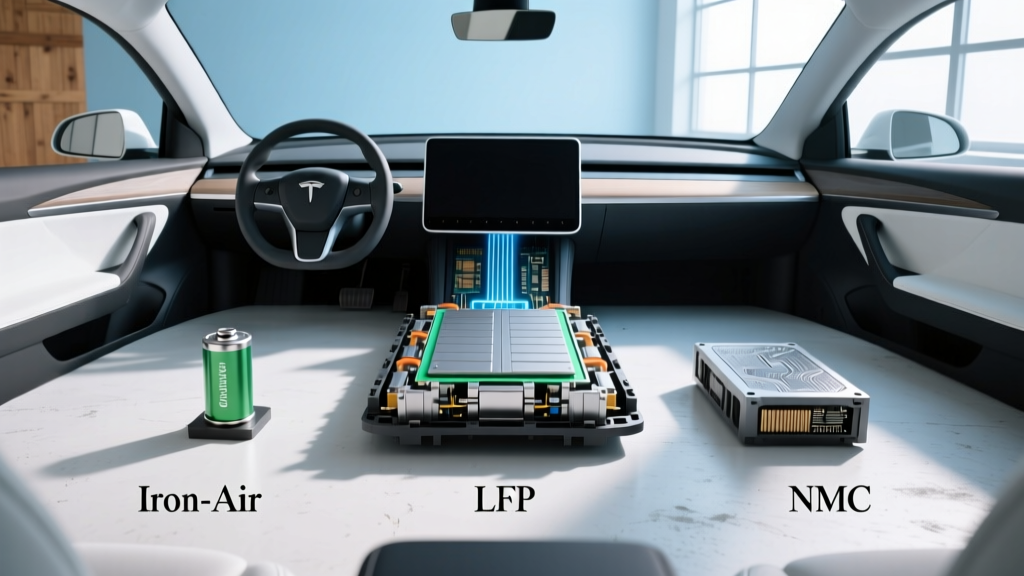
LFP vs. NMC: The Two Chemistries Powering 2026 EVs
Every mainstream EV sold in the US in 2026 uses one of two lithium-ion cathode chemistries: LFP (lithium iron phosphate, LiFePO₄) or NMC/NCA (nickel manganese cobalt / nickel cobalt aluminum). The choice determines range, charging behavior, cold-weather performance, cycle life, and price.
| Attribute | LFP (e.g., Tesla Model 3 RWD, base Ford Mustang Mach-E) | NMC / NCA (e.g., Hyundai Ioniq 5 Long Range, Rivian R1T) |
|---|---|---|
| Energy density (cell-level) | ~160–180 Wh/kg | ~230–270 Wh/kg |
| Typical pack size (2026 US EVs) | 50–65 kWh | 72–100+ kWh |
| Cycle life to 80% SoH | 2,500–4,000+ cycles | 1,200–2,000 cycles |
| Recommended daily SoC | 100% (no penalty) | 80% (100% only for trips) |
| Cold-weather range loss (20°F, highway) | ~28–35% | ~22–30% |
| DC fast-charge peak (typical) | 150–170 kW | 175–350 kW (800V architectures) |
| Cobalt content | None | Yes (supply-chain & ethical factor) |
| Cost per kWh (pack-level, 2026 est.) | $90–$110 | $120–$150 |
| Best for | Daily commuters, L2 home charging, high-mileage drivers | Long road trips, towing, cold climates, max-range trims |
Which is better? Neither is universally superior. LFP wins on longevity and cost; you can charge it to 100% every night without accelerating degradation, which is why Tesla recommends 100% for its LFP Model 3 RWD. NMC wins on energy density and cold performance, which is why long-range and performance trims from Hyundai, BMW, and Rivian still rely on it. If you drive 30 miles a day and charge at home on a Level 2, LFP is the pragmatic pick. If you regularly road-trip 300+ miles or live in sub-freezing winters, NMC's higher density and better cold tolerance justify the premium.
For context, the Greenworks 24V pack you're holding uses NMC pouch cells similar in chemistry (not construction) to an NMC EV pack — optimized for energy density in a light, handheld tool.
How Long Do EV Batteries Actually Last?
The short answer: longer than most buyers expect, and usually longer than the rest of the car. Data from fueleconomy.gov, long-term fleet studies, and manufacturer filings to NHTSA paint a consistent picture for liquid-cooled 2026-era packs.
Typical degradation curve (liquid-cooled NMC, moderate climate):
- Year 1 / 15,000 miles: ~2–3% capacity loss (initial "break-in" drop)
- Year 3 / 45,000 miles: ~6–8% total loss
- Year 5 / 75,000 miles: ~9–11% total loss
- Year 8 / 120,000 miles: ~12–15% total loss
- Year 10 / 150,000 miles: ~15–18% total loss
LFP packs in the same duty cycle typically show 1–2 percentage points less loss at each milestone. Geotab's 2024 longitudinal study of 10,000+ EVs found an average annual loss of roughly 1.8% across mixed chemistries, implying a 15-year pack life before hitting 70% state of health (SoH).
A 2026 Tesla Model 3 Long Range (NMC, 75 kWh usable) that starts at an EPA 341 miles will realistically deliver about 295–305 miles at year 8 / 120,000 miles — still usable, still warrantied. An LFP Chevrolet Bolt successor rated at 260 miles EPA would likely retain ~225 miles at the same age.
Compare this to a Greenworks 24V 4.0 Ah pack: used twice weekly year-round, stored at partial charge, you can expect 3–5 years before noticeable runtime loss. Used daily, left at 100% in a hot garage, maybe 2 years. The physics is identical; the engineering around the cells is what changes the timeline.
What Does the EV Battery Warranty Actually Cover?
Federal law (EPA emissions-warranty precedent and CARB-influenced standards) has pushed every major automaker selling in the US to offer at minimum 8 years / 100,000 miles of traction-battery coverage. Many go further. The warranty covers defects and excessive capacity loss, not normal gradual degradation within the threshold.
| Vehicle | Chemistry | Warranty Term | Capacity Retention Threshold |
|---|---|---|---|
| Tesla Model 3 RWD | LFP | 8 yr / 100,000 mi | ≥70% SoH |
| Tesla Model Y Long Range | NMC | 8 yr / 120,000 mi | ≥70% SoH |
| Hyundai Ioniq 5 (US) | NMC | 10 yr / 100,000 mi | ≥70% SoH |
| Ford F-150 Lightning | NMC | 8 yr / 100,000 mi | ≥70% SoH |
| Chevrolet Equinox EV | NMC (Ultium) | 8 yr / 100,000 mi | ≥60–70% SoH (varies) |
| Rivian R1T / R1S | NMC | 8 yr / 175,000 mi | ≥70% SoH |
| BMW i4 / iX | NMC | 8 yr / 80,000 mi | ≥70% SoH |
The 70% threshold is industry-standard and important: it means a warrantied replacement is only triggered if your pack drops below 70% of original capacity within the term. In practice, very few 2020–2026 liquid-cooled EVs have hit that threshold under normal use. Most warranty claims involve defective modules, bad cell batches, or BMS failures — not wear-out.
Crucially, the 12V auxiliary battery that powers lights, screens, and computers is not covered under the traction-battery warranty. It's a separate, smaller battery (often a lithium 12V in 2026 Teslas and Hyundais) with a typical 3–5 year lifespan and a standard 3 yr / 36,000 mi bumper-to-bumper warranty.
How Much Does an EV Battery Replacement Cost?
This is the question that generates the most fear and the least accurate headlines. Here are the real 2026 numbers, sourced from dealer parts departments and third-party remanufacturers like Redwood Materials and Spiers New Technologies:
| Vehicle / Pack Size | New OEM Pack | Remanufactured Pack | Module-Level Repair |
|---|---|---|---|
| Chevrolet Bolt EV/EUV (65 kWh) | $14,000–$16,000 | $9,000–$11,000 | $1,500–$3,000 |
| Tesla Model 3 (60–75 kWh) | $13,000–$18,000 | $8,500–$12,000 | $2,000–$4,000 |
| Hyundai Ioniq 5 (77 kWh) | $16,000–$20,000 | $10,000–$14,000 | $2,500–$4,500 |
| Ford F-150 Lightning Ext. Range (131 kWh) | $25,000–$32,000 | $16,000–$22,000 | $3,000–$6,000 |
| Rivian R1T Max Pack (149 kWh) | $28,000–$35,000 | $18,000–$24,000 | $4,000–$7,000 |
| Lucid Air Grand Touring (112 kWh) | $24,000–$30,000 | Limited availability | $3,500–$6,500 |
When is replacement actually needed? Almost never during the warranty period for normal use. Most out-of-warranty replacements occur after 12–15 years / 180,000+ miles, or following physical damage (flood, collision, underbody impact). Module-level repair — replacing just the degraded or failed modules rather than the whole pack — is increasingly the default at specialized shops and costs a fraction of a full swap.
Put differently: you'll probably replace the brake rotors, suspension bushings, and multiple sets of tires on a 2026 EV before you touch the traction battery. Pack prices are also falling roughly 8–12% per year at the cell level, so a replacement in 2038 will cost materially less than today's figures.
Five Factors That Kill an EV Battery (and How to Avoid Them)
- Chronic 100% SoC on NMC: Storing an NMC pack at 100% accelerates electrolyte oxidation. Set daily charge limit to 80% and reserve 100% for trips you start within 12 hours. LFP owners: 100% daily is fine and recommended for BMS cell-balancing.
- Deep discharges below 10%: Sitting at very low SoC stresses the anode. Plug in soon after hitting single digits; don't leave the car at 2% for a week.
- Exclusive DC fast-charging: Tesla's own data shows vehicles that DC fast-charge >90% of the time lose ~1–2 percentage points more capacity over 100,000 miles than those primarily L2-charging. Plan road trips around DCFC, but default to Level 2 at home (7–11.5 kW).
- Heat soak: Battery temperature above 95°F (35°C) while at high SoC is the worst-case aging scenario. Park in shade or a garage in summer. Precondition the pack (most EVs do this automatically when a charger is navigated to) before fast-charging.
- Cold fast-charging without preconditioning: Plugging into a 150+ kW charger with a 25°F pack can cause lithium plating on the anode — permanent damage. Always use the car's nav-based preconditioning or manually warm the pack via the app before winter DCFC sessions.
These same principles explain why your Greenworks 24V pack lasts longer when you store it at ~50% in a cool basement rather than fully charged in a hot shed. The difference is that an EV's BMS actively enforces most of these rules for you; a power-tool charger generally does not.
Checking State of Health (SoH): What Owners Can Actually Measure
State of Health is the percentage of original capacity the pack still holds. A 75 kWh pack at 90% SoH delivers 67.5 kWh usable. There are four practical ways to check it in 2026:
- OEM app / in-car display: Tesla, Hyundai, Ford, BMW, and Rivian all expose an SoH estimate or remaining-capacity readout in the mobile app or service menu. Accuracy: ±2–3%.
- OBD-II dongle + app (LeafSpy-style): Tools like OBDeleven, CarScanner, or brand-specific apps read the BMS-reported SoH directly. Works on most 2020+ EVs.
- Manual "fill-up" test: Drive the pack from 100% to ~5%, note the kWh consumed from the car's trip meter, then compare to original usable capacity. Best done at mild temperatures on flat terrain.
- Dealer diagnostic: A service-department battery-health report is the gold standard and is required for any warranty claim. Typically free during scheduled service.
For a Greenworks 24V pack, SoH measurement is crude: runtime under a known load (e.g., minutes of hedge-trimmer use) versus the original baseline. Same principle, lower resolution.
Beyond 2026: Solid-State, Silicon Anodes, and What's Actually Coming
Three emerging technologies will reshape EV batteries — but none are on sale in a US-market EV today, and timelines matter.
Solid-state batteries replace the liquid electrolyte with a ceramic or polymer solid, enabling lithium-metal anodes, ~400 Wh/kg cell-level energy density, and dramatically faster charging. Toyota has announced a commercialization target of 2027–2028 in limited, premium vehicles. Samsung SDI and QuantumScape are sampling cells to OEMs. Realistic mass-market US availability: 2030+, and initially at a steep price premium.
Silicon-dominant anodes (used in small percentages today in cells from Tesla's 4680 suppliers and Sila Nanotechnologies' partners) boost energy density 10–20% without changing the cathode. Expect gradual rollout in 2026–2028 model-year NMC packs — an evolution, not a revolution.
Sodium-ion batteries (no lithium, no cobalt) are entering the market in 2026 in Chinese-market vehicles from BYD and JAC. Energy density is lower (~140 Wh/kg), but cost and cold performance are excellent. US availability is likely 2028+ and aimed at entry-level, short-range city EVs.
None of these are reasons to delay a 2026 EV purchase. Current LFP and NMC packs are mature, well-warrantied, and engineered to outlast the vehicle around them.
The Power-Tool Parallel: Why Your Greenworks 24V Battery and Charger Habits Matter for Your EV
There's a practical reason this comparison earns its place in an EV buyer's guide. Millions of 2026 EV shoppers already own a Greenworks 24V battery and charger platform for lawn care, and the care habits that extend that pack's life transfer directly to the car:
- Store at 40–60% SoC for long-term parking — true for the Greenworks pack in the shed and the EV in the driveway before a vacation.
- Avoid heat: a Greenworks pack baked on a July tailgate degrades faster; an EV parked at 110°F in Phoenix with a 95% SoC does the same.
- Use the manufacturer's charger. Cheap third-party 24V chargers often lack proper termination and cell-balancing; cheap EVSE units can have poor grounding or lack thermal monitoring. OEM or UL-listed equipment only.
- Cycle regularly. A lithium pack that sits unused for six months ages worse than one used weekly. Drive the EV; run the trimmer.
Understanding the small pack demystifies the big one — and removes the last layer of "black box" anxiety around EV ownership.
How long do EV batteries last in years and miles?
Liquid-cooled 2026 EV packs typically retain 80–85% of original capacity at 10 years / 150,000 miles. Most outlast the vehicle they're installed in. LFP chemistries trend toward the higher end of that range; NMC toward the lower, but with more range to begin with.
How much does it cost to replace an EV battery in 2026?
Out-of-warranty, $13,000–$35,000 depending on pack size, with remanufactured packs 30–40% cheaper and module-level repairs often under $5,000. In practice, replacements are rare before 180,000 miles and almost always covered by the 8–10 year warranty if they occur early.
What does the EV battery warranty actually cover?
Defects and capacity loss below a threshold — usually 70% of original capacity — within 8 years / 100,000 miles (some brands extend to 10 years or 175,000 miles). It does not cover the 12V auxiliary battery, physical damage, or normal gradual degradation above the threshold.
How do I check and maximize my EV's battery health?
Check SoH via the OEM app, an OBD-II reader, or a dealer diagnostic. Maximize longevity by defaulting to 80% daily charge on NMC (100% is fine on LFP), using Level 2 home charging as your primary source, preconditioning before DC fast-charging, and avoiding prolonged storage at very high or very low SoC in hot weather.
LFP vs. NMC — which EV battery chemistry is better for me?
LFP if you commute short distances, charge at home nightly, want the longest cycle life, and don't mind slightly lower range and cold-weather performance. NMC if you road-trip frequently, tow, live in a cold climate, or need the longest single-charge range. Both are mature, well-warrantied, and — based on 2026 data — likely to outlast the car.
Does frequent DC fast-charging really hurt the battery?
Modestly. Tesla and independent fleet data show ~1–2% additional capacity loss over 100,000 miles for vehicles that DC fast-charge almost exclusively versus those using primarily Level 2. It's a factor, not a deal-breaker — use DCFC for road trips, L2 for daily life.
Sources: EPA fueleconomy.gov efficiency and range data; manufacturer warranty documentation (Tesla, Hyundai, Ford, Rivian, BMW); IRS §30D clean-vehicle credit guidance at irs.gov for 2026 eligibility rules affecting EV purchase decisions.