What Makes a Battery Brand "Good" for Your EV?
When EV shoppers research good battery brands, they're really asking three questions: Will it last? How much range will I lose over time? And what happens if it fails? Unlike the engine in a gas car — where brand loyalty often centers on reliability reputation — EV battery quality comes down to cell chemistry, manufacturing consistency, and thermal management design. The brand name on the cell matters, but the chemistry inside matters more.
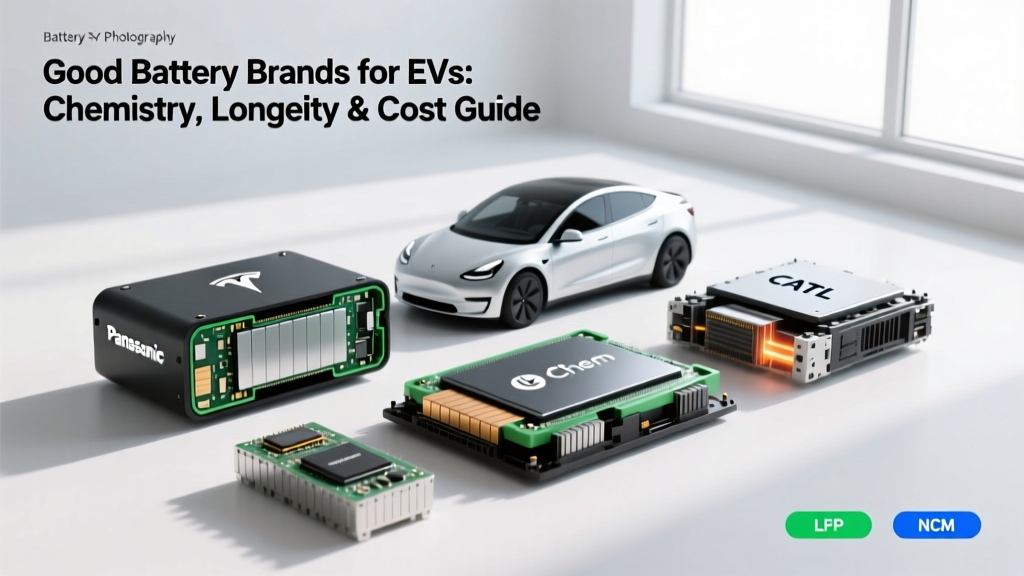
The major cell suppliers powering 2026 EVs include CATL (Contemporary Amperex Technology Co. Limited), LG Energy Solution, Panasonic, BYD, SK On, and Samsung SDI. Each supplies different chemistries to different automakers, and the same brand can produce both excellent and mediocre packs depending on the specific cell format and chemistry chosen for a given vehicle platform.
This guide breaks down what actually determines battery quality — chemistry trade-offs, real degradation data, warranty coverage, replacement costs, and the habits that maximize lifespan — so you can evaluate the battery in any EV you're considering.
LFP vs NMC vs NCA: The Chemistry That Defines Battery Quality
The single biggest factor in EV battery longevity, cost, and performance is cell chemistry. In 2026, virtually all mainstream EVs use one of three lithium-ion variants: LFP (lithium iron phosphate), NMC (nickel manganese cobalt), or NCA (nickel cobalt aluminum). Each has distinct trade-offs.
| Attribute | LFP (Lithium Iron Phosphate) | NMC (Nickel Manganese Cobalt) | NCA (Nickel Cobalt Aluminum) |
|---|---|---|---|
| Energy Density | Lower (~160-180 Wh/kg cell-level) | Higher (~220-260 Wh/kg) | Highest (~260-290 Wh/kg) |
| Cycle Life | 3,000-5,000+ cycles to 80% capacity | 1,000-2,000 cycles to 80% | 800-1,500 cycles to 80% |
| Cold-Weather Performance | Moderate — greater range loss below 32°F | Better low-temp discharge capability | Good low-temp performance |
| Cost per kWh | Lower — no cobalt or nickel | Higher — cobalt/nickel price exposure | Highest — complex manufacturing |
| Thermal Stability / Safety | Excellent — very resistant to thermal runaway | Good — requires robust BMS | Good — requires robust BMS |
| State of Charge Recommendation | Can charge to 100% daily without harm | Best kept 20-80% for daily use | Best kept 20-80% for daily use |
| Common Suppliers | CATL, BYD (Blade Battery) | LG Energy Solution, SK On, Samsung SDI, CATL | Panasonic (Tesla), Samsung SDI |
| Example Vehicles (2026) | Tesla Model 3 RWD, Ford Mustang Mach-E Select, BYD Seal | Hyundai Ioniq 5, Kia EV6, VW ID.4, Ford Mach-E Extended Range | Tesla Model S/X, some Model 3 Long Range |
Which Chemistry Is Better — LFP or NMC?
Neither is universally superior. LFP wins on longevity, cost, and safety. If you plan to keep your EV 10+ years, charge daily, and want minimal degradation anxiety, LFP is the stronger choice. The ability to charge to 100% without accelerated wear simplifies ownership considerably. The trade-off is lower energy density (meaning heavier packs for the same range) and somewhat worse cold-weather range retention.
NMC and NCA win on energy density and cold performance. If you need maximum range in a lighter package, frequently drive in sub-freezing temperatures, or prioritize fast-charge speed, NMC/NCA cells deliver. The trade-off is a shorter cycle life and the need to manage daily state of charge more carefully (staying in the 20-80% window).
For most daily-commute and suburban drivers, LFP's advantages outweigh its density penalty. For road-trip-heavy owners in cold climates, NMC's range and cold performance justify the extra care.
How Long Do EV Batteries Actually Last?
The short answer: longer than most buyers expect. Data from fleet operators, manufacturer reports, and independent testing shows that modern EV batteries typically retain 85-95% of original capacity after 100,000 miles and 75-90% after 200,000 miles, depending on chemistry, climate, and charging habits.
Here are concrete data points from vehicles now well into their service life:
Real-World Degradation Data Points
- Tesla Model 3/Y (NMC/NCA, Panasonic/LG cells): Tesla's 2025 Impact Report documented an average of ~12% capacity loss at 200,000 miles across the fleet. Vehicles with LFP cells (Standard Range/RWD) show slower degradation curves, with many owners reporting 5-8% loss at 100,000 miles.
- Hyundai Ioniq 5 / Kia EV6 (NMC, SK On cells): Early owner data and Recurrent fleet analysis show approximately 4-7% degradation at 60,000 miles, tracking toward ~10-14% at 150,000 miles.
- Nissan Leaf (NMC, various suppliers): The air-cooled Leaf remains a cautionary example. First-generation (24-40 kWh) Leafs in hot climates saw 20-30% capacity loss by 80,000-100,000 miles. The liquid-cooled Leaf Plus (62 kWh, 2019+) performs significantly better, tracking closer to industry norms.
- Chevrolet Bolt EV/EUV (NMC, LG cells): Following the 2021-2022 recall and battery replacement program, replaced Bolt packs have shown minimal degradation. Original packs (pre-recall) averaged ~6-8% loss at 80,000 miles in moderate climates.
- BYD Blade Battery (LFP): BYD's proprietary blade-format LFP cells are rated for 5,000+ cycles to 80% capacity. In taxi fleet data from China, Blade-equipped vehicles have shown under 5% degradation at 100,000 miles.
A critical nuance: degradation is non-linear. Most batteries lose 2-5% capacity in the first year or two (the "break-in" drop), then settle into a slow, linear decline of roughly 1-2% per year or per 15,000-20,000 miles. This means a battery that shows 5% loss at 30,000 miles is not on track to be dead at 150,000 — it's likely on track for 85%+ at that mileage.
What Does the Battery Warranty Actually Cover?
Federal law in the United States mandates that EV batteries carry a minimum warranty of 8 years or 100,000 miles (whichever comes first). In California Air Resources Board (CARB) states — which include California, Colorado, Connecticut, Maine, Maryland, Massachusetts, New Jersey, New York, Oregon, Rhode Island, Vermont, Virginia, and Washington — the mandate extends to 10 years or 150,000 miles.
Most automakers match or exceed these minimums, and the warranty covers capacity retention below a specified threshold — typically 70% of original capacity.
| Automaker | Warranty Term | Capacity Threshold | Chemistry Notes |
|---|---|---|---|
| Tesla (Model 3/Y RWD — LFP) | 8 yr / 100,000 mi | 70% | CATL LFP cells |
| Tesla (Model 3/Y LR/Perf — NMC/NCA) | 8 yr / 120,000 mi | 70% | Panasonic/LG NMC/NCA |
| Tesla (Model S/X) | 8 yr / 150,000 mi | 70% | Panasonic NCA |
| Hyundai / Kia | 10 yr / 100,000 mi | 70% | SK On NMC |
| Ford (Mach-E, F-150 Lightning) | 8 yr / 100,000 mi | 70% | SK On / CATL (varies by trim) |
| Volkswagen (ID.4) | 8 yr / 100,000 mi | 70% | SK On NMC |
| BMW (i4, iX) | 8 yr / 100,000 mi | 70% | Samsung SDI / CATL NMC |
| Rivian (R1T, R1S) | 8 yr / 175,000 mi | 70% | Samsung SDI NMC |
| GM (Chevy, Cadillac EVs) | 8 yr / 100,000 mi | 60% (some models 70%) | LG Ultium NMC |
What the warranty does NOT cover: Normal capacity loss above the threshold, damage from accidents, modifications, or using non-approved charging equipment. If your battery retains 72% at 90,000 miles, the warranty will not replace it — even though you've lost 28% of range. This is why understanding degradation curves and choosing the right chemistry matters.
How Much Does an EV Battery Cost to Replace?
This is the question that generates the most anxiety — and the most misinformation. Here are the facts: the vast majority of EV batteries never need replacement during the vehicle's useful life. When replacement is needed, it's typically due to a manufacturing defect (covered under warranty) or damage from a collision or flood, not end-of-life degradation.
That said, out-of-warranty replacement costs are real and significant. Prices have fallen substantially since 2020 as cell costs have declined, but a full pack replacement remains a major expense.
| Vehicle | Battery Size (kWh) | Chemistry | Estimated Replacement Cost | Typical Replacement Trigger |
|---|---|---|---|---|
| Tesla Model 3 RWD | 60 kWh | LFP (CATL) | $8,000 - $12,000 | Rare before 300,000+ mi |
| Tesla Model Y Long Range | 82 kWh | NMC (LG/Panasonic) | $12,000 - $16,000 | Rare before 200,000+ mi |
| Hyundai Ioniq 5 | 77.4 kWh | NMC (SK On) | $10,000 - $15,000 | Rare before 200,000+ mi |
| Ford F-150 Lightning Ext. Range | 131 kWh | NMC (SK On) | $18,000 - $25,000 | Rare before 200,000+ mi |
| Chevrolet Equinox EV | 85 kWh | NMC (LG Ultium) | $11,000 - $16,000 | Rare before 200,000+ mi |
| BMW iX xDrive50 | 111.5 kWh | NMC (Samsung SDI) | $20,000 - $28,000 | Rare before 200,000+ mi |
Several factors are changing this picture favorably:
- Module-level repair: Many modern packs (Tesla, Hyundai, GM Ultium, BMW) allow individual module replacement rather than full-pack swap. A single failed module might cost $1,500-$3,500 to replace instead of the entire pack.
- Declining cell costs: LFP cell prices fell below $50/kWh at the pack level in 2025, and NMC cells continue to decline. By 2028-2030, replacement costs will be significantly lower than today's figures.
- Third-party repair networks: Companies like Electrified Garage and independent EV specialists now offer diagnostics and module-level repair at 30-50% less than dealer pricing.
The Brands Behind the Pack: CATL, LG, Panasonic, BYD, and SK On
When evaluating good battery brands, it helps to understand which cell supplier is inside your EV. Here's how the major players stack up in 2026:
CATL (China): The world's largest battery manufacturer by volume. Supplies LFP cells to Tesla (Model 3/Y RWD), Ford, BMW, and others. CATL's LFP cells are widely regarded as the benchmark for cycle life and cost efficiency. Their newer "Shenxing" LFP cells support 4C charging (10-80% in approximately 10 minutes under optimal conditions). CATL also supplies NMC cells to several European and Chinese automakers.
LG Energy Solution (South Korea): A major supplier of NMC cells to Tesla, GM, Hyundai, and others. LG cells are known for strong energy density and consistent manufacturing quality. Their involvement in the Chevy Bolt recall (2021) was a setback, but subsequent manufacturing process changes have restored confidence. LG supplies the high-nickel NCMA (nickel cobalt manganese aluminum) cells used in several long-range platforms.
Panasonic (Japan): Tesla's longest-standing battery partner, supplying NCA cells from the Gigafactory Nevada. Panasonic cells have an excellent reliability track record, with Tesla's fleet data showing some of the lowest degradation rates in the industry. Panasonic is also expanding supply to other automakers and investing in 4680-format cells.
BYD (China): Both an automaker and a cell supplier, BYD's proprietary Blade Battery (LFP) uses a unique cell-to-pack architecture that improves volumetric efficiency and safety. BYD supplies cells to Tesla (for some markets), Toyota, and others. The Blade format's resistance to thermal runaway is among the best in the industry.
SK On (South Korea): Supplies NMC cells to Ford (F-150 Lightning, Mustang Mach-E), Hyundai/Kia, and others. SK On cells are competitive on energy density and have performed well in real-world degradation tracking. The company is expanding U.S. manufacturing capacity significantly.
Factors That Accelerate or Slow Battery Degradation
Battery longevity isn't solely determined by the brand or chemistry — how you use and charge the pack has a measurable impact. Here's what the data shows:
Battery Care Best Practices
- Minimize DC fast charging when possible. Frequent use of 150+ kW DC fast charging generates heat that accelerates electrolyte degradation. Occasional road-trip fast charging is fine; daily fast charging will measurably increase wear. Aim for Level 2 home charging as your primary routine.
- Avoid extreme state of charge for storage. For NMC/NCA batteries, storing at 100% SoC for days or weeks accelerates calendar degradation. If you won't drive for a week or more, leave the battery at 50-60%. LFP batteries are more tolerant of high SoC storage.
- Use the 20-80% daily window (NMC/NCA). For nickel-based chemistries, keeping daily charges between 20% and 80% roughly doubles cycle life compared to 0-100% cycling. Most EVs allow you to set a charge limit in the infotainment or app.
- Precondition before fast charging. Battery preconditioning (warming the pack to optimal temperature before DC charging) reduces stress on cells. Tesla, Hyundai, Ford, and most modern EVs do this automatically when you navigate to a charger.
- Park in shade or a garage in extreme heat. Prolonged exposure to ambient temperatures above 95°F with a high SoC is one of the most damaging conditions for lithium-ion cells. A garage or shaded spot meaningfully slows calendar degradation.
- Don't baby it excessively. Modern battery management systems (BMS) are sophisticated. Occasional 100% charges, fast charges on road trips, and cold-weather driving are all within design parameters. The goal is to avoid chronic extremes, not to eliminate them entirely.
How to Monitor Your Battery's State of Health (SoH)
State of Health (SoH) is the percentage of original capacity your battery currently retains. A new battery is 100% SoH; one that holds 85 kWh out of an original 100 kWh is at 85% SoH. Monitoring SoH helps you track degradation, plan for long trips, and verify warranty eligibility.
Methods to Check SoH
1. In-vehicle displays: Some EVs (notably Tesla, BMW, and some Hyundai/Kia models with updated software) display battery health or degradation percentage directly in the settings menu or service screen. Tesla's "Battery Health" feature, rolled out broadly in 2024-2025, shows estimated SoH in the vehicle's service menu.
2. Third-party apps and OBD-II readers: Tools like Teslalogger, Scan My Tesla, Leaf Spy (for Nissan Leaf), and OBD-II dongles paired with apps like ABRP (A Better Routeplanner) or Car Scanner can read detailed battery telemetry including SoH, cell voltage variance, and pack temperature. These typically cost $20-$50 for the hardware.
3. Dealer or independent diagnostic: A service center can run a full battery health report, typically for $100-$200. This is worth doing before purchasing a used EV, especially one approaching the warranty mileage threshold.
4. Manual calculation: Charge to 100% (or your known maximum), note the displayed range, and compare to the original EPA-rated range adjusted for your typical efficiency. This is imprecise (displayed range varies with temperature and recent driving), but it provides a rough SoH estimate.
Emerging Battery Technology: What's Coming (and When)
Several next-generation battery technologies are in development. None are commercially available in production EVs as of 2026, but they represent the trajectory of the industry:
Solid-state batteries: Replace the liquid electrolyte with a solid material, promising higher energy density (potentially 400+ Wh/kg at the cell level), faster charging, and improved safety. Toyota has announced a solid-state battery targeting 2027-2028 production in limited volumes. Samsung SDI and QuantumScape are also advancing prototypes. Realistic timeline for mainstream availability: 2029-2032. Early implementations will likely be in premium vehicles at significant cost premiums.
Silicon anode batteries: Replacing graphite anodes with silicon can increase energy density by 20-40%. Companies like Sila Nanotechnologies and Group14 are supplying silicon-dominant anode materials to manufacturers. Realistic timeline: Partial silicon anodes are already in limited production (2025-2026); full silicon anodes expected 2028-2030.
Sodium-ion batteries: Use abundant sodium instead of lithium, offering lower cost and good cold performance at the expense of energy density. CATL has begun limited production for Chinese-market vehicles. Realistic timeline for U.S. market: 2028+ and likely in entry-level or stationary storage applications first.
These technologies are worth tracking but should not delay a current EV purchase. Today's lithium-ion batteries — from the good battery brands profiled above — are mature, well-warrantied, and demonstrably long-lasting.
Frequently Asked Questions
How long do EV batteries last in years and miles?
Most modern EV batteries retain 80-90% of original capacity at 150,000-200,000 miles. In terms of calendar life, expect 15-20+ years before the battery degrades below 70% SoH under normal use. LFP chemistry batteries tend toward the longer end of this range. According to fueleconomy.gov, EV battery technology has improved significantly, with modern thermal management systems extending useful life well beyond early-generation packs.
How much does an EV battery cost to replace?
Out-of-warranty replacement costs range from approximately $8,000 for a smaller LFP pack (Tesla Model 3 RWD) to $25,000+ for a large pack (Ford F-150 Lightning Extended Range). However, most batteries never require replacement during the vehicle's life, and module-level repairs cost significantly less ($1,500-$3,500 per module). Full pack replacements are rare outside of warranty-covered defects.
What does the EV battery warranty cover?
Federal law requires a minimum 8-year/100,000-mile warranty covering capacity retention below a specified threshold (typically 70% of original capacity). CARB states mandate 10 years/150,000 miles. The warranty covers defects and excessive degradation — not normal wear above the threshold, accident damage, or misuse. Check your specific automaker's terms, as some (Hyundai, Rivian) exceed minimums.
How do I check and maximize my EV battery health?
Monitor SoH through in-vehicle displays, third-party OBD-II apps, or dealer diagnostics. To maximize longevity: use Level 2 home charging as your primary method, keep NMC/NCA batteries in the 20-80% range for daily use (LFP can go to 100%), precondition before DC fast charging, avoid prolonged storage at extreme SoC or temperature, and minimize unnecessary fast charging. Modern BMS systems handle most optimization automatically.
LFP vs NMC — which battery chemistry is better for me?
Choose LFP if you prioritize longevity, lower cost, can charge to 100% daily without worry, and don't need maximum range per charge. Choose NMC/NCA if you need the longest possible range, frequently drive in cold weather, or prioritize fast-charging speed. Both chemistries from reputable suppliers (CATL, LG, Panasonic, BYD, SK On) are proven and well-warrantied.
Are CATL and BYD batteries reliable if they're made in China?
Yes. CATL is the world's largest battery manufacturer and supplies cells to Tesla, BMW, Ford, and others with strong real-world reliability data. BYD's Blade Battery has passed rigorous safety testing including nail penetration tests. Manufacturing origin is less relevant than cell chemistry, quality control processes, and the automaker's pack integration and thermal management design.