When a German research consortium demonstrated a prototype sodium-ion "salt air" battery cell in late 2025, headlines raced ahead of reality. The concept — a sodium-oxygen (Na-O₂) cell that breathes ambient air and uses abundant salt-derived materials — is scientifically compelling. But for EV shoppers in 2026, the practical question is different: how does it compare to the lithium-ion chemistries actually powering today's vehicles? This guide breaks down what the German salt air battery is, where it stands on the road to production, and how current EV battery technology (LFP and NMC/NCA) stacks up on the metrics that matter: energy density, degradation, warranty, and replacement cost.
What Is the German Salt Air Battery?
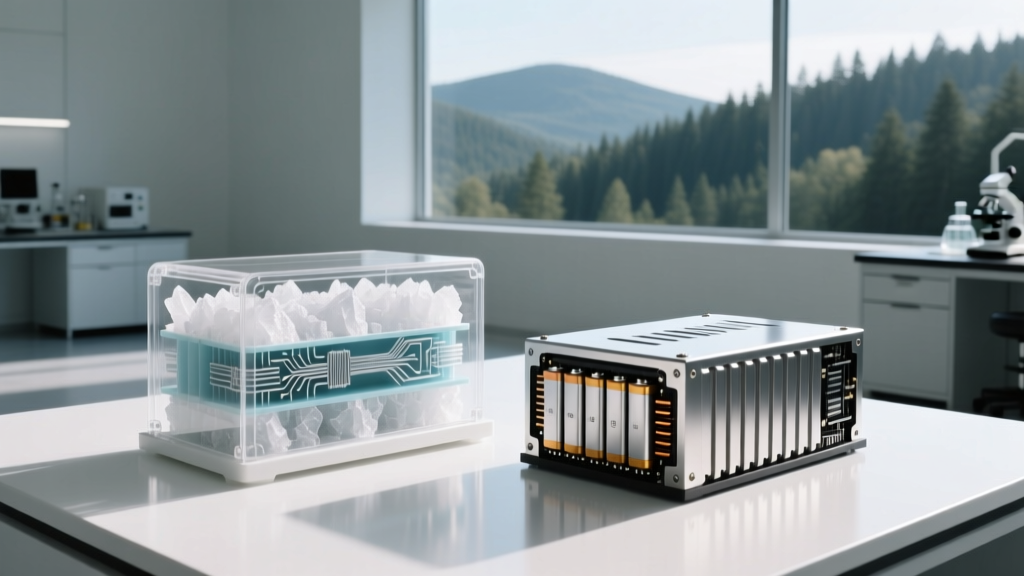
The term "German salt air battery" refers to a class of metal-air batteries being developed by research institutions in Germany, most notably work funded through the Federal Ministry of Education and Research (BMBF). The core concept uses a sodium metal anode paired with an air (oxygen) cathode, with electrolytes derived from abundant sodium compounds — hence the "salt air" shorthand.
The theoretical appeal is enormous:
- Raw material abundance: Sodium is orders of magnitude more plentiful than lithium, avoiding the geopolitical supply-chain bottlenecks tied to lithium mining.
- Theoretical energy density: Na-O₂ cells can theoretically exceed 1,600 Wh/kg at the cell level — roughly 5–6× current lithium-ion cells.
- Lower material cost: No cobalt, nickel, or lithium required.
However, as of early 2026, these cells remain in the laboratory prototype stage. Key engineering challenges — including sodium dendrite formation, limited cycle life (currently measured in dozens to low hundreds of cycles in lab settings), and sensitivity to moisture in the air cathode — have not been resolved for automotive-scale deployment. No OEM has announced a production timeline for a salt air battery in a road-legal EV.
Current EV Battery Chemistry: LFP vs. NMC vs. NCA
Every EV sold in the U.S. in 2026 uses one of three lithium-ion cathode chemistries. Understanding the trade-offs is essential for choosing the right vehicle.
| Attribute | LFP (Lithium Iron Phosphate) | NMC (Nickel Manganese Cobalt) | NCA (Nickel Cobalt Aluminum) |
|---|---|---|---|
| Energy Density (cell-level) | 160–200 Wh/kg | 220–300 Wh/kg | 250–300 Wh/kg |
| Typical Cycle Life | 3,000–6,000+ cycles | 1,000–2,500 cycles | 1,000–2,000 cycles |
| Cold-Weather Performance | Moderate (more range loss below 32°F) | Better (less low-temp resistance) | Better (similar to NMC) |
| Cost per kWh (pack-level) | ~$90–$110 | ~$120–$150 | ~$120–$150 |
| Thermal Stability | Excellent (higher runaway threshold) | Good (requires robust BMS) | Good (requires robust BMS) |
| State-of-Charge Recommendation | Can charge to 100% daily | Better at 80% daily; 100% for trips | Better at 80% daily; 100% for trips |
| Common In | Tesla Model 3 RWD, BYD, base Ford Mustang Mach-E | Hyundai Ioniq 5, VW ID.4, most long-range models | Tesla Model Y/3 Long Range, Rivian |
The practical takeaway: LFP wins on longevity and cost, making it ideal for daily commuters who charge at home and don't need maximum range. NMC and NCA win on energy density and cold performance, suiting drivers who need 300+ miles of EPA range or live in northern climates.
How Long Do EV Batteries Actually Last?
This is the question that dominates EV forums, and the data is reassuring. Modern EV batteries are engineered to outlast the typical ownership period of the vehicle itself.
Real-World Degradation Data
Based on fleet data and long-term owner reports:
- Year 1–2: Most packs lose 2–5% capacity as the SEI (solid electrolyte interphase) layer stabilizes. This is normal and expected.
- Year 3–5: Degradation slows to roughly 1–2% per year under normal use.
- Year 8–10: Average packs retain 85–92% of original capacity. Tesla's 2025 Impact Report noted its fleet averaged ~12% degradation at 200,000 miles.
- Year 12–15: Many packs still retain 75–85% capacity, well above the typical warranty threshold.
Factors That Accelerate Degradation
Not all miles are equal. The following habits measurably increase capacity loss:
- Frequent DC fast charging above 150 kW without preconditioning: adds ~0.5–1% extra annual loss vs. Level 2 home charging.
- Routinely sitting at 100% SoC in hot weather (above 90°F): can add 1–2% extra loss per year for NMC/NCA packs.
- Deep discharges below 10% SoC regularly: stresses cell chemistry.
- Extreme cold charging (below 20°F) without battery preconditioning: risks lithium plating on the anode.
EV Battery Warranty Terms: What's Actually Covered
Federal law mandates a minimum 8-year/100,000-mile warranty on EV batteries for emissions-related compliance, but most manufacturers meet or exceed this baseline. Here's how major warranties compare:
| Manufacturer | Duration | Mileage | Capacity Threshold | Notes |
|---|---|---|---|---|
| Tesla (Model 3/Y LFP) | 8 years | 100,000 mi | 70% retention | Long Range: 8 yr/120,000 mi |
| Hyundai/Kia | 10 years | 100,000 mi | 70% retention | Industry-leading duration |
| Ford (Mustang Mach-E) | 8 years | 100,000 mi | 70% retention | Transferable to second owner |
| Volkswagen (ID.4) | 8 years | 100,000 mi | 70% retention | Covers defects + degradation |
| GM (Ultium platform) | 8 years | 100,000 mi | 70% retention | Modular replacement possible |
| Rivian | 8 years | 120,000 mi | 70% retention | Higher mileage cap |
What the warranty covers: Capacity loss below the stated threshold (e.g., dropping below 70% of original kWh within the warranty period) and manufacturing defects. It does not cover damage from accidents, flooding, unauthorized modifications, or failure to follow the manufacturer's charging guidelines.
What happens if you make a claim: Most manufacturers will replace or refurbish the pack to bring it above the threshold. Hyundai and GM, among others, can replace individual modules rather than the entire pack, reducing waste and downtime.
EV Battery Replacement Cost: The Real Numbers
If a battery does need replacement outside of warranty — a statistically rare event — here's what owners face in 2026:
| Vehicle / Pack Size | Battery kWh | Replacement Cost (Parts + Labor) | Typical Trigger |
|---|---|---|---|
| Tesla Model 3 RWD (LFP) | ~60 kWh | $12,000–$16,000 | Post-warranty degradation or damage |
| Hyundai Ioniq 5 (NMC) | 77.4 kWh | $15,000–$20,000 | Collision damage, rare cell failure |
| Ford F-150 Lightning (Extended) | ~131 kWh | $25,000–$35,000 | Large pack = higher material cost |
| Chevrolet Equinox EV | ~85 kWh | $14,000–$18,000 | Ultium modular design may reduce cost |
| Nissan Ariya | ~91 kWh | $16,000–$22,000 | Limited aftermarket options |
Important context: pack-level battery costs have fallen from over $1,000/kWh in 2010 to approximately $120–$140/kWh in 2026 (BloombergNEF data). The trend continues downward, meaning out-of-warranty replacements will likely cost less in the 2030s. Additionally, the growing used-EV battery recycling and refurbishment market is beginning to offer lower-cost alternatives — remanufactured packs at 50–70% of new-pack pricing are emerging from companies like Redwood Materials and battery refurbishers.
How to Monitor and Maximize Battery Health
Proactive care extends pack life and preserves resale value. Here's a practical checklist:
Checking State of Health (SoH)
- In-vehicle displays: Tesla shows estimated range vs. original; Hyundai/Kia offers a battery health screen in newer models.
- OBD-II tools: Devices like the OBDLink MX+ paired with apps such as LeafSpy (Nissan) or Scan My Tesla can read actual pack capacity in kWh vs. nameplate.
- Dealer diagnostics: Most service centers can run a full capacity test during routine visits — request one annually after year 4.
- Third-party reports: Services like Recurrent Auto provide battery health certificates for resale, using telematics data.
Battery Care Best Practices
- Daily charging limit: Set to 80% for NMC/NCA packs; 100% is fine for LFP. Use the car's scheduled charging feature to finish just before departure.
- Precondition before DC fast charging: Navigate to the charger using the car's built-in nav (triggers thermal preconditioning automatically in Tesla, Hyundai, GM, Ford).
- Avoid prolonged storage at extremes: If leaving the car for 2+ weeks, set SoC to ~50% and plug in (the car's BMS will maintain it).
- Minimize deep discharges: Try not to drop below 10–15% regularly. Occasional low-SoC use is fine; habitual deep cycling accelerates wear.
- Use Level 2 for daily charging: Home Level 2 (7–11 kW) is gentler on the pack than daily DC fast charging. Reserve DCFC for road trips.
- Park in shade/garage when possible: Sustained high battery temperatures (above 95°F ambient for weeks) accelerate calendar aging.
Emerging Battery Tech: What's Realistic and When
Beyond the German salt air battery concept, several next-generation technologies are closer to production — but timelines should be viewed skeptically.
Solid-State Batteries
These replace the liquid electrolyte with a solid ceramic or polymer, promising higher energy density (potentially 400–500 Wh/kg), faster charging, and improved safety. Toyota has announced a solid-state EV for 2027–2028 (preliminary, limited production). Samsung SDI targets 2027 for initial production cells. QuantumScape is shipping prototype cells to OEM partners. Mass-market availability is realistically 2029–2032.
Silicon Anode Enhancements
Adding silicon to the graphite anode increases energy density by 10–20%. This is already shipping in limited form — the 2026 Mercedes-Benz EQG uses a silicon-dominant anode from Sila Nanotechnologies. Expect broader adoption by 2027–2028 across premium models.
Sodium-Ion Batteries (Non-Air)
Distinct from the salt air concept, conventional sodium-ion cells (with a solid cathode, not air-breathing) are already entering production. CATL began shipping Na-ion packs in Chinese-market EVs in 2024, and BYD has announced sodium-ion models for 2026. These offer lower energy density (~140–160 Wh/kg) but excellent cold performance and lower cost. They're best suited for affordable city EVs, not long-range vehicles.
German Salt Air Battery Timeline
Based on current published research, a commercially viable Na-O₂ automotive cell is at minimum 8–12 years away. The cycle-life, moisture-sensitivity, and power-density challenges are fundamental materials-science problems that require breakthroughs, not incremental engineering. Enthusiasm is warranted; patience is required.
Frequently Asked Questions
How long do EV batteries last in years and miles?
Modern EV batteries are designed to last 15–20 years or 200,000–300,000 miles before dropping below 70–80% of original capacity. Real-world fleet data from Tesla, Hyundai, and independent studies shows average degradation of ~12% at 200,000 miles. Most packs will outlast the vehicle they're installed in.
How much does it cost to replace an EV battery?
Out-of-warranty replacement costs range from ~$12,000 for a 60 kWh pack (Tesla Model 3 RWD) to $35,000 for a 131 kWh pack (F-150 Lightning Extended Range). However, fewer than 2% of EVs ever need a full battery replacement, and most replacements occur under warranty at no cost to the owner. Prices continue to decline as cell costs drop.
What does the EV battery warranty cover?
Standard warranties cover capacity loss below a defined threshold (typically 70% retention) and manufacturing defects for 8–10 years or 100,000–120,000 miles. They do not cover accident damage, water intrusion from flooding, or neglect. Always check your specific manufacturer's warranty document — terms vary.
LFP vs. NMC — which battery chemistry is better for me?
Choose LFP if you charge at home daily, want maximum cycle life (3,000–6,000+ cycles), don't need 300+ miles of range, and want to charge to 100% without worry. Choose NMC/NCA if you need maximum range, live in a cold climate (better low-temperature performance), or frequently take road trips requiring DC fast charging. Neither is universally "better" — the right choice depends on your driving pattern.
Will the German salt air battery make current EVs obsolete?
Not in any foreseeable timeframe. The Na-O₂ technology is a promising laboratory concept with a theoretical energy density advantage, but it faces unresolved cycle-life and engineering challenges. Commercial automotive deployment is realistically a 2030s prospect at the earliest. Current lithium-ion chemistries (LFP, NMC, NCA) continue to improve incrementally and will remain the standard through at least 2030.
Does frequent DC fast charging damage my battery?
Occasional DC fast charging (road trips, 1–2 times per week) has minimal impact. However, daily DC fast charging — especially at 150+ kW without preconditioning — can add ~0.5–1% extra degradation per year compared to Level 2 home charging. For daily use, a home Level 2 charger (7–11 kW) is the healthiest option for your pack.