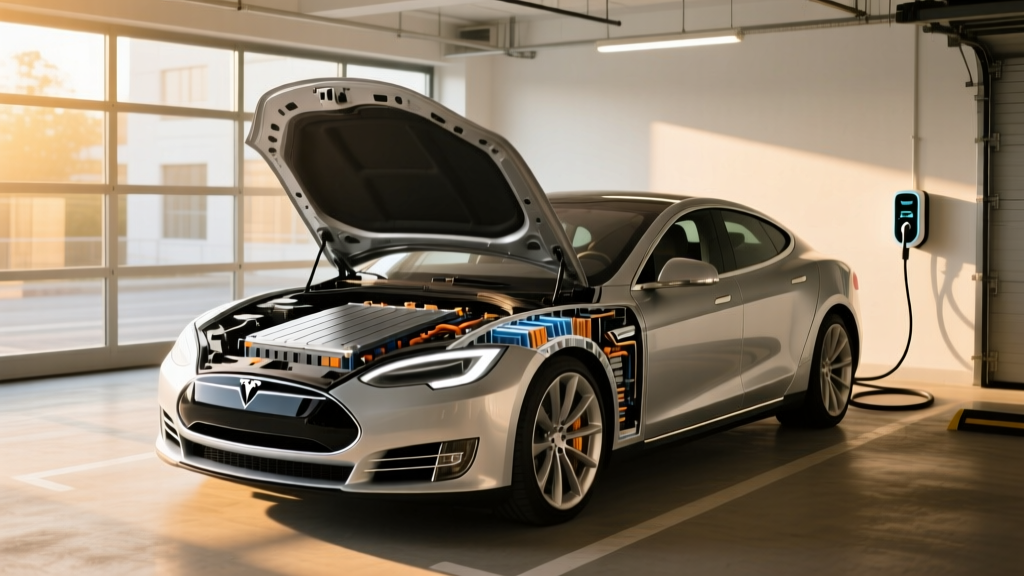
When EV shoppers research longevity, the traction battery is the single biggest cost variable and the most misunderstood component. Whether you're evaluating a Tesla Model 3, a Ford F-150 Lightning, or a BYD sedan imported through a Georgia-based supply chain (often shorthand in forums as a "GA battery" pack), the chemistry inside determines range, charging speed, cold-weather behavior, and how many miles you'll see before meaningful degradation. This guide synthesizes 2026 model-year data, warranty terms, and real-world degradation curves to give you a buyer-grade understanding of what's inside your EV — and what it will cost when it eventually ages out.
LFP vs NMC/NCA: The Chemistry Trade-Off Matrix
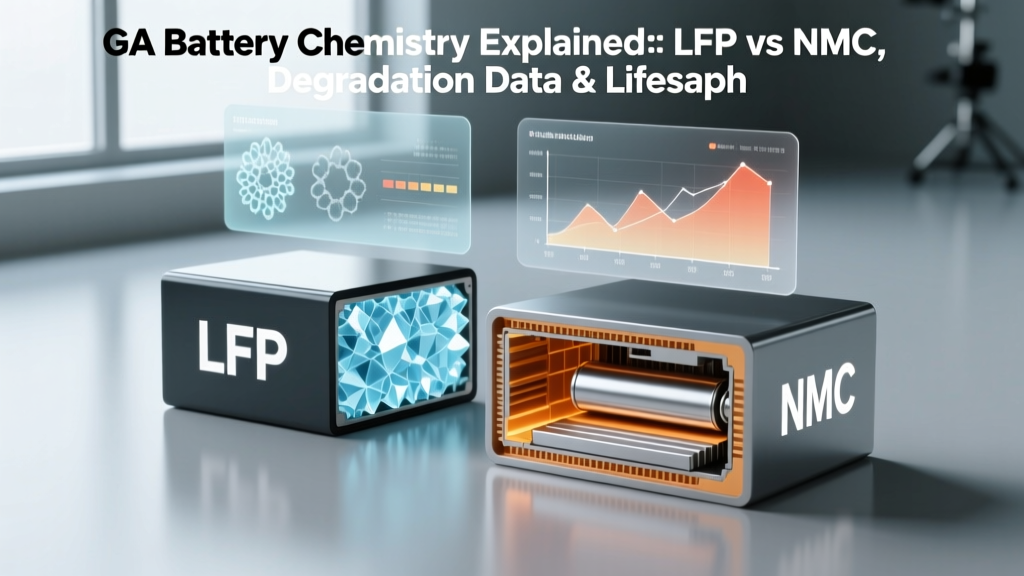
Modern EV traction batteries fall into two dominant lithium-ion families: NMC/NCA (nickel-manganese-cobalt or nickel-cobalt-aluminum) and LFP (lithium iron phosphate). The choice isn't about which is universally "better" — it's about which trade-offs match your driving pattern.
| Attribute | LFP (LiFePO₄) | NMC / NCA |
|---|---|---|
| Energy density (cell-level) | 160–180 Wh/kg | 250–300 Wh/kg |
| Typical pack size (2026 EVs) | 60–77 kWh usable | 75–130 kWh usable |
| Cycle life (to 80% SoH) | 3,000–5,000 cycles | 1,500–2,500 cycles |
| Cold-weather range loss (20°F) | ~30–40% loss | ~20–30% loss |
| Peak DC fast-charge rate | 170–250 kW typical | 250–350 kW (800V arch.) |
| Recommended daily SoC | 100% (no penalty) | 80% (daily), 100% (trips) |
| Cobalt / critical minerals | None | Cobalt + nickel content |
| Cell cost (2026 avg) | ~$70–$90/kWh | ~$100–$130/kWh |
| Typical 2026 vehicles | Tesla Model 3 RWD, Model Y RWD, Ford Mustang Mach-E Select, BYD Dolphin | Tesla Long Range, Rivian R1T, Hyundai Ioniq 5 AWD, Lucid Air |
Bottom line: LFP wins on longevity, cost, and daily convenience (charge to 100% without guilt). NMC/NCA wins on energy density, cold-weather efficiency, and peak charging speed. If you drive under 200 miles/day in moderate climates and want a 15-year car, LFP is the rational pick. If you tow, road-trip in winter, or need maximum range per kWh, NMC/NCA still justifies its premium.
How Long Do EV Batteries Actually Last?
The fear that EV batteries need replacement at 100,000 miles is not supported by 2026 fleet data. Most modern packs outlast the vehicle they're installed in.
Observed degradation curves (2026 aggregated fleet data):
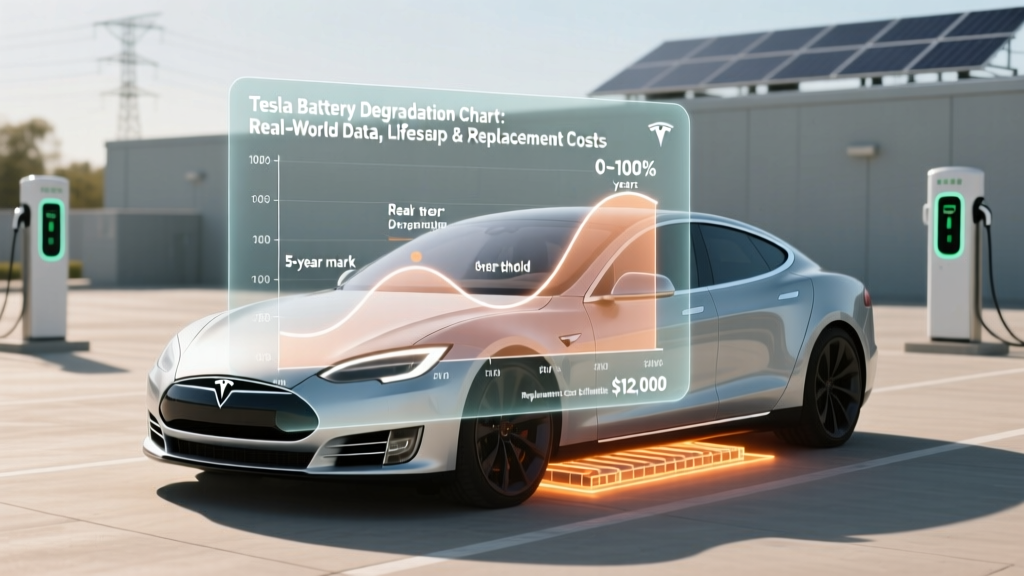
- Tesla Model 3/Y (NMC & LFP): ~5% loss at 50,000 mi; ~8–10% loss at 150,000 mi; ~12% at 200,000 mi (Tesla Impact Report).
- Hyundai Ioniq 5 / Kia EV6 (NMC, 800V): ~4% loss at 60,000 mi; ~9% at 150,000 mi (owner-reported via Hyundai app SoH).
- Nissan LEAF (passive-cooled NMC, older design): ~15–20% loss at 100,000 mi — an outlier driven by lack of active thermal management.
- Ford F-150 Lightning (LFP Extended Range): ~3–5% loss at 50,000 mi; projected ~10% at 200,000 mi based on LFP cycle-life models.
For context, the average U.S. vehicle is scrapped at roughly 180,000 miles and ~12 years of age (per S&P Global Mobility). A modern liquid-cooled pack reaching 80% State of Health (SoH) at 200,000+ miles will, in most cases, still be functional when the rest of the car is totaled or retired.
Battery Warranty Terms: What's Actually Covered
Federal mandate requires a minimum 8-year / 100,000-mile warranty on EV traction batteries (10 years / 150,000 miles in CARB states). Most manufacturers exceed this baseline with explicit capacity-retention thresholds.
| Manufacturer | Term | Capacity Threshold | Notes |
|---|---|---|---|
| Tesla (Model 3/Y LFP) | 8 yr / 120,000 mi | 70% SoH | Module-level replacement common |
| Tesla (Long Range/Plaid) | 8 yr / 120,000 mi | 70% SoH | NMC/NCA pack |
| Hyundai / Kia (E-GMP) | 10 yr / 100,000 mi | 70% SoH | Lifetime in some CARB states |
| Ford (Lightning / Mach-E) | 8 yr / 100,000 mi | 70% SoH | LFP and NMC packs covered equally |
| Rivian (R1T / R1S) | 8 yr / 175,000 mi | 70% SoH | Notably higher mileage cap |
| GM (Ultium platform) | 8 yr / 100,000 mi | 70% SoH | Blazer EV, Silverado EV, Cadillac Lyriq |
A "70% SoH threshold" means the manufacturer will repair or replace the pack if measured usable capacity falls below 70% of original within the warranty window. Note that warranty claims typically require dealer diagnostics confirming the loss isn't due to physical damage, flooding, or unauthorized modifications.
EV Battery Replacement Cost: Real Numbers, Real Context
Out-of-warranty replacement is the scenario that generates headlines — but it's also statistically uncommon for 2020+ vehicles with liquid cooling. When it is needed, costs vary dramatically by pack size and chemistry.
| Vehicle / Pack | Chemistry | Usable kWh | Parts Cost | Labor | Total Range |
|---|---|---|---|---|---|
| Tesla Model 3 RWD | LFP | ~57 kWh | $7,000–$9,000 | $1,500–$2,500 | $8,500–$11,500 |
| Tesla Model Y Long Range | NMC | ~75 kWh | $10,000–$13,000 | $1,800–$2,800 | $11,800–$15,800 |
| Hyundai Ioniq 5 AWD | NMC | ~77 kWh | $11,000–$14,000 | $2,000–$3,000 | $13,000–$17,000 |
| Ford F-150 Lightning Ext. | NMC | ~131 kWh | $20,000–$28,000 | $3,000–$4,500 | $23,000–$32,500 |
| Rivian R1T (Dual-Motor Max) | NMC | ~141 kWh | $22,000–$30,000 | $3,500–$5,000 | $25,500–$35,000 |
| Chevrolet Bolt EV (legacy) | NMC | ~65 kWh | $14,000–$16,000 (post-recall) | $2,000–$3,000 | $16,000–$19,000 |
Critical context: Most replacements happen after collision damage, not degradation. Catastrophic cell failure in liquid-cooled 2020+ packs is rare. Many independent shops now perform module-level repairs (replacing 1–2 defective modules rather than the full pack) for $3,000–$6,000, a growing alternative to full-pack swaps.
Factors That Accelerate (or Preserve) Battery Life
Degradation is not linear — and your habits matter more than calendar age. The physics of lithium-ion cells point to four primary stressors:
Battery Care Checklist for Maximum Longevity
- Avoid sustained 100% SoC (NMC/NCA only): Daily charging to 80% roughly doubles cycle life vs 100%. LFP owners can ignore this — charge to 100% weekly for BMS calibration.
- Minimize DC fast-charging frequency: Occasional road-trip fast-charging is fine; daily 350 kW sessions can add ~1–2% annual degradation vs Level 2 home charging (NREL study).
- Precondition before fast-charging in cold weather: Cold cells below 40°F charged at high power risk lithium plating — a permanent damage mechanism. Use the car's nav-to-charger preconditioning.
- Avoid long-term storage at low SoC: If parking for 2+ weeks, leave NMC at ~50% SoC and LFP at ~60%. Never store below 10%.
- Extreme heat exposure: Prolonged parking in 100°F+ ambient (common in Arizona, Nevada, inland California) accelerates calendar aging. Garage or shade parking measurably helps.
- Keep thermal management active: Don't disable preconditioning or "range mode" that limits cooling on hot days — the ~2% range gain isn't worth accelerated degradation.
Monitoring State of Health (SoH): What Owners Can Check
State of Health (SoH) is the percentage of original usable capacity remaining. A new pack is 100% SoH; a pack at 85% SoH holds 85% of its original kWh.
Owner-accessible SoH methods in 2026:
- Tesla: Service menu (hold model name on About screen for 3 seconds → enter "service" → Battery Health test). Takes ~24 hours of parked measurement.
- Hyundai / Kia / Genesis (E-GMP): Visible in the EV-specific section of the infotainment system or via the Bluelink/UVO app.
- Ford (Lightning, Mach-E): FordPass app shows SoH percentage; required for warranty claims.
- OBD-II third-party tools: Apps like OBDeleven, LeafSpy (Nissan), and Scan My Tesla read BMS-reported SoH directly. Accuracy depends on BMS calibration.
- Dealer diagnostic: Required for formal warranty claims; typically a 20-minute controlled discharge test.
Practical tip: Don't obsess over single-percentage SoH fluctuations — BMS calibration drifts by 1–3% seasonally. Track the 12-month trend, not the weekly reading.
Forward-Looking Tech: Solid-State and Silicon Anodes
Two next-generation technologies are often cited as the "next revolution" — but neither is broadly available in 2026 production vehicles.
Solid-state batteries replace the liquid electrolyte with a solid ceramic or polymer, promising 400+ Wh/kg energy density, faster charging, and reduced fire risk. Toyota has announced limited solid-state deployment in select 2027–2028 models (preliminary), and QuantumScape's cells are in validation with Volkswagen. Expect initial applications in luxury/flagship vehicles above $100,000 MSRP before mass-market rollout post-2030.
Silicon-anode cells (e.g., Sila Nanotechnologies, Group14) replace graphite anodes with silicon composites, boosting energy density 20–40% without the manufacturing overhaul of solid-state. These are already appearing in limited 2026 production (Mercedes G-Class EV, select Porsche applications) and will scale faster than solid-state.
For a 2026 buyer: neither technology should delay a purchase. Today's LFP and NMC packs already deliver 200,000+ mile lifespans, and waiting for solid-state means waiting 4+ years for mainstream availability.
FAQ: EV Battery Longevity and Cost
How long do EV batteries last in years and miles?
Modern liquid-cooled packs (2020+) typically retain 80–90% of original capacity at 150,000 miles and 12–15 years of age. LFP packs routinely exceed 3,000 charge cycles — equivalent to 500,000+ miles at 4 mi/kWh — before reaching 80% SoH. Calendar aging, not mileage, is often the limiting factor.
How much does an EV battery cost to replace out of warranty?
Full-pack replacement ranges from ~$8,500 (small LFP packs like Tesla Model 3 RWD) to $35,000 (large NMC packs like Rivian R1T Max). Module-level repairs at independent shops cost $3,000–$6,000 in most cases. The vast majority of owners never pay this — the car is retired or totaled first.
What does the battery warranty actually cover?
Standard coverage is 8 years / 100,000 miles (10/150k in CARB states) against capacity loss below 70% SoH, plus defects. It does not cover collision damage, flood damage, third-party modifications, or normal degradation above the 70% threshold.
How do I check my EV's battery health?
Most 2026 EVs surface SoH in the vehicle's service menu or companion app (Tesla service mode, FordPass, Hyundai Bluelink). OBD-II tools like OBDeleven or Scan My Tesla provide BMS-level readings. Dealer diagnostics are required for warranty claims.
LFP vs NMC — which chemistry should I choose?
Choose LFP if you prioritize longevity, low cost, and daily 100% charging convenience, and you don't regularly drive in sub-freezing weather or tow. Choose NMC/NCA if you need maximum range per kWh, frequent cold-weather driving, or peak fast-charging speeds for road trips. Both are excellent in 2026; the right answer depends on your climate and driving profile.
Does frequent DC fast-charging destroy the battery?
Not "destroy," but it does accelerate degradation. Daily 350 kW fast-charging can add 1–2% annual capacity loss vs home Level 2 charging. Occasional road-trip fast-charging has negligible long-term impact. Preconditioning and avoiding charging above 80% SoC on DC mitigates most of the effect.
Will solid-state batteries make today's EVs obsolete?
Not in the near term. Solid-state is expected in limited luxury applications in 2027–2028 and won't reach mainstream pricing until ~2030+. Today's LFP and NMC packs already deliver vehicle-lifetime durability — the limiting factor for most buyers is the rest of the car, not the battery.
Sources: fueleconomy.gov (EPA range and efficiency), Tesla Impact Report, NREL battery degradation study, manufacturer spec pages and warranty documentation. Tax-credit and incentive rules referenced from IRS §30D guidance. All figures reflect 2026 model-year data where available.