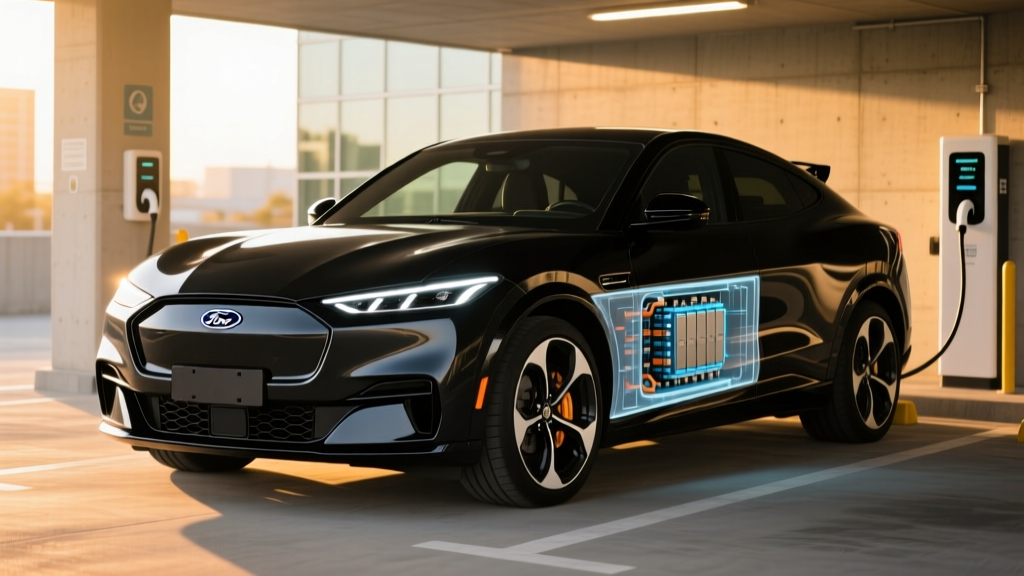
The Ford Mustang Mach-E remains one of the most popular mainstream electric SUVs on the road, and for owners and prospective buyers alike, one question consistently tops the list: how long will the battery actually last? With usable pack sizes ranging from 70 kWh to 91 kWh depending on model year and trim, the Mach-E's high-voltage traction battery represents the single most expensive component in the vehicle. Understanding its chemistry, real-world degradation trajectory, warranty coverage, and the habits that preserve—or erode—its capacity is essential for confident ownership.
This guide breaks down Ford Mustang Mach-E battery life with hard data, warranty specifics, replacement cost context, and actionable care strategies drawn from fleet telemetry, manufacturer specifications, and independent testing.
Mach-E Battery Chemistry: NMC Explained
Every model year of the Ford Mustang Mach-E uses an NMC (Nickel Manganese Cobalt) lithium-ion battery pack supplied primarily by LG Energy Solution. NMC chemistry was chosen for its high energy density, which allows Ford to package up to 91 kWh of usable capacity (Extended Range) into a relatively compact under-floor skateboard while keeping vehicle weight manageable.
NMC cells deliver excellent cold-weather performance compared to LFP (Lithium Iron Phosphate) alternatives and sustain higher peak charge rates at DC fast chargers. The trade-off is a somewhat shorter overall cycle life and a more pronounced degradation curve in the first 12–24 months before the curve flattens.
| Attribute | NMC (Mach-E) | LFP (e.g., Tesla Model 3 RWD) |
|---|---|---|
| Energy Density | High (~250 Wh/kg cell-level) | Moderate (~180 Wh/kg cell-level) |
| Typical Cycle Life | 1,000–2,000 full cycles | 3,000–5,000+ full cycles |
| Cold-Weather Performance | Better low-temp capacity retention | Greater range loss below 32°F |
| Peak DC Fast Charge Rate | Up to 150 kW (Extended Range) | Typically 170 kW but limited SoC window |
| Recommended Daily SoC | 80% for daily use | 100% acceptable (Ford/Tesla guidance) |
| Cost per kWh (pack-level) | Higher (~$130–$150) | Lower (~$100–$120) |
| Cobalt Content | Yes (supply-chain consideration) | None |
The practical takeaway: NMC gives the Mach-E its competitive EPA range figures—up to 320 miles on the California Route 1 Extended Range RWD trim per fueleconomy.gov—but it demands more thoughtful charging habits than LFP to maximize long-term health.
How Long Do Ford Mustang Mach-E Batteries Last?
Based on fleet data, owner reports aggregated by EV tracking platforms, and Ford's own engineering targets, the Mach-E's NMC battery pack is designed to retain at least 70% of its original capacity over 8 years or 100,000 miles—which is the federal warranty minimum that Ford meets. In practice, most Mach-E batteries are outperforming this floor significantly.
Real-world degradation data compiled from owner-reported telemetry on platforms like Recurrent Auto and Geotab shows the following trajectory for liquid-cooled NMC packs similar to the Mach-E's:
- Year 1 (0–15,000 mi): ~2–4% capacity loss (initial settling phase)
- Year 2–3 (15,000–45,000 mi): ~1–2% additional loss per year (curve flattens)
- Year 4–5 (45,000–75,000 mi): ~1% per year (steady-state degradation)
- Year 6–8 (75,000–120,000 mi): ~0.5–1% per year
- Projected at 150,000 miles: ~85–90% State of Health (SoH) for well-maintained packs
A 2021 Mach-E Extended Range that started with 91 kWh usable and has been driven 60,000 miles with predominantly Level 2 home charging and occasional DC fast charging would typically show approximately 88–91% SoH—meaning roughly 80–83 kWh still usable. That translates to an EPA-adjusted real-world range dropping from ~320 miles to approximately ~280–295 miles. Noticeable, but far from debilitating.
Ford's Battery Warranty: What's Covered and What Isn't
Ford provides a dedicated high-voltage battery warranty that exceeds the powertrain warranty in duration. Here are the exact terms for the Mustang Mach-E:
| Component | Coverage Period | Mileage Limit | Details |
|---|---|---|---|
| High-Voltage Battery | 8 years | 100,000 miles | Capacity retention below 70% of original; defects in materials/workmanship |
| Electric Powertrain Components | 5 years | 60,000 miles | Motor, inverter, onboard charger, reduction gear |
| Battery Coolant System | 5 years | 60,000 miles | Thermal management pump, lines, coolant |
The critical threshold is 70% capacity retention. If your Mach-E's battery drops below 70% SoH within the 8-year/100,000-mile window, Ford is obligated to repair or replace the pack to bring it above that threshold. This does not mean you get a brand-new battery—Ford may replace individual modules (the Mach-E pack contains multiple modules that can be serviced independently) rather than the entire pack.
What the warranty does not cover:
- Gradual capacity loss above the 70% threshold (considered normal wear)
- Damage from accidents, flooding, or improper modifications
- Range reduction from cold weather or driving style (this is physics, not a defect)
- The 12V auxiliary battery (covered under the standard 3-year/36,000-mile bumper-to-bumper warranty, not the HV battery warranty)
Owners in California Air Resources Board (CARB) states—including California, New York, Massachusetts, and several others—may benefit from extended emissions-related warranty provisions that can extend battery coverage to 10 years/150,000 miles under certain conditions. Check your state's specific CARB adoption status and your warranty booklet for applicability.
Mach-E Battery Replacement Cost: What to Expect
Here is the number that causes the most anxiety—and the most misunderstanding. Let's put it in context with actual figures.
| Scenario | Pack Size | Estimated Cost (Parts + Labor) | Likelihood |
|---|---|---|---|
| Full Pack Replacement (Out of Warranty) | 70 kWh (Standard Range) | $14,000–$18,000 | Very rare before 150,000+ mi |
| Full Pack Replacement (Out of Warranty) | 91 kWh (Extended Range) | $18,000–$24,000 | Very rare before 150,000+ mi |
| Single Module Replacement | Varies | $2,500–$5,000 | More common; addresses localized cell failure |
| Under Warranty Replacement | Any | $0 to owner | If SoH drops below 70% within 8yr/100k mi |
The critical context: complete battery pack replacement on a Mach-E is extremely uncommon within the vehicle's normal ownership lifecycle. Data from Geotab's fleet analysis of over 10,000 EVs shows that the average EV battery loses only about 2.3% of capacity per year, meaning most packs will retain 80%+ capacity at the 10-year mark. The Mach-E's active liquid thermal management system further protects against the accelerated degradation seen in older, passively-cooled EVs.
When replacements do occur outside of warranty, they are most often triggered by physical damage (collision, ground strike), manufacturing defects that surface late, or coolant system failures that allow thermal damage—rather than simple age-related degradation. Module-level repairs are far more common and far more affordable than full pack swaps.
Factors That Accelerate (or Preserve) Mach-E Battery Health
Not all miles are created equal when it comes to battery wear. The following factors have measurable, data-backed impacts on NMC cell longevity:
High-Frequency DC Fast Charging
DC fast charging at 150 kW generates significant heat within the cells. The Mach-E's liquid cooling system actively manages this, but repeated sessions—especially in hot climates—accelerate electrolyte decomposition and increase internal resistance. Guideline: Use DC fast charging for road trips and rely on Level 2 (7–11 kW) for daily charging. Owners who fast-charge more than 3 times per week show measurably higher degradation rates in fleet data.
State of Charge Habits
NMC cells experience the most stress at the extremes—below 10% and above 90% SoC. Storing the vehicle at 100% for extended periods (days or weeks) is more damaging than driving to 100% and immediately using it. Ford's infotainment system allows you to set a charge target limit—set it to 80% for daily driving and only charge to 100% when you need maximum range for a trip.
Extreme Temperature Exposure
Repeated exposure to ambient temperatures above 95°F or below 10°F without preconditioning accelerates calendar aging. The Mach-E's thermal management system will actively heat or cool the battery, but this draws energy. Best practice: Plug in during extreme weather so the thermal system draws from grid power rather than the battery itself. Use the FordPass app to precondition the cabin and battery while still plugged in.
Deep Discharge Cycles
Regularly driving the battery below 10% SoC stresses NMC chemistry. Unlike LFP, which tolerates deep cycles better, NMC benefits from partial cycles. Keeping the battery between 20% and 80% for daily use is the optimal longevity window.
- Set daily charge limit to 80% via FordPass or in-vehicle settings
- Use Level 2 home charging as your primary method
- Limit DC fast charging to road trips or when genuinely needed
- Precondition the battery in extreme cold (plug in and use FordPass scheduling)
- Avoid leaving the vehicle at 100% SoC for more than a few hours
- Don't routinely drive below 10%—charge before you hit that threshold
- Keep the vehicle plugged in during extreme heat waves so thermal management runs on grid power
- Update SYNC and battery management system (BMS) firmware when Ford releases updates
How to Check Your Mach-E Battery State of Health
Ford does not display a precise SoH percentage on the Mach-E's dashboard, which frustrates many owners. However, there are several reliable methods to monitor your battery's health:
FordPass App: Recent software updates have added battery health indicators in the FordPass vehicle health section. While not a granular percentage, it will flag if capacity has dropped below warranty thresholds.
OBD-II Diagnostic Tools: Third-party OBD-II readers paired with apps like Car Scanner or FORScan (a Ford-specific diagnostic tool) can read the BMS-reported SoH value directly from the vehicle's CAN bus. FORScan in particular can pull detailed cell-level voltage data, total charge/discharge cycles, and pack-level capacity figures. A basic ELM327-compatible OBD-II adapter costs $20–$40, and FORScan offers a free basic license.
Dealer Diagnostic Report: Request a battery health report during any service visit. Ford dealers can run a full BMS diagnostic and provide a printout showing SoH percentage, individual module voltage balance, and any fault codes. This is especially valuable before purchasing a used Mach-E.
Manual Range Tracking: Track your real-world miles per kWh over time. A new Mach-E Extended Range AWD should average approximately 3.0–3.3 mi/kWh in mixed driving. If you're consistently seeing 2.5 mi/kWh or lower in similar conditions after the vehicle's first year, that may indicate above-average degradation (or simply a change in driving patterns—rule that out first).
Looking Ahead: Solid-State and Next-Gen Battery Technology
The EV battery landscape is evolving, and Ford has invested heavily in next-generation cell technology through partnerships and its BlueOval SK joint venture with SK On. Here is where emerging tech stands as of 2026:
Silicon-dominant anode batteries: Companies like Sila Nanotechnologies and Group14 are producing silicon-anode cells that offer 10–20% higher energy density than current graphite-anode NMC. These are entering production in select applications but are not yet in any shipping Ford vehicle. Expect potential adoption in refreshed or next-generation Ford EVs in the 2027–2029 timeframe.
Solid-state batteries: Solid-state technology replaces the liquid electrolyte with a solid conductor, promising higher energy density, faster charging, and improved safety. Toyota has announced limited production for 2027–2028, and Ford has not committed to a solid-state timeline. Realistically, solid-state packs will not appear in mainstream Ford vehicles before 2030 at the earliest, and initial costs will be high.
LFP adoption by Ford: Ford has begun incorporating LFP cells in some lower-cost models and trims to reduce reliance on cobalt and nickel. A future base-trim Mach-E or successor could potentially use LFP, which would mean longer cycle life but lower range per charge due to reduced energy density.
For current Mach-E owners, these developments are forward-looking context—not a reason to delay a purchase or fear your existing battery. NMC technology is mature, well-understood, and proven to deliver reliable service over hundreds of thousands of miles when properly maintained.
Frequently Asked Questions
How long do Ford Mustang Mach-E batteries last in years and miles?
Based on fleet data and degradation modeling, a well-maintained Mach-E NMC battery should retain 85–90% of its original capacity at 150,000 miles (roughly 10–12 years of average driving). Ford warrants the battery to retain at least 70% capacity over 8 years or 100,000 miles. Most packs will outlast the vehicle's useful life as a primary daily driver.
How much does it cost to replace a Mustang Mach-E battery?
A full out-of-warranty pack replacement runs $14,000–$24,000 depending on whether you have the 70 kWh Standard Range or 91 kWh Extended Range pack. However, full replacements are extremely rare. Module-level repairs cost $2,500–$5,000, and any failure dropping capacity below 70% within the 8-year/100,000-mile window is covered at no cost. Per IRS guidelines, if a battery replacement is needed, the new battery's sourcing may affect eligibility for credits if you were to purchase a new EV instead.
What does the Mach-E battery warranty actually cover?
Ford covers the high-voltage battery for 8 years or 100,000 miles against defects and capacity loss below 70% of original capacity. This includes cell failures, module imbalances, and BMS defects. It does not cover normal gradual degradation above 70%, physical damage, or the 12V auxiliary battery.
Does frequent DC fast charging hurt the Mach-E battery?
Yes, in measurable but manageable amounts. Every DC fast charge session at 150 kW generates cell heat that the liquid cooling system must manage. Occasional fast charging (1–2 times per week) has minimal long-term impact. Daily fast charging, especially in hot climates, measurably accelerates degradation. Use Level 2 home charging as your primary method.
Is LFP better than the NMC battery in my Mach-E?
It depends on priorities. LFP offers longer cycle life (3,000–5,000+ cycles vs. 1,000–2,000 for NMC), no cobalt, and tolerance for 100% daily charging. NMC offers higher energy density (more range in the same space), better cold-weather performance, and higher sustained fast-charge rates. For a vehicle like the Mach-E that prioritizes range and performance, NMC is the appropriate chemistry. For a commuter car where range demands are modest, LFP may be preferable.
Should I charge my Mach-E to 100% every night?
No. For NMC chemistry, daily charging to 80% is optimal for longevity. Charge to 100% only when you need maximum range for a trip, and try to time it so you depart shortly after reaching full charge rather than letting the vehicle sit at 100% SoC for hours or days.
Can cold weather permanently damage my Mach-E battery?
Cold weather temporarily reduces range (20–30% in sub-freezing conditions) and slows charging speeds—this is reversible and not damage. The Mach-E's thermal management system actively heats the battery to protect it. However, charging a frozen battery without preconditioning can cause lithium plating, which is permanent damage. Always precondition in cold weather, ideally while plugged in.