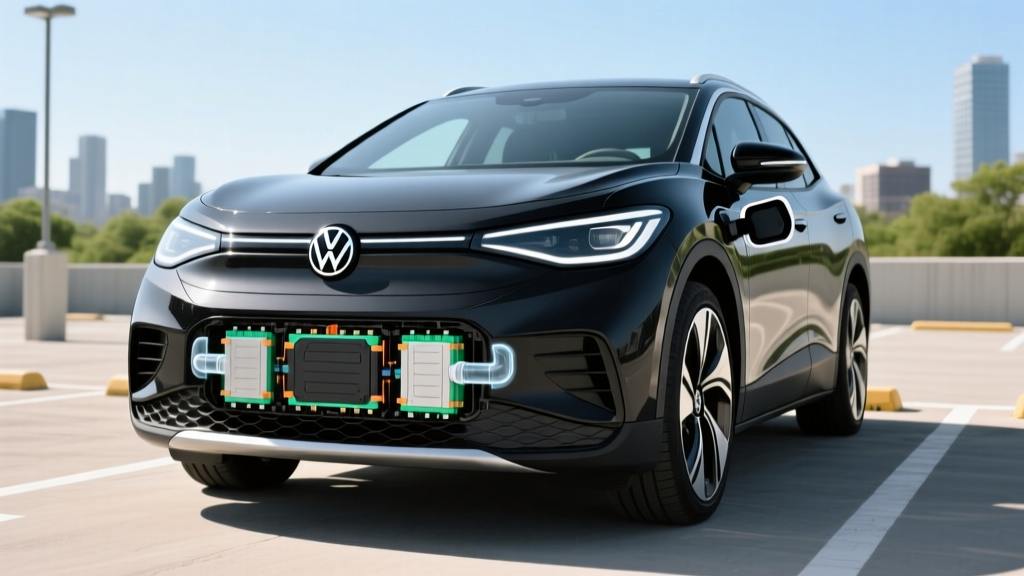
If you landed here searching for a Ford Fusion key fob battery replacement, you're probably holding a dead fob and a car that won't unlock. We'll fix that in about three minutes and roughly five dollars. But because many Fusion owners are also cross-shopping plug-in hybrids like the Ford Escape PHEV or full EVs like the Mustang Mach-E, we're also going to cover the bigger battery question: what happens to the high-voltage traction battery over 10 years and 150,000 miles?
This guide tackles both — the literal key fob fix, and the EV battery technology deep-dive that actually matters when you're deciding whether to go electric.
Ford Fusion Key Fob Battery Replacement: The 3-Minute Fix
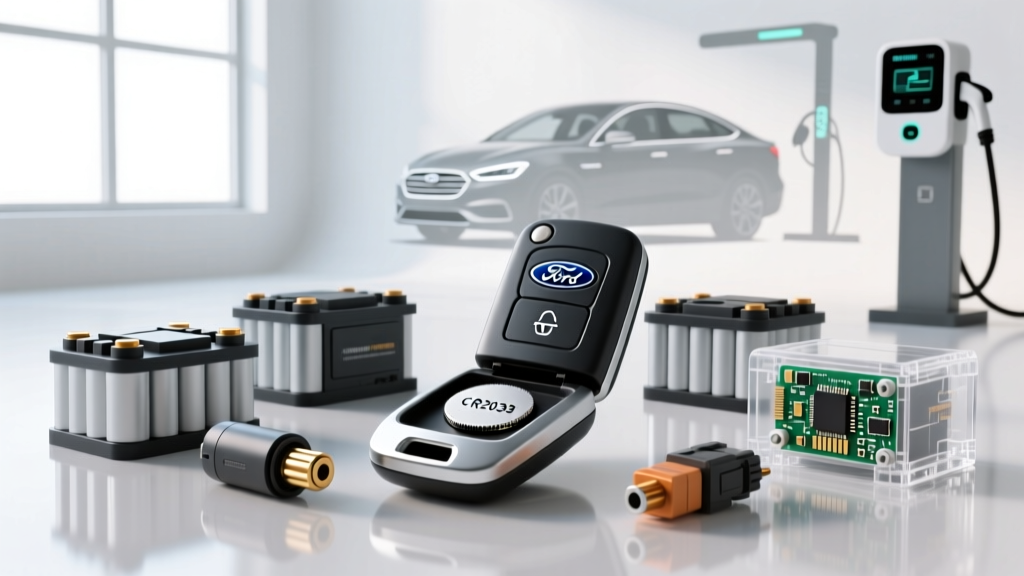
The Ford Fusion (including the Fusion Hybrid and Fusion Energi PHEV, last sold in the U.S. as a 2020 model) uses the standard Ford intelligent access fob. Here's the exact spec you need:
- Battery type: CR2032 (3V lithium coin cell)
- Cost: $3–$7 for a name-brand cell (Energizer, Panasonic, Duracell)
- Tools: Small flathead screwdriver or a coin
- Time: 2–3 minutes
Step-by-step
- Remove the physical key blade from the fob (slide the release latch and pull).
- Insert a small flathead into the slot where the key blade was and gently twist to pop the fob halves apart.
- Lift out the old CR2032. Note the orientation — the positive (+) side faces up.
- Insert the new CR2032, positive side up, and press it flat.
- Snap the fob halves back together and reinsert the key blade.
- Test lock/unlock and push-button start.
EV Traction Batteries: Chemistry, Degradation, and What Owners Should Know
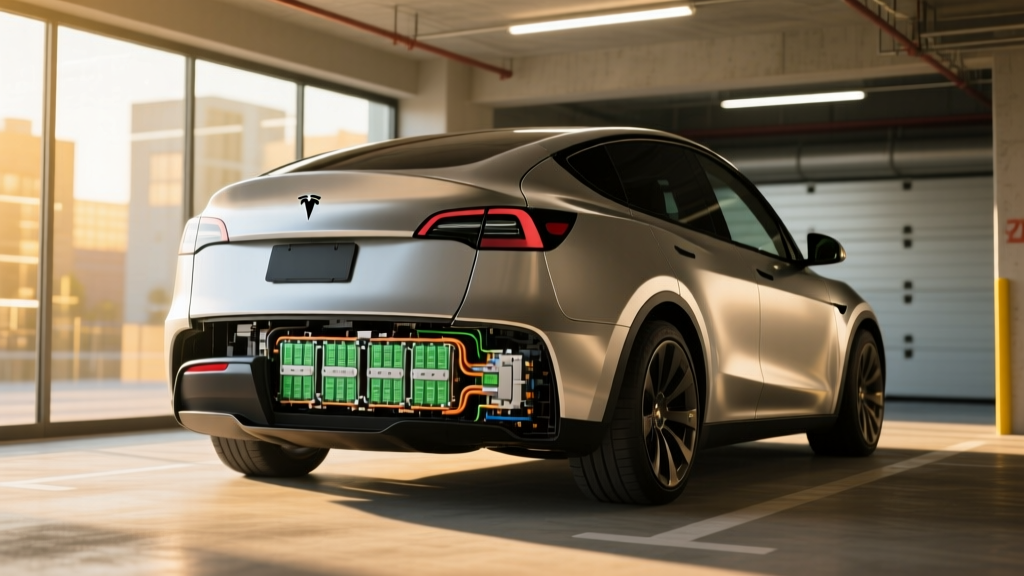
Now to the battery that actually propels the car. Whether you're looking at a Mustang Mach-E, an F-150 Lightning, a Tesla Model Y, or a Hyundai Ioniq 5, the high-voltage traction battery is the single most expensive component in the vehicle. Understanding its chemistry, how it degrades, and what warranty protects it is essential for any electrified-vehicle buyer in 2026.
LFP vs NMC/NCA: The Chemistry Decision
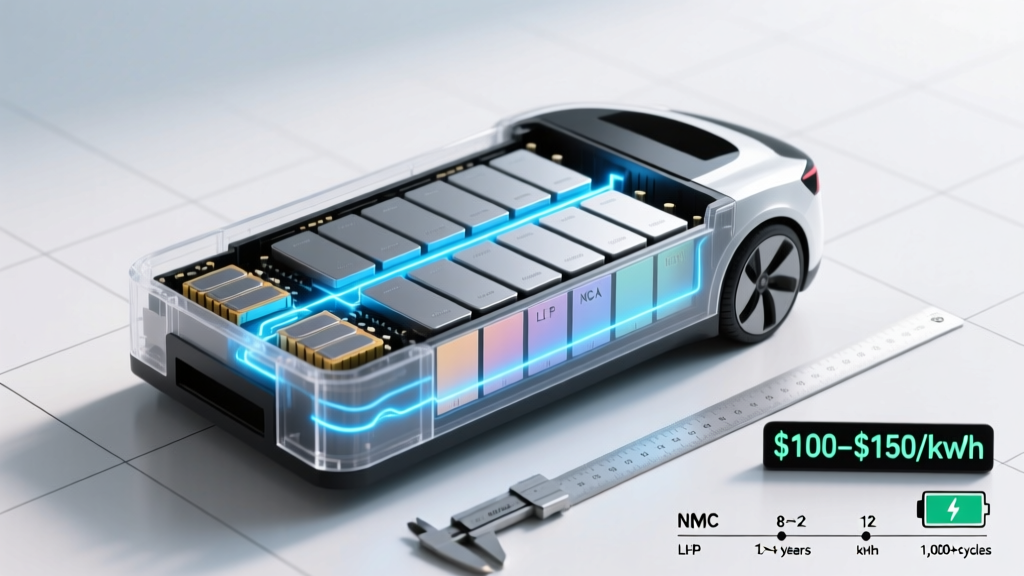
Two lithium-ion chemistries dominate the 2026 EV market: LFP (lithium iron phosphate) and NMC/NCA (nickel manganese cobalt / nickel cobalt aluminum). Tesla, Ford, BYD, and several Chinese-market exporters now offer LFP in standard-range trims, while NMC/NCA remains the choice for long-range and performance models.
| Attribute | LFP (Lithium Iron Phosphate) | NMC / NCA |
|---|---|---|
| Energy density | ~160–180 Wh/kg (lower) | ~230–300 Wh/kg (higher) |
| Cycle life | 3,000–5,000+ cycles | 1,000–2,000 cycles |
| Cold-weather performance | Weaker — slower charging below 32°F | Better low-temp conductivity |
| Thermal stability / safety | Excellent — less prone to thermal runaway | Good, but requires more active cooling |
| Cost per kWh (2026) | ~$80–$100 | ~$110–$140 |
| State-of-charge recommendation | Can charge to 100% daily (helps BMS calibration) | Best kept 20–80% for daily use |
| Typical use case | Standard-range, fleet, high-mileage | Long-range, performance, cold-climate |
Bottom line: If you commute 40 miles a day, charge at home, and want a battery that will likely outlast the car, LFP is the pragmatic pick. If you need 320+ miles of EPA range, tow frequently, or live in sub-zero winters, NMC/NCA delivers the energy density you need.
How Long Do EV Batteries Actually Last?
The fear that EV batteries "need replacing every 5 years" is not supported by fleet data. According to fueleconomy.gov and long-term fleet studies from Recurrent and Geotab, most modern liquid-cooled EV batteries retain 85–92% of original capacity after 100,000 miles.
Here's what the degradation curve actually looks like based on aggregated fleet data:
| Milestone | Average Capacity Retained | Real-World Range Impact (300-mi EPA pack) |
|---|---|---|
| Year 1 / 15,000 mi | 95–97% | ~285–291 mi |
| Year 3 / 45,000 mi | 92–95% | ~276–285 mi |
| Year 5 / 75,000 mi | 89–93% | ~267–279 mi |
| Year 8 / 120,000 mi | 85–90% | ~255–270 mi |
| Year 12 / 180,000 mi | 78–86% | ~234–258 mi |
Key observations: degradation is steepest in the first 12–18 months (roughly 3–5% loss as the solid electrolyte interphase stabilizes), then flattens to about 1–2% per year. LFP packs tend to show even slower mid-life degradation due to their more stable cathode structure.
What Does the EV Battery Warranty Cover?
Federal law in the U.S. mandates that EV batteries carry a minimum warranty of 8 years / 100,000 miles. In California Air Resources Board (CARB) states, that extends to 10 years / 150,000 miles. Most automakers meet or exceed these minimums.
| Manufacturer | Warranty Term | Capacity Retention Threshold |
|---|---|---|
| Tesla (Model Y / 3 NMC) | 8 yr / 120,000 mi | 70% |
| Tesla (Model Y / 3 LFP) | 8 yr / 100,000 mi | 70% |
| Ford (Mustang Mach-E) | 8 yr / 100,000 mi | 70% |
| Hyundai / Kia (Ioniq 5 / EV6) | 10 yr / 100,000 mi | 70% |
| GM (Chevy Equinox EV / Blazer EV) | 8 yr / 100,000 mi | 70% (60% for fleet) |
| BMW (iX / i4) | 8 yr / 100,000 mi | 70% |
| Rivian (R1T / R1S) | 8 yr / 175,000 mi | 70% |
The warranty covers defects and excessive capacity loss — meaning if your battery drops below the stated threshold (usually 70% of original kWh) within the term, the manufacturer must repair or replace it at no cost. It does not cover damage from collisions, flooding, or unauthorized modifications.
How Much Does an EV Battery Replacement Cost?
Out-of-warranty replacement is the scenario that generates the most anxiety. Here are real-world replacement cost ranges for 2026, based on manufacturer service bulletins and third-party repair networks:
| Vehicle | Battery Size | Chemistry | Replacement Cost (Parts + Labor) |
|---|---|---|---|
| Nissan Leaf (40 kWh) | 40 kWh | NMC | $6,500–$9,000 |
| Chevy Bolt EV / EUV | 65 kWh | NMC | $9,000–$14,000 |
| Tesla Model 3 (LFP) | 60 kWh | LFP | $8,000–$12,000 |
| Tesla Model Y (NMC) | 75 kWh | NMC | $12,000–$16,000 |
| Ford Mustang Mach-E (Extended Range) | 91 kWh usable | NMC | $15,000–$22,000 |
| Ford F-150 Lightning (Extended Range) | 131 kWh usable | NMC | $20,000–$30,000 |
| Hyundai Ioniq 5 | 77.4 kWh | NMC | $12,000–$18,000 |
| Rivian R1T (Large Pack) | 128 kWh | NMC | $20,000–$28,000 |
Context that matters: battery pack prices have fallen from over $1,000/kWh in 2010 to roughly $100–$140/kWh in 2026, per BloombergNEF. Module-level repairs (replacing a single degraded module rather than the full pack) are increasingly common at specialized EV shops and can cut costs by 60–70%. Full pack replacement is typically only needed after severe physical damage or widespread cell failure well beyond 200,000 miles.
Factors That Accelerate (or Slow) Battery Degradation
Battery aging is driven by three forces: temperature, charge state, and charge speed. Here's how to manage each:
- Daily charging limit: Set to 80% for NMC/NCA packs; LFP packs can (and should) be charged to 100% at least weekly for BMS calibration.
- Avoid prolonged 100% SoC: Don't charge to 100% and let the car sit for days. Charge to 100% only when you'll drive within a few hours.
- DC fast charging: Occasional use is fine. Daily DCFC (especially above 150 kW on packs not designed for it) can accelerate degradation by 1–3% over 100,000 miles versus Level 2 charging.
- Extreme heat: Avoid leaving the car at high SoC in 95°F+ heat for extended periods. Use preconditioning and garage parking when possible.
- Extreme cold: Plug in and precondition in sub-freezing weather. Cold charging without preconditioning forces the battery management system to limit charge rate, which is protective but slow.
- Storage: If storing for weeks, leave the battery at ~50% SoC and plugged in (the car will maintain the buffer).
- Regen braking: Moderate regen settings don't meaningfully affect battery life. Max regen is fine for the battery — the BMS manages charge acceptance.
How to Check Your EV Battery Health (State of Health)
State of Health (SoH) is the metric that tells you what percentage of original capacity your battery can still hold. Here's how to monitor it:
- In-car displays: Tesla, Hyundai/Kia, BMW, and Rivian show estimated range and, in some cases, a battery health percentage in the settings menu.
- OBD-II dongles + apps: Tools like OBDeleven, Leaf Spy (Nissan Leaf), or Scan My Tesla can read the BMS-reported SoH directly.
- Recurrent / fleet analytics: Services like Recurrent (free for owners) track your battery's degradation curve over time and compare it to a fleet average.
- Dealer diagnostic: Any authorized service center can pull a full BMS health report — ask for it during routine service.
A healthy EV that's 3 years old should show 92–96% SoH. If you're seeing below 88% at 50,000 miles, that's worth a warranty investigation.
What's Next: Solid-State and Silicon Anode Batteries
Two emerging technologies are frequently mentioned as "next-gen" battery solutions. Here's where they actually stand in 2026:
Solid-state batteries replace the liquid electrolyte with a solid material (sulfide, oxide, or polymer), promising higher energy density (~400–500 Wh/kg at the cell level), faster charging, and improved safety. Toyota has announced limited production of solid-state-equipped EVs for 2027–2028, and Samsung SDI and QuantumScape have demonstrated prototype cells. However, no solid-state EV is currently available for purchase, and cost, manufacturing scale, and cycle-life durability remain unresolved for mass production. Realistic widespread availability: 2029–2032.
Silicon anode batteries replace graphite anodes with silicon-dominant composites, increasing energy density by 20–40%. Companies like Sila Nanotechnologies and Group14 are supplying silicon anode materials to automakers now. The Mercedes-AMG EQG (G-Wagen EV) uses a silicon anode pack. Expect this technology to expand into mainstream models by 2027–2028, primarily in premium and performance segments first.
Frequently Asked Questions
How long do EV batteries last in years and miles?
Most liquid-cooled EV batteries from 2020 onward are designed to last 15–20 years or 200,000+ miles before dropping below 70% capacity. Fleet data from Geotab and Recurrent shows average annual degradation of 1–2% after the initial break-in period. The battery will likely outlast other major vehicle components.
How much does an EV battery cost to replace?
Full pack replacement ranges from $6,500 (small packs like the Nissan Leaf) to $30,000 (large packs like the F-150 Lightning Extended Range). However, most EVs will never need a full replacement — module-level repairs at $2,000–$5,000 are more common, and warranty coverage protects against early failures.
What does the EV battery warranty actually cover?
Federal minimum is 8 years / 100,000 miles (10/150,000 in CARB states). Coverage applies if capacity drops below the stated threshold (typically 70%). It does not cover accident damage, flooding, or abuse. Some manufacturers (Hyundai, Rivian) exceed the federal minimum.
How do I check and maximize my EV battery health?
Monitor SoH through in-car displays, OBD-II apps, or services like Recurrent. Maximize life by keeping NMC packs between 20–80% SoC for daily use, avoiding prolonged high-SoC storage in heat, preconditioning before DC fast charging, and using Level 2 home charging as your primary method.
LFP vs NMC — which battery chemistry is better?
Neither is universally better. LFP offers longer cycle life (3,000–5,000 cycles), lower cost (~$80–100/kWh), and better thermal safety, but lower energy density and weaker cold-weather charging. NMC delivers higher range per kWh and better cold performance, at higher cost and shorter cycle life. Choose LFP for daily commuting and high mileage; choose NMC for maximum range and cold-climate driving.
Does frequent DC fast charging damage the battery?
Occasional DCFC (1–2 times per week) causes negligible additional degradation in modern liquid-cooled packs. Daily DCFC at high power (150+ kW) without preconditioning can add 1–3% extra degradation over 100,000 miles. Preconditioning the battery before charging — which most EVs do automatically when you navigate to a charger — significantly reduces this impact.
What's the difference between the 12V battery and the traction battery?
Every EV has two batteries: a small 12V auxiliary battery (like a conventional car battery) that powers lights, infotainment, and door locks, and the large high-voltage traction battery (40–131+ kWh) that drives the motor. The 12V battery may need replacement every 3–5 years ($150–$400). The traction battery is what the warranty covers and what this guide focuses on. Your Ford Fusion key fob battery (CR2032) is a third, separate battery that powers only the remote.
Sources: U.S. Department of Energy / fueleconomy.gov, IRS §30D Clean Vehicle Credit, manufacturer warranty documentation (Ford, Tesla, Hyundai, GM).