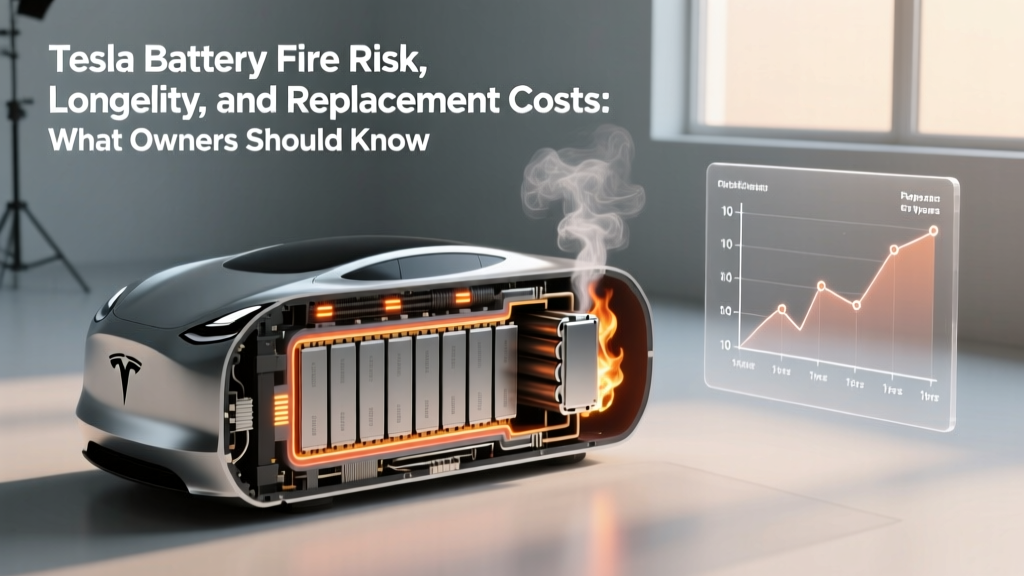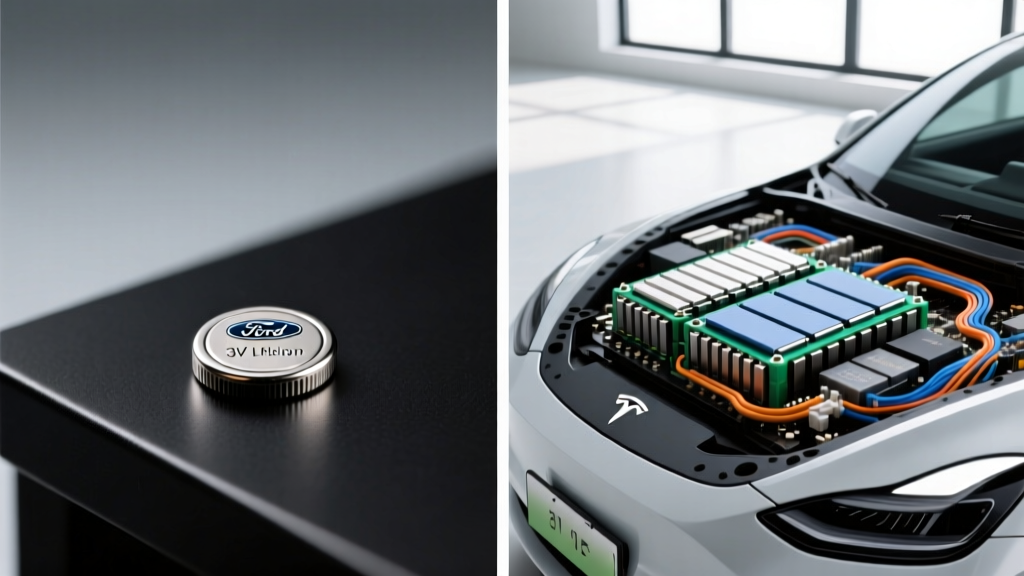
If you've ever had to swap out the CR2032 coin cell in a Ford Fusion key battery fob, you already understand the basic principle: batteries degrade, lose capacity, and eventually need replacement. That 3-volt coin cell powers a keyless entry transmitter for roughly two to three years before it dies. But when the conversation shifts from a $4 key fob battery to the 80+ kWh high-voltage traction battery powering a modern electric vehicle, the stakes — and the science — change dramatically.
This guide bridges that gap. We'll cover what makes EV batteries tick, how chemistries like LFP and NMC differ, what degradation actually looks like in real-world data, how warranties protect you, and when (or if) you'll face a replacement bill. Whether you're cross-shopping your first EV or optimizing the one you own, these are the numbers that matter.
The 12V vs. High-Voltage Distinction: Why Your Key Fob Battery Isn't the Same Animal
Before we get into traction battery chemistry, let's clear up a common confusion. Every EV still carries a 12-volt auxiliary battery — much like the one in a gas-powered Ford Fusion — that powers accessories, lights, infotainment, and yes, receives the signal from your key fob. If your Ford Fusion Energi (Ford's plug-in hybrid variant, discontinued after 2020) won't unlock, the issue is likely the key fob's CR2032 coin cell or the car's 12V auxiliary battery, not the high-voltage traction pack.
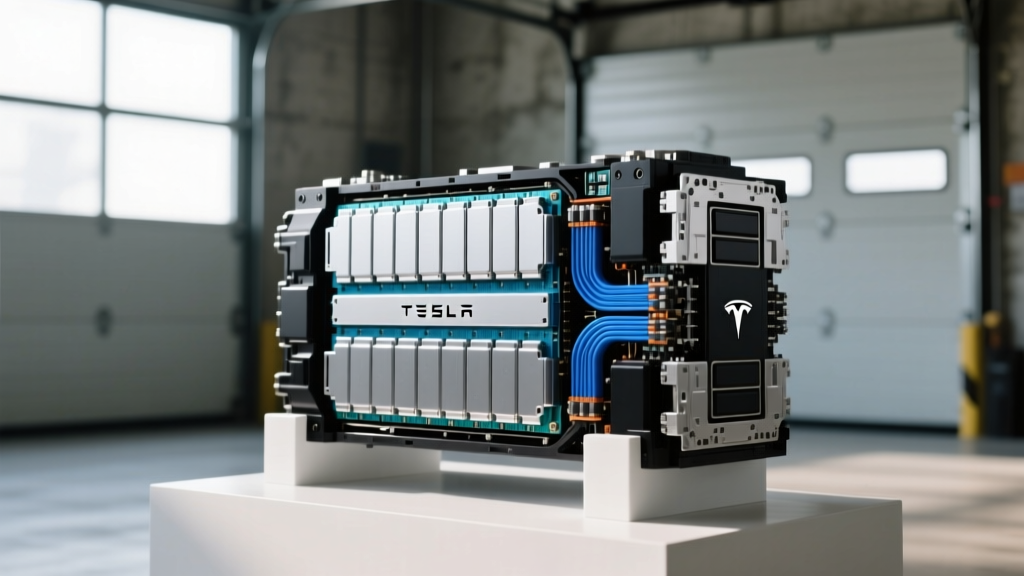
The high-voltage traction battery is an entirely different system. It operates at 400V (or 800V in vehicles like the Hyundai Ioniq 5 and Kia EV6), stores between 40 and 130+ kWh of energy depending on the vehicle, and is responsible for propulsion. This is the battery we're analyzing in depth below. The two systems share almost no components and have entirely different degradation profiles, replacement costs, and warranty coverage.
Battery Chemistry Explained: LFP vs. NMC/NCA Trade-Offs
The two dominant lithium-ion chemistries in 2026 EVs are NMC/NCA (nickel manganese cobalt / nickel cobalt aluminum) and LFP (lithium iron phosphate). Each has distinct engineering trade-offs that affect range, longevity, cost, and cold-weather behavior.
| Attribute | LFP (Lithium Iron Phosphate) | NMC / NCA (Nickel-Based) |
|---|---|---|
| Energy Density | Lower (~160-180 Wh/kg cell-level) | Higher (~220-260 Wh/kg cell-level) |
| Typical Use Case | Standard-range / budget models (Tesla Model 3 RWD, Ford Mustang Mach-E Select base) | Long-range / performance models (Model 3 LR, Mach-E GT, most 300+ mi EVs) |
| Cycle Life | 3,000-5,000+ full cycles to 80% SoH | 1,000-2,000 full cycles to 80% SoH |
| Cold-Weather Performance | Moderate range loss; slower charge acceptance below freezing without preconditioning | Better low-temp charge acceptance; still loses 20-30% range in deep cold |
| Recommended SoC for Daily Use | 100% daily charging is fine (flat voltage curve) | 80% daily recommended; 100% for road trips only |
| Cost per kWh (pack-level) | ~$90-110 (2026 estimates) | ~$120-145 (2026 estimates) |
| Cobalt Content | Zero | Varies; trending toward low-cobalt formulations |
| Thermal Stability | Higher thermal runaway threshold (~270°C) | Lower threshold (~210°C); requires more robust BMS cooling |
Which is better? There's no universal answer. If you prioritize maximum range per charge and don't mind capping daily charging at 80%, NMC delivers more miles from a lighter, more compact pack. If you want a battery that tolerates daily 100% charging, lasts longer in cycle count, and costs less upfront — and you can accept 250 miles instead of 340 — LFP is the pragmatic choice. Tesla, BYD, and Ford have all expanded LFP usage in standard-range trims through 2025-2026 for exactly these reasons.
How Long Do EV Batteries Actually Last? Degradation Data
The short answer: far longer than most buyers fear. Real-world fleet data from sources including fueleconomy.gov and independent analyses show that modern EV batteries lose roughly 1-2% of total capacity per year under normal use. The degradation curve is not linear — it's steepest in the first year or two (roughly 2-4% initial loss as the solid electrolyte interface stabilizes), then flattens significantly.
- Year 1: ~2-3% loss (97-98% SoH)
- Year 3: ~5-7% cumulative loss (93-95% SoH)
- Year 5: ~8-10% cumulative loss (90-92% SoH)
- Year 8: ~10-14% cumulative loss (86-90% SoH)
- Year 10: ~12-18% cumulative loss (82-88% SoH)
Source: Geotab fleet data (6,300+ EVs), Recurrent Auto battery health reports. LFP packs typically show slower mid-life degradation but may exhibit a slightly steeper initial drop.
At the 200,000-mile mark — where many gas cars are nearing end-of-life — most well-maintained EV batteries retain 80-88% of original capacity. A vehicle that started with 320 miles of EPA-rated range would still deliver roughly 260-280 miles. That's not a crisis; it's a modest reduction that most owners absorb without changing their routines.
What Does the Battery Warranty Actually Cover?
Federal law (EPA emissions-related warranty requirements) effectively mandates that automakers provide a minimum of 8 years / 100,000 miles of battery warranty coverage. California Air Resources Board (CARB) states push this to 10 years / 150,000 miles. Most manufacturers meet or exceed these thresholds voluntarily nationwide.
| Manufacturer / Model | Warranty Period | Mileage Cap | Capacity Retention Threshold |
|---|---|---|---|
| Tesla Model 3 / Model Y (NMC Long Range) | 8 years | 120,000 mi | 70% of original capacity |
| Tesla Model 3 RWD (LFP) | 8 years | 100,000 mi | 70% |
| Ford Mustang Mach-E | 8 years | 100,000 mi | 70% |
| Hyundai Ioniq 5 / Ioniq 6 | 10 years | 100,000 mi | 70% |
| Chevrolet Equinox EV / Blazer EV | 8 years | 100,000 mi | 60% (some trims 70%) |
| BMW i4 / iX | 8 years | 100,000 mi | 70% |
| Rivian R1T / R1S | 8 years | 175,000 mi | 70% |
The key detail is the capacity retention threshold — typically 70%. If your battery drops below that threshold within the warranty window, the manufacturer will repair or replace it at no cost. In practice, very few batteries hit 70% within 8 years/100,000 miles under normal conditions. The warranty is a floor, not a prediction.
EV Battery Replacement Cost: What the Numbers Say
This is where anxiety runs highest — and where context matters most. Out-of-warranty battery replacement is expensive, but it's also increasingly rare within a vehicle's typical ownership window.
| Vehicle Class / Example | Battery Size | Estimated Pack Cost | Labor + Installation | Total Range |
|---|---|---|---|---|
| Compact EV (Chevy Bolt EV, ~65 kWh) | 60-66 kWh | $7,500 - $9,500 | $1,500 - $2,500 | $9,000 - $12,000 |
| Mid-size crossover (Mach-E, Model Y, ~75-82 kWh) | 75-82 kWh | $10,000 - $14,000 | $2,000 - $3,000 | $12,000 - $17,000 |
| Large SUV / truck (F-150 Lightning, Rivian R1T, ~100-135 kWh) | 98-135 kWh | $14,000 - $22,000 | $2,500 - $4,000 | $16,500 - $26,000 |
| Luxury sedan (BMW iX, Mercedes EQS, ~100-108 kWh) | 100-108 kWh | $16,000 - $25,000 | $3,000 - $5,000 | $19,000 - $30,000 |
Several factors are driving costs down over time. Pack-level pricing has fallen from roughly $180/kWh in 2022 to an estimated $100-130/kWh in 2026, per BloombergNEF tracking. Module-level repairs are also increasingly viable — many shops can replace individual degraded modules rather than the entire pack, bringing costs to $2,000-$5,000 for partial repairs.
When is replacement typically needed? For most EVs, a full pack replacement due to degradation alone is unlikely before 15-20 years or 200,000+ miles. Premature replacements are more often tied to manufacturing defects (covered under warranty), physical damage from road debris or collisions, or coolant system failures that damage cells — not gradual wear.
Factors That Accelerate (or Preserve) Battery Health
Battery degradation isn't purely time-dependent. Your habits meaningfully influence how quickly capacity declines. Here's the hierarchy of impact, based on cell-level testing and fleet telemetry:
- Avoid sustained 100% SoC (NMC/NCA only): Store and daily-drive between 20-80%. Charge to 100% only when departing on a trip. LFP owners can ignore this — charge to 100% freely.
- Minimize DC fast-charging frequency: Occasional road-trip fast charging is fine. Daily reliance on 150+ kW DC charging accelerates degradation by an estimated 1-3% over the battery's life compared to Level 2 home charging. Precondition the battery before fast charging (most EVs do this automatically when you navigate to a charger).
- Avoid deep discharges below 10%: Consistently running the battery to near-empty stresses cells. Plug in before you drop below 15-20% when practical.
- Manage extreme heat exposure: Prolonged parking in 100°F+ ambient heat without thermal management active accelerates calendar degradation. Garage parking or shaded spots help. Most liquid-cooled packs handle this well, but it still matters.
- Cold-weather preconditioning: In sub-freezing temperatures, use your EV's scheduled departure or preconditioning feature while plugged in. This warms the battery before driving, reducing stress and restoring charge acceptance for regenerative braking.
- Don't baby it excessively: The difference between "perfect" battery care and "normal" care over 8 years is roughly 3-5% of capacity. Use the car — the battery management system (BMS) is designed to protect the pack from the worst abuse scenarios automatically.
How to Check Your Battery's State of Health (SoH)
State of Health (SoH) is expressed as a percentage: 100% means the battery holds its original rated capacity; 85% means it holds 85% of that. Here's how to monitor it across common platforms:
- Tesla: No native SoH display in the car. Use third-party apps like Tessie or TeslaFi, which estimate SoH from energy consumed vs. miles driven over multiple charge cycles. Alternatively, check the "Trip" meter after a full 100% charge and compare displayed range to original EPA rating (accounting for the ~3% EPA-vs-real-world gap).
- Hyundai / Kia: The EV's infotainment system includes a battery health diagnostic under EV settings, showing a SoH percentage. The BMS also reports this via OBD-II scanners compatible with Hyundai's protocol.
- Ford (Mach-E, F-150 Lightning): FordPass provides estimated battery health. Dealerships can run a full diagnostic that reads individual cell voltages and module balance data.
- Universal method: An OBD-II dongle paired with apps like ABRP (A Better Route Planner) or Car Scanner can read the BMS-reported SoH on most EVs. This is the most reliable owner-accessible method.
- Dealer diagnostic: Any authorized service center can perform a full capacity test, typically as part of a warranty claim or pre-purchase inspection. Request a "battery health report" that shows pack-level and module-level SoH.
Emerging Battery Tech: Solid-State, Silicon Anode, and What's Real
Headlines promise revolutionary batteries every year. Here's a grounded assessment of what's actually coming and when, as of 2026:
Solid-state batteries replace the liquid electrolyte with a solid conductor, theoretically offering higher energy density (potentially 350-400 Wh/kg at cell level), faster charging, and improved safety. Toyota has announced limited production of solid-state-equipped vehicles for 2027-2028, initially in small volumes for the Japanese market. Samsung SDI and QuantumScape are targeting 2027-2029 for automotive-scale production. This technology is not available in any production EV sold in the U.S. as of 2026. Expect initial solid-state EVs to carry a significant price premium, likely restricted to luxury segments through the early 2030s.
Silicon-dominant anodes (replacing graphite with silicon to increase lithium storage capacity) are closer to market. Companies like Sila Nanotechnologies and Group14 are supplying silicon-carbon composite anodes to manufacturers including Mercedes-Benz and Panasonic. Expect incremental adoption in 2026-2028 model-year vehicles, offering roughly 10-20% energy density improvement rather than a step-change revolution.
Sodium-ion batteries are entering the market at the low end — CATL and BYD have begun producing sodium-ion packs for budget EVs in China. These offer lower energy density but dramatically lower cost and no lithium, cobalt, or nickel. U.S. availability is likely 2028+ and initially limited to fleet or entry-level models.
None of these technologies should factor into a 2026 purchase decision. Today's NMC and LFP batteries are mature, well-warrantied, and demonstrably long-lasting. Waiting for solid-state is waiting for a vehicle that doesn't exist yet at a price point that won't be accessible for years.
Frequently Asked Questions
How long do EV batteries last in years and miles?
Based on fleet data from Geotab and Recurrent Auto, most modern liquid-cooled EV batteries retain 80-88% of original capacity at 200,000 miles or 10-12 years. Many will outlast the vehicle itself. The 8-year/100,000-mile warranty floor is conservative relative to actual degradation trajectories.
How much does it cost to replace an EV battery?
Out-of-warranty replacement ranges from roughly $9,000-$12,000 for a compact EV (60-66 kWh pack) to $16,500-$26,000 for a large truck or SUV (100-135 kWh). Pack-level pricing has dropped to $100-130/kWh in 2026. Module-level repairs can reduce costs to $2,000-$5,000. Full replacements due to degradation are rare before 15+ years.
What does the EV battery warranty cover?
Standard warranties cover capacity loss below a defined threshold (typically 70% of original capacity) for 8 years/100,000 miles (10 years/150,000 miles in CARB states). Manufacturing defects and premature failures are covered. Damage from accidents, flooding, or unauthorized modifications is not. Check your specific manufacturer's warranty document for exact terms.
LFP vs. NMC — which chemistry should I choose?
Choose LFP if: you want lower cost, can accept ~250 miles of range, prefer daily 100% charging without concern, and prioritize maximum cycle life. Choose NMC if: you need 300+ miles of range, want the lightest possible pack, and are comfortable capping daily charge at 80%. Both chemistries are proven and well-supported in 2026.
Can I check my EV battery health myself?
Yes. Hyundai/Kia display SoH directly in the infotainment system. Tesla owners can use third-party apps (Tessie, TeslaFi) or compare full-charge range to EPA estimates. For any EV, an OBD-II scanner with EV-compatible software can read BMS-reported SoH. Dealerships can perform comprehensive module-level diagnostics.
Does frequent DC fast charging damage my battery?
Occasional fast charging has minimal impact. Daily reliance on 150+ kW DC charging may accelerate degradation by 1-3% over the battery's life compared to exclusive Level 2 (7-11 kW) home charging. Modern BMS systems actively manage charge rates and temperatures to mitigate damage. If you have home Level 2 access, use it for daily charging and reserve DC fast charging for road trips.
Sources: U.S. EPA fueleconomy.gov for efficiency and range data; manufacturer warranty documentation (Tesla, Ford, Hyundai); IRS.gov for §30D tax credit rules affecting EV purchase economics; Geotab and Recurrent Auto fleet battery health studies.