If you've been browsing EV forums or tech headlines lately, you may have stumbled across the term flint paper battery — a concept that surfaces periodically in advanced battery research discussions. While no production electric vehicle currently ships with a "flint paper battery," the term points to a real area of materials science: ultra-thin, flexible, paper-like electrode substrates being explored for next-generation energy storage. For EV buyers in 2026, the practical question isn't whether this specific concept will appear in a showroom tomorrow — it's how these emerging ideas compare to the lithium-ion chemistries actually powering today's EVs, and what you should expect from your battery over the next decade.
This guide cuts through the hype. We'll cover the LFP and NMC/NCA chemistries you can actually buy today, real-world degradation data, warranty coverage, replacement costs, and the forward-looking technologies — including paper-based electrode research and solid-state cells — that may reshape EV batteries later this decade.
Today's EV Battery Chemistries: LFP vs. NMC vs. NCA
Every battery electric vehicle (BEV) sold in the U.S. in 2026 uses some variant of lithium-ion chemistry. The two dominant families are LFP (lithium iron phosphate) and NMC/NCA (nickel manganese cobalt / nickel cobalt aluminum). The chemistry inside your pack determines energy density, cycle life, cold-weather behavior, and cost — and understanding the trade-offs is essential before you buy.
| Attribute | LFP (LiFePO₄) | NMC / NCA |
|---|---|---|
| Energy Density (cell-level) | ~160–180 Wh/kg | ~220–300 Wh/kg |
| Typical Cycle Life | 3,000–6,000+ cycles | 1,000–2,500 cycles |
| Cold-Weather Performance | Moderate; slower charge acceptance below 32°F | Better low-temp charge/discharge |
| Thermal Stability | Excellent; higher thermal runaway threshold | Good; requires robust BMS/cooling |
| Cobalt/Nickel Content | None (iron + phosphate) | Significant nickel; some cobalt |
| Cost per kWh (cell) | ~$80–$100 | ~$110–$140 |
| Common 2026 Applications | Tesla Model 3/Y RWD, Ford Mustang Mach-E Select (LFP option), BYD models, Rivian Standard | Hyundai Ioniq 5/6, Tesla Long Range/Performance, GM Ultium vehicles, Porsche Taycan |
| Recommended Daily Charge Limit | 100% SoC acceptable | 80% SoC for daily; 100% for trips |
The bottom line: LFP wins on longevity, safety, and cost but sacrifices some range per kilogram. NMC/NCA delivers more range in a lighter, more compact pack — critical for long-range and performance trims. Neither is universally "better"; the right choice depends on your driving pattern, climate, and budget.
How Long Do EV Batteries Actually Last?
The short answer: most EV traction batteries outlast the vehicles they're installed in. Data aggregated from fleet operators, manufacturer warranty claims, and independent testing organizations like Recurrent Auto consistently shows that modern lithium-ion packs retain 85–95% of original capacity after 100,000 miles.
Typical Degradation Curve (NMC, liquid-cooled pack, average use):
- Year 1 / 15,000 mi: ~2–4% capacity loss (initial formation loss)
- Year 3 / 45,000 mi: ~5–7% total loss
- Year 5 / 75,000 mi: ~7–10% total loss
- Year 8 / 120,000 mi: ~10–14% total loss
- Year 10 / 150,000 mi: ~12–18% total loss
LFP packs typically degrade more slowly, with many showing only 5–8% loss at 150,000 miles. The degradation curve flattens significantly after the first year — the steep early drop is mostly solid-electrolyte interphase (SEI) layer formation, after which loss becomes nearly linear at roughly 1–2% per year.
A 2025 study by Geotab, tracking over 10,000 EVs in real-world fleet use, found a median annual degradation rate of 1.8% per year across all chemistries — meaning a typical pack retains roughly 82% capacity at the 10-year mark. That's well above the 70% threshold that triggers most warranty replacements.
What Does the EV Battery Warranty Actually Cover?
Federal law mandates a minimum battery warranty of 8 years / 100,000 miles (whichever comes first) for all EVs sold in the U.S., with California Air Resources Board (CARB) states requiring 10 years / 150,000 miles. Most manufacturers meet or exceed these floors.
| Manufacturer / Model | Warranty Term | Capacity Retention Threshold | Chemistry |
|---|---|---|---|
| Tesla Model 3/Y RWD | 8 yr / 100,000 mi | 70% | LFP |
| Tesla Model 3/Y Long Range | 8 yr / 120,000 mi | 70% | NMC |
| Hyundai Ioniq 5 | 10 yr / 100,000 mi | 70% | NMC |
| Ford F-150 Lightning | 8 yr / 100,000 mi | 70% | NMC (Extended Range) |
| Chevrolet Equinox EV | 8 yr / 100,000 mi | 60% (below triggers) | NMC (Ultium) |
| Rivian R1T / R1S | 8 yr / 175,000 mi | 70% | NMC |
| BMW iX | 8 yr / 100,000 mi | 70% | NMC |
What triggers a warranty claim: If your pack's usable capacity falls below the stated threshold (typically 70% of original) within the warranty period, the manufacturer must repair or replace it at no cost. Note that gradual, normal degradation above the threshold is not covered — a pack at 72% capacity at year 7 is functioning as designed.
Important caveat: Warranty coverage generally requires that the vehicle has not been subjected to abuse — such as repeated deep discharges below 0% SoC, prolonged storage at 100% in extreme heat, or aftermarket modifications to the battery management system (BMS). Keep your service records and avoid third-party BMS tuners.
EV Battery Replacement Cost: What to Expect
This is the question that generates the most anxiety — and the most misinformation. Yes, a full high-voltage traction battery replacement is expensive. But context matters enormously: the vast majority of EV owners will never need one.
| Vehicle | Pack Size (usable kWh) | New Pack Cost (est.) | Refurbished / Reman (est.) |
|---|---|---|---|
| Tesla Model 3 RWD | 57.5 kWh (LFP) | $10,000–$13,000 | $6,500–$8,500 |
| Tesla Model Y Long Range | 75 kWh (NMC) | $13,000–$17,000 | $9,000–$12,000 |
| Hyundai Ioniq 5 | 77.4 kWh (NMC) | $14,000–$18,000 | $9,500–$13,000 |
| Ford F-150 Lightning Ext. Range | 131 kWh (NMC) | $22,000–$30,000 | $15,000–$20,000 |
| Chevrolet Bolt EV/EUV | 65 kWh (NMC) | $12,000–$15,000 | $7,500–$10,000 |
| Porsche Taycan | 83.7 kWh (NMC) | $20,000–$28,000 | N/A (limited supply) |
When is replacement typically needed? In practice, very few packs require full replacement before 200,000 miles. Most warranty claims involve individual module or cell-group replacements (a fraction of the full-pack cost), not complete swaps. Tesla's 2025 Impact Report stated that fewer than 1.5% of its battery packs had been replaced across all model years, and the majority of those were due to early manufacturing defects covered under warranty, not end-of-life degradation.
If you do face an out-of-warranty replacement, refurbished packs from certified recyclers (like Redwood Materials or Cirba Solutions) are increasingly available at 40–60% of new-pack cost, with typical warranties of 3 years / 36,000 miles.
Factors That Accelerate (or Preserve) Battery Life
Battery degradation isn't random — it's driven by measurable physical and chemical stressors. Understanding them lets you maximize your pack's lifespan without obsessive micromanagement.
What Hurts Your Battery
- Frequent DC fast charging above 150 kW without preconditioning: generates excess heat in cells, accelerating SEI layer growth. Occasional road-trip fast charging is fine; daily 350 kW sessions add up.
- Prolonged storage at 100% SoC, especially in heat above 90°F: increases electrolyte oxidation. If storing for more than a week, set charge limit to 50–60%.
- Deep discharges to 0% or near-0%: stresses anode copper current collectors. Try not to regularly drop below 10%.
- Extreme cold charging without preconditioning: lithium plating can occur below 32°F if the pack isn't warmed. Use your vehicle's scheduled departure or preconditioning feature.
- Sustained high-speed driving in hot weather: combines high discharge rates with ambient heat, pushing cell temps above 104°F.
What Preserves Your Battery
- Daily charging to 80% (NMC/NCA) or 100% (LFP): keeps cells in the lowest-stress SoC window.
- Level 2 home charging (7–11 kW) as your primary method: gentle on cells, generates minimal heat.
- Preconditioning before DC fast charging: the vehicle's thermal management system warms or cools the pack to the optimal ~95–104°F window, enabling faster charging with less degradation.
- Keeping the vehicle plugged in when parked for extended periods: the BMS can maintain optimal SoC and run thermal management as needed.
- Garage parking in extreme climates: even an unheated garage buffers against the worst temperature swings.
How to Check and Monitor Battery Health (State of Health)
State of Health (SoH) is the percentage of your battery's current maximum capacity relative to its original capacity when new. A pack with 90% SoH can store 90% of the kWh it could on day one. Here's how to track it:
Manufacturer Apps and In-Vehicle Displays
Most 2026 EVs include SoH estimation in the owner app or vehicle settings. Tesla's app shows estimated range at 100% (which you can cross-reference against the original EPA figure). Hyundai, Kia, and BMW provide more direct SoH percentage readouts in their diagnostic menus. Ford's Pass app includes a battery health indicator for the F-150 Lightning and Mustang Mach-E.
Third-Party Tools
Recurrent Auto (free enrollment) connects to your vehicle's telematics and provides detailed degradation tracking benchmarked against similar vehicles. OBDeleven or Car Scanner ELM OBD2 apps can pull raw BMS data via an OBD-II dongle, including cell voltage variance, pack SoH, and individual module balance — useful for pre-purchase inspections on used EVs.
The Manual Calculation Method
Charge to 100%, note the displayed range, and divide by the original EPA range. A 2023 Ioniq 5 with an original EPA rating of 303 miles showing 278 miles at 100% has roughly 91.7% SoH. This isn't perfectly precise (displayed range is an estimate, not a coulomb count), but it's a practical sanity check.
The "Flint Paper Battery" and Emerging Technologies: What's Real, What's Next
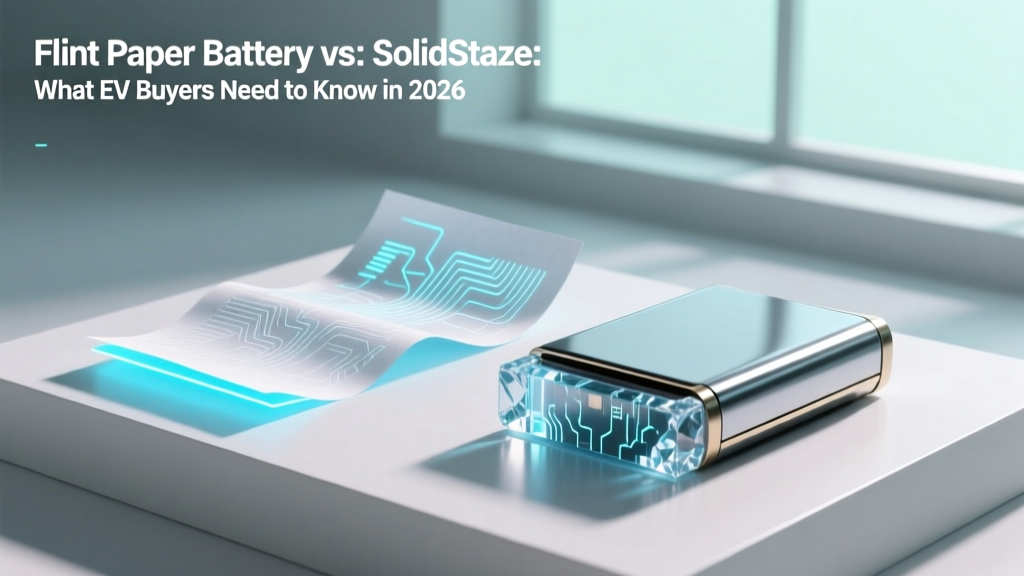
The flint paper battery concept refers to research into ultra-thin, flexible electrode substrates — sometimes cellulose-based or nanostructured paper composites — that could theoretically replace rigid metal foil current collectors in lithium-ion cells. The appeal is clear: lighter weight, potentially lower materials cost, and manufacturing flexibility. However, this research remains at the laboratory and early prototype stage. No automotive-grade cells using paper-based substrates have entered mass production as of 2026, and the path from lab cell to vehicle-qualified pack typically takes 7–12 years.
Here's where the major next-generation technologies actually stand:
Solid-State Batteries
Solid-state cells replace the liquid electrolyte with a solid ceramic, polymer, or sulfide conductor — enabling lithium-metal anodes, higher energy density (~350–500 Wh/kg at cell level), and improved safety. Toyota has announced a solid-state EV for 2027–2028 with a claimed 460+ mile range and 10-minute fast charging. Samsung SDI targets 2027 production. QuantumScape continues testing with Volkswagen but has not announced a production vehicle. Realistically, solid-state packs will debut in limited, premium applications before reaching mainstream pricing — expect broad availability no earlier than 2029–2030.
Silicon-Dominant Anodes
Replacing graphite anodes with silicon (or silicon-carbon composites) can boost energy density by 20–40%. Sila Nanotechnologies supplies silicon anode material for the Mercedes G-Class electric SUV (2025+). Group14 Technologies (backed by Porsche) is scaling production. This technology is already here in limited applications and will expand through the late 2020s.
Sodium-Ion Batteries
Sodium-ion cells use abundant, cheap materials and perform well in cold weather, but have lower energy density (~120–160 Wh/kg). CATL and BYD are deploying sodium-ion packs in Chinese-market city EVs. U.S. availability is unlikely before 2028, and the chemistry is best suited to budget urban vehicles with shorter range requirements.
Timeline reality check: Any technology described as "available" before 2028 should be treated as preliminary. Battery manufacturing scale-up is capital-intensive and slow — gigafactory build-out alone takes 2–3 years after cell qualification.
Frequently Asked Questions
How long do EV batteries last in years and miles?
Most modern EV batteries retain 80–90% of original capacity after 10 years or 150,000 miles. Real-world fleet data from Geotab and Recurrent Auto shows median degradation of ~1.8% per year. Many packs remain functional well beyond 200,000 miles — they simply hold less energy, reducing range rather than causing failure.
How much does it cost to replace an EV battery?
Full pack replacement ranges from roughly $10,000 for a compact LFP pack (Tesla Model 3 RWD) to $30,000 for a large NMC pack (F-150 Lightning Extended Range). However, most owners never need a full replacement. Module-level repairs are significantly cheaper, and refurbished packs offer 40–60% savings. The vast majority of packs outlast the vehicle.
What does the EV battery warranty cover?
Federal law requires at least 8 years / 100,000 miles of battery coverage (10 years / 150,000 miles in CARB states). The warranty guarantees the pack will retain a minimum percentage of original capacity — typically 70%. If capacity drops below that threshold within the warranty period, the manufacturer repairs or replaces the pack at no cost. Normal gradual degradation above the threshold is not covered.
How do I check my EV's battery health?
Check your vehicle's app or settings menu for a State of Health (SoH) indicator. You can also compare your displayed range at 100% charge to the original EPA range rating. For detailed data, third-party services like Recurrent Auto or OBD-II diagnostic apps can pull raw BMS data including cell voltage variance and precise SoH estimates.
LFP vs. NMC — which battery chemistry is better for me?
Choose LFP if you prioritize longevity, lower cost, and the ability to charge to 100% daily without concern — ideal for commuters, city drivers, and warm-climate owners. Choose NMC/NCA if you need maximum range per charge, better cold-weather fast-charging performance, or a lighter pack for towing and performance driving. Neither is universally superior; the right choice depends on your specific use case.
Is the flint paper battery available in any EV today?
No. The flint paper battery concept — referring to paper-based or cellulose-derived electrode substrates — remains in the research and early prototype phase. No production vehicle uses this technology. It represents one of many materials-science pathways being explored for future battery generations, but commercialization is likely a decade or more away.
Does frequent DC fast charging damage my battery?
Occasional DC fast charging (road trips, a few times per month) has minimal impact on modern packs with active thermal management. However, daily use of high-power chargers (150–350 kW) without preconditioning accelerates degradation through cumulative heat stress. For daily charging, Level 2 home charging at 7–11 kW is gentler and recommended. Always use your vehicle's preconditioning feature before fast charging.
For the latest EPA range and efficiency data on any EV, check fueleconomy.gov. For current federal EV tax credit rules under IRC §30D, including income caps, MSRP limits, and battery-sourcing requirements, see the IRS clean vehicle credits page.