The high-voltage traction battery remains the single most expensive component in any electric vehicle, and buyer scrutiny of battery supply chains has never been higher. As automakers diversify their cell suppliers beyond the familiar names — CATL, LG Energy Solution, Panasonic, SK On — newer entrants and specialized manufacturers are entering the conversation. One name that surfaces in niche and aftermarket circles is the Flint Battery Company, a lesser-known player that buyers occasionally encounter when researching replacement cells, energy storage modules, or regional battery supply. This guide uses that curiosity as a starting point to deliver what actually matters: a rigorous, data-backed breakdown of EV battery chemistry, degradation behavior, warranty coverage, replacement economics, and care practices as they stand in 2026.
LFP vs NMC/NCA: The Chemistry Decision That Shapes Your EV
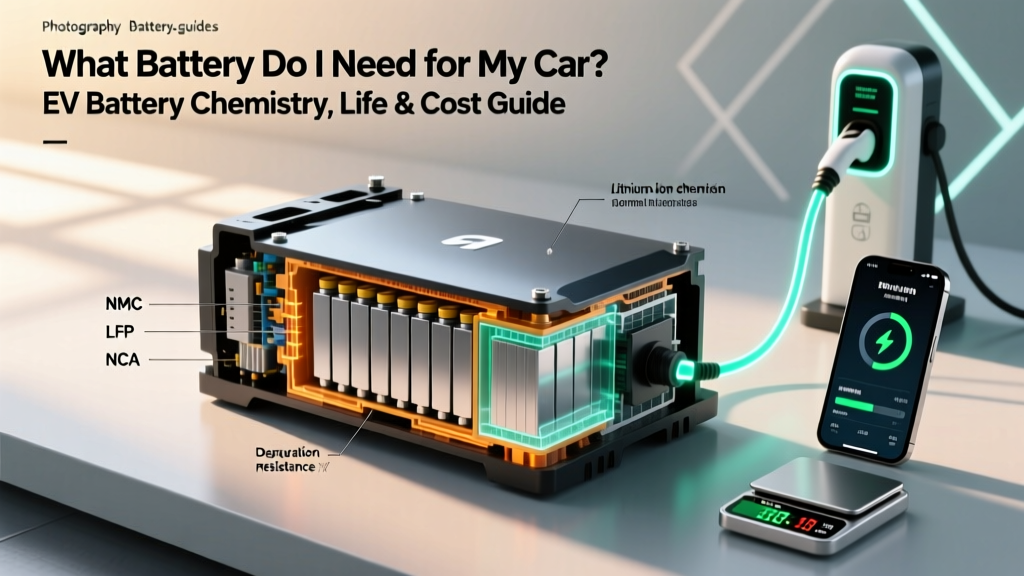
Every EV battery on the road today uses one of two dominant lithium-ion chemistries at the cathode: LFP (lithium iron phosphate, LiFePO4) or NMC/NCA (nickel manganese cobalt / nickel cobalt aluminum). The chemistry choice affects your real-world range, how the battery ages, how it handles cold weather, and what you paid for the vehicle.
| Attribute | LFP (Lithium Iron Phosphate) | NMC / NCA (Nickel-Based) |
|---|---|---|
| Energy density (cell-level) | ~160–180 Wh/kg | ~220–300 Wh/kg |
| Typical cycle life | 3,000–5,000+ cycles to 80% SoH | 1,000–2,500 cycles to 80% SoH |
| Cold-weather performance | Moderate; greater range loss below 32°F | Better low-temp discharge; heat pump pairing helps |
| Cost per kWh (pack-level, 2026) | ~$90–$110/kWh | ~$120–$150/kWh |
| Thermal stability / safety | Excellent; higher runaway threshold | Good; requires more robust BMS and cooling |
| Cobalt content | None | Low-cobalt (NMC 811) to moderate (NMC 532) |
| Common 2026 applications | Tesla Model 3/Y RWD, Ford Mustang Mach-E Select (LFP trims), BYD Blade packs, Rivian Standard | Hyundai Ioniq 5/6 Long Range, Chevy Silverado EV, BMW iX, Lucid Air, Porsche Taycan |
Which is better? There is no universal winner. LFP excels for buyers who prioritize longevity, lower upfront cost, and cobalt-free sourcing — and who can accept slightly lower range per kilogram. NMC/NCA serves buyers who need maximum range in a given pack volume, tow frequently, or live in consistently cold climates. Tesla's split strategy — LFP in Standard Range RWD models, NMC in Long Range and Performance trims — has become the industry template.
Where a company like Flint Battery Company enters the picture is typically at the module or pack-integration tier, supplying cells or assembled modules for aftermarket replacements, conversions, or stationary storage applications rather than as an OEM Tier 1 supplier to major automakers. Buyers researching Flint for EV applications should verify cell chemistry, cycle-life ratings, and whether modules are compatible with their vehicle's battery management system (BMS) firmware.
How Long Do EV Batteries Actually Last? Degradation Data
The fear that an EV battery will "die" at 80,000 miles is not supported by fleet data. Modern thermal management systems, improved electrolyte formulations, and conservative buffer strategies (automakers lock away 5–10% of gross capacity at the top and bottom of the state-of-charge window) have pushed real-world degradation curves well below early-generation EVs like the 2011–2017 Nissan Leaf.
Typical degradation trajectory (liquid-cooled packs, 2020–2026 models):
- Year 1 / 15,000 mi: 2–4% capacity loss (initial SEI layer formation)
- Year 3 / 45,000 mi: 5–8% total loss
- Year 5 / 75,000 mi: 7–11% total loss
- Year 8 / 120,000 mi: 10–15% total loss (still above most warranty thresholds)
- Year 12+ / 175,000+ mi: 15–22% total loss; pack remains functional but range-reduced
These figures align with aggregated fleet data from sources like Recurrent Auto, which tracks over 15,000 EVs in real-world conditions, and Tesla's own 2024 Impact Report, which cited an average 12% degradation at 200,000 miles across Model S/X fleets. LFP packs tend to show slower mid-life degradation but can exhibit a steeper initial drop in the first 1–2% before stabilizing — a characteristic of the chemistry's voltage curve.
The critical takeaway: most EV batteries will outlast the vehicle's economic life. The car's suspension, interior, and electronics will typically need replacement or major service before the traction battery falls below 70% state of health (SoH).
What the Battery Warranty Actually Covers — and What It Doesn't
Federal law (EPA emissions warranty requirements interpreted for EV powertrains) effectively mandates a minimum of 8 years / 100,000 miles for battery coverage in states that follow California's CARB standards, and most automakers apply this nationally. But the details matter enormously.
| Manufacturer | Coverage Period | Capacity Retention Threshold | Notes |
|---|---|---|---|
| Tesla (Model 3/Y LFP) | 8 yr / 120,000 mi | 70% SoH | LFP packs covered identically to NMC |
| Tesla (Model S/X, LR/Performance) | 8 yr / 150,000 mi | 70% SoH | Longer mileage for larger packs |
| Hyundai / Kia (E-GMP) | 10 yr / 100,000 mi | 70% SoH | Among the longest time-period coverage |
| Ford (Mach-E, F-150 Lightning) | 8 yr / 100,000 mi | 70% SoH | Applies to both LFP and NMC trims |
| GM (Ultium platform) | 8 yr / 100,000 mi | 70% SoH | Some commercial fleet terms differ |
| Rivian | 8 yr / 175,000 mi (Max pack) | 70% SoH | Higher mileage for larger battery configurations |
| BMW (iX, i4, i7) | 8 yr / 100,000 mi | 70% SoH | Extends to 8 yr / 100k for HV components |
What is covered: Capacity loss below the stated threshold (typically 70% of original usable capacity), manufacturing defects, cell imbalance beyond BMS correction, and thermal management system failures.
What is typically excluded: Damage from accidents, flooding, or improper aftermarket modifications (including non-OEM battery modules from third-party suppliers); capacity loss from persistent DC fast charging above manufacturer-recommended limits; use outside stated temperature operating ranges; and cosmetic issues that don't affect function.
If you source a replacement module from a company like Flint Battery Company rather than an OEM-certified dealer, understand that this will almost certainly void the remaining factory battery warranty on that pack segment.
EV Battery Replacement Costs: What to Budget in 2026
Out-of-warranty battery replacement remains the specter that haunts EV purchase decisions. Here's what it actually costs when it's needed — which, statistically, is rare within the first 12–15 years of ownership.
| Vehicle / Pack Size | Battery kWh (Usable) | Chemistry | Replacement Cost Range (Parts + Labor) |
|---|---|---|---|
| Tesla Model 3 RWD (~60 kWh) | ~57 kWh | LFP | $10,000 – $13,000 |
| Tesla Model Y Long Range (~82 kWh) | ~78 kWh | NMC | $14,000 – $18,000 |
| Hyundai Ioniq 5 Long Range (~77 kWh) | ~74 kWh | NMC | $13,000 – $17,000 |
| Ford F-150 Lightning Extended (~131 kWh) | ~125 kWh | NMC | $22,000 – $30,000 |
| Chevy Silverado EV 4WT (~200 kWh) | ~190 kWh | NMC (Ultium) | $30,000 – $40,000+ |
| Nissan Ariya (~91 kWh) | ~87 kWh | NMC | $15,000 – $19,000 |
Costs have declined roughly 30–40% since 2020 at the cell level, but labor, diagnostic procedures, BMS reprogramming, coolant system servicing, and dealer markup keep out-the-door prices elevated. Independent EV shops and module-level repair (replacing individual failed modules rather than the entire pack) can reduce costs by 40–60% — this is where aftermarket suppliers and specialty companies sometimes enter the picture. However, module-level repair requires precise cell matching and BMS recalibration; mismatched modules accelerate imbalance and can trigger further degradation.
Factors That Accelerate (or Slow) Battery Degradation
Battery longevity is not purely a function of time and mileage. How you charge, store, and drive the vehicle materially affects the degradation curve. Here is a prioritized, data-informed checklist.
Battery Care Checklist — Maximize State of Health
- Limit routine SoC to 20–80% for NMC/NCA. Charging to 100% and holding there accelerates electrolyte oxidation. LFP tolerates 100% better and Tesla recommends periodic 100% charges for LFP to recalibrate the BMS.
- Minimize DC fast charging above 150 kW when not needed. Occasional road-trip Supercharging is fine; daily 250 kW sessions add measurable stress. Studies from the Idaho National Laboratory showed ~10% additional degradation after 40,000 miles of exclusive DCFC vs. Level 2 charging.
- Precondition the battery before fast charging. Most EVs do this automatically when a DCFC station is navigated to. Cold batteries (<50°F) that accept high-power charges without preconditioning suffer lithium plating — a permanent, irreversible capacity loss mechanism.
- Avoid prolonged storage above 90% or below 10% SoC. If storing for 2+ weeks, target 50–60% SoC and a moderate ambient temperature.
- Use a Level 2 home charger (7–11 kW) as your primary charging method. This is the single most impactful longevity practice.
- Keep thermal management active. Don't disable preconditioning or cabin-overheat features that indirectly manage pack temperature. Garage parking in extreme climates helps.
- Update BMS firmware. OTA updates often refine charge curves, buffer strategies, and thermal protocols. Skip them at your pack's peril.
How to Monitor Battery Health (State of Health, SoH)
State of Health (SoH) is the ratio of your battery's current maximum capacity to its original capacity, expressed as a percentage. A new EV starts at 100% SoH; a pack at 85% SoH holds 85% of its original kWh. Here's how to track it:
- In-vehicle menus: Some EVs (notably Tesla via the Service menu, and Hyundai/Kia via the EV-specific settings) display estimated SoH or a degradation graph. Not all manufacturers expose this directly.
- OBD-II diagnostic tools: Devices like the OBDLink SX paired with apps such as EVNotify or LeafSpy (Nissan-specific) can read the BMS-reported SoH value directly. This is the most accurate consumer-accessible method.
- Third-party services: Recurrent Auto offers a free battery health report that connects to your vehicle's telematics and benchmarks your degradation against a fleet of identical models.
- Dealer diagnostic: Requesting a "battery health check" during service visits provides a printed SoH readout. Some dealers will do this for free; others charge a diagnostic fee of $50–$150.
- Manual calculation: Track your kWh consumed per full charge over time. If your 77 kWh pack used to accept 73 kWh from 5% to 95% and now accepts only 66 kWh, your SoH has declined approximately 10%.
For buyers considering a used EV, a pre-purchase battery health report is as essential as a compression test was for ICE vehicles. Never buy a used EV without an SoH readout.
Emerging Battery Technology: What's Real vs. What's Still on the Horizon
The EV battery landscape is shifting, but timelines matter. Here is where next-generation technologies actually stand as of 2026:
Solid-state batteries: Toyota, Samsung SDI, and QuantumScape have all demonstrated prototype cells with energy densities exceeding 400 Wh/kg and faster charge acceptance. Toyota has announced limited production in select models beginning in 2027–2028, but these will be low-volume, premium applications. Mass-market solid-state availability is not expected before 2030. No currently purchasable EV uses a solid-state traction battery.
Silicon-dominant anodes: Companies like Sila Nanotechnologies and Group14 are supplying silicon-composite anode materials to manufacturers including Mercedes-Benz (for the upcoming G-Class electric) and Panasonic. Silicon anodes increase energy density by 20–40% over graphite but face cycle-life and swelling challenges. Expect broader adoption in 2027–2029 model-year vehicles.
Sodium-ion batteries: CATL has begun volume production of sodium-ion cells for low-range, budget EVs in China. Energy density (~140 Wh/kg) limits these to city cars and micro-EVs. U.S. market availability is not yet confirmed for any major model.
These technologies will eventually reach consumers, but for anyone purchasing an EV in 2026, LFP and NMC remain the proven, warrantied, and economically rational choices. Waiting for solid-state is, for most buyers, a multi-year delay with no guaranteed price advantage at launch.
Frequently Asked Questions
How long do EV batteries last in years and miles?
Based on aggregated fleet data, modern liquid-cooled EV batteries (2020–2026 models) retain 70–85% of original capacity at 150,000 miles and 10–12 years. Many will function adequately past 200,000 miles, though with reduced range. LFP chemistry typically shows slower long-term degradation than NMC.
How much does an EV battery cost to replace?
Out-of-warranty replacement ranges from approximately $10,000 for a ~60 kWh LFP pack (Tesla Model 3 RWD) to $30,000–$40,000+ for large packs like the Chevy Silverado EV's ~200 kWh Ultium battery. Module-level repair at independent shops can reduce this by 40–60%. Under warranty, replacement is free if SoH drops below the manufacturer's threshold (typically 70%).
What does the battery warranty cover?
Manufacturer warranties cover capacity loss below a stated threshold (usually 70% SoH) and manufacturing defects for 8 years / 100,000 miles minimum (longer for Hyundai/Kia at 10 years and Rivian at 175,000 miles for Max packs). They do not cover accident damage, aftermarket modifications, or degradation from abuse such as repeated extreme-temperature DC fast charging without preconditioning.
How do I check and maximize my EV's battery health?
Check SoH via in-vehicle menus, an OBD-II reader with EV-compatible software, or a third-party service like Recurrent Auto. Maximize longevity by charging primarily on Level 2, limiting NMC packs to 20–80% daily SoC, preconditioning before DC fast charging, avoiding prolonged storage at extreme SoC levels, and keeping BMS firmware updated.
LFP vs NMC — which battery chemistry is better for me?
Choose LFP if you prioritize cycle life, lower cost, cobalt-free sourcing, and plan to own the vehicle 8+ years. Accept slightly lower energy density and greater cold-weather range loss. Choose NMC/NCA if you need maximum range per charge, tow heavy loads, live in consistently cold climates, or need the fastest possible DC charge acceptance. Neither is universally superior — the right choice depends on your driving profile.
Is Flint Battery Company an OEM supplier for major EV brands?
Flint Battery Company is not a known Tier 1 OEM cell supplier for major U.S.-market automakers as of 2026. Buyers encountering the name typically find it in aftermarket, module-level replacement, or energy storage contexts. Always verify cell specifications, chemistry, cycle-life ratings, and BMS compatibility before using any non-OEM battery module in an EV traction pack.
Sources: EPA Fuel Economy (fueleconomy.gov) for vehicle specifications; Recurrent Auto battery degradation research; manufacturer warranty documentation (Tesla, Hyundai, Ford, GM, Rivian, BMW — official press/spec sites).