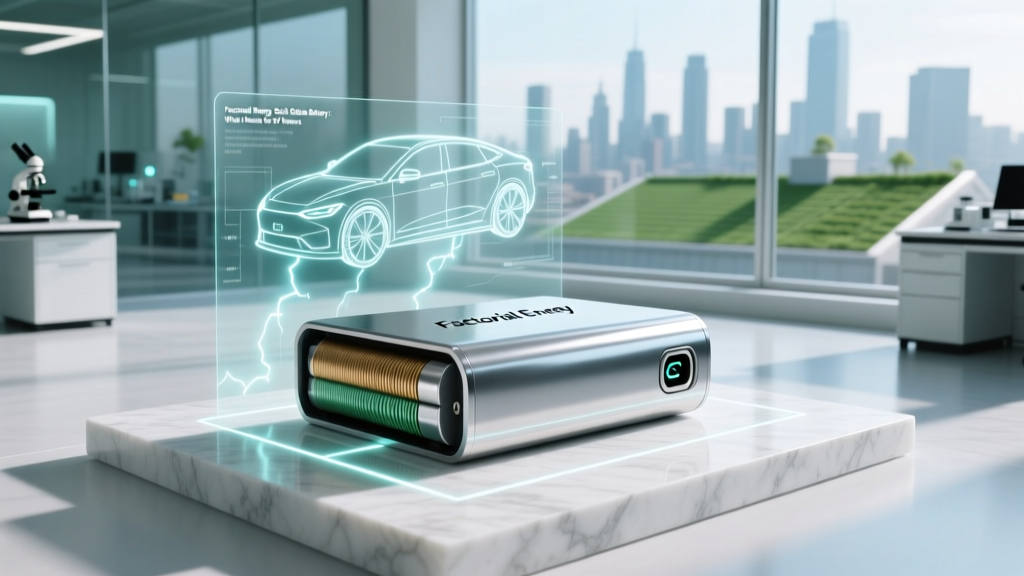
If you follow EV battery news, you have likely seen the phrase "Factorial Energy solid state battery" surface in headlines. The Massachusetts-based startup has partnered with Mercedes-Benz, Stellantis, and Hyundai to develop solid-state cells that promise higher energy density, faster charging, and improved safety compared to conventional lithium-ion packs. But what does this technology actually deliver, and how does it compare to the batteries powering EVs on dealer lots today?
This guide breaks down Factorial's solid-state claims against the reality of current LFP and NMC chemistries — with hard data on degradation, warranty coverage, replacement costs, and the daily habits that extend or shorten battery life. Whether you are shopping for a 2026 EV or planning to keep your current one past 150,000 miles, the chemistry under your floor matters more than any single feature on the window sticker.
Current EV Battery Chemistry: LFP vs NMC vs NCA
Every EV sold in the US today uses one of three lithium-ion cathode chemistries: lithium iron phosphate (LFP), nickel manganese cobalt (NMC), or nickel cobalt aluminum (NCA). The chemistry dictates energy density, cycle life, cold-weather performance, and cost. Here is how they stack up in 2026 production vehicles:
| Attribute | LFP (LiFePO₄) | NMC / NCA |
|---|---|---|
| Energy Density (cell-level) | ~160–180 Wh/kg | ~230–300 Wh/kg |
| Typical Cycle Life | 3,000–6,000+ cycles | 1,000–2,000 cycles |
| Cold Performance (−10°C range loss) | ~35–45% loss | ~25–35% loss |
| Cost per kWh (cell-level, 2026) | ~$70–85 | ~$95–120 |
| Recommended Daily SoC | 100% OK | 80% preferred for daily |
| Thermal Stability | Excellent (no thermal runaway to ~270°C) | Good (runaway onset ~210°C) |
| Notable 2026 Vehicles | Tesla Model 3 RWD, Ford Mustang Mach-E Select (LFP option) | Hyundai Ioniq 5, BMW iX, Rivian R1S, most long-range trims |
The trade-off is straightforward: NMC/NCA delivers more range in a smaller, lighter pack — critical for large SUVs and performance sedans. LFP is cheaper, lasts more charge cycles, and tolerates daily 100% charging, but weighs more and suffers greater range loss in freezing temperatures. Neither chemistry is universally "better." Your choice depends on climate, daily mileage, and whether you prioritize upfront cost or long-term cycle life.
How Long Do EV Batteries Actually Last?
The short answer: longer than most buyers assume. Data from fleet operators, manufacturer warranty claims, and third-party studies consistently show that modern EV traction batteries lose roughly 10–15% of original capacity over 150,000–200,000 miles. Most packs will outlast the vehicle's body, suspension, and interior.
Typical Degradation Curve (NMC packs, aggregated fleet data):
- Year 1 / 15,000 mi: ~2–4% capacity loss (initial formation settling)
- Year 3 / 45,000 mi: ~6–8% cumulative loss
- Year 5 / 75,000 mi: ~8–11% cumulative loss
- Year 8 / 120,000 mi: ~10–14% cumulative loss
- Year 10+ / 150,000+ mi: ~12–18% cumulative loss (varies widely by usage)
Sources: Geotab fleet study, Recurrent Auto battery health data, Tesla Impact Reports.
LFP packs tend to degrade more slowly in terms of cycle count but may show similar calendar aging. A 2026 Tesla Model 3 RWD with its ~60 kWh LFP pack can reasonably expect to retain 85%+ capacity at 150,000 miles under normal use. An NMC pack in a Hyundai Ioniq 5 (~77.4 kWh usable) typically holds 82–87% at the same mileage.
The degradation curve is not linear. Most loss occurs in the first year, then slows significantly. This "hockey stick" pattern means a 5-year-old battery is not on a countdown to failure — it is likely settling into a long plateau.
What Does the Battery Warranty Actually Cover?
Federal law mandates a minimum 8-year/100,000-mile warranty on EV battery packs (10 years/150,000 miles in California and states adopting CARB rules). Most manufacturers exceed this baseline. Here is how major brands structure coverage in 2026:
| Manufacturer | Warranty Term | Capacity Retention Threshold | Notes |
|---|---|---|---|
| Tesla (Model 3/Y LFP) | 8 yr / 120,000 mi | 70% | Long-range NMC trims: 8 yr / 120,000 mi |
| Hyundai / Kia | 10 yr / 100,000 mi | 70% | Among the longest terms in the industry |
| Ford (Mach-E, F-150 Lightning) | 8 yr / 100,000 mi | 70% | Covers battery and hybrid/electric components |
| BMW (iX, i4) | 8 yr / 100,000 mi | 70% | Transferable to subsequent owners |
| Rivian (R1T, R1S) | 8 yr / 175,000 mi | 70% | Higher mileage cap reflects adventure-use positioning |
| GM (Ultium-based) | 8 yr / 100,000 mi | 70% | Covers battery, electric drive, and power electronics |
Key detail: the 70% threshold means the manufacturer replaces or repairs the pack only if usable capacity drops below 70% of original within the warranty period. A pack at 72% capacity still functions fine — you simply have less range. In practice, very few packs breach this threshold under normal use within the warranty window. Warranty claims are typically triggered by defective modules or BMS (battery management system) faults, not gradual degradation.
For the latest IRS guidance on how battery sourcing affects the §30D federal tax credit, check irs.gov — battery mineral sourcing requirements can affect whether a vehicle qualifies for the full $7,500 credit or the $3,750 partial credit.
EV Battery Replacement Cost: What to Expect
Battery replacement is the single most cited fear among prospective EV buyers. The numbers are real but rarely needed within a vehicle's typical ownership period:
| Vehicle / Pack Size | Battery Capacity | Replacement Cost (2026 est.) | Typical Replacement Trigger |
|---|---|---|---|
| Tesla Model 3 RWD (LFP) | ~60 kWh | $8,000–$12,000 | Physical damage, rare BMS failure; degradation-driven replacement uncommon before 250k+ mi |
| Hyundai Ioniq 5 (NMC) | 77.4 kWh usable | $12,000–$18,000 | Module-level repair often possible vs full pack swap |
| Ford F-150 Lightning Ext. Range | ~131 kWh | $20,000–$30,000 | Largest packs cost most; module service reduces full-replacement likelihood |
| Chevrolet Bolt EV/EUV | ~65 kWh | $9,000–$14,000 | Post-recall replacement packs use updated NMC chemistry |
| Rivian R1T (Large Pack) | ~128 kWh | $18,000–$25,000 | Modular pack design allows partial module replacement |
Context that matters: replacement costs have been declining roughly 8–12% annually as cell prices fall and more refurbished packs enter the market. Many manufacturers now offer module-level repairs — replacing a single degraded or defective module for $1,500–$4,000 rather than swapping the entire pack. A full pack replacement is usually a last resort after a collision, flood, or extreme manufacturing defect.
For the vast majority of owners who trade or sell within 8–12 years, battery replacement is a non-issue. The battery will still have 80%+ capacity when the rest of the car is ready for the junkyard.
Factorial Energy Solid State Battery: The Forward-Looking Promise
Factorial Energy's solid-state technology aims to replace the liquid electrolyte in conventional lithium-ion cells with a solid material — typically a polymer, ceramic, or composite. The theoretical advantages are substantial:
- Energy density: Factorial's "FEST" (Factorial Electrolyte System Technology) cells have demonstrated over 390 Wh/kg at the cell level in lab settings — roughly 30–60% higher than current NMC cells.
- Safety: solid electrolytes are non-flammable, eliminating the thermal runaway risk that requires complex cooling systems in liquid-electrolyte packs.
- Charging speed: solid-state cells can theoretically accept higher C-rates without lithium plating, potentially enabling 10–80% charges in under 10 minutes.
- Lifespan: Factorial claims its cells maintain over 80% capacity after 1,000+ cycles in testing, though independent long-term data is not yet publicly available.
Where it stands in 2026: Factorial has delivered B-sample cells to Mercedes-Benz and Stellantis for integration into test vehicles. Hyundai has also announced a joint development agreement. However, no Factorial-equipped production vehicle is currently available for purchase. The company targets limited production integration by 2027–2028, with meaningful volume unlikely before 2029–2030.
This timeline is consistent with the broader solid-state industry. Toyota, QuantumScape, Samsung SDI, and Solid Power are all pursuing similar milestones. The manufacturing challenge — producing solid-state cells at scale with consistent yield and acceptable cost — remains the primary bottleneck. Expect solid-state packs to debut in premium vehicles with price tags well above $80,000 before the technology filters down to mainstream models.
For current solid-state development status, see Factorial Energy's official site and DOE battery research publications.
Factors That Affect EV Battery Life (and How to Minimize Them)
Battery degradation is driven by three primary stressors: heat, high state of charge, and high charge/discharge rates. You cannot eliminate degradation, but you can slow it meaningfully:
- Avoid sustained 100% SoC (NMC/NCA): Store and daily-drive between 20–80%. Charge to 100% only when you need the full range for a trip, and drive off shortly after reaching full. LFP packs are an exception — manufacturers recommend periodic 100% charges to recalibrate the BMS.
- Limit DC fast charging frequency: Occasional fast charging (road trips, 1–2 times per week) has minimal measurable impact. Daily DC fast charging at 150+ kW accelerates degradation by roughly 2–5% over 100,000 miles compared to Level 2 home charging, per Geotab data.
- Use preconditioning: Most EVs let you precondition the battery before fast charging or departure. This warms the cells to the optimal ~25–35°C range, reducing charging-induced stress and improving charge acceptance in cold weather.
- Park in shade or a garage in summer: Sustained high ambient temperatures (above 35°C / 95°F) accelerate calendar aging. A pack sitting at 100% SoC in a 40°C parking lot for weeks degrades measurably faster than one stored at 50% SoC in a cool garage.
- Don't let the pack sit at 0% for extended periods: Deep discharge below the BMS buffer can cause copper dissolution in the anode. If storing an EV for weeks, leave it at ~50% SoC.
- Use regenerative braking moderately in extreme cold: In sub-freezing temperatures, high regen can stress cold cells. Many EVs automatically limit regen when the battery is cold — let the system manage this.
How to Check and Monitor Battery Health (SoH)
State of Health (SoH) is the percentage of original battery capacity remaining. A new pack is 100% SoH; a pack that held 77.4 kWh when new and now holds 68 kWh is at ~88% SoH.
Built-in tools:
- Tesla: The Service menu (accessed via the software screen) displays a battery health test result. Third-party apps like TeslaFi or Tessie log SoH estimates from BMS data over time.
- Hyundai / Kia: The EV settings menu shows battery health percentage on many 2024+ models via the infotainment system.
- BMW: The My BMW app displays battery SoH, and dealerships can run a detailed battery health report.
- Ford: The FordPass app provides battery state information; the in-dash display shows estimated range vs. historical efficiency.
- OBD-II dongles: Devices like the OBDeleven (VW/Audi group) or generic ELM327 adapters paired with apps such as Car Scanner or ABRP can read BMS-reported SoH, cell voltage variance, and pack temperature data on many EVs.
What to watch for: cell voltage variance (the spread between the highest and lowest cell in the pack) is often a more useful health indicator than SoH alone. A variance consistently above 50–100 mV at rest may indicate a weakening module. Healthy packs typically show under 20 mV variance at equilibrium.
Silicon Anode and Other Near-Term Battery Advances
Beyond Factorial's solid-state cells, several incremental technologies are reaching production in 2026–2027:
- Silicon-dominant anodes: Companies like Sila Nanotechnologies and Group14 are supplying silicon-composite anode materials to manufacturers including Mercedes-Benz (G-Class EV) and Porsche. Silicon anodes can boost energy density 10–20% without changing the cathode chemistry. Expect this in premium models first.
- LFP improvements: CATL's second-generation LFP cells and BYD's Blade Battery Gen 2 push energy density toward 200 Wh/kg — narrowing the gap with NMC while maintaining the cost and cycle-life advantages.
- Sodium-ion batteries: CATL and HiNA have begun producing sodium-ion cells for lower-range, budget vehicles in China. Energy density (~140–160 Wh/kg) limits US applications to city cars and fleet vehicles, but the cost ($50–65/kWh at cell level) is compelling for entry-level models.
None of these technologies are "around the corner" for mainstream US buyers in 2026, but they represent real engineering progress — not vaporware. The trajectory points toward cheaper, longer-lasting, and denser packs through the end of the decade.
Frequently Asked Questions
How long do EV batteries last in years and miles?
Most modern EV traction batteries retain 80–88% of original capacity at 150,000 miles or 10 years under normal use. Fleet data from Geotab and Recurrent shows that packs routinely exceed 200,000 miles before dropping below the 70% warranty threshold. Full failure is rare — gradual capacity loss is the norm.
How much does an EV battery cost to replace in 2026?
Replacement costs range from roughly $8,000 for a ~60 kWh LFP pack (Tesla Model 3 RWD) to $25,000–$30,000 for a ~130 kWh NMC pack (Ford F-150 Lightning Extended Range). However, module-level repairs costing $1,500–$4,000 often resolve issues without a full pack swap. Most owners never need a replacement within typical ownership periods.
What does the EV battery warranty cover?
Federal law requires 8 years/100,000 miles minimum (10/150k in CARB states). Coverage applies if usable capacity falls below a defined threshold — typically 70% of original — or if a manufacturing defect causes failure. The warranty covers the battery pack, BMS, and often related power electronics. It does not cover damage from collisions, floods, or unauthorized modifications.
LFP vs NMC — which battery chemistry is better for me?
Choose LFP if you want lower cost, longer cycle life, the ability to charge to 100% daily, and you live in a mild climate. Choose NMC/NCA if you need maximum range per kWh, tow frequently, drive in very cold winters, or buy a larger vehicle where weight matters. Neither is universally superior — the right choice depends on your driving pattern and climate.
How do I check my EV battery's State of Health?
Most 2024+ EVs display SoH in the infotainment system or companion app (Tesla, Hyundai, BMW). For older vehicles, an OBD-II adapter with an EV-compatible app (Car Scanner, ABRP) can read BMS data including SoH, cell voltage spread, and pack temperature. Dealerships can also run a formal battery health report during service visits.
When will Factorial Energy's solid-state battery be available in a production car?
Factorial has announced B-sample deliveries to Mercedes-Benz, Stellantis, and Hyundai, with test vehicle integration underway. The company targets limited production by 2027–2028, but meaningful consumer availability is unlikely before 2029–2030. No Factorial-equipped vehicle is currently available for purchase. Treat any "solid-state EV" headline with timeline scrutiny — the manufacturing scale-up is the hard part.
Does frequent DC fast charging damage my battery?
Occasional DC fast charging has a small, measurable effect — Geotab data shows roughly 2–5% additional degradation over 100,000 miles for vehicles that fast-charge daily versus those that primarily use Level 2. The bigger degradation drivers are sustained high SoC and high ambient temperature. If you fast-charge a few times per week on road trips, the impact on your pack's lifespan is minimal.