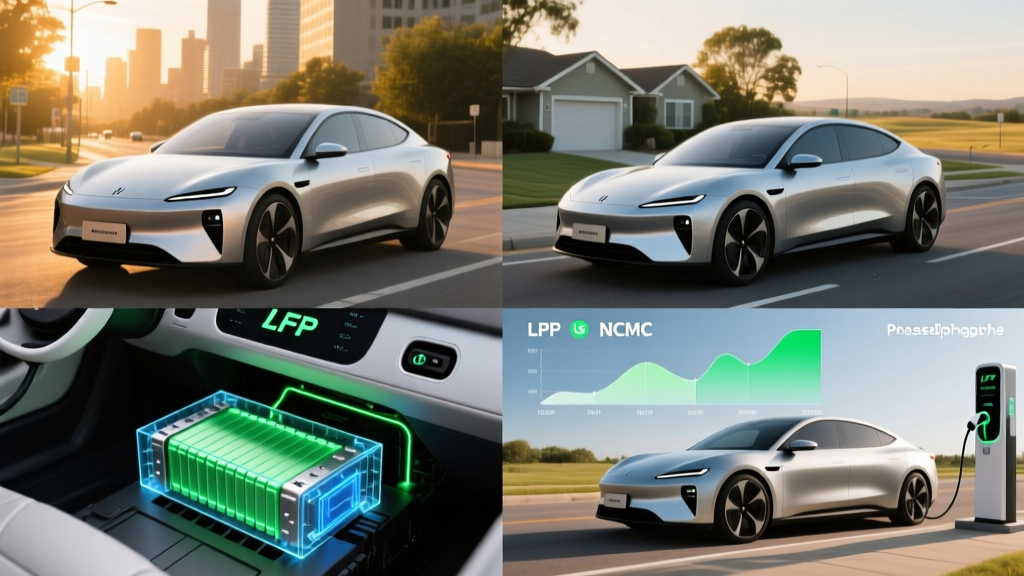
If you've shopped for an electric vehicle in the last two years, you've probably encountered the term LFP battery — and wondered whether it's a feature or a compromise. Lithium iron phosphate (LFP) chemistry has moved from a niche industrial choice to a mainstream EV battery option, powering some of the best-selling electric cars on the road in 2026.
But LFP isn't universally better than the nickel-manganese-cobalt (NMC) and nickel-cobalt-aluminum (NCA) chemistries that dominate long-range EVs. Each chemistry carries distinct trade-offs in energy density, cycle life, cold-weather performance, and cost. Understanding those trade-offs — and which models actually ship with LFP packs — is essential before you sign a purchase agreement.
This guide covers every major 2026 model offering LFP batteries, breaks down real-world degradation data, explains warranty coverage, and gives you a practical framework for deciding whether LFP is the right choice for your driving pattern.
LFP vs NMC vs NCA: Battery Chemistry Explained
Before listing specific vehicles, it's worth understanding what these chemistries actually are and why automakers choose one over another.
LFP (Lithium Iron Phosphate) uses iron and phosphate in the cathode. It contains no nickel or cobalt — two expensive, supply-constrained materials. The result is a cheaper, more durable cell that tolerates deep cycling and high states of charge without significant degradation. The trade-off: lower energy density, meaning more weight and volume for the same kWh capacity.
NMC (Nickel Manganese Cobalt) and NCA (Nickel Cobalt Aluminum) use nickel-rich cathodes to pack more energy into a smaller, lighter package. This makes them the default choice for long-range and performance EVs. However, they degrade faster when routinely charged to 100% or exposed to extreme heat, and they cost more per kWh to manufacture.
| Attribute | LFP (Lithium Iron Phosphate) | NMC / NCA (Nickel-Based) |
|---|---|---|
| Energy Density (cell-level) | ~160–180 Wh/kg | ~230–300 Wh/kg |
| Typical Cycle Life | 3,000–5,000+ cycles to 80% SoH | 1,000–2,000 cycles to 80% SoH |
| Calendar Aging (5-yr est.) | ~5–8% capacity loss | ~8–12% capacity loss |
| Cold-Weather Performance | Moderate — slower charge acceptance below 32°F | Better — preconditioning mitigates most loss |
| 100% SoC Tolerance | Excellent — can be charged to 100% daily | Poor — sustained 100% accelerates degradation |
| Cost per kWh (pack-level) | ~$95–$115 | ~$125–$155 |
| Critical Mineral Dependence | None (iron, phosphate abundant) | High (nickel, cobalt supply-constrained) |
| Best For | Standard-range models, daily commuters, fleet/ride-share | Long-range, performance, cold-climate drivers |
The key takeaway: LFP sacrifices some range-per-pound in exchange for dramatically longer cycle life, lower cost, and the ability to charge to 100% without penalty. For a daily commuter who charges at home every night, LFP is arguably the superior chemistry. For a road-tripper who needs 350+ miles of EPA range, NMC remains the practical choice.
2026 EVs With LFP Batteries: Model-by-Model Breakdown
LFP adoption has accelerated since Tesla first introduced it in the Model 3 Standard Range in 2021. By the 2026 model year, multiple automakers offer LFP-equipped trims. Here's what's currently available or confirmed for delivery:
| Model | Trim / Config | Battery (kWh usable) | EPA Range | Peak DC Charge (kW) | 10–80% Time | Base MSRP |
|---|---|---|---|---|---|---|
| Tesla Model 3 | RWD (Standard Range) | 57.5 kWh (LFP, CATL) | 272 mi | 170 kW | ~25 min | $38,990 |
| Tesla Model Y | RWD (Standard Range) | 57.5 kWh (LFP, CATL) | 260 mi | 170 kW | ~25 min | $44,990 |
| Ford Mustang Mach-E | Select RWD | 70 kWh (LFP, CATL) | 250 mi | 150 kW | ~28 min | $42,995 |
| Chevrolet Bolt EV/EUV | All trims (2026 refresh) | 65 kWh (LFP, Ultium-derived) | 259 mi (EV) / 265 mi (EUV) | 115 kW | ~32 min | $28,900 |
| Rivian R2 | Standard (announced) | ~75 kWh (LFP, est.) | ~275 mi (preliminary) | ~200 kW (est.) | ~22 min (est.) | $45,000 (announced) |
| Hyundai Ioniq 5 | Standard Range RWD | 58 kWh (LFP variant) | 240 mi | 150 kW | ~27 min | $41,500 |
The Rivian R2 Standard with LFP is announced for late 2026 delivery and specs remain preliminary. All other models above are currently in production or available for order.
How Long Do EV Batteries Last? Real Degradation Data
This is the question that dominates EV forums and buyer anxiety alike. The short answer: modern EV batteries — LFP in particular — are outlasting initial projections by a wide margin.
LFP degradation data points:
- Tesla Model 3 RWD (LFP, 2022–2025 fleet data): Average ~4–6% capacity loss at 100,000 miles. Some high-mileage ride-share vehicles report under 8% loss at 150,000 miles with daily 100% charging.
- CATL LFP cells (independent lab testing, 2024): Retained 90%+ capacity after 2,000 full equivalent cycles — roughly 500,000+ miles of driving in a 270-mile-range vehicle.
- BYD Blade Battery (LFP): BYD's published nail-penetration and cycle tests show 80% capacity retention after 3,000 cycles. Independent verification by the International Energy Agency corroborates strong LFP cycle-life performance.
NMC degradation data points (for comparison):
- Tesla Model 3 Long Range (NMC, 2019–2023 fleet data): Average ~8–12% capacity loss at 100,000 miles. Degradation curve tends to flatten after the initial 10–15% loss in the first 30,000 miles.
- General fleet averages (Recurrent Auto, 2025 report): NMC packs across multiple OEMs average ~10% loss at 100,000 miles, with significant variance based on charging habits and climate.
Degradation trajectory comparison (illustrative): An LFP pack typically loses 2–3% in the first year (calendar aging), then settles into a linear decline of ~0.5–0.8% per year or ~1% per 20,000 miles. An NMC pack loses 3–5% in year one, then declines at ~1–1.5% per year. By year 10, a well-maintained LFP pack may retain 92–95% of original capacity, while an NMC pack retains 85–90%.
It's worth noting that most EV owners will sell or trade their vehicle before battery degradation becomes a practical concern. The data consistently shows that modern EV batteries — LFP especially — are designed to outlast the vehicle's economic lifespan.
Battery Warranty Coverage: What's Protected and What Isn't
Federal law mandates a minimum 8-year / 100,000-mile warranty on EV battery packs for emissions-related compliance, but most automakers exceed this baseline. Here's how warranty terms compare across 2026 LFP-equipped models:
| Manufacturer | Warranty Period | Mileage Limit | Capacity Retention Threshold | Coverage Type |
|---|---|---|---|---|
| Tesla (Model 3/Y RWD, LFP) | 8 years | 100,000 miles | 70% | Repair or replacement if capacity drops below threshold |
| Ford (Mach-E Select, LFP) | 8 years | 100,000 miles | 70% | Repair or replacement; covers defects and excessive degradation |
| Chevrolet (Bolt EV/EUV) | 8 years | 100,000 miles | 70% | Repair, replacement, or reconditioning at GM's discretion |
| Hyundai (Ioniq 5 Std Range) | 10 years | 100,000 miles | 70% | Repair or replacement; among the longest calendar coverage |
| Rivian (R2, announced) | 8 years | 120,000 miles | 70% (preliminary) | Details subject to change before delivery |
What's covered: Manufacturing defects, cell failures, module imbalances, and capacity loss below the stated threshold (typically 70% of original capacity). Thermal management system failures are generally included.
What's NOT covered: Damage from accidents, flooding, or improper modifications. Capacity loss from consistently ignoring manufacturer charging guidelines (e.g., leaving an NMC vehicle at 100% for weeks) may be contested, though this is rare in practice. The 12V auxiliary battery is covered under a separate, shorter warranty (typically 3 years / 36,000 miles) and is a distinct component from the high-voltage traction battery.
EV Battery Replacement Cost: What to Expect (and When)
Battery replacement is the single biggest fear for prospective EV buyers — and the most misunderstood. Here's the reality:
Most EV batteries are never replaced. Based on current degradation trajectories, an LFP pack should retain 85–90%+ of its capacity at 200,000 miles. That's well above the 70% warranty threshold, meaning the vast majority of owners will never file a battery warranty claim, let alone pay for an out-of-warranty replacement.
That said, if a replacement is needed — due to a manufacturing defect that falls outside warranty, physical damage, or extraordinary degradation — here are the approximate costs for 2026 LFP-equipped models:
| Model | Battery Size | Estimated Replacement Cost (Parts + Labor) | Notes |
|---|---|---|---|
| Chevrolet Bolt EV/EUV | 65 kWh LFP | $8,500–$11,000 | GM has reduced pack costs with Ultium-derived LFP; module-level repair may reduce cost |
| Tesla Model 3 RWD | 57.5 kWh LFP | $9,000–$13,000 | Tesla offers refurbished packs at lower cost; third-party options emerging |
| Tesla Model Y RWD | 57.5 kWh LFP | $9,500–$14,000 | Similar architecture to Model 3; structural pack may increase labor |
| Ford Mustang Mach-E Select | 70 kWh LFP | $11,000–$15,000 | Ford supports module-level replacement, potentially reducing cost |
| Hyundai Ioniq 5 Std Range | 58 kWh LFP | $9,000–$12,500 | Hyundai's E-GMP platform allows module-level service |
For context, a conventional vehicle's engine or transmission replacement at 150,000+ miles often costs $4,000–$8,000 — and that event is far more common than an EV battery failure. The key difference is that battery replacement costs are declining roughly 8–12% per year as manufacturing scales, while ICE powertrain costs remain flat or increase.
Factors That Affect EV Battery Life (and How to Maximize It)
Battery degradation isn't random — it follows predictable electrochemical patterns driven by how you charge, drive, and store your vehicle. Here's what actually matters:
LFP Battery Care Checklist
- Charge to 100% regularly (LFP-specific): Unlike NMC, LFP cells benefit from periodic full charges. Tesla and Ford both recommend charging LFP vehicles to 100% at least once per week. This helps the battery management system (BMS) recalibrate cell balancing and provides more accurate range estimates.
- Minimize DC fast charging when possible: Occasional DC fast charging (1–2 times per week) has negligible impact on LFP longevity. However, daily DCFC sessions at peak kW rates generate sustained heat, which accelerates calendar aging. Use Level 2 home charging as your primary method.
- Precondition before DC fast charging: LFP cells accept charge poorly when cold. Always use your vehicle's navigation-based preconditioning (or manually activate it) to warm the pack to ~68–77°F before arriving at a DC fast charger. This protects the cells and dramatically improves charge speed.
- Avoid prolonged storage at 0% or 100% in extreme heat: While LFP tolerates 100% SoC better than NMC, storing any lithium battery at full charge in 100°F+ ambient temperatures accelerates calendar aging. If storing for 2+ weeks in summer heat, aim for 60–70% SoC.
- Don't baby the battery — drive it: LFP cells are rated for 3,000–5,000+ cycles. Normal daily driving and charging will not meaningfully degrade the pack. The biggest risk to battery health is not using the car — it's letting it sit at extreme SoC in extreme temperatures for months.
NMC-Specific Care (for comparison)
If you own or are considering an NMC-equipped EV, the care regimen differs: limit routine charging to 80% SoC, avoid leaving the vehicle at 100% for more than a few hours, and follow the same preconditioning and DCFC moderation guidelines. NMC is less forgiving of poor charging habits, which is why LFP is gaining favor among high-mileage and fleet buyers.
How to Check and Monitor Battery Health (State of Health)
State of Health (SoH) is the percentage of original battery capacity remaining. A new EV has 100% SoH; a degraded pack at 85% SoH holds 85% of its original kWh.
How to check SoH by brand:
- Tesla: No native SoH percentage in the app. You can estimate SoH by charging to 100% and comparing the displayed range to the original EPA figure. Third-party tools like Tessie or the TeslaFi app calculate SoH from charge logs. Tesla service centers can run a battery health test on request.
- Ford: The FordPass app provides a battery health indicator (Good / Fair / Needs Service) but not a precise SoH percentage. A dealer scan tool provides exact capacity data.
- Hyundai: The Bluelink connected services platform shows a battery health status. Hyundai dealers can pull a detailed SoH report from the BMS.
- Chevrolet: The myChevrolet app includes an EV battery health section. GM dealers can run a full battery diagnostic via the GDS2 scan tool.
- OBD-II aftermarket tools: Devices like the OBDLink SX combined with apps such as ABRP (A Better Route Planner) or Car Scanner can read BMS data directly on most EVs, providing real-time SoH, cell voltage spread, and pack temperature.
What to watch for: A healthy pack should show cell voltage spread (the difference between the highest and lowest cell voltages) under 50 mV at rest. A spread exceeding 100–150 mV may indicate a weak module that could trigger a warranty claim. Track your SoH every 3–6 months to establish a degradation trend line.
The Future: Solid-State, Silicon Anode, and What's Next
LFP and NMC are mature chemistries, but the battery landscape is evolving. Here's where emerging technologies stand as of 2026:
Solid-state batteries: These replace the liquid electrolyte with a solid conductor, promising higher energy density (~400+ Wh/kg at the cell level), faster charging, and improved safety. Toyota has announced a solid-state EV for 2027–2028, and Samsung SDI is in pilot production. However, manufacturing costs remain 2–3x higher than current lithium-ion, and commercial availability at scale is not expected before 2029–2030. Treat any "solid-state EV" announcement before 2028 as preliminary.
Silicon anode technology: Companies like Sila Nanotechnologies and Group14 are replacing graphite anodes with silicon-dominant materials, boosting energy density by 20–40% without changing the cathode chemistry. This benefits both LFP and NMC cells. Early commercial deployments are appearing in premium EVs for 2026–2027 model years, but widespread adoption is still 2–3 years out.
Sodium-ion batteries: CATL and BYD are producing sodium-ion cells for low-cost, short-range EVs in China. Energy density is lower than LFP (~120–140 Wh/kg), but raw materials are abundant and cheap. US-market availability is uncertain and likely limited to commercial/fleet applications initially.
The practical takeaway: LFP and NMC will remain the dominant chemistries through at least 2030. If you're buying an EV today, there's no reason to wait for solid-state — the cost premium will be substantial, and current batteries already exceed the needs of most drivers.
LFP vs NMC: Which Battery Chemistry Should You Choose?
The decision framework is straightforward once you map it to your driving pattern:
Choose an EV with an LFP battery if:
- You charge primarily at home (Level 1 or Level 2)
- Your daily commute is under 100 miles round-trip
- You want to charge to 100% nightly without worrying about degradation
- You plan to keep the vehicle 8+ years or 150,000+ miles
- You want the lowest upfront cost and best long-term value retention
- You live in a mild or moderate climate (USDA zones 7–11)
Choose an EV with an NMC/NCA battery if:
- You regularly drive 250+ miles between charges (road trips, rural routes)
- You live in a cold climate where every mile of range matters (zones 3–6)
- You need maximum range from a compact battery package (apartment dwellers without home charging)
- You prioritize acceleration and performance (NMC cells typically deliver higher C-rates)
For the majority of US EV buyers — who drive an average of 37 miles per day according to Federal Highway Administration data — LFP's range trade-off is irrelevant. A 250-mile EPA range covers more than 95% of daily driving with a comfortable buffer, and the longevity and cost advantages compound over years of ownership.
Frequently Asked Questions
How long do EV batteries last in years and miles?
Modern LFP batteries are projected to retain 85–90%+ of original capacity at 200,000 miles or 15+ years based on current fleet data. NMC batteries average 80–88% retention at the same mileage. In practical terms, the battery will likely outlast the vehicle's body, interior, and suspension components. According to fueleconomy.gov, EV batteries are designed to last the lifetime of the vehicle.
How much does an EV battery cost to replace?
Out-of-warranty replacement costs for 2026 LFP-equipped models range from approximately $8,500 to $15,000 depending on battery size and labor. However, most batteries never require replacement. Warranty coverage (8 years / 100,000 miles minimum) protects against premature degradation below 70% capacity.
What does the EV battery warranty actually cover?
EV battery warranties cover manufacturing defects and capacity loss below a stated threshold (typically 70% of original capacity) for 8–10 years or 100,000 miles. They do not cover physical damage from accidents, flooding, or unauthorized modifications. The 12V auxiliary battery is a separate component with its own shorter warranty.
Can I charge an LFP battery to 100% every day?
Yes. In fact, Tesla and Ford both recommend charging LFP-equipped vehicles to 100% at least once per week for accurate BMS calibration. LFP chemistry is highly tolerant of full charges, unlike NMC, which degrades faster when held at 100% SoC for extended periods.
Do LFP batteries perform poorly in cold weather?
LFP batteries experience somewhat greater range loss in sub-freezing temperatures compared to NMC — typically 20–30% range reduction vs. 15–25% for NMC. However, preconditioning the battery (warming it before driving and before DC fast charging) significantly mitigates this. Cold-weather range loss is a function of cabin heating demand and electrochemical kinetics, not a fundamental flaw in LFP chemistry.
Is LFP safer than NMC in a crash?
LFP cells have a higher thermal runaway threshold (~518°F vs. ~392°F for NMC), making them inherently more resistant to fire propagation. BYD's Blade Battery (LFP) has passed nail penetration tests without ignition. However, all EV batteries sold in the US must meet NHTSA FMVSS safety standards, and real-world crash-fire rates for all EV chemistries remain far lower than gasoline vehicle fire rates.
Does the §30D federal tax credit apply to LFP battery EVs?
Potentially, but eligibility depends on multiple factors beyond chemistry. Under current IRS §30D rules, the vehicle must meet MSRP caps ($55,000 for sedans, $80,000 for SUVs/pickups), buyer income limits ($150K single / $300K joint), and battery component and critical mineral sourcing requirements. LFP's lack of cobalt and nickel can actually help with critical mineral sourcing compliance, but Chinese-manufactured LFP cells (CATL, BYD) may face Foreign Entity of Concern (FEOC) restrictions that disqualify some models. Always verify current-year eligibility on the IRS website or consult a tax professional before relying on the credit.