When people search for "aviation battery" technology, they're usually looking at the rigorous safety and energy-density standards that aerospace demands — and wondering how those compare to the lithium-ion packs powering modern electric vehicles. The answer reveals a lot about where EV batteries stand in 2026, what chemistry is actually inside your car, and what you can realistically expect over a decade of ownership.
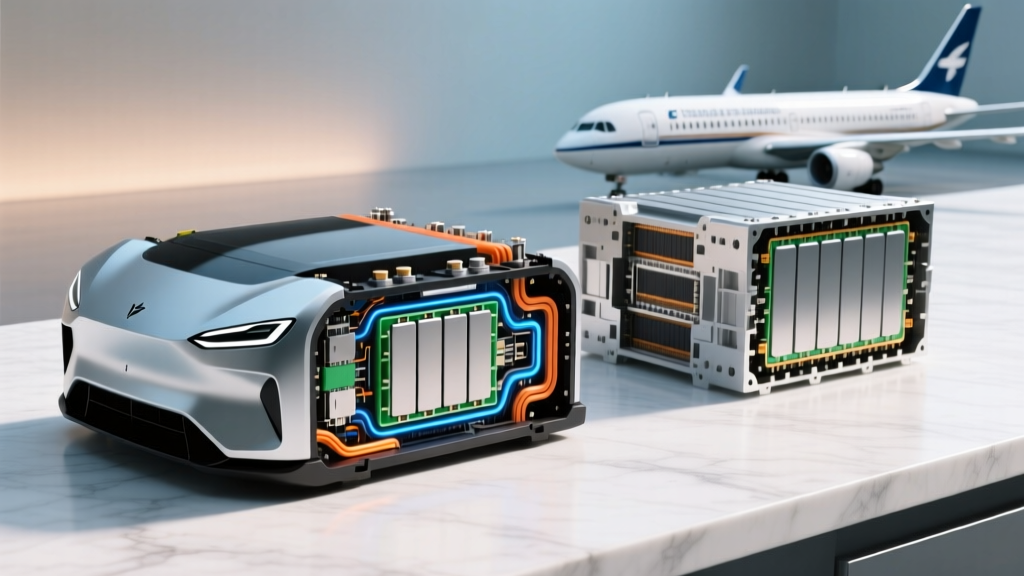
Aviation batteries — whether for eVTOL aircraft, electric trainers, or auxiliary power units — prioritize extreme safety margins, lightweight construction, and fault tolerance above all else. EV batteries, by contrast, optimize for cost per kilowatt-hour, cycle life, and fast-charging capability. Understanding the engineering trade-offs between these two worlds gives EV buyers a sharper lens for evaluating the pack under their floor.
How EV Battery Chemistry Compares to Aviation Standards
Aviation battery systems, particularly those being developed for electric flight, often use high-nickel NMC (nickel-manganese-cobalt) or NCA (nickel-cobalt-aluminum) chemistries pushed toward maximum energy density — sometimes exceeding 280 Wh/kg at the cell level. The FAA and EASA require redundant battery management systems, thermal runaway containment, and cycle-life margins far beyond automotive standards.
EV manufacturers have a wider menu. In 2026, two chemistries dominate the US market:
| Attribute | LFP (Lithium Iron Phosphate) | NMC/NCA (Nickel-based) |
|---|---|---|
| Energy Density (cell-level) | 160–180 Wh/kg | 230–280 Wh/kg |
| Typical Cycle Life | 3,000–5,000+ cycles | 1,000–2,000 cycles |
| Cold-Weather Performance | Moderate (10–20% range loss at 20°F) | Better (5–15% range loss at 20°F) |
| Thermal Stability | Excellent — higher runaway threshold | Good — requires more active management |
| Cost per kWh (2026 pack-level) | ~$95–$110 | ~$115–$140 |
| Common in 2026 US Models | Tesla Model 3 RWD, base Model Y, BYD, some Rivian configs | Hyundai Ioniq 5/6, Ford Mustang Mach-E ER, Chevy Equinox EV, Lucid, BMW iX |
| Aviation Parallel | Used in ground-support, drone platforms where longevity matters | Preferred in eVTOL/electric flight where weight is critical |
The aviation battery sector's obsession with energy density mirrors what EV buyers feel as range anxiety: every kilogram counts. But for a 4,500-lb SUV, the calculus shifts. LFP's lower energy density means a heavier pack for the same kWh, but the trade-off buys you dramatically longer cycle life and a safety margin that approaches aviation-grade thermal stability — without the aerospace price tag.
LFP vs NMC: Which Is Better for Your EV?
Neither chemistry is universally superior. The right answer depends on how you drive, where you live, and how long you plan to keep the car.
Choose LFP if: You plan to own the vehicle for 8–10+ years, you mostly charge at home (LFP tolerates regular 100% charges better), you live in a moderate climate, and you value long-term degradation resistance over maximum single-charge range. Tesla recommends charging LFP packs to 100% at least weekly to keep the BMS calibrated.
Choose NMC/NCA if: You need maximum range from a smaller, lighter pack (important for larger vehicles or frequent road trips), you live in a cold climate where NMC's superior low-temp performance matters, or you frequently DC fast-charge and want better charge-curve behavior in varied conditions.
Aviation battery engineers would recognize this trade-off immediately: it's the same weight-vs.-durability calculation that determines whether an electric trainer aircraft uses a high-density pack for endurance or a robust pack for training-cycle longevity.
How Long Do EV Batteries Actually Last?
The fear that EV batteries need replacement at 100,000 miles is not supported by current fleet data. Most modern packs are engineered to outlast the vehicle's structural and economic life.
Real-World Degradation Data Points (2024–2026 fleet studies):
- Tesla fleet average: ~12% capacity loss at 150,000 miles, per Tesla's 2024 Impact Report. Degradation curve flattens significantly after the initial 10–15% loss in the first 30,000 miles.
- Nissan Leaf (passive-cooled, older NMC): Higher degradation — 15–25% loss by 100,000 miles, primarily due to lack of active thermal management. This is largely a legacy issue; current liquid-cooled packs perform far better.
- Hyundai/Kia E-GMP platform (Ioniq 5, EV6): Anecdotal fleet data and fueleconomy.gov efficiency tracking shows 5–8% loss at 60,000 miles with active thermal management.
- LFP-equipped Tesla Model 3 RWD: Early fleet data suggests 5–7% loss at 80,000 miles, consistent with LFP's higher cycle-life rating.
For context, an aviation battery in a certified electric aircraft may be retired at 80% state of health (SoH) due to regulatory conservatism. An EV battery at 80% SoH still delivers usable daily range — a 300-mile EPA vehicle at 80% health still offers 240 miles, which covers the vast majority of American commutes and daily driving.
What Does the EV Battery Warranty Cover?
Federal law mandates a minimum 8-year/100,000-mile warranty on EV battery packs for emissions-related compliance, and most manufacturers exceed this baseline. Here's how major 2026 warranties compare:
| Manufacturer | Warranty Period | Capacity Retention Threshold | Notes |
|---|---|---|---|
| Tesla | 8 yr / 100,000 mi (Model 3/Y RWD); 8 yr / 120,000 mi (Long Range/Performance) | 70% | Covers defects and excessive degradation below threshold |
| Hyundai / Kia | 10 yr / 100,000 mi | 70% | Among the longest in the industry; covers Ioniq 5, EV6, EV9 |
| Ford | 8 yr / 100,000 mi | 70% | Applies to Mustang Mach-E, F-150 Lightning |
| General Motors (Chevy/Cadillac) | 8 yr / 100,000 mi | 70% | Ultium-platform vehicles: Equinox EV, Blazer EV, Lyriq |
| Rivian | 8 yr / 175,000 mi (R1T/R1S Max Pack) | 70% | Higher mileage threshold on larger packs |
| BMW | 8 yr / 100,000 mi | 70% | iX, i4, i7 |
The 70% retention threshold is industry-standard. If your battery drops below 70% of original capacity within the warranty period, the manufacturer will repair or replace modules (or the full pack) at no cost. In practice, warranty claims for degradation remain rare — most packs hold well above 70% even at high mileage.
Importantly, these warranties cover the high-voltage traction battery — not the 12V auxiliary battery that powers lights, infotainment, and computers. The 12V battery is a conventional lead-acid or lithium unit with a typical 3–5 year lifespan and is covered under the standard bumper-to-bumper warranty.
How Much Does an EV Battery Replacement Cost?
Out-of-warranty battery replacement is the single biggest fear for prospective EV buyers. Here's what the numbers actually look like in 2026:
| Vehicle / Platform | Battery Size (usable kWh) | Estimated Replacement Cost (parts + labor) | When Typically Needed |
|---|---|---|---|
| Tesla Model 3 RWD (LFP) | ~57 kWh | $10,000–$13,000 | Rarely before 200,000+ mi; most vehicles retired first |
| Tesla Model Y Long Range (NMC) | ~75 kWh | $13,000–$16,000 | Rarely before 180,000+ mi |
| Hyundai Ioniq 5 (NMC) | 77.4 kWh | $14,000–$18,000 | Largely theoretical; 10-yr warranty covers most ownership |
| Ford F-150 Lightning Extended Range | ~131 kWh | $22,000–$28,000 | Very large pack; module-level repair may reduce cost |
| Chevy Equinox EV (Ultium) | ~85 kWh | $14,000–$17,000 | GM's modular Ultium architecture allows partial pack replacement |
| Nissan Leaf (older, passive-cooled) | 40–62 kWh | $6,500–$9,000 | Most likely candidate for actual replacement due to age/thermal design |
These costs are significant, but context matters. Pack-level prices have fallen roughly 14% since 2022, and module-level repairs — replacing only degraded sections rather than the full pack — are increasingly common on platforms like GM's Ultium and Hyundai's E-GMP. Most EV batteries in 2026 simply never need replacement during the vehicle's useful life. The car's suspension, interior, and electronics typically reach end-of-life before the battery falls below usable capacity.
For comparison, aviation battery replacement for a certified electric aircraft can run $50,000–$150,000+ per pack, reflecting the extreme certification costs, lower production volumes, and redundant-system requirements that aerospace demands.
Factors That Accelerate (or Preserve) Battery Life
Not all miles are equal when it comes to battery wear. The same 100,000-mile odometer reading can mask very different battery health depending on how those miles were accumulated.
What degrades a battery faster:
- Frequent DC fast charging above 150 kW — Sustained high-C-rate charging generates heat. Occasional road-trip fast charging is fine; daily 350 kW sessions will accelerate wear. Most 2026 packs have sophisticated thermal management that mitigates this, but physics still applies.
- Consistently storing at 100% SoC — High state of charge increases internal stress, particularly on NMC chemistry. LFP tolerates 100% storage better, but the general best practice for NMC is to charge to 80% for daily use and 100% only when you'll drive immediately.
- Extreme heat exposure — Ambient temperatures above 95°F combined with high SoC accelerate electrolyte decomposition. Garage parking in hot climates meaningfully extends pack life.
- Deep discharges to 0% — Dropping below 5% regularly stresses the anode. The low-SoC buffer (typically 2–5% below the displayed 0%) protects against catastrophic damage, but habitual deep cycling still adds wear.
- Track use / sustained high-power discharge — Repeated hard acceleration and high-speed driving generates sustained heat that thermal management can only partially offset.
What preserves battery health:
- Home Level 2 charging at 7–11 kW — The gentlest way to charge; low heat generation, easy on the cells.
- Keeping SoC between 20–80% for daily use (NMC); 0–100% is fine for LFP with weekly full charges for BMS calibration.
- Preconditioning the battery before fast charging — Most 2026 EVs do this automatically when you navigate to a charger. It warms the pack to optimal temperature, improving charge speed and reducing stress.
- Using scheduled charging to avoid the battery sitting at high SoC for extended periods.
- Driving in moderate climates or using garage parking in extreme heat/cold.
How to Check and Monitor Battery Health (SoH)
State of Health (SoH) is a percentage representing your battery's current maximum capacity relative to its original factory capacity. A new EV starts at 100% SoH; a pack at 85% SoH has lost 15% of its original capacity.
Built-in vehicle tools:
- Tesla: The app and service menu show estimated range at 100% charge. Comparing this to the original EPA figure gives a rough SoH proxy. Tesla service centers can pull detailed cell-level logs showing capacity, internal resistance, and module balance.
- Hyundai/Kia: The infotainment system's EV diagnostics page shows battery condition as a percentage. The Bluelink / Kia Connect app provides remote monitoring.
- GM (Ultium): The myChevrolet/myCadillac app includes a battery health indicator, and dealers can run a full diagnostic via the OnStar system.
- Ford: The FordPass app provides battery state-of-charge and basic health indicators. Full SoH diagnostics available at dealers.
Third-party tools:
- OBD-II scanners with EV capability — Devices like the OBDLink SX paired with apps such as EVbatmon or LeafSpy (for Nissan) can read real-time cell voltages, pack temperature, and estimated SoH. These are popular among used-EV buyers doing pre-purchase inspections.
- Recurrent Auto / Geotab fleet data — If you're evaluating a used EV, services like Recurrent publish fleet degradation curves by model that provide benchmark comparisons.
Aviation battery monitoring is far more stringent — continuous cell-level voltage and temperature telemetry with automated alerts to maintenance crews. EV systems are converging toward this level of granularity, with 2026 battery management systems logging thousands of data points per drive cycle.
Emerging Battery Tech: Solid-State and Silicon Anodes
The next frontier in battery technology — relevant to both EVs and aviation — centers on two advances:
Solid-state batteries replace the liquid electrolyte with a solid ceramic, polymer, or sulfide conductor. Benefits include higher energy density (potentially 350–500 Wh/kg at the cell level), faster charging without lithium plating risk, and dramatically improved thermal stability. Toyota has announced a solid-state EV for 2027–2028 with a claimed 600+ mile range, though production volumes and pricing remain unconfirmed. Samsung SDI and QuantumScape are targeting 2027–2028 production timelines as well.
Silicon-dominant anodes replace graphite with silicon, which can store roughly 10x more lithium ions per gram. Companies like Sila Nanotechnologies and Group14 are already shipping silicon-anode cells for consumer electronics, with automotive-scale production expected in 2027–2029. The challenge: silicon expands ~300% during lithiation, requiring engineering solutions to prevent mechanical degradation over cycles.
For aviation battery applications, these technologies are particularly compelling because aerospace's willingness to pay premium prices makes them viable earlier than in cost-sensitive automotive applications. Expect eVTOL and electric trainer aircraft to adopt solid-state and silicon-anode cells 1–2 years before they reach mass-market EVs.
Realistic timeline for EV buyers: Solid-state and silicon-anode batteries will not meaningfully affect 2026–2028 vehicle purchases. Current NMC and LFP chemistries, combined with improving manufacturing quality, already deliver 150,000–200,000+ mile lifespans with manageable degradation. If you're buying an EV in the next 2–3 years, today's battery technology is mature, well-warrantied, and sufficient for the vast majority of ownership scenarios.
EV Battery FAQ
How long do EV batteries last in years and miles?
Most modern liquid-cooled EV batteries (2022–2026 model years) are designed to retain 70–85% of original capacity at 150,000–200,000 miles, which translates to 12–15+ years of typical use. Fleet data from Tesla, Hyundai, and GM supports this. The battery will likely outlast the vehicle's body, suspension, and interior.
How much does an EV battery cost to replace?
Full pack replacement ranges from roughly $6,500 (smaller, older packs like the Nissan Leaf) to $28,000 (large packs like the F-150 Lightning Extended Range). Most mainstream EVs fall in the $10,000–$18,000 range. Module-level repairs can reduce this cost by 40–60%. However, the majority of EV batteries never need replacement during normal ownership.
What does the EV battery warranty actually cover?
Federal law requires a minimum 8-year/100,000-mile warranty. Most manufacturers guarantee the battery will retain at least 70% of original capacity during this period. If it drops below that threshold due to degradation or defect, the manufacturer repairs or replaces it at no cost. This covers the high-voltage traction battery only — the 12V auxiliary battery is separate.
How do I check my EV's battery health?
Most 2026 EVs display battery condition in the infotainment system or companion app. For a more detailed read, OBD-II EV scanners can pull cell-level voltage data and estimated SoH. Tesla owners can request a battery health report from service. When buying used, compare the vehicle's current 100%-charge range to its original EPA rating for a quick estimate.
Is LFP or NMC better for daily driving?
For daily commuting with home charging, LFP is generally the better long-term choice: it tolerates 100% charges, degrades more slowly, and costs less. For road-trip-heavy driving, cold climates, or vehicles where maximum range per charge matters, NMC/NCA offers higher energy density and better cold-weather performance. Neither is wrong — they serve different use cases.
Does frequent DC fast charging damage the battery?
Occasional DC fast charging — like on road trips — has minimal impact on modern, liquid-cooled packs. Daily reliance on 150+ kW DC charging, especially in hot weather, will accelerate degradation over time. The battery management system actively limits charge rate when temperatures are extreme, but minimizing high-C-rate charging when you have the option (i.e., charging at home overnight on Level 2) is the single best practice for longevity.
How does EV battery tech compare to aviation battery standards?
Aviation batteries prioritize energy density and fault tolerance above cost, often using the same NMC chemistry as EVs but with far more redundancy, containment systems, and conservative cycle-life limits. EV batteries prioritize cost-efficiency and cycle longevity. The two sectors share the same fundamental lithium-ion science, but their engineering optimization targets diverge sharply — which is why an eVTOL battery pack might cost 5–10x more per kWh than an EV pack despite similar chemistry.
Whether you're evaluating a Tesla Model 3 with LFP, a Hyundai Ioniq 5 with NMC, or simply trying to understand what's happening inside the pack you already own, the data is clear: 2026-era EV batteries are durable, well-warrantied, and engineered for the long haul. The aviation sector's influence on battery safety standards has filtered down into automotive BMS design, thermal management, and cell monitoring — making today's EV batteries some of the most thoroughly engineered energy storage systems in consumer use.