The Short Answer: EV Truck Batteries Are Built to Outlast 200,000 Miles
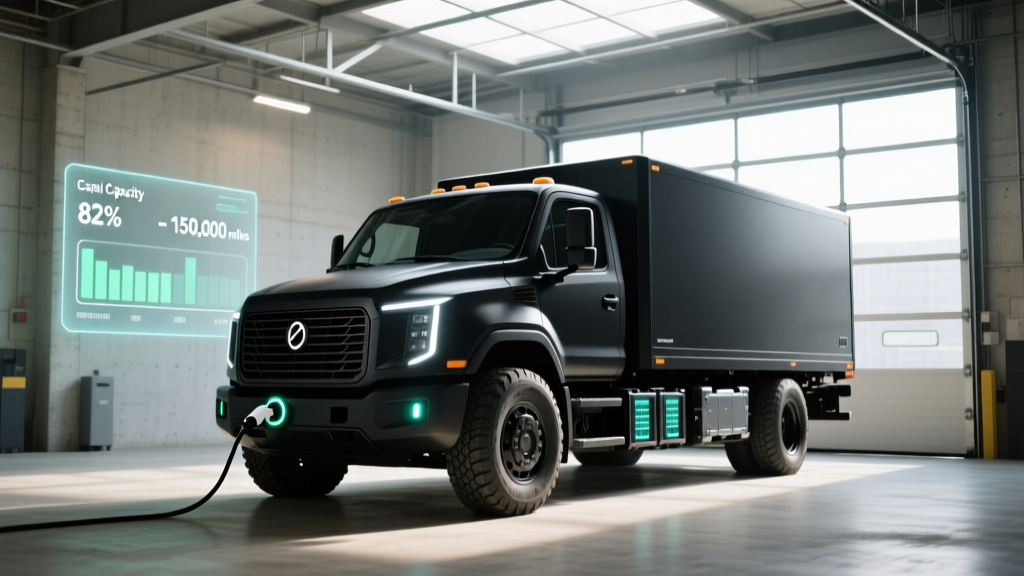
If you're shopping for a Ford F-150 Lightning, Chevrolet Silverado EV, or Rivian R1T and wondering how long the high-voltage traction battery will actually last, the data is encouraging. Based on manufacturer warranty commitments, third-party fleet data, and real-world owner reports through 2026, most electric truck battery packs are engineered to retain 70–80% of their original capacity after 150,000–200,000 miles or 8–10 years of typical use. Many will outlive the truck's body and suspension components.
That said, electric pickup trucks carry some of the largest battery packs on the road — the F-150 Lightning Extended Range uses a 131 kWh usable pack, and the Silverado EV tops out at roughly 200 kWh — which means degradation behavior, replacement cost, and care habits carry outsized financial weight compared to a compact EV sedan. Let's break down exactly what the data shows.
EV Truck Battery Degradation: What the Numbers Actually Show
Lithium-ion battery degradation is not linear. Most EV truck packs experience a steeper capacity loss in the first 1–2 years (roughly 3–5%), then settle into a slow, gradual decline of about 1–2% per year for the remainder of their life. This pattern holds across chemistries, though the rate varies.
Here's what real-world and manufacturer-reported data points tell us about electric truck battery longevity:
| Source / Model | Mileage / Time | Observed Capacity Retention | Notes |
|---|---|---|---|
| Ford F-150 Lightning (fleet data, ford.com) | 100,000 mi / ~3 yr | ~90–93% | Moderate DC fast-charging use |
| Rivian R1T (owner-reported aggregations) | 60,000 mi / ~2.5 yr | ~92–95% | Mostly Level 2 home charging |
| Tesla fleet-wide data (2022 Impact Report) | 150,000 mi | ~88% avg | Includes Model S/X; comparable NMC chemistry |
| GM Ultium platform (projected, gm.com) | 200,000 mi / 8 yr | ≥70% (warranty floor) | Silverado EV / Sierra EV target |
For a truck like the F-150 Lightning with an EPA-estimated 320 miles of range (Extended Range), a 10% loss at 100,000 miles means you'd still see roughly 288 miles of usable range — a meaningful but not crippling reduction. At 200,000 miles, expect closer to 256–275 miles depending on charging habits and climate.
LFP vs NMC in Electric Trucks: Chemistry Trade-Offs
Electric truck manufacturers are increasingly choosing between two dominant lithium-ion chemistries: NMC (nickel manganese cobalt) and LFP (lithium iron phosphate). Each has distinct trade-offs that matter more in a heavy truck than in a passenger sedan.
| Factor | LFP (Lithium Iron Phosphate) | NMC (Nickel Manganese Cobalt) |
|---|---|---|
| Energy density | Lower (~160 Wh/kg cell-level) | Higher (~220–260 Wh/kg cell-level) |
| Cycle life | 3,000–5,000+ cycles to 80% | 1,000–2,000 cycles to 80% |
| Cold-weather performance | Weaker below 14°F; slower charging | Better low-temp discharge and charge acceptance |
| Cost per kWh | ~$80–100/kWh (2026 cell pricing) | ~$110–140/kWh (2026 cell pricing) |
| Thermal stability | Superior; less prone to thermal runaway | Good with active thermal management |
| Weight penalty | Heavier pack for same kWh | Lighter pack for same kWh |
| Current truck applications | Ford F-150 Lightning Standard Range (98 kWh); Tesla Cybertruck RWD (announced) | F-150 Lightning Extended Range (131 kWh); Rivian R1T (Large/Max); Silverado EV (200 kWh) |
For truck buyers, the choice comes down to use case. If you need maximum range for towing or long highway runs, NMC packs deliver more energy in a lighter package — critical when payload and towing capacity matter. If you primarily drive locally, charge at home, and want the longest possible cycle life with lower replacement risk, LFP is the more durable and economical choice.
LFP packs also tolerate being held at 100% state of charge far better than NMC, which simplifies daily use. Ford recommends charging the F-150 Lightning Standard Range (LFP) to 100% regularly, while Extended Range (NMC) owners should target 80–90% for daily driving.
What the Battery Warranty Actually Covers
Federal law mandates that EV battery packs carry a minimum warranty of 8 years or 100,000 miles. In California and states that follow CARB (California Air Resources Board) emissions standards, that extends to 10 years or 150,000 miles. Most truck manufacturers meet or exceed these floors.
| Truck Model | Warranty Term | Capacity Retention Threshold | Coverage Scope |
|---|---|---|---|
| Ford F-150 Lightning | 8 yr / 100,000 mi | 70% of original capacity | Defects + excessive degradation |
| Rivian R1T | 8 yr / 175,000 mi | 70% of original capacity | Defects + excessive degradation |
| Chevrolet Silverado EV | 8 yr / 100,000 mi | 70% of original capacity | Defects + excessive degradation |
| Tesla Cybertruck (AWD) | 8 yr / 120,000 mi | 70% of original capacity | Defects + excessive degradation |
| GMC Sierra EV | 8 yr / 100,000 mi | 70% of original capacity | Defects + excessive degradation |
The critical number is the 70% capacity retention threshold. If your truck's battery drops below 70% of its original usable kWh within the warranty period, the manufacturer is obligated to repair or replace it to bring it back above that threshold. In practice, this almost always means module-level replacement rather than a full pack swap, which reduces repair time and cost.
Warranty claims for battery degradation remain rare. Based on data from major automakers and third-party warranty administrators, fewer than 2% of EV battery packs require warranty service for degradation within the first 8 years. Manufacturing defects (bad cells, BMS faults, coolant leaks) account for a slightly higher share of claims but are still uncommon.
EV Truck Battery Replacement Costs: What You'd Actually Pay
If your battery falls outside the warranty period and requires replacement, the cost is significant but rarely catastrophic — and it's declining yearly. Here's what full-pack replacement looks like across current electric trucks:
| Truck Model | Pack Size (Usable kWh) | Chemistry | Estimated Full-Pack Replacement | Typical Replacement Timeline |
|---|---|---|---|---|
| F-150 Lightning Std Range | 98 kWh | LFP | $12,000–$16,000 | Rarely before 200,000+ mi |
| F-150 Lightning Ext Range | 131 kWh | NMC | $18,000–$24,000 | Rarely before 180,000+ mi |
| Rivian R1T (Large Pack) | 128 kWh | NMC | $17,000–$22,000 | Rarely before 180,000+ mi |
| Rivian R1T (Max Pack) | 149 kWh | NMC | $20,000–$26,000 | Rarely before 170,000+ mi |
| Silverado EV (Max Range) | ~200 kWh | NMC (Ultium) | $25,000–$35,000 | Rarely before 180,000+ mi |
| Tesla Cybertruck (AWD) | ~123 kWh | NMC | $16,000–$22,000 | Rarely before 180,000+ mi |
Several important context points on these figures:
- Module-level repair is far cheaper. Most degradation issues involve individual modules or cell groups. Replacing 1–3 modules typically costs $2,000–$6,000 rather than a full pack swap.
- Cell prices continue to fall. Battery cell pricing has dropped from ~$180/kWh in 2022 to roughly $90–$110/kWh in 2026, and replacement costs track this decline. A pack that costs $20,000 to replace today may cost $12,000–$14,000 by 2032.
- Most trucks are retired or sold before needing a pack replacement. The average light truck is scrapped or sold at 180,000–220,000 miles. By that point, a degraded battery still provides 75–85% range — adequate for many second-owner use cases.
- Refurbished packs are emerging. Third-party suppliers and OEM programs are beginning to offer remanufactured packs at 40–60% of new-pack pricing.
Factors That Accelerate (or Protect) Truck Battery Life
Not all miles are equal when it comes to battery wear. The following factors have the most measurable impact on long-term capacity retention in electric trucks:
DC Fast-Charging Frequency
Occasional DC fast charging (1–2 sessions per week at 150–250 kW) has minimal impact on modern truck batteries with active liquid thermal management. However, daily DC fast charging — particularly at 350 kW chargers without adequate preconditioning — can accelerate degradation by 1–3% over a 100,000-mile period compared to primarily Level 2 charging. The heat generated during high-C-rate charging stresses cell chemistry. If you rely on public DC fast charging, try to limit sessions to 80% SoC and use the truck's navigation-based battery preconditioning when available.
State of Charge Habits
For NMC packs (most Extended Range and Max Range trucks), the sweet spot is 20–80% SoC for daily driving. Storing the truck at 100% for extended periods (days or weeks) accelerates calendar degradation. LFP packs are more tolerant of 100% storage, which is one reason Ford recommends regular full charges for the Standard Range Lightning.
Extreme Temperatures
Battery chemistry degrades faster when repeatedly exposed to high heat (sustained ambient above 95°F) or extreme cold (below 10°F) without thermal management intervention. Modern truck packs have robust liquid cooling and heating systems that mitigate this, but parking in shade or a garage in hot climates and using preconditioning in cold climates measurably extends life.
Towing and Heavy Load Cycles
Electric trucks that regularly tow heavy trailers (8,000+ lbs) cycle through deeper discharge and higher charge rates, which adds wear. A truck used primarily for towing may see 1–2% more degradation over 100,000 miles compared to one used for commuting. This is still well within warranty margins.
- Charge to 80% daily for NMC packs; 100% is fine for LFP
- Use Level 2 home charging as your primary method
- Limit DC fast charging to road trips or when necessary
- Enable battery preconditioning before fast-charging sessions
- Avoid storing the truck at 100% or below 10% for more than a few days
- Park in shade or a garage during sustained heat waves
- Plug in during extreme cold so the thermal management system can maintain pack temperature
- Keep the truck's software updated — BMS improvements are delivered OTA
How to Check Your Truck's Battery Health (State of Health)
Most EV trucks provide some form of battery health monitoring, though the level of detail varies by manufacturer:
Ford F-150 Lightning: The SYNC infotainment system includes a battery health indicator under the EV settings menu. Ford also provides a detailed State of Health (SoH) readout through dealership diagnostic tools. The FordPass app shows estimated range trends over time, which indirectly reflects degradation.
Rivian R1T: The Rivian app and in-vehicle display show current usable capacity relative to the original spec. Rivian service centers can pull a full SoH report with per-module voltage data during routine service visits.
Tesla Cybertruck: Tesla's service menu (accessible via the touchscreen) includes a battery health test that runs a capacity estimation cycle. The Tesla app also logs range-at-full-charge data over time, letting you track the degradation curve yourself.
GM (Silverado EV / Sierra EV): The myChevrolet/myGMC apps include a battery health section. GM dealerships can run an Ultium-specific diagnostic that provides module-level balance and capacity data.
For a more independent check, third-party OBD-II dongles and apps like OBDeleven or manufacturer-specific scan tools can read the Battery Management System (BMS) data directly, including total energy throughput, individual cell voltages, and calculated SoH percentage. This is the same data dealerships use.
What's Next: Solid-State and Silicon-Anode Batteries for Trucks
Several next-generation battery technologies are in development that could significantly change the longevity and cost equation for electric trucks — but none are available in production vehicles as of 2026.
Solid-state batteries replace the liquid electrolyte with a solid ceramic or polymer layer, promising higher energy density (potentially 350–400 Wh/kg), faster charging, and dramatically longer cycle life (5,000–10,000+ cycles). Toyota, Samsung SDI, and QuantumScape are leading development, with limited production expected in select passenger vehicles around 2027–2028. Truck applications would likely follow in the 2029–2031 timeframe given the larger pack sizes and cost sensitivity.
Silicon-anode batteries (from companies like Sila Nanotechnologies and Group14) increase energy density by 20–40% over current graphite anodes. These are closer to market — GM has announced silicon-anode integration in some Ultium cells — but widespread truck adoption is expected around 2027–2029.
Sodium-ion batteries offer a lower-cost, cobalt-free alternative with excellent cycle life but lower energy density. CATL and other manufacturers are producing these for light commercial vehicles in China. They may appear in entry-level or fleet-spec electric trucks in the late 2020s, particularly for applications where weight and range are less critical than cost and durability.
These technologies are promising but remain forward-looking. If you're buying an electric truck in 2026, the current-generation LFP and NMC packs represent mature, well-tested chemistry with proven longevity data.
Frequently Asked Questions
How long do EV truck batteries last in years?
Based on current degradation data and warranty structures, expect an electric truck battery to provide reliable service for 15–20 years under typical use (10,000–15,000 miles/year). Capacity will decline gradually — expect roughly 85–90% retention at 10 years — but the pack rarely fails catastrophically.
Is it true that replacing an EV truck battery costs more than the truck?
No. A full-pack replacement for an F-150 Lightning Extended Range runs $18,000–$24,000 in 2026. That's significant, but well below the $55,000–$80,000+ MSRP of the truck itself. Module-level repairs are far cheaper ($2,000–$6,000), and cell prices continue declining. Most trucks never need a full replacement during their first ownership.
Does frequent fast charging ruin an electric truck battery?
"Ruin" is too strong, but daily DC fast charging does measurably accelerate wear. Trucks charged primarily on Level 2 (240V, 7–19 kW) show 1–3% better capacity retention over 100,000 miles compared to those charged daily at 150+ kW DC stations. Modern thermal management systems mitigate much of the heat damage, so occasional fast charging (road trips, a few times per month) has negligible impact.
Which is better for truck batteries — LFP or NMC?
Neither is universally better. LFP wins on cycle life (3,000–5,000+ cycles vs 1,000–2,000), cost ($80–100/kWh vs $110–140/kWh), and tolerance for 100% SoC storage. NMC wins on energy density (more range in a lighter pack), cold-weather performance, and fast-charge acceptance. For a work truck driven locally with home charging, LFP is ideal. For a truck that tows long distances or operates in cold climates, NMC is the better fit.
Does the battery warranty cover towing-related degradation?
Yes. Manufacturer battery warranties cover capacity loss regardless of whether it results from commuting, towing, or general use — as long as the truck hasn't been abused (e.g., repeated deep discharges to 0% and storage in that state, aftermarket modifications to the battery system, or flood/fire damage). Normal towing within the truck's rated capacity is explicitly covered.
How do I know if my truck battery needs replacement?
You'll notice a meaningful reduction in range at full charge — typically when capacity drops below 75–80%, the real-world impact becomes noticeable in daily driving. The truck's BMS will flag warnings if individual modules are imbalanced or failing. Most owners will see gradual range reduction rather than sudden failure. If capacity drops below 70% within the warranty period, contact the dealer for a warranty claim.