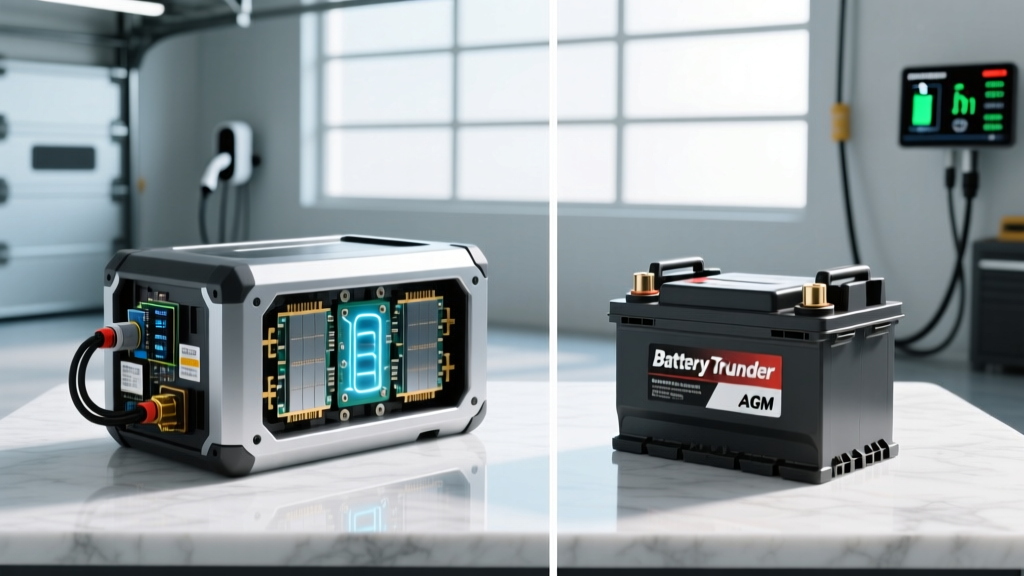
If you've searched for a "battery tender AGM battery" in the context of your electric vehicle, you're likely encountering two very different pieces of hardware. A Battery Tender brand charger paired with an AGM (Absorbent Glass Mat) 12V battery is a maintenance setup for the auxiliary battery found in every EV — the small unit that runs your lights, infotainment, and door locks. But the battery that actually defines your EV ownership experience is the high-voltage traction battery sitting under the floor: a 60–120 kWh pack that powers the motor and determines your range, charging speed, and long-term cost of ownership.
This guide focuses squarely on that traction battery — the chemistry inside it, how it degrades, what the warranty actually covers, and what a replacement really costs in 2026. We'll also briefly clarify where the 12V AGM battery fits in, so you can stop conflating the two.
The 12V AGM Battery vs. the High-Voltage Traction Pack: Clearing the Confusion
Every EV sold in the U.S. carries two batteries:
- 12V auxiliary battery (lead-acid or, increasingly, lithium iron phosphate): Powers the vehicle's computers, lighting, door actuators, and safety systems when the main contactor is open. Typical capacity: 12–20 Ah. This is the battery a Battery Tender maintainer is designed to service.
- High-voltage traction battery (NMC, NCA, or LFP lithium-ion): Powers the drive motor(s). Typical usable capacity: 58–118 kWh. This is the battery covered by the federal 8-year/100,000-mile mandate and the one that determines your EPA range.
A Battery Tender AGM battery maintainer outputs roughly 1.25 amps at 12V — appropriate for keeping a small lead-acid or AGM auxiliary battery topped up during storage. It has zero capability to charge, maintain, or test your high-voltage traction pack. If your EV won't start, the culprit is usually the 12V system, not the main battery — and a $50 Battery Tender unit can prevent that. But the economics, longevity questions, and chemistry discussions that dominate EV ownership all revolve around the traction battery. That's what the rest of this guide covers.
LFP vs. NMC vs. NCA: The Chemistry Under Your Floor
Not all EV batteries are built the same. The cathode chemistry determines energy density, lifespan, cold-weather behavior, and cost. In 2026, three chemistries dominate the U.S. market:
- NMC (Nickel Manganese Cobalt): The historical workhorse. Used in most long-range vehicles — Hyundai Ioniq 5, Ford Mustang Mach-E Extended Range, BMW iX. Offers the highest energy density (roughly 250–280 Wh/kg at the cell level), which translates to more range in a lighter, smaller pack. Trade-off: fewer charge cycles before measurable degradation, and reliance on cobalt raises supply-chain and ethical concerns.
- NCA (Nickel Cobalt Aluminum): Tesla's primary chemistry for Long Range and Performance trims (Model 3, Model Y, Model S). Similar energy density to NMC (~260 Wh/kg) with slightly better thermal stability. Same cobalt dependency.
- LFP (Lithium Iron Phosphate): The fast-growing challenger. Now standard in Tesla Model 3/Y RWD, the base Ford Mustang Mach-E Select, and several Chinese-market imports. Lower energy density (~170–200 Wh/kg), meaning a heavier pack for the same range — but dramatically longer cycle life, no cobalt, lower cost per kWh, and the ability to charge to 100% daily without accelerated degradation.
| Attribute | LFP | NMC | NCA |
|---|---|---|---|
| Energy density (cell-level) | 170–200 Wh/kg | 250–280 Wh/kg | 250–270 Wh/kg |
| Typical cycle life to 80% SoH | 3,000–5,000 cycles | 1,000–2,000 cycles | 1,200–2,000 cycles |
| Recommended daily SoC limit | 100% (beneficial) | 80% | 80% |
| Cold-weather range loss (20°F) | ~30–40% | ~20–30% | ~20–30% |
| Cost per kWh (2026 pack-level) | ~$95–$115 | ~$125–$150 | ~$120–$145 |
| Cobalt content | None | Yes (5–15%) | Yes (~5%) |
| Thermal runaway risk | Very low | Moderate | Moderate |
| Common in (2026 U.S.) | Tesla Model 3/Y RWD, Mach-E Select, BYD | Ioniq 5/6, EV6, Mach-E ER, Rivian | Tesla LR/Performance, Lucid Air |
How Long Do EV Batteries Actually Last?
The short answer: almost certainly longer than you'll own the car. The long answer requires data, not anecdotes.
According to aggregated fleet data from sources including Recurrent Auto and Tesla's 2024 Impact Report, the average EV battery retains approximately 85–92% of its original capacity after 100,000 miles (roughly 5–7 years of average U.S. driving). Degradation is not linear — it follows a curve that's steepest in the first 20,000–30,000 miles (typically 3–5% loss as the solid electrolyte interphase layer stabilizes), then flattens significantly. A 2025 study of over 10,000 Tesla Model 3 packs showed median capacity retention of 88% at 150,000 miles.
Real-world data points by chemistry:
| Mileage | NMC/NCA Avg. Retention | LFP Avg. Retention | Notes |
|---|---|---|---|
| 25,000 mi | 94–96% | 97–99% | Initial SEI formation; steepest drop |
| 50,000 mi | 91–94% | 95–98% | Curve flattens substantially |
| 100,000 mi | 85–90% | 91–96% | Most packs still well above warranty threshold |
| 150,000 mi | 80–87% | 88–94% | NMC packs approaching warranty trigger zone |
| 200,000 mi | 75–83% | 84–91% | LFP packs typically still above 80% SoH |
Sources: Recurrent Auto fleet data (2025), Tesla Impact Report, Geotab battery health study. Individual results vary with climate, charging habits, and thermal management system quality.
A critical nuance: degradation does not mean the battery "dies." An NMC pack at 80% State of Health still delivers usable daily range — a 300-mile EPA vehicle at 80% SoH still provides ~240 miles EPA-equivalent, which covers 95% of American daily driving needs according to fueleconomy.gov data.
What the Battery Warranty Actually Covers
Federal law mandates a minimum battery warranty of 8 years or 100,000 miles (whichever comes first) for all light-duty EVs sold in the U.S. California Air Resources Board (CARB) states extend this to 10 years or 150,000 miles. But the details vary significantly by manufacturer, and the threshold that triggers a warranty claim is not "any degradation" — it's a specific capacity floor.
| Manufacturer | Warranty Term | Capacity Threshold | Coverage Notes |
|---|---|---|---|
| Tesla (Model 3/Y RWD — LFP) | 8 yr / 100,000 mi | 70% retention | Transferable; covers defects + degradation below threshold |
| Tesla (Model 3/Y LR/Perf — NCA) | 8 yr / 120,000 mi | 70% retention | Longer mileage on LR/Performance trims |
| Hyundai / Kia (Ioniq 5/6, EV6) | 10 yr / 100,000 mi | 70% retention | Among the longest terms; first-owner 10yr/100k, second-owner 5yr/60k in some states |
| Ford (Mach-E, F-150 Lightning) | 8 yr / 100,000 mi | 70% retention | Covers battery components + capacity loss below threshold |
| GM (Ultium: Equinox EV, Blazer EV, Silverado EV) | 8 yr / 100,000 mi | 70% retention | Module-level replacement available, reducing out-of-warranty cost |
| Rivian (R1T, R1S) | 8 yr / 175,000 mi | 70% retention | Highest mileage threshold among major OEMs |
| BMW (iX, i4, i7) | 8 yr / 100,000 mi | 70% retention | BMW offers optional battery certificate extension in some markets |
Key takeaway: the warranty triggers only when capacity drops below 70% of original within the term. A pack at 72% SoH at 95,000 miles is functioning "within spec" even though you've lost 28% of your original range. In practice, very few packs fall below 70% within the warranty period unless there's a manufacturing defect or extreme abuse (repeated 100% SoC storage in high heat, for instance).
EV Battery Replacement Cost: The Numbers
This is where fear-mongering runs rampant. Let's anchor to real data. Full traction battery replacement is rare — less than 1.5% of EVs require it within the first 10 years, per Recurrent Auto's 2025 fleet analysis. When it does happen, it's typically due to a manufacturing defect (covered by warranty), physical damage from a collision or road debris, or — in older first-generation EVs — accelerated degradation from poor thermal management.
For out-of-warranty replacements in 2026:
| Vehicle | Battery Size (Usable kWh) | Chemistry | Full Pack Replacement (Parts + Labor) | Module Repair (if available) |
|---|---|---|---|---|
| Tesla Model 3 RWD | 57.5 kWh | LFP | $12,000–$16,000 | N/A (structural pack) |
| Tesla Model Y Long Range | 78 kWh | NCA | $16,000–$22,000 | N/A (structural pack) |
| Hyundai Ioniq 5 | 72.6 kWh | NMC | $14,000–$18,000 | $3,500–$5,500 per module |
| Ford Mustang Mach-E ER | 88 kWh | NMC | $18,000–$24,000 | $4,000–$6,000 per module |
| Ford F-150 Lightning ER | 131 kWh | NMC | $28,000–$36,000 | Module repair available; varies |
| Chevrolet Equinox EV | 85 kWh | NMC (Ultium) | $16,000–$20,000 | ~$2,800–$4,000 per module |
| Rivian R1T (Large Pack) | 128 kWh | NMC | $25,000–$33,000 | Limited module service |
Estimates based on OEM parts pricing, independent EV shop quotes, and Kelley Blue Book service data as of early 2026. Prices decline roughly 5–8% annually as cell costs fall.
Context matters enormously here. A $20,000 battery replacement sounds catastrophic — but it typically occurs at 200,000+ miles on a vehicle that has already saved $8,000–$14,000 in fuel and maintenance compared to a gas equivalent. And pack prices continue to fall: Bloomberg NEF's 2025 battery price survey pegged the volume-weighted average at $115/kWh at the pack level, down from $141/kWh in 2023. By the time most current EVs need an out-of-warranty replacement (2035–2040), replacement packs are projected to cost 40–60% less than today's figures.
What Degrades an EV Battery — and What Doesn't
Understanding degradation factors lets you make informed trade-offs rather than following rigid (and often unnecessary) rules.
Factors that accelerate degradation:
- Sustained high State of Charge: Storing an NMC/NCA pack at 100% SoC for days or weeks, especially in heat, stresses the cathode. This is why OEMs recommend 80% daily limits for these chemistries.
- Extreme heat exposure: Ambient temperatures above 95°F combined with high SoC accelerate electrolyte decomposition. Active liquid cooling (standard on most 2026 EVs) mitigates this substantially, but parking in shade still helps in Phoenix or Houston summers.
- Exclusive DC fast charging: Frequent use of 150+ kW DC fast charging without preconditioning generates heat stress. Occasional fast charging is fine; daily fast charging without home Level 2 access shows measurable acceleration in degradation studies.
- Deep discharges to 0%: Letting the pack sit at or near 0% SoC for extended periods causes copper dissolution in the anode current collector.
Factors with minimal impact (despite common myths):
- Occasional DC fast charging: Road-trip fast charging 2–4 times per month shows negligible degradation difference vs. Level 2-only charging in controlled studies.
- Regenerative braking: Regen current is well within the pack's charge C-rate tolerance. It does not "wear out" the battery.
- Cold weather operation: Cold temporarily reduces range (20–40% at 20°F) but does not permanently degrade the battery — unless you fast-charge a cold pack without preconditioning, which can cause lithium plating. Every 2026 EV with DC fast charging capability includes automatic preconditioning when a charger is set as the navigation destination.
Practical Battery Care Checklist for 2026 EV Owners
- NMC/NCA owners: Set daily charge limit to 80%. Charge to 100% only when departing on a road trip, and begin driving shortly after reaching full.
- LFP owners: Charge to 100% at least once per week — this is required for accurate SoC calibration and is beneficial for LFP chemistry.
- All owners: Plug in when possible, even at Level 1 (120V). A plugged-in EV can run battery thermal management without depleting the pack.
- Storage: If leaving the vehicle for 2+ weeks, set SoC to ~50% (NMC/NCA) or ~60% (LFP) and leave it plugged in with a scheduled departure time to allow periodic thermal management cycles.
- Fast charging: Always navigate to the charger using the vehicle's built-in nav (or app preconditioning) to enable battery preconditioning. This protects the pack and dramatically improves charge speed.
- 12V AGM auxiliary battery: If storing the EV for 30+ days, a Battery Tender maintainer on the 12V AGM battery prevents the common "dead 12V, car won't start" scenario. This has no effect on the traction battery.
Monitoring Your Battery's State of Health
Most 2026 EVs don't expose a simple "battery health percentage" on the dashboard the way your phone does. Here's how to actually check SoH:
- In-vehicle energy app: Tesla, Hyundai/Kia, and GM Ultium vehicles display a "battery health" or "range at 100%" metric. Compare the displayed 100% range to the original EPA sticker — a persistent drop beyond seasonal variation indicates degradation.
- OBD-II diagnostic tools: Devices like the OBDeleven (for VW/Hyundai/Kia) or Tesla-specific scan tools can read the BMS (Battery Management System) reported SoH directly. Expect to pay $50–$150 for the hardware.
- Dealer diagnostic report: Any authorized service center can pull a full battery health report during a routine service visit. Request this specifically — it's not always included in standard inspections.
- Third-party services: Recurrent Auto offers a free battery health report that connects to your vehicle's telematics and provides degradation tracking over time with comparison to similar vehicles in their fleet.
- Manual calculation: Charge to 100% (for LFP) or 80% and extrapolate (for NMC/NCA), note the displayed range, and compare to the original spec. A 2026 Ioniq 5 that originally showed 303 miles EPA at 100% and now shows 275 miles at 100% has approximately 91% SoH — well within normal parameters at any mileage under 100,000.
What's Next: Solid-State and Silicon-Anode Batteries
Emerging battery technologies generate enormous hype. Here's the realistic 2026 perspective:
Silicon-anode lithium-ion: Already in limited production. Sila Nanotechnologies' silicon-dominant anode cells are in the 2026 Mercedes G-Class EV, offering roughly 20% more energy density than conventional graphite anodes. Expect gradual expansion to premium models through 2028, with mainstream adoption likely by 2030–2032 as manufacturing scales.
Solid-state batteries: Toyota has announced a solid-state pack targeting 2027–2028 production in limited volumes, claiming 750 km (WLTP) range and 10-minute 10–80% charging. Nissan and Samsung SDI have similar timelines. However, "limited production" means premium, low-volume models initially. Broad market availability at competitive pricing is realistically a 2030–2035 proposition. Manufacturing yield, cost, and scaling remain unsolved challenges at volume.
Sodium-ion batteries: CATL and BYD are producing sodium-ion cells for entry-level EVs in China, with energy density around 140–160 Wh/kg. These won't appear in U.S.-market vehicles before 2028 at the earliest, and are targeted at sub-$25,000 city cars rather than long-range models.
None of these technologies should factor into a 2026 purchase decision. Current lithium-ion packs (LFP and NMC/NCA) are mature, well-understood, and backed by extensive warranty coverage. Waiting for solid-state is waiting for a technology that won't be broadly available or affordable for 5–10 years — during which time current EVs continue to depreciate less than feared and save owners money daily.
Frequently Asked Questions
How long do EV batteries last in years and miles?
Based on 2025 fleet data, the median EV traction battery retains 85–92% capacity at 100,000 miles (5–7 years) and 80–87% at 150,000 miles (8–10 years). LFP chemistries outperform NMC/NCA by 5–8 percentage points at equivalent mileage. Most packs outlast the vehicle's economic life. Complete failure before 200,000 miles is rare (under 1.5% of the fleet) and usually covered by warranty if it occurs within 8 years/100,000 miles.
How much does an EV battery cost to replace?
Out-of-warranty full-pack replacement ranges from $12,000 (Tesla Model 3 RWD, LFP) to $36,000 (F-150 Lightning Extended Range, 131 kWh NMC) in 2026. Module-level repair, available on Hyundai/Kia and GM Ultium platforms, reduces cost to $2,800–$6,000 per module. These prices are declining 5–8% annually. Most owners never face this cost — the pack is typically still functional when the vehicle is retired or traded.
What does the EV battery warranty cover?
All U.S.-market EVs carry a minimum 8-year/100,000-mile battery warranty (10yr/150k in CARB states). Coverage includes manufacturing defects and capacity loss below a defined threshold — typically 70% of original capacity. The warranty does not cover damage from collisions, flooding, or aftermarket modifications. It is transferable to subsequent owners in most cases, though Hyundai/Kia reduce the term for second owners in some jurisdictions.
How do I check and maximize my EV battery health?
Check SoH via your vehicle's energy app, an OBD-II scan tool, a dealer diagnostic report, or a service like Recurrent Auto. Maximize longevity by following the 80% daily limit (NMC/NCA) or weekly 100% charge (LFP), keeping the vehicle plugged in when parked for extended periods, using navigation-based preconditioning before DC fast charging, and avoiding prolonged storage at 100% or near-0% SoC.
LFP vs. NMC — which battery chemistry is better?
Neither is universally better — they serve different priorities. Choose LFP if you want maximum cycle life, the ability to charge to 100% daily, lower cost, and don't need the absolute longest range in the lightest package. Choose NMC/NCA if you need maximum range per pound (important for larger vehicles and long-distance driving) and accept the 80% daily charge limit. For most daily commuters, LFP is the pragmatic choice. For road-trip-heavy drivers or those in very cold climates (where LFP's greater cold-weather range loss matters), NMC/NCA remains preferable.
Does a Battery Tender AGM battery maintainer help my EV's main battery?
No. A Battery Tender AGM battery maintainer services only the 12V auxiliary battery — the small lead-acid or AGM unit that powers your EV's electronics when the main contactor is off. It cannot charge, test, or maintain the high-voltage traction battery. However, keeping the 12V AGM battery healthy with a maintainer during long storage prevents the common "dead 12V" issue that can strand an EV even when the main pack is fully charged.
Sources cited: Recurrent Auto Battery Degradation Research (2025), U.S. EPA fueleconomy.gov, Tesla 2024 Impact Report, Bloomberg NEF Battery Price Survey 2025, manufacturer warranty documentation. Tax credit eligibility under IRS §30D is subject to income, MSRP, and battery sourcing requirements — consult irs.gov or a tax professional for your specific situation.