Why a "2008 Ford Ranger Battery" Search Leads Straight to EV Battery Science
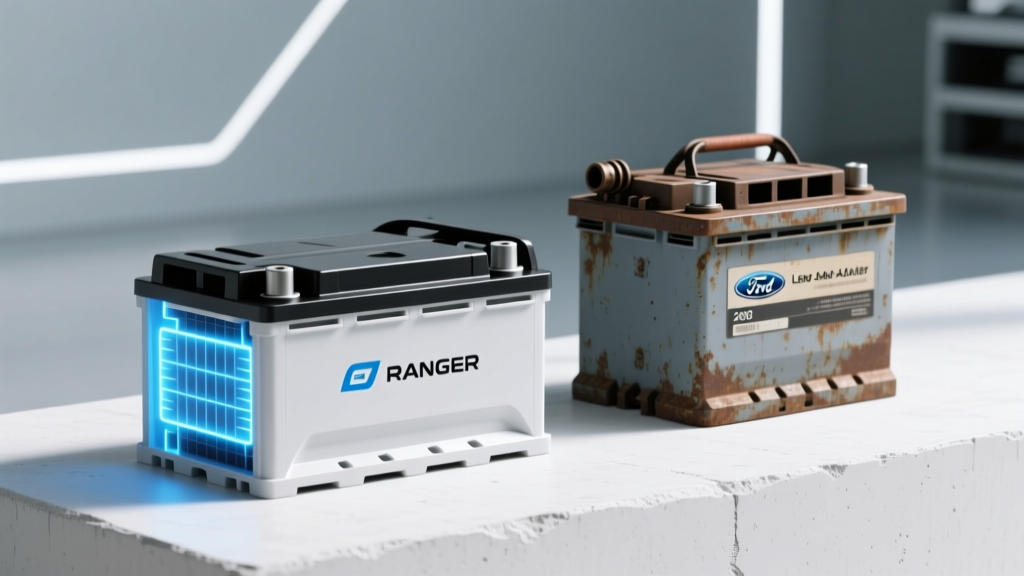
If you've ever typed 2008 Ford Ranger battery into a search bar, you were probably looking for a Group 65, 12-volt lead-acid battery that costs around $150-$220 at an auto-parts store. That battery starts an internal-combustion engine and powers the radio. It has nothing to do with the 60-100+ kWh high-voltage lithium-ion traction packs that propel today's electric vehicles — yet the confusion between the two is one of the most common sources of EV misinformation online.
This guide draws a hard line between the 12V auxiliary battery (yes, EVs have one too) and the high-voltage traction battery, then goes deep on what actually matters for EV owners and shoppers in 2026: chemistry, degradation, warranty, replacement cost, and the habits that extend pack life.
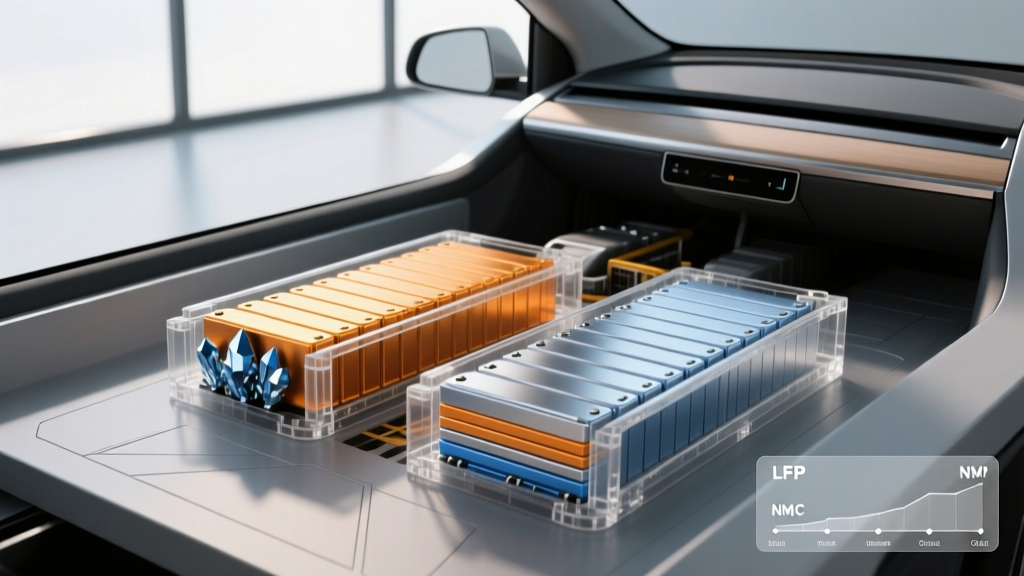
Battery Chemistry 101: LFP vs. NMC/NCA
Every modern EV traction battery uses lithium-ion cells, but the cathode chemistry varies. The two dominant families in 2026 are LFP (lithium iron phosphate) and NMC/NCA (nickel manganese cobalt / nickel cobalt aluminum). Here's how they stack up:
| Attribute | LFP (LiFePO₄) | NMC / NCA |
|---|---|---|
| Energy density (cell-level) | ~160-180 Wh/kg | ~220-260 Wh/kg |
| Typical cycle life | 3,000-5,000+ cycles to 80% SoH | 1,500-2,500 cycles to 80% SoH |
| Cold-weather performance | More range loss below 32°F; slower DC fast charge unless preconditioned | Better low-temp conductivity; faster cold-weather charging |
| Cost per kWh (pack-level, 2026) | ~$90-$110 | ~$120-$145 |
| Thermal stability / safety | Higher onset temp for thermal runaway (~270°C) | Lower onset (~210°C); requires more robust BMS cooling |
| Charging to 100% daily | Recommended by most OEMs (helps BMS cell balancing) | Generally discouraged long-term; 80% daily is preferred |
| Notable 2026 applications | Tesla Model 3/Y RWD, Ford Mustang Mach-E Select (LFP option), BYD global models | Hyundai Ioniq 5/6, Kia EV6/EV9, Ford F-150 Lightning Extended, Chevy Equinox EV |
Which is better? Neither, universally. LFP wins on longevity, cost, and safety — ideal for daily commuters who charge at home and don't need maximum range. NMC wins on energy density and cold-weather usability — better for long-range trims and northern-climate drivers. Tesla, Ford, and others now offer both chemistries across their lineups so buyers can choose based on use case.
How Long Do EV Batteries Actually Last? (Degradation Data)
The short answer: far longer than most buyers fear. The high-voltage traction pack in a 2026 EV is engineered to outlast the vehicle's economic life in the majority of cases.
- 1 year / ~15,000 mi: ~1-3% capacity loss (initial formation loss, then plateau)
- 3 years / ~45,000 mi: ~4-7% loss typical (NMC); ~2-4% (LFP)
- 5 years / ~75,000 mi: ~7-12% loss (NMC); ~4-7% (LFP)
- 8 years / ~120,000 mi: ~10-17% loss (NMC); ~6-10% (LFP)
- 10 years / ~150,000 mi: ~12-20% loss (NMC); ~8-12% (LFP)
To put that in perspective: a 2026 Hyundai Ioniq 5 with an EPA-estimated 303 miles of range and an NMC pack might realistically deliver ~255-270 miles after 8 years of typical use. That's still a very usable daily driver, and it's well above the 70% capacity-retention threshold that triggers a warranty claim.
For comparison, the 12V battery in that same 2008 Ford Ranger you searched for? Expect 3-5 years before it sulfates and needs replacement. The EV traction pack is a fundamentally different engineering product.
What the Battery Warranty Actually Covers
Federal law (EPA emissions warranty provisions and CARB-influenced state rules) effectively sets a floor, but most OEMs exceed it. Here's how the major 2026 warranties look:
| Vehicle | Warranty Term | Capacity-Retention Threshold | Notes |
|---|---|---|---|
| Tesla Model 3 RWD (LFP) | 8 yr / 100,000 mi | 70% | LFP-specific; covers defects + excessive degradation |
| Tesla Model 3/Y Long Range (NMC) | 8 yr / 120,000 mi | 70% | Higher mileage cap for LR/AWD trims |
| Hyundai Ioniq 5 | 10 yr / 100,000 mi | 70% | Among the longest terms in the US market |
| Ford F-150 Lightning | 8 yr / 100,000 mi | 70% | Covers both standard (77 kWh) and extended (98 kWh) packs |
| Chevy Equinox EV | 8 yr / 100,000 mi | 60% (GM Ultium) | GM uses a slightly lower threshold on Ultium packs |
| Kia EV6 / EV9 | 10 yr / 100,000 mi | 70% | Same generous terms as Hyundai sibling |
What's covered: Cell defects, module failures, BMS malfunctions, and capacity loss below the stated threshold under normal use.
What's typically excluded: Damage from accidents, flooding, unauthorized modifications, or using the pack as a stationary storage unit outside V2H/V2L specifications. Always read your specific warranty booklet.
EV Battery Replacement Cost: The Real Numbers
This is where fear-mongering runs rampant. Let's ground it in data.
| Vehicle / Pack Size | Battery Cost (Parts) | Labor | Total Estimate |
|---|---|---|---|
| Tesla Model 3 RWD (~57 kWh LFP) | $8,000-$11,000 | $1,500-$2,500 | $9,500-$13,500 |
| Hyundai Ioniq 5 (~77 kWh NMC) | $12,000-$16,000 | $2,000-$3,000 | $14,000-$19,000 |
| Ford F-150 Lightning Ext. (~98 kWh NMC) | $18,000-$24,000 | $2,500-$4,000 | $20,500-$28,000 |
| Chevy Bolt EV (discontinued, ~65 kWh NMC) | $9,000-$14,000 | $1,500-$2,500 | $10,500-$16,500 |
Critical context: These are worst-case, full-pack-replacement numbers. In practice:
- Most degradation-related replacements occur under warranty at $0 to the owner.
- Many failures involve individual modules, not the entire pack — module-level repair can cost $2,000-$5,000.
- Pack prices have fallen ~90% since 2010 (BloombergNEF data) and continue declining.
- The vast majority of EV traction packs never need replacement during the vehicle's first-owner lifespan.
Compare that to the 2008 Ford Ranger battery at your local auto-parts store: $180, but you'll buy 3-5 of them over 15 years. The EV pack is a single, long-life component.
Factors That Accelerate (or Preserve) Battery Life
Degradation isn't random. It's driven by physics — specifically heat, voltage stress, and charge rate. Here's what matters most:
- Avoid sustained 100% SoC: For NMC packs, set your daily charge limit to 80%. Reserve 100% for road trips. LFP packs are an exception — OEMs like Tesla and Ford recommend periodic 100% charges for accurate BMS cell balancing.
- Minimize DC fast charging when possible: Occasional DCFC (150-350 kW) is fine and expected. But daily fast charging at high power generates sustained heat that accelerates electrolyte decomposition. Home Level 2 (7-11 kW) is the longevity sweet spot.
- Precondition before fast charging: Most 2026 EVs do this automatically when you navigate to a charger. Preconditioning warms the pack to ~30-35°C, enabling faster charging with less stress.
- Avoid extreme SoC in extreme heat: Parking at 100% SoC in 100°F+ ambient temps is the single worst thing you can do. If you must park in heat, keep SoC around 50-60%.
- Don't baby it too much: Driving and charging the car normally causes minimal wear. Modern BMS and thermal management systems (liquid cooling, active heating) handle the heavy lifting. The car protects itself.
How to Check and Monitor Battery Health (SoH)
State of Health (SoH) is the percentage of original capacity your pack retains. A new pack is 100%; a pack that holds 85% of its original energy is at 85% SoH. Here's how to check it:
- In-car displays: Tesla shows battery health via the service menu (or via API to third-party apps). Hyundai/Kia include SoH readouts in the EV settings menu on 2025+ models.
- OBD-II dongles + apps: Tools like OBDLink SX paired with apps such as EV Health or Car Scanner can pull BMS-reported SoH data on most EVs.
- Third-party services: Recurrent offers fleet and individual battery-health reports based on telematics data.
- Dealer diagnostic: Any authorized service center can run a full pack-health scan. Request this during routine service or before buying a used EV.
Buying a used EV? Always get a battery health report. A 2022 model with 92% SoH is a great buy; one at 78% SoH may be approaching a warranty claim — which could be a pro (free replacement) or a con (hassle) depending on timing.
What's Next: Solid-State, Silicon Anodes, and Realistic Timelines
The battery lab pipeline is full of promising tech. Here's what's real vs. announced as of 2026:
- Silicon-dominant anodes: Companies like Sila Nanotechnologies and Group14 are shipping silicon-carbon composite anodes in limited production (Mercedes G-Class EV uses a Sila-supplied pack). Expect broader adoption by 2028-2030. Benefit: 10-20% energy-density improvement.
- Semi-solid-state batteries: NIO (China) has deployed a 150 kWh semi-solid pack in limited fleet use. Toyota, Samsung SDI, and QuantumScape target 2027-2029 for early production. These use a partial solid electrolyte for improved safety and density.
- True solid-state batteries: Full solid-electrolyte cells remain in lab and pilot-line stages. Mass production at automotive scale is widely projected for 2030-2033 at the earliest. Don't delay a 2026 purchase waiting for this.
- Sodium-ion batteries: CATL and BYD are producing Na-ion cells for lower-cost, shorter-range EVs (primarily in China). US-market availability is limited but expected to grow in entry-level segments by 2028.
None of these technologies are currently available in a vehicle you can buy at a US dealership today. The LFP and NMC packs in 2026 EVs are mature, well-understood, and backed by extensive real-world data.
Frequently Asked Questions
Is the 12V battery in my EV the same as a 2008 Ford Ranger battery?
No. Your EV does have a 12V auxiliary battery (often a smaller AGM or lithium-iron-phosphate unit), and it serves a similar role — powering electronics, lights, and the contactor that connects the high-voltage pack. But the traction battery that actually drives the wheels is an entirely separate, high-voltage (400V or 800V) lithium-ion pack typically containing 60-100+ kWh of energy. When people say "EV battery," they mean the traction pack.
How long do EV batteries last in years and miles?
Based on fleet data from Recurrent Auto and Geotab, most modern EV traction batteries retain 85-90% of original capacity at 100,000 miles. LFP packs trend toward the higher end of that range. With typical annual driving of ~12,000-15,000 miles, expect 15+ years of usable service before capacity loss becomes a practical inconvenience — and the warranty covers you well before that in most cases.
How much does it cost to replace an EV battery?
Full pack replacement ranges from ~$10,000 for a smaller pack (Tesla Model 3 RWD) to ~$28,000 for a large pack (F-150 Lightning Extended Range) out of warranty. However, most replacements occur under warranty at no cost, and many issues are resolved at the module level for $2,000-$5,000. The idea that every EV owner will face a $20,000 bill is not supported by data.
What does the EV battery warranty cover?
Federal and OEM warranties cover defects and excessive capacity degradation — typically defined as falling below 70% of original capacity (60% for GM Ultium) within 8-10 years or 100,000 miles. They do not cover accident damage, misuse, or unauthorized modifications. Check your owner's manual or warranty booklet for exact terms.
Should I choose LFP or NMC?
Choose LFP if you charge at home daily, prioritize longevity and lower cost, and don't need maximum single-charge range. Choose NMC if you regularly drive 300+ miles between charges, live in a cold climate, or need the longest-range trim available. Both chemistries are proven and well-supported in 2026.
How do I maximize my EV battery's lifespan?
Charge to 80% daily (NMC) or 100% periodically (LFP per OEM guidance), use Level 2 home charging as your primary method, precondition before DC fast charging, avoid parking at high SoC in extreme heat, and just drive the car normally. The thermal management system handles the rest.