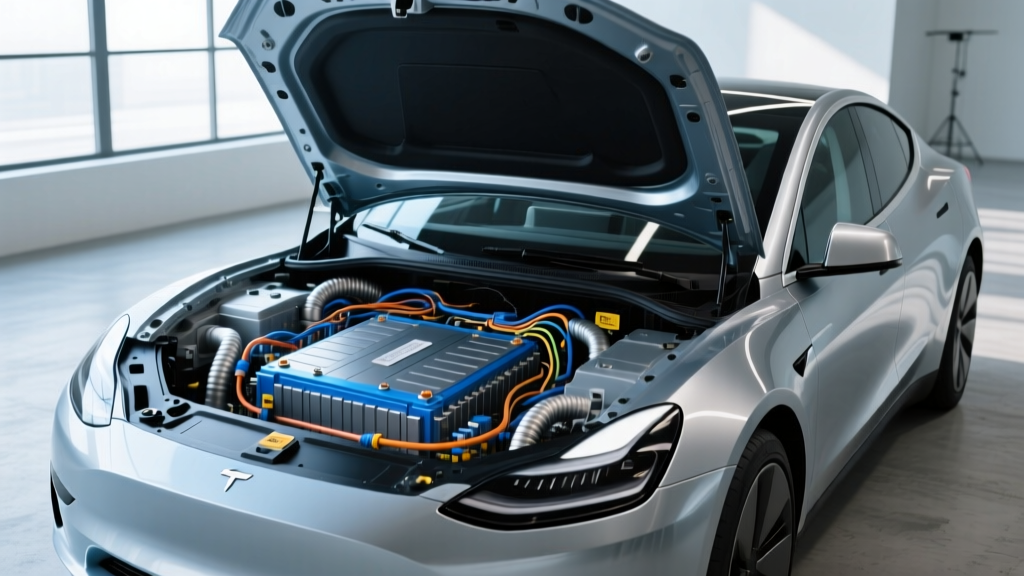
When drivers search "how to connect battery to car," they are often thinking about a traditional 12-volt jump-start or a lead-acid replacement. But in a modern electric vehicle, the high-voltage traction battery is a sealed, manufacturer-integrated system that powers the drivetrain — and it is not something an owner physically connects or swaps at home. Understanding how that battery works, what it costs, how long it lasts, and how to care for it is the real question behind the search. This guide covers everything an EV owner or prospective buyer needs to know about the traction battery, from chemistry to replacement economics.
What "Connecting a Battery" Means in an Electric Vehicle
In a conventional internal-combustion car, the 12V battery sits under the hood with accessible terminals. You can disconnect it, replace it, or jump-start it with a set of jumper cables. An EV has a 12V auxiliary battery too (for lights, infotainment, and control modules), but the main energy source is a high-voltage traction battery — typically operating between 350V and 800V — housed in a sealed enclosure beneath the floor pan.
This traction battery is bolted into the vehicle structure and wired directly to the power electronics and drive motors by the manufacturer. It is not user-serviceable. No owner should attempt to disconnect, open, or rewire a high-voltage pack; doing so carries a severe electrocution risk and will void the warranty. When EV owners talk about "battery connection," they are usually referring to one of three things:
- Charging connection: Plugging into a Level 1, Level 2, or DC fast charger using J1772, NACS, CCS, or CHAdeMO connectors.
- Battery health monitoring: Using onboard diagnostics or third-party tools to check State of Health (SoH).
- Battery replacement: A dealer or specialist procedure where the old pack is removed and a new or refurbished pack is installed.
The rest of this guide addresses what actually matters: how long the battery lasts, what degrades it, what the warranty covers, and what replacement costs look like if you ever need one.
EV Battery Chemistry: LFP vs. NMC/NCA Trade-Offs
The two dominant lithium-ion chemistries in 2026 EVs are LFP (lithium iron phosphate) and NMC/NCA (nickel manganese cobalt / nickel cobalt aluminum). The chemistry inside your pack determines range, longevity, cold-weather behavior, and cost. Here is how they compare:
| Attribute | LFP (Lithium Iron Phosphate) | NMC/NCA (Nickel-Based) |
|---|---|---|
| Energy Density | Lower (~160–180 Wh/kg cell-level) | Higher (~220–260 Wh/kg cell-level) |
| Typical Cycle Life | 3,000–5,000+ cycles to 80% capacity | 1,000–2,000 cycles to 80% capacity |
| Cold-Weather Performance | Moderate loss; slower charge acceptance below freezing | Better low-temp performance with active thermal management |
| Cost per kWh (Pack-Level) | ~$90–$110/kWh | ~$120–$150/kWh |
| Recommended Charge Habit | Can be charged to 100% daily without significant harm | Best kept between 20–80% for daily use; 100% for trips only |
| Common Applications (2026) | Tesla Model 3 RWD, Model Y RWD, BYD models, Ford Mustang Mach-E Select | Tesla Long Range/Performance, Hyundai Ioniq 5/6, Rivian, BMW iX, most long-range trims |
| Cobalt Content | Zero cobalt — lower supply-chain and ethical risk | Contains cobalt and nickel — higher raw-material cost |
Which is better? There is no universal answer. If you prioritize maximum range per charge and don't mind managing charge limits, NMC/NCA delivers higher energy density. If you want a battery you can charge to 100% every night, expect to keep the car for 200,000+ miles, and want lower replacement risk, LFP is the more durable and economical choice. Many 2026 standard-range models use LFP specifically because its longer cycle life offsets its lower energy density.
How Long Do EV Batteries Last? Real Degradation Data
The most common fear among EV shoppers is that the battery will need an expensive replacement within a few years. The data does not support that fear for the vast majority of owners.
Based on aggregated fleet data and long-term owner reports (sources include Recurrent Auto and Tesla's own impact reports), typical degradation looks like this:
| Vehicle Age / Mileage | Average Capacity Retained | Notes |
|---|---|---|
| Year 1 / ~12,000 mi | 95–98% | Initial drop as cells stabilize; most noticeable in first few months |
| Year 3 / ~36,000 mi | 91–95% | Gradual, linear degradation phase |
| Year 5 / ~60,000 mi | 88–93% | Most packs still well above warranty threshold |
| Year 8 / ~100,000 mi | 83–90% | Approaching warranty period end; still functional |
| Year 10+ / 150,000+ mi | 78–87% | Noticeable range loss but vehicle remains drivable |
Key observations from real-world data:
- Early drop, then plateau: Most lithium-ion packs lose 2–5% in the first year as the solid electrolyte interphase (SEI) layer forms, then degradation slows significantly.
- LFP degrades more slowly: Tesla Model 3 RWD (LFP) fleets show an average of ~8% loss at 100,000 miles, compared to ~10–12% for NMC packs in similar duty cycles.
- Outliers exist but are rare: Early-generation packs (2011–2015 Nissan Leaf with passive air cooling) degraded faster, sometimes losing 20–30% by 80,000 miles. Modern liquid-cooled thermal management has largely solved this.
- Most packs outlast the car: At 85% retained capacity after 150,000 miles, a 300-mile EPA-rated EV still delivers ~255 miles of range — plenty for daily driving.
Battery Warranty Coverage: What's Protected and for How Long
Federal law (via EPA and CARB-influenced requirements) mandates that EV manufacturers warranty the traction battery for a minimum of 8 years or 100,000 miles (whichever comes first). In California Air Resources Board (CARB) states, that extends to 10 years or 150,000 miles. Most manufacturers meet or exceed these minimums.
| Manufacturer | Warranty Period | Capacity Threshold | Notes |
|---|---|---|---|
| Tesla (Model 3/Y RWD — LFP) | 8 yr / 100,000 mi | 70% retention | Long Range/Performance: 8 yr / 120,000 mi |
| Hyundai / Kia (Ioniq 5/6, EV6) | 10 yr / 100,000 mi | 70% retention | Among the longest coverage in the industry |
| Ford (Mustang Mach-E, F-150 Lightning) | 8 yr / 100,000 mi | 70% retention | Covers battery components and capacity loss |
| General Motors (Ultium-based EVs) | 8 yr / 100,000 mi | 70% retention | Includes Cadillac, Chevrolet, GMC EVs |
| Rivian (R1T, R1S) | 8 yr / 175,000 mi | 70% retention | Higher mileage cap reflects truck use case |
| BMW (iX, i4, i7) | 8 yr / 100,000 mi | 70% retention | Standard across BMW EV lineup |
What the warranty covers: If your battery's usable capacity drops below the stated threshold (typically 70%) within the warranty period due to normal use, the manufacturer will repair or replace the pack at no cost. This covers cell-level degradation, module failures, and manufacturing defects.
What it does not cover: Damage from accidents, flooding, improper modifications, or use outside manufacturer guidelines (e.g., repeated exposure to extreme heat without thermal preconditioning). Cosmetic issues and 12V auxiliary battery failures are handled under separate warranties.
EV Battery Replacement Cost: When and How Much
If your battery degrades beyond the warranty threshold after the warranty expires — or if it suffers physical damage — replacement is the only option. Here is what that looks like in 2026:
| Vehicle / Battery Size | Battery Capacity | Estimated Replacement Cost (Parts + Labor) | Typical Replacement Timeline |
|---|---|---|---|
| Tesla Model 3 RWD (LFP) | ~60 kWh | $8,000–$12,000 | Rarely before 200,000+ mi |
| Tesla Model Y Long Range | ~75 kWh | $12,000–$16,000 | Rarely before 180,000+ mi |
| Hyundai Ioniq 5 | ~77.4 kWh | $11,000–$15,000 | Rarely before 180,000+ mi |
| Ford F-150 Lightning (Extended Range) | ~131 kWh | $20,000–$28,000 | Rarely before 150,000+ mi |
| Chevrolet Equinox EV | ~85 kWh | $12,000–$16,000 | Rarely before 175,000+ mi |
| Rivian R1T (Max Pack) | ~149 kWh | $22,000–$30,000 | Rarely before 175,000+ mi |
Context that matters: These are worst-case, out-of-warranty figures. In practice, the overwhelming majority of EV batteries never need full replacement. Data from Recurrent Auto's fleet study shows that fewer than 1.5% of EVs in their dataset required a battery replacement outside of recall campaigns. For most owners, the battery will outlast the vehicle's useful life or be passed on to a second owner with 80–90% capacity remaining.
If replacement is needed, options include:
- New OEM pack: Most expensive, full warranty, longest life expectancy.
- Refurbished/remanufactured pack: 30–50% less than new; uses tested modules from returned packs.
- Module-level repair: Some specialists can replace individual failed modules within a pack for $2,000–$5,000 rather than swapping the entire assembly.
Factors That Accelerate Battery Degradation
Not all miles are equal when it comes to battery wear. The following factors have measurable impact on long-term State of Health:
Battery Care Best Practices
- Limit DC fast charging to road trips: Frequent use of 150+ kW DC fast chargers (more than 2–3 times per week) accelerates degradation by approximately 1–3% over the pack's life compared to primarily Level 2 charging. The heat generated at high charge rates stresses cells. Use Level 2 (7–11.5 kW) at home for daily charging.
- Avoid sustained 100% or 0% State of Charge: For NMC/NCA packs, keeping daily SoC between 20–80% reduces calendar aging. LFP packs tolerate 100% daily charging better, and Tesla actually recommends periodic 100% charges for LFP to allow the BMS to recalibrate.
- Precondition before fast charging: Most 2026 EVs automatically precondition the battery when you navigate to a DC fast charger. This warms the cells to optimal temperature (~25–35°C), enabling faster charging and reducing lithium plating risk. If your car has a manual precondition option, use it in cold weather.
- Minimize exposure to extreme heat: Battery degradation accelerates significantly above 40°C (104°F) ambient. Parking in shade or a garage in hot climates measurably extends pack life. Liquid-cooled packs (standard on virtually all 2026 EVs) mitigate this substantially compared to older passively-cooled designs.
- Don't store at extreme SoC: If leaving the vehicle unused for more than two weeks, set the charge limit to 50–60%. Storing at 100% for extended periods accelerates calendar degradation; storing near 0% risks the pack falling below the minimum voltage threshold.
- Use regenerative braking moderately in cold weather: In sub-freezing temperatures, aggressive regen can stress cold cells. Many 2026 EVs automatically reduce regen when the battery is cold; respect this behavior rather than overriding it.
How to Check and Monitor Battery Health (SoH)
State of Health (SoH) is expressed as a percentage of the battery's original usable capacity. A new pack is 100% SoH; a pack that held 75 kWh when new and now holds 67.5 kWh is at 90% SoH. Here is how to check it:
- In-vehicle displays: Many 2026 EVs (Tesla, Hyundai/Kia, BMW, Rivian) include a battery health indicator in the settings or service menu. Tesla's app shows estimated range at 100% SoC, which you can compare to the original EPA figure to calculate approximate SoH.
- OBD-II diagnostic tools: Third-party tools like OBDLink MX+ paired with apps such as EV Health or LeafSpy (for Nissan) can read the battery management system (BMS) directly and report SoH percentage, cell voltage variance, and cycle count.
- Dealer diagnostic check: Any authorized service center can run a full battery health report. This is recommended before purchasing a used EV and is sometimes offered free during routine service visits.
- Third-party services: Companies like Recurrent offer battery health reports based on connected-car data, which can be useful for resale documentation.
What to watch for: Cell voltage variance greater than 0.1V between the highest and lowest cells in a pack can indicate an imbalanced or failing module. A sudden drop in SoH (more than 2–3% in a single month) warrants a dealer visit.
Emerging Battery Technology: What's Coming Next
Several next-generation battery technologies are in development that promise to reshape EV ownership economics. It is important to understand their realistic timelines:
- Solid-state batteries: Replace the liquid electrolyte with a solid material, promising higher energy density (potentially 400+ Wh/kg at the cell level), faster charging, and improved safety. Toyota, Samsung SDI, and QuantumScape have announced production timelines targeting 2027–2029 for limited production vehicles. Cost and manufacturing scale remain significant hurdles. Not available in any production vehicle as of 2026.
- Silicon-dominant anodes: Replacing graphite anodes with silicon can increase energy density by 20–40%. Companies like Sila Nanotechnologies and Group14 are supplying early production cells. Expect to see this in select 2026–2027 model-year vehicles as a gradual improvement, not a step-change.
- Sodium-ion batteries: Lower cost and no lithium or cobalt required, but significantly lower energy density (~120–150 Wh/kg). Best suited for urban/short-range EVs and stationary storage. CATL and BYD are producing these for the Chinese market; US availability is limited as of 2026.
- LMFP (lithium manganese iron phosphate): An evolution of LFP that adds manganese for ~15–20% higher energy density while retaining cobalt-free chemistry and long cycle life. Expected in several 2027 model-year vehicles from major manufacturers.
These technologies are forward-looking. If you are buying an EV in 2026, today's LFP and NMC chemistries are mature, well-understood, and backed by robust warranty coverage. Waiting for solid-state is not a practical strategy for anyone who needs a vehicle now.
Frequently Asked Questions
Can I replace my EV battery myself?
No. The high-voltage traction battery operates at 350–800 volts and carries a lethal electrocution risk if handled improperly. Replacement requires a certified technician, specialized lift equipment, and manufacturer-specific software to pair the new pack with the vehicle's BMS. This is strictly a dealer or certified-EV-shop procedure.
Does fast charging damage my EV battery?
Occasional DC fast charging (a few times per month on road trips) has negligible impact on modern liquid-cooled packs. However, relying on DC fast charging as your primary charging method (daily or near-daily) can accelerate degradation by 1–3% over the battery's lifetime compared to Level 2 home charging. The heat and high current at 150+ kW charge rates are the stress factors.
Will my EV battery need replacing before 100,000 miles?
Statistically, this is very unlikely. Fleet data shows fewer than 1.5% of modern EVs require battery replacement before 100,000 miles, and most of those are due to manufacturing defects covered under the 8-year/100,000-mile warranty. Normal degradation at 100,000 miles is typically 8–15%, leaving 85–92% of original capacity.
Is the 12V battery in my EV the same as the traction battery?
No. Your EV has two separate batteries. The 12V auxiliary battery (like a conventional car battery) powers the lights, infotainment, door locks, and control computers. The high-voltage traction battery (the large pack under the floor) powers the drive motors. The 12V battery can be replaced by an owner like any conventional car battery; the traction battery cannot.
How does cold weather affect my EV battery?
Cold temperatures (below 32°F / 0°C) temporarily reduce range by 15–30% depending on severity, because the battery's internal resistance increases and energy is diverted to cabin and battery heating. This is a temporary effect — capacity returns when temperatures rise. Preconditioning the battery before driving and while charging mitigates cold-weather range loss significantly.
Does the federal EV tax credit apply to battery replacement?
No. The IRS §30D clean vehicle credit applies to the purchase of a new qualifying EV or a new battery component installed in an EV (if separately purchased and meeting critical-mineral and sourcing requirements). A warranty-covered replacement is not eligible since you are not purchasing a new vehicle. Consult a tax professional for specific eligibility questions.