The high-voltage traction battery is the single most expensive component in any electric vehicle — and how you charge it day to day has a measurable impact on its lifespan, range retention, and resale value. Yet most EV owners treat charging as a simple plug-in-and-forget routine, missing the chemistry-specific nuances that separate a battery lasting 200,000 miles from one needing early intervention.
This guide breaks down exactly how to charge rechargeable batteries in modern EVs, what's happening inside the cells, and what the data says about long-term degradation across the two dominant chemistries on the road: lithium iron phosphate (LFP) and nickel-manganese-cobalt/nickel-cobalt-aluminum (NMC/NCA).
LFP vs NMC/NCA: The Chemistry That Dictates How You Charge
Before optimizing your charging routine, you need to know which chemistry is under your floor. The two dominant EV battery chemistries behave very differently — and their care requirements are not interchangeable.
| Attribute | LFP (Lithium Iron Phosphate) | NMC/NCA (Nickel-Manganese-Cobalt / Nickel-Cobalt-Aluminum) |
|---|---|---|
| Energy Density | Lower (~160–180 Wh/kg cell-level) | Higher (~220–300 Wh/kg cell-level) |
| Cycle Life | 3,000–6,000+ cycles to 80% SoH | 1,000–2,500 cycles to 80% SoH |
| Cold-Weather Performance | Weaker; greater range loss below 32°F | Better low-temp conductivity |
| Charging to 100% Daily | Recommended (BMS needs full SoC for cell balancing) | Discouraged; 80% daily limit preferred |
| Cost per kWh (pack-level) | ~$100–$115 (2025–2026) | ~$125–$150 (2025–2026) |
| Cobalt/Nickel Content | None — uses iron and phosphate | Contains nickel, cobalt, or aluminum |
| Typical Applications | Tesla Model 3/Y RWD, Ford Mustang Mach-E Select (LFP option), BYD models | Tesla Long Range, Hyundai Ioniq 5/6, Kia EV6, Rivian, Lucid, most AWD/Performance trims |
The practical takeaway: If your EV has an LFP pack (check your owner's manual or window sticker), charging to 100% regularly is not just acceptable — it's beneficial. LFP cells have a very flat voltage curve, meaning the battery management system (BMS) struggles to estimate state of charge (SoC) accurately unless it periodically sees a full charge. Tesla explicitly recommends charging LFP-equipped vehicles to 100% at least once per week.
For NMC/NCA packs, the opposite holds. These cells experience accelerated degradation when held at high SoC for extended periods. Most manufacturers default the charge limit to 80% for daily driving, reserving 100% for road trips when you'll be departing immediately.
How Long Do EV Batteries Actually Last?
The short answer from fleet data: most modern EV batteries outlast the vehicles they're installed in. But "last" needs a precise definition — batteries don't suddenly die. They gradually lose capacity, and the industry threshold for end-of-life in automotive service is typically 70–80% of original capacity.
- Tesla fleet data (2024 Impact Report): Model S/X batteries retained ~88% capacity at 150,000 miles; Model 3/Y (mixed chemistries) averaged ~85% at 150,000 miles.
- Geotab fleet study (2024, 10,000+ vehicles): Average EV battery degradation was 1.8% per year across all brands, meaning ~82% SoH at the 10-year mark under typical use.
- Recurrent Auto data (2025): Chevrolet Bolt EV owners saw ~90% capacity retention at 80,000 miles; early Nissan Leaf (passive-cooled) degraded faster at ~78% SoH at 80,000 miles in hot climates.
- Taxi/ride-share high-mileage data: Tesla Model 3 units in ride-share service have exceeded 300,000 miles on original packs with ~75% SoH — well above warranty thresholds.
The critical variable is thermal management. Vehicles with active liquid cooling and heating (Tesla, Hyundai E-GMP, Ford, Rivian, GM Ultium) show dramatically better longevity than older passively-cooled designs (early Nissan Leaf, early Fiat 500e). If you're buying in 2026, every major-platform EV has active thermal management — this is no longer a concern for new purchases.
What the Battery Warranty Actually Covers
Federal law mandates a minimum 8-year/100,000-mile warranty on EV battery packs for emissions-related compliance, and every major manufacturer meets or exceeds this baseline. But the details matter enormously.
| Manufacturer | Warranty Period | Mileage Limit | Capacity Retention Threshold |
|---|---|---|---|
| Tesla (Model 3/Y) | 8 years | 100,000–120,000 mi (varies by trim) | 70% minimum |
| Tesla (Model S/X) | 8 years | 150,000 mi | 70% minimum |
| Hyundai/Kia (E-GMP) | 10 years | 100,000 mi | 70% minimum |
| Ford (Mach-E, F-150 Lightning) | 8 years | 100,000 mi | 70% minimum |
| GM (Ultium platform) | 8 years | 100,000 mi | 70% minimum |
| Rivian | 8 years | 120,000–175,000 mi (varies) | 70% minimum |
| BMW (iX, i4, i7) | 8 years | 100,000 mi | 70% minimum |
Key warranty nuances:
- The warranty covers capacity degradation below the threshold, not a complete failure. If your 82 kWh pack drops to 56 kWh (below 70%), that's a warranty claim.
- Manufacturers may replace with a refurbished or remanufactured pack of equivalent capacity — not necessarily a brand-new unit.
- Damage from accidents, flooding, or unauthorized modifications voids coverage.
- Some warranties (like Hyundai/Kia's 10-year term) are longer than the federal minimum, which adds significant resale value in high-mileage scenarios.
- According to fueleconomy.gov, battery warranty claims remain rare — the vast majority of packs retain well above 70% capacity through the warranty period.
EV Battery Replacement Cost: When and How Much
This is the question that generates the most anxiety — and the most misinformation. Let's anchor the discussion in data.
| Vehicle / Platform | Battery Size (kWh) | Replacement Cost Range (Parts + Labor) | Notes |
|---|---|---|---|
| Tesla Model 3 RWD (LFP) | ~60 kWh | $12,000–$16,000 | LFP packs cheaper per kWh; module-level repair sometimes possible |
| Tesla Model Y Long Range | ~75–82 kWh | $16,000–$22,000 | 4680 structural pack may require full unit replacement |
| Hyundai Ioniq 5 / Kia EV6 | ~77.4 kWh | $15,000–$20,000 | Modular design allows individual module replacement (~$2,500–$4,000/module) |
| Ford Mustang Mach-E ER | ~91 kWh | $18,000–$25,000 | Ford has pursued module-level service |
| Ford F-150 Lightning ER | ~131 kWh | $25,000–$35,000 | Largest consumer pack; highest replacement cost |
| Chevrolet Equinox EV / Blazer EV | ~85–102 kWh | $16,000–$24,000 | Ultium modular platform supports partial replacement |
| Rivian R1T / R1S (Large Pack) | ~135 kWh | $25,000–$32,000 | Module-level service available at Rivian service centers |
Context that matters: Battery pack prices have fallen from ~$1,200/kWh in 2010 to roughly $110–$140/kWh at the pack level in 2025–2026, per BloombergNEF tracking. More importantly, full pack replacement is increasingly rare. Modern packs are modular — a single degraded or failed module can often be replaced for $2,000–$5,000 rather than swapping the entire unit.
For perspective, a conventional vehicle's transmission replacement runs $4,000–$8,000, and engine replacements hit $5,000–$10,000+. The EV battery is the powertrain equivalent, and its failure rate is substantially lower than internal combustion engine or transmission failure rates over equivalent mileage.
Factors That Accelerate (or Slow) Battery Degradation
Battery chemistry sets the ceiling, but your habits determine where you land within that range. Here's what the data shows actually moves the needle:
- Avoid sustained 100% SoC (NMC/NCA only): Set daily charge limit to 80%. Charge to 100% only when departing on a trip within hours.
- Don't baby the DC fast charger — but don't abuse it either: Occasional DCFC (1–3 times/week) shows negligible impact in fleet data. Daily DCFC-only charging (ride-share use) shows ~2–4% additional degradation over 100,000 miles vs. L2-only.
- Precondition before fast charging: Cold batteries charge slowly and experience lithium plating risk. Navigation-routed preconditioning (Tesla, Hyundai, Ford) warms the pack to ~30–35°C for optimal charge acceptance.
- Minimize extreme SoC storage: If storing the vehicle for 2+ weeks, leave it at ~50% SoC. Never store at 100% or below 10%.
- Use a Level 2 home charger: Overnight L2 charging (7–11 kW) keeps the battery in its thermal comfort zone and avoids the heat generated by repeated DCFC sessions.
- Let thermal management do its job: Don't disable preconditioning or cabin-overheat features to save a few watts. The thermal system protects the pack.
- Hot-climate parking: When possible, park in shade or a garage in sustained 95°F+ heat. Soaking at high SoC in extreme heat is the single worst combination for NMC cells.
What doesn't matter as much as people think:
- Regenerative braking intensity: Regen current is well within the battery's acceptable charge rate. Max regen won't harm the pack.
- Charging to 90% vs 80% daily: The degradation difference is marginal. The big cliff is above 95% sustained.
- "Battery memory effect": This is a nickel-cadmium artifact. Lithium-ion cells have no memory effect. Partial charges are perfectly healthy.
How to Check Your Battery's State of Health (SoH)
State of Health (SoH) is expressed as a percentage: 100% means your pack holds its original rated energy; 85% means it holds 85% of that. Here's how to monitor it:
Built-in vehicle tools:
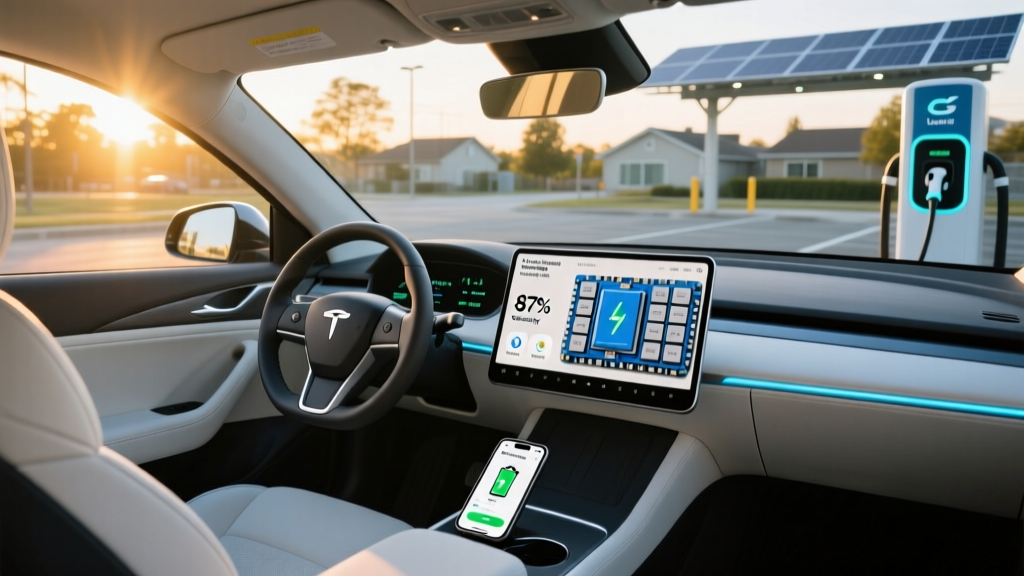
- Tesla: The Service menu (hold model name on About screen) shows battery health assessment. The mobile app also surfaces degradation estimates over time.
- Hyundai/Kia: The EV dashboard includes a battery health indicator, though it's less granular than third-party tools.
- GM Ultium vehicles: Battery health data is accessible through the myChevrolet/myCadillac app's vehicle diagnostics section.
- Ford: The FordPass app provides battery health status under vehicle diagnostics.
Third-party diagnostics:
- OBD-II dongles + apps: Tools like Scan My Tesla, ABRP (A Better Route Planner) OBD integration, and Leaf Spy (for Nissan Leaf) read BMS data directly, showing cell-level voltage spread, actual usable kWh, and calculated SoH.
- Recurrent Auto: A free service that tracks your battery over time using telematics data and compares your degradation curve against a fleet average of identical vehicles.
- Dealer diagnostics: Any authorized service center can run a full battery health report. Request this during routine service or pre-purchase inspection on a used EV.
What healthy cell spread looks like: In a balanced pack, individual cell groups should read within 10–20 millivolts of each other at rest. Spread exceeding 50 mV may indicate a weak module worth investigating under warranty.
Charging Habits by Chemistry: Your Quick-Reference Guide
| Practice | LFP Owners | NMC/NCA Owners |
|---|---|---|
| Daily charge limit | 100% | 80% (90% max if needed) |
| Frequency of 100% charges | Weekly minimum (for BMS balancing) | Road trips only; depart shortly after reaching 100% |
| DC fast charging | Fine regularly; precondition when possible | Fine 2–3x/week; precondition always; favor L2 for daily |
| Long-term storage SoC | 50–60% | 40–60% |
| Cold-weather range expectation | ~30–40% loss at 20°F | ~20–30% loss at 20°F |
| Calendar degradation sensitivity | Low; LFP is very stable at high SoC | Moderate; high SoC + heat accelerates calendar aging |
What's Next: Solid-State and Silicon-Anode Batteries
Forward-looking battery technologies are frequently hyped. Here's where they actually stand as of 2026:
Solid-state batteries: These replace the liquid electrolyte with a solid material, promising higher energy density (potentially 400+ Wh/kg), faster charging, and improved safety. Toyota has announced limited production of solid-state-equipped vehicles for 2027–2028, initially in low-volume models. Samsung SDI and QuantumScape are targeting 2027–2029 for broader automotive deployment. These are not available in any consumer EV as of 2026.
Silicon-anode batteries: Companies like Sila Nanotechnologies and Group14 are integrating silicon into the anode to boost energy density by 20–40%. Early deployments are appearing in premium applications (Mercedes-Benz's G-Class 580e uses a silicon-dominant anode from Sila). Expect broader adoption in 2027–2029 model years, primarily as an incremental improvement to existing NMC cells rather than a wholesale chemistry replacement.
Sodium-ion batteries: CATL and BYD have begun deploying sodium-ion packs in Chinese-market budget EVs. These offer lower energy density but dramatically lower cost and better cold-weather performance. U.S. market availability remains uncertain and likely 2028+ at the earliest.
None of these technologies change today's charging advice. The LFP and NMC packs in 2026 model-year vehicles will remain the dominant chemistries through the end of the decade, and the care principles above will apply for the full service life of any EV purchased today.
Frequently Asked Questions
How long do EV batteries last in years and miles?
Fleet data shows most modern liquid-cooled EV batteries retain 80–90% capacity at 150,000 miles and 8–10 years. At typical U.S. driving rates (~13,500 miles/year), that translates to 11+ years before reaching the 70% warranty threshold. Many packs exceed 200,000 miles before degrading below 70%. The U.S. Department of Energy notes that battery lifespans have improved significantly with each generation of thermal management systems.
How much does an EV battery cost to replace?
Full pack replacement ranges from roughly $12,000 for a ~60 kWh LFP pack to $25,000–$35,000 for large 130+ kWh packs (F-150 Lightning, Rivian). However, module-level repair is increasingly common and costs $2,000–$5,000 per module. Full replacement is rarely needed — most degradation claims are handled under the 8-year/100,000-mile warranty at no cost to the owner.
What does the EV battery warranty cover?
Manufacturer warranties cover capacity loss below a specified threshold (typically 70% of original capacity) within the warranty period (typically 8 years/100,000 miles, with Hyundai/Kia offering 10 years/100,000 miles). They do not cover damage from accidents, misuse, or unauthorized modifications. The warranty guarantees the pack will retain at least the threshold capacity — not that it will perform like new.
How do I check and maximize my EV battery health?
Check SoH through your vehicle's built-in diagnostics menu, the manufacturer's mobile app, or a third-party OBD-II tool. Maximize health by setting the correct daily charge limit for your chemistry (100% for LFP, 80% for NMC), preconditioning before DC fast charging, avoiding prolonged storage at extreme SoC levels, and using Level 2 home charging as your primary method.
LFP vs NMC — which battery chemistry is better?
Neither is universally better. LFP wins on longevity (3,000–6,000+ cycle life), cost (~$100–$115/kWh), and simplicity (charge to 100% freely). NMC wins on energy density (more range in the same space), cold-weather performance, and availability in AWD/performance trims. Choose LFP if you prioritize long-term durability and don't need maximum range. Choose NMC if you need the longest possible single-charge range, live in a cold climate, or want AWD. For detailed chemistry sourcing data relevant to federal EV tax credit eligibility, consult the IRS critical minerals and battery component requirements, as chemistry influences sourcing compliance.
Does fast charging damage my EV battery?
DC fast charging generates more heat than Level 2 charging, and heat is the primary degradation accelerator. However, modern EVs actively manage battery temperature during DCFC sessions — throttling charge speed when the pack gets warm. Fleet data shows the difference between DCFC-heavy and L2-only charging is roughly 2–4% additional capacity loss over 100,000 miles. For most owners, the convenience of fast charging on road trips far outweighs this marginal impact. The key is to always precondition the battery before a fast-charge session.