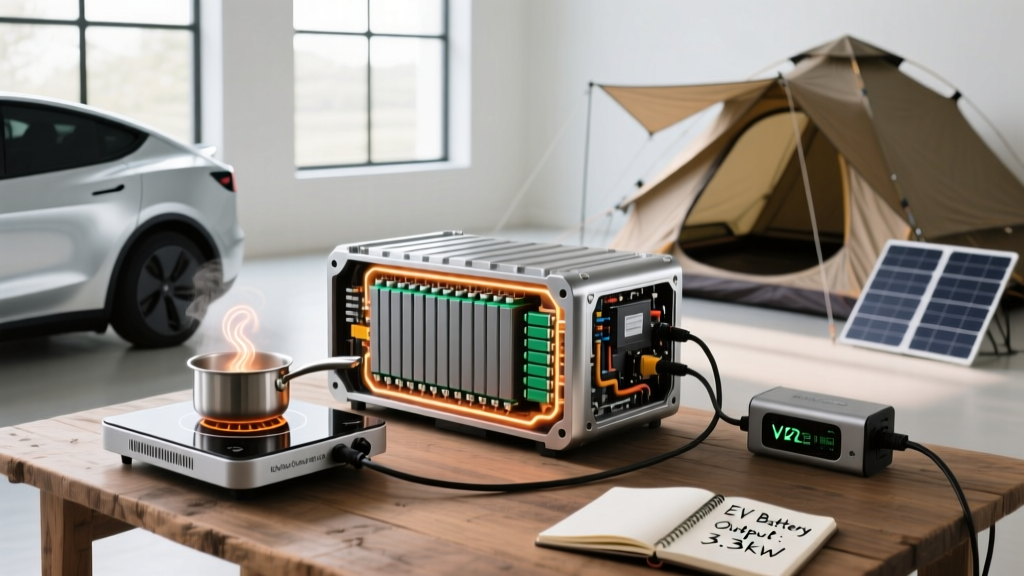
Search "induction cooktop battery" and you'll mostly find off-grid solar setups and portable power stations. But a growing number of EV owners are asking a more interesting question: can the high-voltage traction battery in my electric vehicle actually power an induction cooktop for camping, tailgating, or emergency cooking? The short answer is yes — if your EV supports Vehicle-to-Load (V2L) and you understand the math. The longer answer involves kW draw limits, kWh capacity trade-offs, and some practical ceiling on how long you can sauté before you need to find a charger.
This guide covers the real numbers behind V2L-powered induction cooking, then zooms out to the EV battery technology you need to understand: chemistry (LFP vs NMC), degradation data, warranty coverage, replacement costs, and how to monitor State of Health. Whether you're boiling water at a campsite or just trying to maximize your pack's lifespan, the battery is the most expensive component in your EV — here's what actually matters.
How V2L Powers an Induction Cooktop From Your EV
An induction cooktop works by generating a high-frequency electromagnetic field that induces current directly in ferromagnetic cookware. It's efficient — typically 85-90% of electrical energy goes into heating the pot, compared to ~40% for a gas burner. A single-burner portable induction cooktop draws between 1,000 and 1,800 watts (1.0–1.8 kW) on high, and as little as 200–500 watts on a simmer setting.
Vehicle-to-Load (V2L) is a feature that inverts the EV's high-voltage DC traction battery into standard 120V AC power through an external outlet or an adapter plugged into the charge port. Here's how the major V2L-capable EVs stack up for 2026:
| Vehicle | V2L Max Output | Battery (kWh usable) | Chemistry |
|---|---|---|---|
| Hyundai Ioniq 5 | 3.6 kW (120V) | 84.0 kWh | NMC |
| Hyundai Ioniq 6 | 3.6 kW (120V) | 77.4 kWh | NMC |
| Kia EV6 | 3.6 kW (120V) | 77.4 kWh | NMC |
| Ford F-150 Lightning | 9.6 kW (Pro Power Onboard, 240V) | 98.0 kWh (ext. range) | NMC |
| Kia EV9 | 3.6 kW (120V) | 99.8 kWh | NMC |
| Rivian R1T (Gen 2) | Up to 9.6 kW (camp kitchen) | 106.2 kWh (Max Pack) | NMC |
The practical math: Running a 1,800W induction burner on high for 30 minutes consumes 0.9 kWh. That's roughly 1% of an Ioniq 5's 84 kWh usable pack. Boiling a liter of water (~2 minutes at high draw) uses about 0.06 kWh. For a weekend camping trip with two meals a day on a single burner, you're looking at 3–5 kWh total — or about 4–6% of a mid-size EV battery. You'll barely notice the range impact.
Limitations to know: Most V2L systems output through a standard NEMA 5-15 (120V/15A) outlet, capping continuous draw at ~1,800W. The F-150 Lightning's Pro Power Onboard offers 240V/30A (9.6 kW) through a dedicated outlet, enough to run a full-size 3,600W dual-burner induction range — but that's a $70,000+ truck, not a compact crossover. Also, V2L will not operate while the vehicle is in Drive; you must be in Park.
LFP vs NMC: Which Battery Chemistry Is in Your EV?
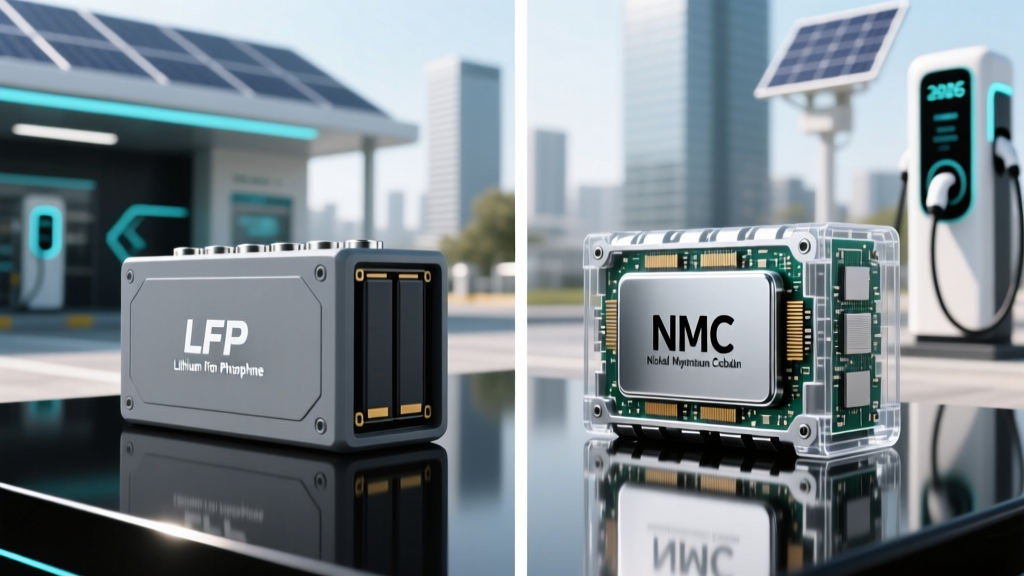
The two dominant lithium-ion chemistries in 2026 EVs are Lithium Iron Phosphate (LFP) and Nickel Manganese Cobalt (NMC, sometimes NCA — Nickel Cobalt Aluminum). They behave differently in ways that directly affect your ownership experience, from charging habits to cold-weather range to how long the pack will last.
| Attribute | LFP (Lithium Iron Phosphate) | NMC / NCA |
|---|---|---|
| Energy density | ~160–180 Wh/kg (lower) | ~220–260 Wh/kg (higher) |
| Cycle life | 3,000–5,000+ cycles to 80% SoH | 1,500–2,500 cycles to 80% SoH |
| Cold-weather performance | More range loss below 32°F; slower cold charging | Better low-temp conductivity |
| Charging to 100% | Recommended regularly for BMS calibration | Daily limit of 80–90% advised |
| Cost per kWh | ~$80–100/kWh (lower) | ~$110–140/kWh (higher) |
| Cobalt/nickel content | None (less supply-chain risk) | Contains cobalt and nickel |
| Common in (2026 models) | Tesla Model 3/Y RWD, Ford Mustang Mach-E Select (LFP option), BYD models | Hyundai Ioniq 5/6, Kia EV6/EV9, F-150 Lightning, most long-range trims |
Which is better? It depends on your use case. If you charge at home nightly and want maximum pack longevity with minimal degradation anxiety, LFP's cycle-life advantage is substantial — Tesla's LFP Model 3 RWD packs have shown minimal degradation in high-mileage fleet data. If you need maximum range in a lighter vehicle, tow frequently, or regularly drive in cold climates, NMC's energy density and cold-weather edge make it the practical choice.
For V2L induction cooking specifically, chemistry matters less than total usable kWh and the inverter's max output. But if you're running your pack down to 20% SoC on a camping trip every weekend, LFP's tolerance for deep cycling is an advantage.
How Long Do EV Batteries Actually Last?
The fear that EV batteries need replacing every 5–8 years is a persistent myth not supported by fleet data. Modern liquid-cooled battery packs are engineered for the life of the vehicle.
Here's what real-world degradation data shows across major platforms:
- Year 1 (~15,000 mi): 2–4% capacity loss (initial formation loss)
- Year 3 (~45,000 mi): 5–8% total loss
- Year 5 (~75,000 mi): 7–12% total loss
- Year 8 (~120,000 mi): 10–15% total loss
- Year 10 (~150,000 mi): 12–18% total loss
LFP packs (Tesla Model 3 RWD fleet data) show flatter curves: ~3–5% loss at 100,000 miles, with many packs retaining 90%+ State of Health at 150,000 miles. Source: Recurrent Auto battery health data.
A pack that degrades to 80% capacity still delivers meaningful range. A 310-mile EPA Ioniq 5 at 80% SoH still gives ~248 miles — more than most drivers need daily. Catastrophic failure (sudden, total pack death) is exceedingly rare in liquid-cooled systems; gradual capacity fade is the norm.
What Does the EV Battery Warranty Cover?
Federal law mandates a minimum 8-year/100,000-mile battery warranty for EVs, but the specifics — particularly the capacity retention threshold — vary by manufacturer. Here's a breakdown of current 2026 model-year warranty terms:
| Manufacturer | Warranty Term | Capacity Threshold | Notes |
|---|---|---|---|
| Tesla (Model 3/Y RWD, LFP) | 8 yr / 100,000 mi | 70% retention | Long Range/Performance: 8 yr / 120,000 mi |
| Hyundai / Kia | 10 yr / 100,000 mi | 70% retention | Among the longest terms in the industry |
| Ford (Mach-E, Lightning) | 8 yr / 100,000 mi | 70% retention | Covers battery and hybrid/electric components |
| GM (Ultium-based) | 8 yr / 100,000 mi | 70% retention | Covers capacity loss and defects |
| Rivian | 8 yr / 175,000 mi | 70% retention | Higher mileage cap for adventure-use vehicles |
| BMW | 8 yr / 100,000 mi | 70% retention | Transferable to subsequent owners |
What triggers a warranty claim: If your pack's State of Health drops below the stated threshold (typically 70%) within the warranty window, the manufacturer must repair or replace the battery at no cost. In practice, most manufacturers will first attempt module-level repairs — replacing individual degraded modules rather than the entire pack — which is faster and less costly for them. Total pack replacement under warranty is rare but does happen.
What's NOT covered: Cosmetic issues, range reduction from extreme ambient temperatures (temporary, not permanent), damage from accidents or flooding, and capacity loss from aftermarket modifications. Normal degradation above the 70% threshold is considered expected wear.
How Much Does an EV Battery Replacement Cost?
If your pack fails outside warranty, replacement costs remain the single biggest ownership fear. Here's where the market stands in 2026:
| Battery Size | Typical Vehicles | Parts Cost | Labor | Total Estimate |
|---|---|---|---|---|
| 50–60 kWh | Tesla Model 3 RWD, Chevy Bolt (discontinued but in service) | $5,000–$8,000 | $1,500–$3,000 | $6,500–$11,000 |
| 75–85 kWh | Hyundai Ioniq 5, Kia EV6, Tesla Model Y LR | $8,000–$13,000 | $2,000–$4,000 | $10,000–$17,000 |
| 95–110 kWh | F-150 Lightning Ext., Kia EV9, Rivian R1T Max | $12,000–$18,000 | $2,500–$5,000 | $14,500–$23,000 |
Context that matters: Battery pack prices have fallen roughly 80% since 2013, from ~$600/kWh to approximately $110–140/kWh for NMC and $80–100/kWh for LFP at the cell level in 2026. Pack-level costs (including BMS, cooling, housing) are higher, but the trajectory is downward. Module-level repair — replacing only the degraded sections — typically costs $2,000–$5,000 and is the more common out-of-warranty service.
When is replacement actually needed? Data from Recurrent Auto and fleet operators shows that fewer than 2% of EV battery packs require full replacement. The vast majority of packs outlive the vehicle's economic life. A 2018 Tesla Model 3 with 150,000 miles and 85% SoH still has 260+ miles of range — perfectly usable for daily driving.
Factors That Accelerate Battery Degradation
Not all miles are equal when it comes to pack wear. These factors measurably affect how quickly your battery loses capacity:
- DC fast charging frequency: Occasional fast charging (1–2x/week) has minimal impact. Daily DCFC sessions, especially at peak kW rates above 200 kW, accelerate degradation by ~1–2% additional over 5 years due to thermal stress. Preconditioning the battery before fast charging (most EVs do this automatically when navigating to a charger) significantly reduces this.
- State of Charge habits: For NMC packs, keeping daily SoC between 20–80% reduces stress. Sitting at 100% SoC for extended periods (days/weeks) accelerates calendar degradation. LFP packs are the exception — manufacturers recommend charging to 100% at least weekly for accurate BMS calibration.
- Extreme temperatures: Sustained exposure to ambient temps above 95°F accelerates chemical degradation. Cold temps below 20°F temporarily reduce range (15–30% loss) but don't cause permanent damage unless you fast-charge a frozen pack without preconditioning.
- Deep discharge cycles: Regularly running the pack to 0% (true empty, below the buffer) stresses cells. The built-in buffer (typically 2–5 kWh below displayed 0%) protects against this, but it's best practice to charge before hitting 10%.
- Calendar aging: Even a garage-kept EV with zero miles will lose ~1–2% capacity per year from chemical processes alone. This is unavoidable and affects all lithium-ion batteries.
How to Check and Monitor Battery State of Health
State of Health (SoH) is the percentage of original capacity your battery currently holds. A new pack is 100% SoH; a pack at 85% SoH holds 85% of its original kWh. Here's how to check it:
- In-vehicle displays: Tesla's app shows estimated range and, on newer software versions, a battery health percentage. Hyundai/Kia's infotainment system includes an EV battery diagnostics page showing SoH percentage. The FordPass app displays battery health for Mach-E and Lightning owners.
- OBD-II diagnostic tools: Devices like the OBDLink MX+ paired with apps such as ABRP (A Better Routeplanner) or Car Scanner can read the BMS-reported SoH directly from the CAN bus. This is the most accurate consumer-accessible method.
- Third-party services: Recurrent Auto offers free battery health reports for connected EVs, comparing your pack's degradation to a database of thousands of identical vehicles. Recurrent's data is also used by lenders and insurers to assess EV residual values.
- Dealer diagnostic scan: A service center can run a full pack health report showing individual cell/module voltage deltas, which reveals whether degradation is uniform (normal) or if a specific module is failing (warranty-repairable).
How often to check: Monthly is sufficient for most owners. If you're approaching a warranty mileage threshold (e.g., 95,000 miles on an 8-year/100,000-mile warranty), get a dealer scan to document SoH in case you need to file a claim.
Emerging Battery Tech: Solid-State and Silicon Anodes
Two technologies dominate the "next-generation battery" conversation, but neither is available in production EVs as of 2026:
Solid-state batteries replace the liquid electrolyte with a solid ceramic, polymer, or glass material. The promised advantages are significant: 30–50% higher energy density (enabling 400+ mile packs in compact vehicles), faster charging (potentially 10–80% in under 10 minutes), and improved safety (no flammable liquid electrolyte). Toyota has announced solid-state prototypes and targets limited production in 2027–2028, initially in low-volume models. Samsung SDI and QuantumScape are also advancing solid-state cells, but manufacturing scale-up remains the primary bottleneck. Realistic timeline for mainstream availability: 2029–2032.
Silicon anode batteries replace graphite anodes with silicon, which can store roughly 10x more lithium ions per unit mass. This boosts energy density by 20–40% without changing the cathode chemistry. Sila Nanotechnologies and Group14 Technologies are supplying silicon anode materials to battery manufacturers, and incremental silicon blends (5–15% silicon content) are already appearing in some 2026 cells. Full silicon anodes face expansion/cracking issues during charge cycles that are still being solved. Realistic timeline for widespread adoption: 2027–2029 in premium models.
What this means for today's buyers: Current LFP and NMC packs are mature, well-understood technology with proven longevity data. Waiting for solid-state is not a rational purchase strategy — the timeline is uncertain, early versions will command premium pricing, and today's packs will serve reliably for 15+ years.
Frequently Asked Questions
Can any EV battery power an induction cooktop?
Only EVs with a V2L (Vehicle-to-Load) feature can output AC power to external devices like an induction cooktop. As of 2026, V2L is available on the Hyundai Ioniq 5/6, Kia EV6/EV9, Ford F-150 Lightning (via Pro Power Onboard), and Rivian R1T/R1S. Teslas do not currently offer V2L. The cooktop's wattage must not exceed the V2L system's max output — typically 3.6 kW for 120V systems.
How much EV range do I lose cooking on an induction cooktop?
Running a 1,800W portable induction burner for one hour consumes ~1.8 kWh. In a Hyundai Ioniq 5 (averaging ~0.30 kWh/mi), that translates to about 6 miles of range. A full weekend of campsite cooking (5 kWh total) costs roughly 15–17 miles of range — negligible for most trips.
Is LFP or NMC better for daily driving?
For daily commuting with home charging, LFP is arguably better: it tolerates 100% SoC charging, offers 3,000–5,000+ cycle life, and costs less per kWh. The trade-off is lower energy density (less range per pound) and worse cold-weather performance. If you need 300+ miles of range, tow, or live in a cold climate, NMC's advantages outweigh LFP's longevity edge.
How long do EV batteries last before needing replacement?
Most liquid-cooled EV batteries retain 70–85% of original capacity at 150,000 miles and 10+ years. Fleet data shows fewer than 2% of packs require full replacement. With current degradation rates, a typical EV battery will outlast the vehicle's economic life (15–20 years) before dropping to unusable range levels.
What does the federal battery warranty require manufacturers to cover?
Federal law requires a minimum 8-year/100,000-mile warranty covering battery capacity loss below a stated threshold (usually 70% retention) and manufacturing defects. Hyundai and Kia extend this to 10 years/100,000 miles. The warranty covers repair or replacement at no cost to the owner, though module-level repair is more common than full pack swap.
Does frequent DC fast charging damage the battery?
Occasional DC fast charging has minimal impact on modern liquid-cooled packs. Studies show daily DCFC use adds roughly 1–2% additional degradation over 5 years compared to Level 2 home charging. Always precondition the battery before fast charging (most EVs handle this automatically when you navigate to a charger) to reduce thermal stress.
Can I check my EV battery health myself?
Yes. Many EVs display SoH in the infotainment system or companion app (Tesla, Hyundai/Kia, Ford). For more detailed data, an OBD-II adapter with apps like Car Scanner can read BMS-reported health directly. Services like Recurrent Auto provide free comparative battery health reports by connecting to your vehicle's telematics data.
- Choose LFP if: You charge at home daily, want maximum cycle life, drive in moderate climates, and don't need 300+ mile range.
- Choose NMC if: You need long range, tow, live in cold climates, or want the lightest pack for performance.
- For V2L induction cooking: Any V2L-equipped EV handles a 1,800W portable burner easily. Budget 5 kWh per weekend of campsite cooking — about 15 miles of range in a mid-size crossover.
- For battery longevity: Charge NMC to 80% daily, charge LFP to 100% weekly, precondition before fast charging, and don't stress about occasional DCFC use.