If you've ever wondered why a midsize electric sedan tips the scales at 4,500+ pounds, the answer sits between the axles: the high-voltage traction battery. EV car battery weight is one of the most consequential — and least discussed — specs in electric-vehicle engineering. It influences range, handling, tire wear, braking distance, and even how much energy the car uses per mile. Yet most spec sheets bury battery mass under a generic "curb weight" number.
This guide unpacks what makes EV batteries heavy, how chemistry choices (LFP vs. NMC) shift the weight-to-energy equation, what degradation actually looks like after 100,000 miles, and what you'll pay if a replacement is ever needed. We'll also cover how to monitor State of Health (SoH) and what emerging solid-state and silicon-anode cells could mean for future weight reduction.
Why EV Car Battery Weight Matters More Than You Think
A typical lithium-ion EV battery pack weighs between 600 and 1,500 pounds, depending on capacity and chemistry. For context, that's roughly 20–35% of a vehicle's total curb weight. The GMC Hummer EV's 212.7 kWh Ultium pack weighs an estimated 2,923 pounds — heavier than an entire Honda Civic. The Tesla Model 3 Standard Range's ~60 kWh LFP pack comes in around 1,060 pounds.
Why does this matter?
- Energy consumption: Heavier cars require more energy to accelerate and climb hills. A 5,000-lb EV might consume 3.5–4.0 miles per kWh on the highway, while a 3,800-lb model could achieve 4.0–4.5 mi/kWh with the same powertrain efficiency.
- Tire and brake wear: More mass means faster tire degradation. EV-specific tires (higher load rating, low rolling resistance) cost 15–30% more than standard all-seasons.
- Handling dynamics: Battery packs are mounted low, giving EVs a low center of gravity and strong cornering grip — but the total mass still resists quick direction changes.
- Range trade-off: Adding more kWh extends range, but the extra weight partially offsets the gain. Engineers call this the "battery mass penalty."
Battery Chemistry and Weight: LFP vs. NMC vs. NCA
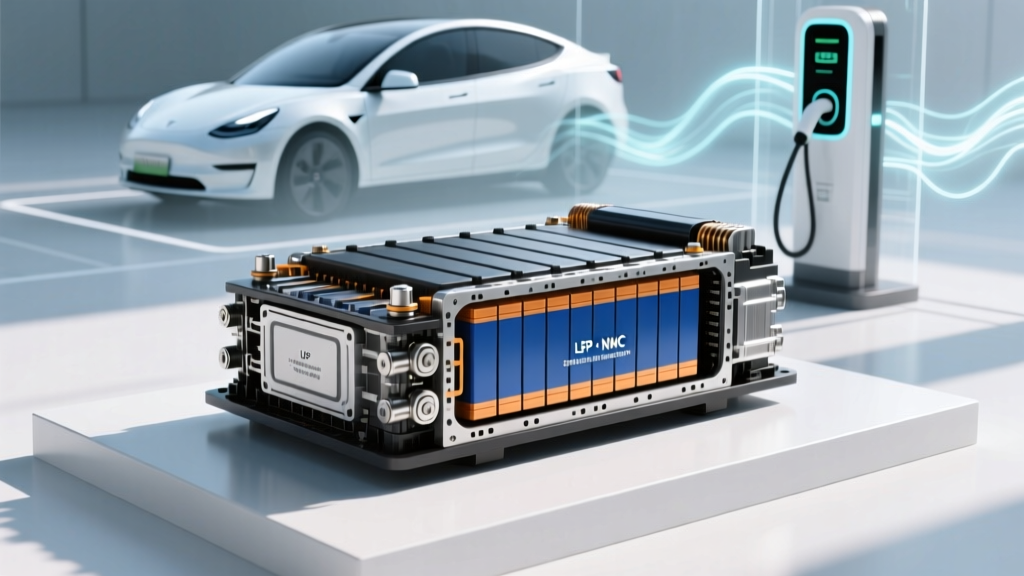
Not all lithium-ion cells weigh the same per unit of stored energy. The cathode chemistry determines energy density — how many watt-hours you get per kilogram of cell mass. This is the single biggest factor in EV car battery weight for a given range target.
| Attribute | LFP (Lithium Iron Phosphate) | NMC (Nickel Manganese Cobalt) | NCA (Nickel Cobalt Aluminum) |
|---|---|---|---|
| Cell-level energy density | 160–180 Wh/kg | 220–260 Wh/kg | 240–270 Wh/kg |
| Pack-level energy density | 120–150 Wh/kg | 150–190 Wh/kg | 160–200 Wh/kg |
| Typical cycle life (to 80% SoH) | 3,000–5,000+ cycles | 1,500–2,500 cycles | 1,200–2,000 cycles |
| Cold-weather performance (below 32°F) | Moderate — slower charge acceptance | Good — better low-temp conductivity | Good — similar to NMC |
| Cost per kWh (cell level, 2026) | ~$50–65/kWh | ~$75–95/kWh | ~$80–100/kWh |
| Thermal stability | Excellent — less prone to thermal runaway | Good — requires active management | Good — requires active management |
| Common applications (2026 MY) | Tesla Model 3 RWD, Model Y RWD, Ford Mustang Mach-E Select | Hyundai Ioniq 5/6, Kia EV6/EV9, VW ID.4, Chevy Equinox EV | Tesla Model S/X, Rivian R1T/R1S (dual-motor large pack) |
The weight implication: To store 75 kWh of usable energy, an LFP pack will weigh roughly 1,100–1,250 lbs at the pack level, while an NMC pack of the same capacity might weigh 850–1,000 lbs. That ~200-lb difference affects efficiency, but LFP's superior cycle life and lower cost often make the trade-off worthwhile for standard-range and mid-range trims.
Manufacturers are narrowing the gap. CATL's third-generation LFP cells (introduced 2024–2025) push energy density to ~180 Wh/kg at the cell level, and BYD's Blade Cell structural pack design eliminates module-level hardware, boosting pack-level density. Still, for vehicles targeting 320+ miles of EPA-estimated range, NMC and NCA remain the default for weight-constrained platforms.
Real-World Battery Weight by Popular 2026 EV Models
Here's how EV car battery weight stacks up across some of the most-purchased models in the US market. Note that pack weight includes cells, cooling hardware, structural enclosure, and battery management electronics.
| Vehicle | Usable Battery (kWh) | Chemistry | Est. Pack Weight (lbs) | Vehicle Curb Weight (lbs) | Battery as % of Curb |
|---|---|---|---|---|---|
| Tesla Model 3 RWD | 57.5 | LFP | ~1,060 | 3,862 | 27% |
| Tesla Model Y Long Range AWD | 75 | NMC | ~1,000 | 4,398 | 23% |
| Hyundai Ioniq 5 Long Range AWD | 77.4 | NMC | ~1,050 | 4,665 | 23% |
| Ford F-150 Lightning Extended Range | 131 | NMC | ~1,800 | 6,570 | 27% |
| Chevrolet Equinox EV 3RS | 85 | NMC | ~1,150 | 4,843 | 24% |
| GMC Hummer EV Pickup | 212.7 | NMC | ~2,923 | 9,063 | 32% |
| Rivian R1T Dual-Motor Max Pack | 141 | NCA/NMC | ~1,850 | 7,148 | 26% |
| BMW i4 eDrive40 | 81.5 | NMC | ~1,100 | 4,682 | 23% |
Note: Pack weights are estimates derived from manufacturer disclosures, teardown analyses, and industry data. Curb weights sourced from fueleconomy.gov and manufacturer spec sheets.
How Long Do EV Batteries Actually Last? Degradation Data
The most persistent fear among EV shoppers is premature battery failure. The data tells a reassuring story: modern liquid-cooled packs lose capacity slowly, and the vast majority will outlast the vehicle's first ownership cycle.
What degradation looks like in practice:
- Year 1 (0–15,000 mi): 2–4% loss. This initial "formation" drop is normal as the solid-electrolyte interface (SEI) layer stabilizes.
- Years 2–5 (15,000–75,000 mi): ~1–2% per year. Degradation slows significantly after the first year.
- Years 5–10 (75,000–150,000 mi): ~1–1.5% per year. A well-maintained NMC pack typically retains 85–92% capacity at 100,000 miles. LFP packs often retain 90–95%+ over the same distance due to their superior cycle life.
- Beyond 150,000 miles: Most packs remain above 80% State of Health (SoH). Tesla's 2024 Impact Report noted that Model S/X batteries retained approximately 88% capacity at 150,000 miles on average.
Real-world fleet data from Recurrent Auto (a battery analytics firm tracking over 15,000 EVs) shows that the median EV battery in 2025–2026 retains roughly 90% of original capacity at 80,000 miles. Outlier cases of rapid degradation are almost always linked to manufacturing defects covered under warranty, not normal aging.
Factors That Accelerate Degradation
- ✅ Keep daily State of Charge between 20–80% for NMC/NCA; LFP can be charged to 100% regularly (manufacturers recommend periodic full charges for LFP calibration).
- ✅ Minimize DC fast charging above 150 kW to road trips only; daily Level 2 charging at 7–11 kW is gentler on cells.
- ✅ Precondition the battery before fast charging in cold weather (below 40°F) — most EVs do this automatically when a charger is set as your navigation destination.
- ✅ Avoid leaving the car at 100% SoC in hot weather (>90°F) for extended periods. If you must charge to full, do it right before departure.
- ✅ Use scheduled charging / scheduled departure features to minimize time spent at high SoC.
- ❌ Don't store the vehicle at 0% or 100% SoC for weeks at a time — aim for ~50% for long-term parking.
Battery Warranty Coverage: What's Actually Protected
Federal regulations mandate that EV batteries carry a minimum warranty of 8 years / 100,000 miles (10 years / 150,000 miles in CARB states like California, New York, and Massachusetts). Most manufacturers exceed these minimums with capacity-retention guarantees.
| Manufacturer | Warranty Period | Capacity Retention Threshold | Coverage Type |
|---|---|---|---|
| Tesla (Model 3/Y RWD — LFP) | 8 yr / 100,000 mi | 70% | Defect + degradation below threshold |
| Tesla (Model 3/Y LR, S, X) | 8 yr / 120,000 mi (S/X: 150,000 mi) | 70% | Defect + degradation below threshold |
| Hyundai / Kia (E-GMP platform) | 10 yr / 100,000 mi | 70% | Defect + degradation below threshold |
| General Motors (Ultium) | 8 yr / 100,000 mi | 70% | Defect + degradation below threshold |
| Ford | 8 yr / 100,000 mi | 70% | Defect + degradation below threshold |
| Rivian | 8 yr / 175,000 mi | 70% | Defect + degradation below threshold |
| BMW | 8 yr / 100,000 mi | 70% | Defect + degradation below threshold |
Key nuance: Warranty coverage triggers only when capacity drops below the stated threshold (usually 70%). A battery at 72% SoH at 95,000 miles is functioning within spec, even though you've lost nearly a third of your original range. This is why monitoring SoH proactively matters — see the next section.
How Much Does It Cost to Replace an EV Battery?
Out-of-warranty battery replacement is the nightmare scenario EV skeptics cite. Here's what the numbers actually look like in 2026:
| Vehicle / Pack Size | Battery Capacity | Replacement Cost (Parts + Labor) | Cost per kWh |
|---|---|---|---|
| Tesla Model 3 RWD (LFP) | 57.5 kWh | $8,000–$12,000 | ~$140–210/kWh |
| Hyundai Ioniq 5 / Kia EV6 | 77.4 kWh | $12,000–$18,000 | ~$155–230/kWh |
| Ford F-150 Lightning Ext. Range | 131 kWh | $20,000–$30,000 | ~$150–230/kWh |
| Chevrolet Bolt EV (older platform) | 65 kWh | $9,000–$14,000 | ~$140–215/kWh |
| Tesla Model S / X | 100 kWh | $15,000–$22,000 | ~$150–220/kWh |
When is replacement actually needed? Based on current degradation trajectories, most EV batteries will not fall below 70% SoH until 200,000–300,000+ miles under normal use. LFP packs may exceed 400,000 miles before hitting that threshold. Given that the average US vehicle is scrapped at around 200,000 miles (per Bureau of Transportation Statistics data), the majority of EV batteries will never need a full replacement during the vehicle's life.
Module-level repair is also increasingly viable. Rather than replacing the entire pack, specialized EV shops can identify and swap individual degraded modules for $2,000–$6,000 — a fraction of a full-pack cost.
Monitoring Battery Health: How to Check Your SoH
State of Health (SoH) is the percentage of original capacity your battery can still hold. A new battery is 100% SoH; one that holds 75 kWh out of an original 85 kWh is at ~88% SoH.
How to Check SoH
- In-car displays: Tesla shows a "Battery Health" percentage in the service menu (added via 2024 software update). Some Hyundai/Kia models display estimated degradation in the EV settings panel.
- OBD-II dongles + apps: Tools like OBDLink SX paired with apps such as EVNotify or Car Scanner can read battery management system (BMS) data including SoH, cell voltage spread, and pack temperature.
- Third-party services: Companies like Recurrent Auto offer free battery health reports by connecting to your vehicle's telematics data (with permission). Their reports compare your pack's degradation against a fleet of identical vehicles.
- Dealer diagnostic: Any authorized service center can pull a full BMS report. Request this during routine service visits, especially before and after the warranty period.
What to watch for: Cell voltage imbalance (any individual cell group deviating more than 50 mV from the pack average) can signal a weak module. If your SoH drops more than 3% in a single year outside the first year, schedule a diagnostic check — this could indicate a defect still covered under warranty.
Emerging Battery Tech: Solid-State, Silicon Anode, and Weight Reduction
Several next-generation technologies aim to reduce EV car battery weight while increasing energy density. Here's a realistic timeline for each:
Solid-State Batteries
Solid-state cells replace the liquid electrolyte with a solid ceramic, polymer, or sulfide conductor. Benefits include higher energy density (projected 350–500 Wh/kg at the cell level — roughly double current NMC), faster charging potential, and improved safety. Toyota, Samsung SDI, and QuantumScape are leading development.
Realistic timeline: Limited production in premium/low-volume vehicles began in 2025–2026 (Toyota announced a pilot in select bZ models). Broad commercial availability in mainstream EVs is expected 2028–2032. Cost remains 2–4x current lithium-ion per kWh.
Silicon Anode Cells
Replacing graphite anodes with silicon (or silicon-carbon composites) can boost cell energy density by 20–40%. Companies like Sila Nanotechnologies and Group14 Technologies are supplying silicon anode materials to battery manufacturers. Mercedes-Benz's EQG (G-Class EV) uses silicon anode cells from Sila for improved energy density.
Realistic timeline: Already in limited production (2024–2026). Expect broader adoption across premium and mid-market EVs by 2027–2029 as manufacturing scales and silicon swelling issues are further resolved.
Cell-to-Pack and Cell-to-Chassis Designs
BYD's Blade Battery, Tesla's structural 4680 pack, and CATL's Cell-to-Pack (CTP) technology eliminate module-level hardware, integrating cells directly into the pack enclosure — or even making the battery a structural part of the vehicle chassis. This reduces pack weight by 10–20% without changing cell chemistry.
Realistic timeline: Already deployed in multiple 2025–2026 models. Expect near-universal adoption across new EV platforms by 2028.
EV Car Battery Weight FAQ
How much does a typical EV car battery weigh?
Most EV battery packs weigh between 600 and 1,500 pounds, depending on capacity and chemistry. A 60 kWh LFP pack weighs roughly 1,000–1,100 lbs, while a 100 kWh NMC pack weighs around 1,200–1,400 lbs. Large-truck packs like the Hummer EV's 212.7 kWh unit approach 3,000 lbs.
Does a heavier EV battery mean more range?
Not necessarily. While a larger battery stores more energy (more kWh = more potential range), the extra weight increases energy consumption per mile. The net gain depends on the vehicle's efficiency engineering. A 100 kWh pack in a heavy SUV may deliver only marginally more range than a 85 kWh pack in a lighter sedan.
Which is lighter: LFP or NMC?
NMC is lighter per kWh stored. NMC cells offer 220–260 Wh/kg vs. LFP's 160–180 Wh/kg. For the same usable capacity, an NMC pack will weigh roughly 15–25% less than an equivalent LFP pack. However, LFP's lower cost, longer cycle life, and better thermal stability make it a practical choice for standard-range trims where the weight penalty is acceptable.
Will my EV battery need replacing during ownership?
Statistically, probably not. Current data shows most liquid-cooled EV batteries retain 80–90% capacity at 150,000 miles. With average vehicle lifespans around 200,000 miles, the battery will likely outlive other major components. Warranty coverage (8 yr/100,000 mi minimum) protects against premature defects.
How does cold weather affect battery weight and performance?
Cold temperatures don't change the physical weight of the battery, but they reduce usable capacity by 15–30% in extreme cold (below 20°F) due to slowed electrochemical reactions and energy diverted to battery heating. This is temporary — capacity returns as temperatures normalize. Preconditioning the battery before driving mitigates this loss significantly.
Does battery weight affect tire wear?
Yes. Heavier EVs wear tires 20–30% faster than comparable gas vehicles. The combination of high curb weight (driven largely by battery mass) and instant torque accelerates tread wear. Budget for tire replacement every 25,000–40,000 miles and choose EV-rated tires with higher load indexes.