When shoppers ask "what are car batteries made of," the answer depends entirely on whether we're talking about the small 12V auxiliary battery under the hood or the high-voltage traction battery pack that actually propels the vehicle. This guide focuses exclusively on the high-voltage traction battery — the large, expensive, and technologically complex energy storage system that determines your EV's range, charging speed, and long-term ownership costs.
Modern EV traction batteries are lithium-ion cells assembled into modules and packs, but the specific chemistry inside those cells varies significantly between manufacturers and even between trims of the same model. That chemistry choice affects everything from how far you can drive on a charge to how the battery holds up after 150,000 miles.
The Raw Materials Inside an EV Battery Pack
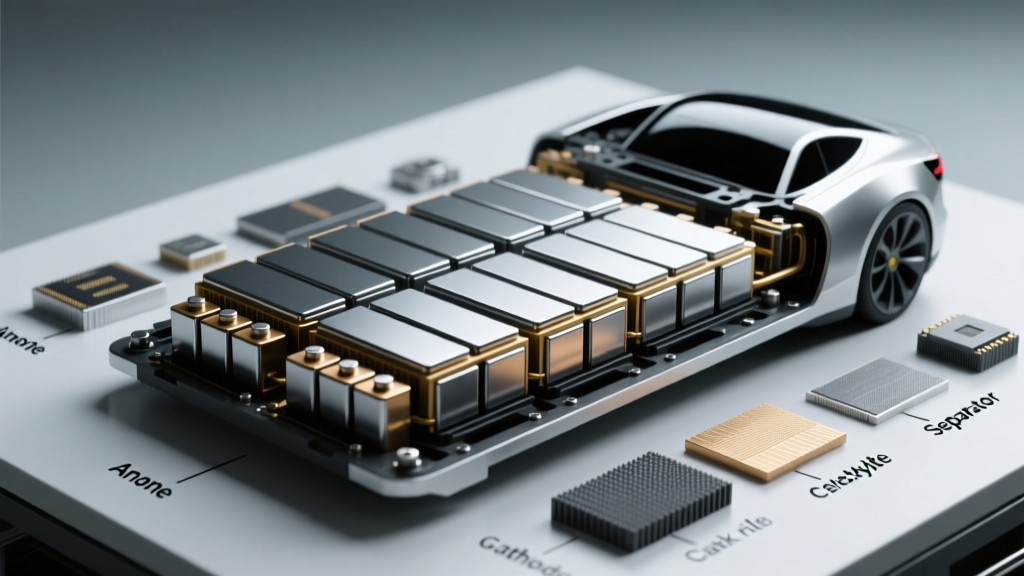
A lithium-ion EV battery pack consists of several key components at the cell level:
- Cathode (positive electrode): This is where the chemistry name comes from. Common cathode materials include nickel, manganese, cobalt, aluminum, and iron phosphate. The cathode determines energy density, thermal stability, and cost.
- Anode (negative electrode): Typically graphite (carbon), though silicon-blend anodes are entering production to boost energy density.
- Electrolyte: A lithium salt solution that allows lithium ions to move between cathode and anode during charge and discharge cycles.
- Separator: A thin porous membrane that prevents direct contact between electrodes while allowing ion flow.
- Current collectors: Aluminum foil on the cathode side, copper foil on the anode side.
These cells are grouped into modules, then integrated into a pack with a battery management system (BMS), thermal management hardware (coolant channels, heaters), and structural housing. The pack-level engineering is as important as the cell chemistry — a well-managed pack degrades far more slowly than one with poor thermal control.
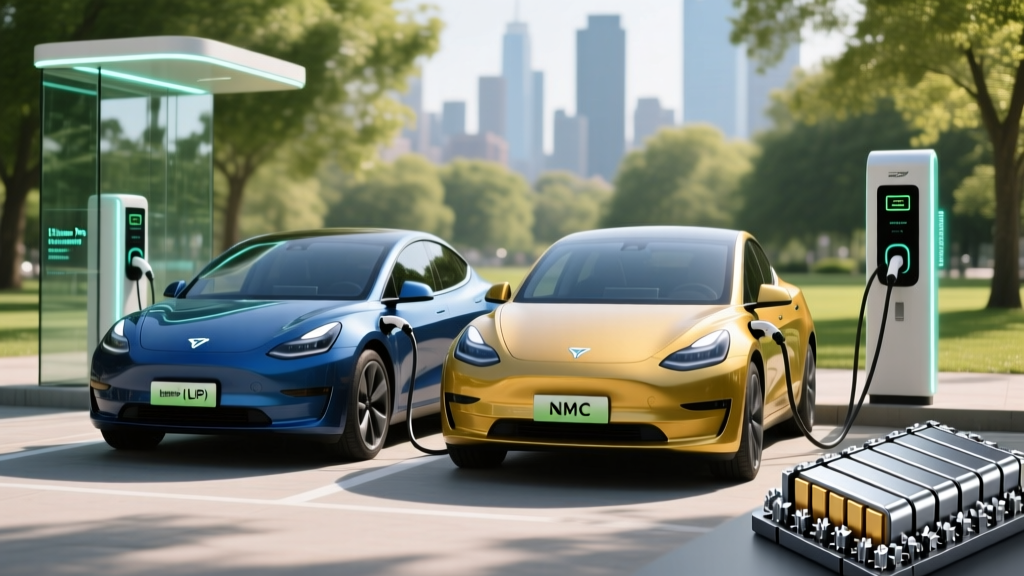
LFP vs NMC vs NCA: The Chemistry Showdown
Three cathode chemistries dominate the 2026 EV market. Understanding the trade-offs is essential for any buyer choosing between models or trims.
| Attribute | LFP (Lithium Iron Phosphate) | NMC (Nickel Manganese Cobalt) | NCA (Nickel Cobalt Aluminum) |
|---|---|---|---|
| Energy density | Lower (~160 Wh/kg cell-level) | Higher (~220-260 Wh/kg) | Highest (~260-300 Wh/kg) |
| Cycle life | Excellent (3,000-5,000+ cycles) | Good (1,000-2,000 cycles) | Good (1,000-1,500 cycles) |
| Cold-weather performance | Weaker — greater range loss below freezing | Better low-temp discharge capability | Better low-temp discharge capability |
| Thermal stability / safety | Excellent — very resistant to thermal runaway | Good — requires robust BMS management | Good — requires robust BMS management |
| Cost | Lower — no cobalt or nickel | Higher — cobalt and nickel price exposure | Higher — cobalt content |
| Charging to 100% daily | Recommended — LFP benefits from periodic full charges for BMS calibration | Not recommended — 80% daily charge preferred for longevity | Not recommended — 80% daily charge preferred |
| Common in (2026 models) | Tesla Model 3/Y RWD, Ford Mustang Mach-E Select (standard range), many Chinese-market EVs | Hyundai Ioniq 5/6, Kia EV6/EV9, VW ID.4, Chevrolet Equinox EV, most long-range trims | Tesla Model S/X, some Panasonic-supplied packs |
Which is better? There's no universal winner. LFP is the smarter choice for buyers who want maximum longevity, plan to keep the vehicle well past 150,000 miles, and don't need the absolute longest single-charge range. NMC and NCA deliver more range per kilogram, making them preferable for long-range trims and heavier vehicles like the Kia EV9 or Rivian R1S where pack weight matters. If you live in a cold climate and regularly drive in sub-freezing temperatures, NMC's superior low-temperature performance is a tangible advantage.
How Long Do EV Batteries Actually Last?
The short answer: in most cases, the traction battery will outlast the rest of the vehicle. But "outlast" doesn't mean "zero degradation." Every lithium-ion battery loses capacity over time and use.
Real-world degradation data points:
- Tesla fleet data (2025 impact report): Model 3/Y batteries retained approximately 85% of original capacity at 200,000 miles. Model S/X retained roughly 88% at the same mileage.
- Geotab fleet study (2024, ~10,000 vehicles): Average EV battery degradation was approximately 1.8% per year across all chemistries, meaning a typical EV retains ~82% capacity after 10 years.
- Recurrent Auto data (2025): Chevrolet Bolt EV owners showed an average of 8-10% capacity loss after 100,000 miles and 5-6 years of ownership, with LFP-equipped vehicles showing measurably less.
- Hyundai/Kia E-GMP platform: Early Ioniq 5 and EV6 owners report approximately 5-7% degradation at 60,000 miles, consistent with NMC cells managed conservatively by the BMS.
The key takeaway is that degradation is non-linear. Most batteries experience a steeper drop in the first 20,000-30,000 miles (roughly 2-4%), then settle into a very gradual, nearly linear decline. A battery that has lost 10% after 100,000 miles is not on track to lose 20% by 200,000 — it will likely lose closer to 15% total.
For a 2026 EV with an EPA range of 310 miles, expect roughly 270-280 miles of usable range after 100,000 miles and 5-6 years of typical ownership. That's still more daily range than most drivers need.
What Does the Battery Warranty Actually Cover?
Federal law mandates that EV battery warranties cover a minimum of 8 years / 100,000 miles (whichever comes first). California and states that follow CARB emissions rules extend this to 10 years / 150,000 miles. But the details matter enormously.
| Manufacturer | Warranty Period | Capacity Retention Threshold | What Triggers a Claim |
|---|---|---|---|
| Tesla (Model 3/Y RWD — LFP) | 8 yr / 100,000 mi | 70% | Battery falls below 70% of original capacity |
| Tesla (Model 3/Y Long Range, S, X) | 8 yr / 120,000 mi | 70% | Battery falls below 70% of original capacity |
| Hyundai / Kia (E-GMP platform) | 10 yr / 100,000 mi | 70% | SoH below 70% as diagnosed by dealer |
| General Motors (Ultium platform) | 8 yr / 100,000 mi | 70% | Capacity below 70% or material defect |
| Ford (Mach-E, F-150 Lightning) | 8 yr / 100,000 mi | 70% | Battery capacity below 70% |
| Volkswagen (ID.4) | 8 yr / 100,000 mi | 70% | Net capacity below 70% |
Critical nuance: The warranty does not guarantee your battery will stay at 100%. It guarantees it won't drop below the stated threshold (typically 70%). A battery at 72% capacity after 9 years is functioning within warranty specifications, even though you've lost nearly a third of your original range. For a 300-mile EPA vehicle, 70% retention means ~210 miles of range — still viable for most daily driving but noticeably reduced for road trips.
Warranty claims for capacity loss remain rare. Most claims involve manufacturing defects (bad cell groups, BMS failures, coolant leaks into the pack) rather than normal degradation exceeding the threshold.
How Much Does It Cost to Replace an EV Battery?
This is the question that generates the most anxiety — and the most misinformation. Let's anchor the numbers in reality.
| Vehicle / Pack Size | Battery Capacity | Estimated Replacement Cost (2026) | Notes |
|---|---|---|---|
| Tesla Model 3 RWD | ~60 kWh (LFP) | $12,000 – $16,000 | LFP packs are cheaper; module-level repair may reduce cost |
| Hyundai Ioniq 5 / Kia EV6 | 77.4 kWh (NMC) | $16,000 – $22,000 | E-GMP pack; individual module replacement sometimes possible |
| Ford F-150 Lightning Extended Range | ~131 kWh (NMC) | $25,000 – $35,000 | Largest consumer pack; full replacement is expensive |
| Chevrolet Equinox EV | ~85 kWh (NMC, Ultium) | $15,000 – $20,000 | Ultium modular architecture may allow partial replacement |
| Tesla Model S / X | ~100 kWh (NCA) | $20,000 – $28,000 | Aftermarket refurbished packs available for older models |
When is replacement typically needed? For the vast majority of owners, it isn't — at least not during the first 15 years or 200,000 miles. Out-of-warranty full pack replacements are currently most common on early-generation EVs (2012-2017 Nissan Leafs with air-cooled packs, early Tesla Model S units) that experienced accelerated degradation or physical damage. Modern liquid-cooled packs with sophisticated BMS management are far more durable.
A growing number of shops can perform module-level repairs — replacing only the degraded cell modules rather than the entire pack — for $3,000 to $8,000. This option is expanding as independent EV repair shops gain access to diagnostic tools and replacement modules. According to Recurrent Auto, fewer than 5% of EVs in their study cohort of over 15,000 vehicles required any battery-related repair outside of warranty coverage.
What Kills an EV Battery Early (and What Doesn't)
Lithium-ion batteries degrade through a combination of calendar aging (time and temperature) and cycle aging (charge-discharge use). Here's what actually moves the needle:
Factors that accelerate degradation:
- Persistent high State of Charge: Storing an NMC or NCA battery at 100% for days or weeks accelerates cathode breakdown. Charge to 80% for daily use; save 100% for road trips. (LFP is the exception — it benefits from regular 100% charges for cell balancing.)
- Extreme heat exposure: Ambient temperatures above 95°F combined with high SoC is the single worst condition for lithium-ion longevity. If you live in Phoenix or Las Vegas, garage parking and preconditioning are meaningful protections.
- Frequent DC fast charging at high power: Occasional fast charging is fine. Daily reliance on 150+ kW DC fast charging, especially without preconditioning, generates sustained heat that accelerates cell wear. Data from Geotab's fleet study shows vehicles that DC fast-charged more than 3 times per week showed slightly higher degradation rates than those primarily using Level 2.
- Deep discharges to 0%: Regularly running the battery to near-empty stresses the cells. The BMS maintains a buffer (typically 3-5% at the bottom), but habitual deep discharges aren't ideal.
- Charging in extreme cold without preconditioning: Plugging into a DC fast charger with a frozen battery can cause lithium plating on the anode — permanent damage. Always precondition (warm the battery) before fast charging in cold weather.
Factors that are less harmful than commonly believed:
- Moderate DC fast charging: Using DCFC on road trips 1-2 times per month has negligible long-term impact with modern thermal management.
- High-mileage driving: Cycle count matters less than depth of discharge and temperature. Many high-mileage EVs (150,000+ miles) show less degradation than low-mileage ones that sat at 100% in hot climates.
- Regenerative braking: Regen does not meaningfully accelerate battery wear. The charge rates involved are well within cell specifications.
How to Check and Monitor Your Battery's State of Health
State of Health (SoH) is expressed as a percentage of the battery's original usable capacity. A new battery is at 100% SoH; a battery that has lost 12% of its capacity sits at 88% SoH.
In-vehicle tools:
- Tesla: The mobile app displays estimated range at 100%, which you can compare to the original EPA figure. Third-party apps like Tessie or TeslaFi provide more granular SoH estimates by logging charge data.
- Hyundai/Kia: The infotainment system's EV menu shows a battery health indicator, though it's a simplified bar graph rather than a precise percentage. Dealer diagnostic scans provide exact SoH figures.
- GM (Ultium): The myChevrolet/myCadillac app shows battery health status. OnStar diagnostics can provide a detailed report.
- Ford: FordPass provides battery health notifications. A dealer scan tool reads precise SoH.
Third-party and OBD-II tools: Devices like the OBDLink MX+ paired with apps such as Car Scanner or ABRP (A Better Route Planner) can read battery SoH, cell voltage variance, and pack temperature directly from the CAN bus. For pre-purchase inspections on used EVs, a dealer diagnostic report or a third-party scan is the most reliable verification method.
The practical check: Charge to 100% (or your normal daily limit) and note the displayed estimated range. Compare this to the EPA-rated range when the vehicle was new. If your 310-mile EPA vehicle shows 255 miles at 100% after 80,000 miles, that's roughly 82% SoH — right in line with expected degradation curves.
Emerging Battery Tech: Solid-State and Silicon Anodes
Next-generation battery technologies are in active development, but buyers should calibrate expectations against realistic timelines.
Solid-state batteries replace the liquid electrolyte with a solid material (ceramic, sulfide, or polymer), promising higher energy density, faster charging, and improved safety. Toyota has announced a solid-state battery targeting 750 km (~466 miles) of range with a 10-minute 10-80% charge, with initial production slated for 2027-2028 in limited volumes. Samsung SDI and QuantumScape are also pursuing solid-state cells with pilot production underway. However, manufacturing scale-up and cost reduction remain significant hurdles. Widespread solid-state availability in affordable consumer EVs is not expected before 2030 at the earliest.
Silicon anode technology is closer to market. Companies like Sila Nanotechnologies and Group14 are supplying silicon-blend anode materials that increase energy density by 20-40% compared to pure graphite. These are appearing in limited production vehicles and are expected to become more common in 2026-2028 model-year EVs as an incremental improvement rather than a revolution.
Sodium-ion batteries are entering the market as a lower-cost alternative for shorter-range, budget EVs. CATL has begun production, and these cells eliminate lithium, cobalt, and nickel entirely. Expect to see sodium-ion packs in entry-level EVs and urban-focused models, though energy density is significantly lower than lithium-ion.
None of these technologies are currently available in production vehicles you can buy today. If you're shopping now, current-generation lithium-ion packs (LFP, NMC, NCA) are mature, well-understood, and backed by extensive warranty coverage and real-world degradation data.
Frequently Asked Questions
Do EV batteries contain cobalt? Is that an ethical concern?
It depends on the chemistry. NMC and NCA batteries contain cobalt (typically 5-10% of the cathode by weight), and cobalt mining has documented labor and environmental concerns, particularly in the Democratic Republic of Congo. LFP batteries contain zero cobalt — the cathode is iron phosphate, which is abundant and ethically straightforward to source. If cobalt sourcing is a priority, LFP-equipped vehicles (Tesla Model 3 RWD, standard-range Mach-E) are the clear choice. The industry trend is toward reduced-cobalt and cobalt-free chemistries.
How long do EV batteries last in years and miles?
Based on fleet data from Geotab, Tesla, and Recurrent Auto, modern liquid-cooled EV batteries typically retain 80-88% of original capacity at 200,000 miles and 10-12 years. Many will outlast the vehicle's body, suspension, and interior. Complete failure before 150,000 miles is rare and usually covered by the 8-year/100,000-mile minimum warranty.
Can I replace just one bad module instead of the whole pack?
Increasingly, yes. Many modern packs (GM Ultium, Hyundai E-GMP, Tesla structural packs to a lesser extent) use modular designs that allow individual module replacement. A single module replacement typically costs $3,000-$8,000 versus $15,000-$35,000 for a full pack. Availability depends on the model, the specific failure, and whether your repair shop has the diagnostic capability and parts access.
Does fast charging really damage my battery?
Occasional DC fast charging — the kind you'd do on road trips — has minimal impact. The concern is frequent high-power DCFC (multiple times per week) combined with high ambient temperatures and no preconditioning. Modern BMS and thermal management systems have significantly reduced this risk compared to early-generation EVs. If you can charge at home on Level 2 most of the time and use DCFC for trips, your battery will fare well.
Should I buy an EV with an LFP or NMC battery?
Choose LFP if: you want maximum cycle life and longevity, plan to keep the vehicle 10+ years, prefer daily 100% charging convenience, want lower cost, and don't need the absolute maximum EPA range. Choose NMC/NCA if: you need the longest single-charge range for road trips, live in a cold climate where low-temperature performance matters, or are buying a heavier vehicle (SUV, truck) where energy density directly translates to practical range.
What happens to old EV batteries?
End-of-life EV batteries are increasingly recycled. Companies like Redwood Materials (founded by Tesla co-founder JB Straubel) and Li-Cycle recover 90-95% of critical minerals — lithium, nickel, cobalt, copper — from spent cells. Many retired EV batteries also find second-life applications in stationary energy storage, where reduced capacity is less consequential. According to the U.S. Department of Energy, battery recycling infrastructure is scaling rapidly to match the growing volume of retired packs.
Understanding what EV car batteries are made of — and how that chemistry translates to real-world longevity — removes most of the uncertainty from EV ownership. The data is clear: modern traction batteries are durable, well-warranted, and rarely need replacement during a typical ownership cycle. The chemistry choice (LFP vs NMC) is a genuine trade-off, not a right-or-wrong decision, and should be matched to how you actually drive and how long you plan to keep the vehicle.