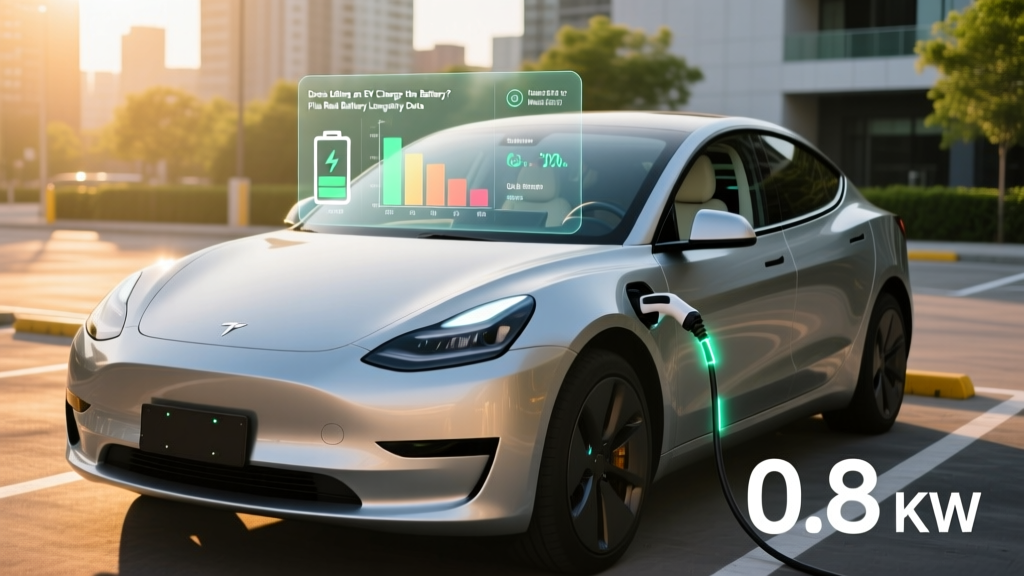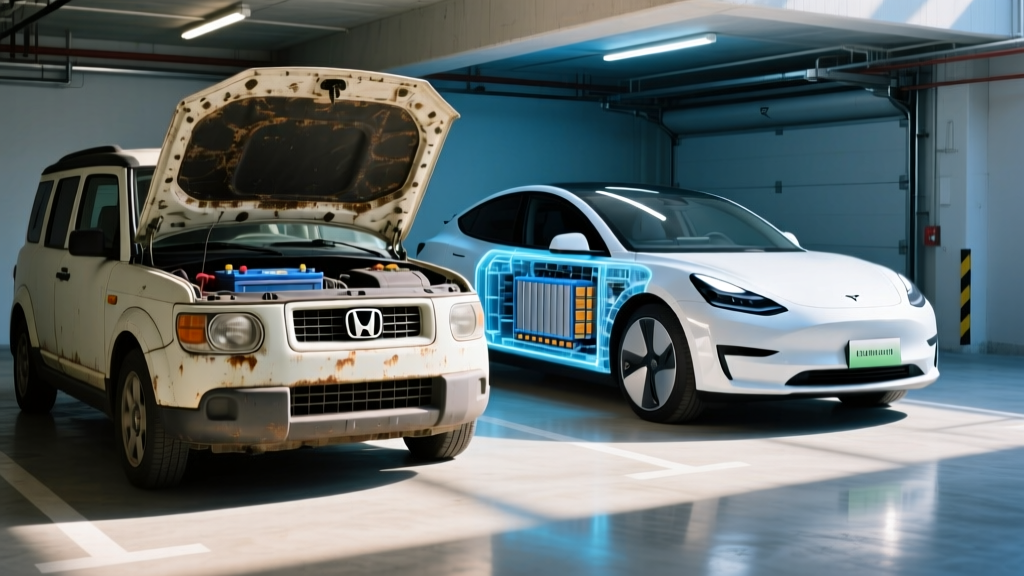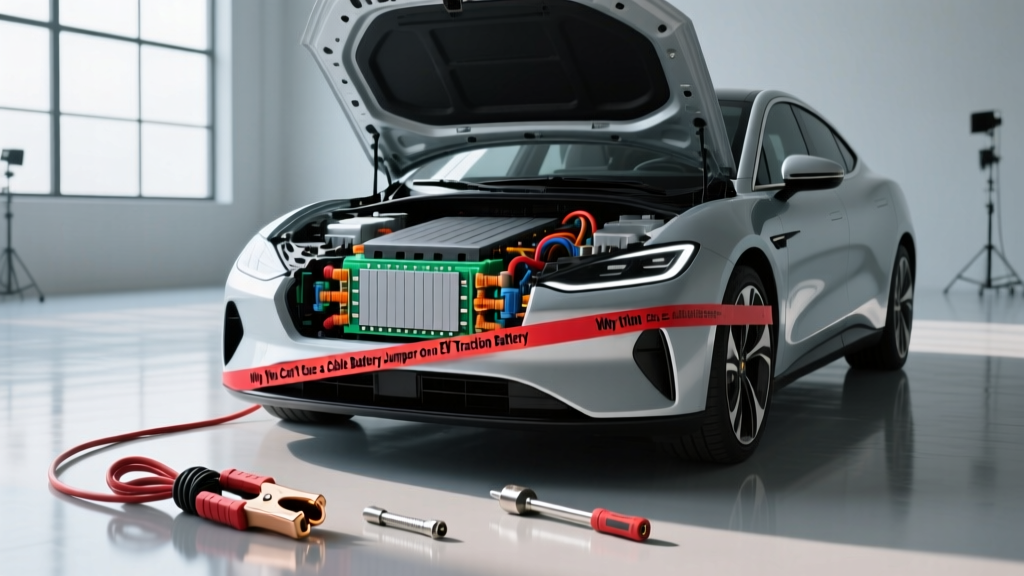
If you've ever searched for a cable battery jumper after your electric vehicle threw a low-battery warning, you're not alone — but the answer is more nuanced than it first appears. Modern EVs carry two completely separate battery systems: a high-voltage traction battery (typically 400V to 800V) that propels the car, and a conventional 12V auxiliary battery that powers the computers, lights, and door locks. Jumper cables and portable lithium jump-starter packs can only address the 12V side. The traction battery requires an entirely different framework of knowledge — from chemistry and degradation to warranty coverage and eventual replacement cost.
This guide covers everything an EV owner or buyer needs to know about the traction battery that actually matters for range and performance, while clarifying when a cable battery jumper is — and isn't — the right tool.
The Two Batteries in Your EV: What a Jumper Cable Can and Can't Fix
Every battery-electric and plug-in hybrid vehicle sold in the U.S. carries a 12V auxiliary battery alongside the main high-voltage pack. That 12V battery does the same jobs it does in a gas car: it boots the vehicle computers, runs the infotainment system, powers the lights, and actuates the contactors that connect the traction battery to the drivetrain.
Here's where confusion sets in. When an EV appears "dead" and won't start, it's almost always the 12V battery that has failed or discharged — not the 400V+ traction pack. In that scenario, a standard cable battery jumper or a portable 12V lithium jump pack can get the vehicle's systems running again, which then allows the DC-DC converter to recharge the 12V battery from the traction pack. Tesla's owner manuals, for instance, explicitly describe 12V jump-starting procedures using external jumper cables connected to designated terminals.
However, if the traction battery itself is depleted (i.e., the car shows 0% state of charge and has no range), no jumper cable will help. The only solution is to supply energy to the pack via a charging cable — either Level 1 (120V household), Level 2 (240V), or DC fast charging — or to have the vehicle towed on a flatbed to a charger.
LFP vs NMC vs NCA: Which Chemistry Powers Your EV?
The traction battery in your EV uses one of several lithium-ion chemistries, and the choice affects range, longevity, charging behavior, and cost. The three dominant chemistries in 2026-model EVs are:
- LFP (Lithium Iron Phosphate): Used in standard-range Tesla Model 3 and Model Y, base Ford Mustang Mach-E, and many Chinese-market EVs now arriving globally.
- NMC (Nickel Manganese Cobalt): Found in most Hyundai/Kia E-GMP vehicles (Ioniq 5, EV6, EV9), Volkswagen ID.4, and many long-range models.
- NCA (Nickel Cobalt Aluminum): Primarily used in Tesla long-range and performance models.
| Attribute | LFP | NMC/NCA |
|---|---|---|
| Energy Density | Lower (~160 Wh/kg cell-level) | Higher (~250–300 Wh/kg cell-level) |
| Cycle Life | 3,000–5,000+ cycles | 1,000–2,000 cycles |
| Cold-Weather Performance | Weaker; more range loss below 32°F | Better low-temp discharge capability |
| Recommended Charge Habit | Can charge to 100% daily; benefits from periodic full charges for BMS calibration | Best kept 20–80% daily; 100% only for trips |
| Cost per kWh | Lower (~$80–100/kWh pack-level, 2026) | Higher (~$110–140/kWh pack-level, 2026) |
| Thermal Stability | Superior; lower thermal runaway risk | Good but requires more active thermal management |
| Typical Applications | Standard-range, fleet, budget EVs | Long-range, performance, large SUVs/trucks |
Which is better? There's no universal winner. LFP is the better choice for drivers who want maximum cycle life, lower cost, and the convenience of daily 100% charging — ideal for commuters and high-mileage drivers. NMC/NCA wins when you need maximum range from a lighter, more energy-dense pack, making it the right call for long-distance travelers and larger vehicles like the Rivian R1S or Ford F-150 Lightning Extended Range.
How Long Do EV Traction Batteries Actually Last?
The most persistent myth in EV ownership is that the battery will need replacement within a few years, turning the vehicle into a financial liability. Real-world data tells a different story.
According to data aggregated from fleet operators and long-term owners, the average lithium-ion EV traction battery loses approximately 5–10% of its original capacity over the first 100,000 miles, after which degradation typically slows to a gradual linear decline. A 2025 analysis by Recurrent Auto, which tracks over 15,000 EVs in real-world conditions, found that most modern EV batteries retain 90% or more of their original range after five years of typical use.
• Year 1 / 15,000 mi: ~2–4% loss (initial formation drop)
• Year 3 / 45,000 mi: ~6–8% total loss
• Year 5 / 75,000 mi: ~8–10% total loss
• Year 8 / 120,000 mi: ~10–14% total loss
• Year 10 / 150,000 mi: ~12–18% total loss
LFP batteries tend to degrade more slowly but may show slightly higher initial loss in cold climates.
For context, a 2026 Tesla Model Y Long Range with an EPA-rated 320 miles and an NMC/NCA pack would realistically deliver around 280–290 miles at 100,000 miles — still entirely usable for daily driving and road trips. The battery doesn't "fall off a cliff"; it slowly loses capacity over a timeline that typically exceeds the vehicle's useful life.
According to fueleconomy.gov, the U.S. Department of Energy's EV technology overview confirms that modern liquid-cooled battery packs are engineered for 150,000–200,000+ miles of service before capacity drops below 70–80% of original.
What Does the EV Battery Warranty Actually Cover?
Federal law mandates that all EV traction batteries carry a minimum warranty of 8 years or 100,000 miles (whichever comes first). In California and states that follow CARB (California Air Resources Board) emissions standards, that mandate extends to 10 years or 150,000 miles. Most manufacturers meet or exceed these minimums.
| Manufacturer | Coverage Period | Capacity Threshold | Notes |
|---|---|---|---|
| Tesla (Model 3/Y) | 8 yr / 100,000–120,000 mi (varies by trim) | 70% retention | Long Range & Performance: 120k mi |
| Hyundai / Kia (E-GMP) | 10 yr / 100,000 mi | 70% retention | Among the longest coverage periods |
| Ford (Mach-E, F-150 Lightning) | 8 yr / 100,000 mi | 70% retention | Covers battery and EV components |
| Volkswagen (ID.4) | 8 yr / 100,000 mi | 70% retention | Transferable to second owner |
| Rivian (R1T/R1S) | 8 yr / 175,000 mi | 70% retention | Higher mileage cap reflects truck use case |
| GM (Ultium platform) | 8 yr / 100,000 mi | 70% retention (60% for some commercial) | Modular design allows partial module replacement |
The critical number here is the capacity retention threshold. If your battery's State of Health (SoH) drops below the stated percentage within the warranty window, the manufacturer is obligated to repair or replace the pack at no cost to you. In practice, warranty replacements are rare — Recurrent's data shows that fewer than 1.5% of EVs in their dataset have required a battery warranty claim.
EV Battery Replacement Cost: What to Expect and When
If your battery degrades beyond the warranty threshold after the warranty expires, or if it suffers physical damage (flooding, collision), replacement costs are significant but often misunderstood.
| Vehicle | Battery Size | Chemistry | Estimated Replacement Cost |
|---|---|---|---|
| Tesla Model 3 Standard Range | ~60 kWh | LFP | $8,000–$12,000 |
| Tesla Model Y Long Range | ~75 kWh | NMC/NCA | $12,000–$16,000 |
| Hyundai Ioniq 5 | 77.4 kWh | NMC | $13,000–$18,000 |
| Ford F-150 Lightning Ext. Range | 131 kWh | NMC | $20,000–$30,000 |
| Chevrolet Equinox EV | ~85 kWh | NMC (Ultium) | $14,000–$18,000 |
| Rivian R1T Max Pack | ~149 kWh | NMC | $25,000–$35,000 |
Several factors are shifting these costs downward. Pack-level pricing has fallen from over $200/kWh in 2020 to roughly $100–140/kWh by 2026 for NMC and under $100/kWh for LFP, according to BloombergNEF tracking. Additionally, platforms like GM's Ultium and VW's MEB use modular battery designs that allow technicians to replace individual modules (typically 8–16 per pack) rather than the entire assembly, reducing out-of-warranty repair bills to $2,000–$5,000 per module.
When is replacement actually needed? In practice, very few EV owners ever pay for a traction battery replacement. The vast majority of EVs are traded, sold, or retired before the battery degrades to a point where replacement is economically justified. A battery at 75% SoH still provides substantial daily range — a 300-mile EPA vehicle at 75% health still delivers ~225 miles, which covers the average American's daily driving needs many times over.
Factors That Accelerate Battery Degradation
While modern battery management systems (BMS) and liquid cooling protect the pack effectively, certain habits and conditions can accelerate capacity loss:
- Avoid sustained 100% SoC: For NMC/NCA packs, set your daily charge limit to 80%. Reserve 100% for road-trip departures. LFP packs are an exception — manufacturers recommend periodic 100% charges for BMS cell-balancing calibration.
- Minimize DC fast charging when possible: Occasional DCFC is fine, but daily reliance on 150+ kW charging generates sustained heat that accelerates calendar aging. Home Level 2 (7–11 kW) is gentler on the cells.
- Precondition in cold weather: Use your EV's scheduled departure or preconditioning feature to warm the battery while still plugged in. A cold battery charged at high power experiences lithium plating, which causes permanent capacity loss.
- Avoid prolonged storage at extremes: If leaving your EV parked for weeks, aim for ~50% SoC. Storing at 100% or near 0% for extended periods stresses the chemistry.
- Use thermal management actively: In hot climates, park in shade or a garage when possible. Battery temperatures above 104°F (40°C) for extended periods accelerate degradation.
- Don't obsess over regen settings: While aggressive regenerative braking charges the battery at higher C-rates, the BMS manages this within safe limits. The effect on long-term degradation is negligible compared to SoC and temperature habits.
How to Check Your EV's Battery State of Health (SoH)
State of Health (SoH) is the percentage of original capacity your battery can still hold. A new battery is 100% SoH; a battery that held 75 kWh when new and now holds 67.5 kWh is at 90% SoH.
Here's how to monitor it:
1. In-Vehicle Displays: Some manufacturers provide SoH readouts directly. Nissan Leaf owners have long had access to a battery health bar in the instrument cluster. Tesla does not natively display SoH, but third-party apps like Tessie or TeslaFi can estimate it from charge-log data.
2. OBD-II Dongles and Apps: Devices like the OBDLink MX+ paired with apps such as LeafSpy (for Nissan), Car Scanner, or ABRP can read the BMS-reported SoH directly from the vehicle's CAN bus. This is the most accurate consumer-accessible method.
3. Dealer Diagnostics: Any authorized service center can run a full battery health report. Request this during routine service or before purchasing a used EV. The report will show individual module voltage deltas, total capacity in kWh, and SoH percentage.
4. Charge-Log Analysis: If you consistently charge to a known percentage and note the energy added (in kWh) via your charger's app or the vehicle's trip computer, you can estimate SoH manually: (kWh added ÷ % charged) × 100 = estimated total capacity. Compare this to the original spec.
What's Next: Solid-State and Silicon-Anode Batteries
Next-generation battery technologies promise step-change improvements in energy density, charging speed, and safety — but realistic timelines matter.
Solid-State Batteries: These replace the liquid electrolyte with a solid ceramic or polymer conductor, potentially doubling energy density and enabling 10-minute fast charges with reduced fire risk. Toyota has announced a solid-state EV targeted for 2027–2028 production, initially in limited volumes. Samsung SDI and QuantumScape are also in advanced prototype stages. Realistically, solid-state packs won't reach mainstream, cost-competitive production volumes until 2029–2032.
Silicon-Anode Batteries: Companies like Sila Nanotechnologies and Group14 are replacing graphite anodes with silicon-dominant composites, boosting energy density by 20–40%. These are closer to market — the Mercedes G-Class 580 EQ (announced) uses a silicon-anode pack from Sila, and we expect broader adoption in premium models by 2027–2028.
Sodium-Ion: CATL and BYD are producing sodium-ion batteries for lower-cost, shorter-range applications. These won't replace lithium-ion in long-range EVs but could power budget city cars and energy storage by 2027.
For buyers in 2026, today's lithium-ion chemistries — LFP and NMC/NCA — are mature, well-understood, and backed by substantial real-world longevity data. Waiting for solid-state means waiting several years and likely paying a significant early-adopter premium.
Frequently Asked Questions
Can I use a cable battery jumper on my EV's main traction battery?
No. Jumper cables are designed for 12V systems only. Your EV's traction battery operates at 400V–800V and can only be recharged through a proper EV charging cable connected to a Level 1, Level 2, or DC fast charger. If your EV won't start, it's almost certainly the 12V auxiliary battery that needs a jump — and yes, a standard cable battery jumper works for that, following the procedure in your owner's manual.
How long do EV batteries last in years and miles?
Based on fleet data and manufacturer engineering targets, modern liquid-cooled EV batteries typically last 150,000–200,000+ miles (15–20 years) before degrading to 70–80% of original capacity. Most EV batteries will outlast the vehicle they're installed in. Average degradation is roughly 1–2% per year under normal use.
How much does it cost to replace an EV battery?
Full traction battery replacement costs range from approximately $8,000 for a smaller LFP pack (e.g., Tesla Model 3 Standard Range) to $35,000 for a large NMC pack (e.g., Rivian R1T Max Pack). However, modular platforms allow individual module replacement for $2,000–$5,000. In practice, the vast majority of EV owners never need a paid battery replacement — the battery outlasts the car or is covered under warranty.
What does the EV battery warranty cover?
Federal law requires a minimum of 8 years/100,000 miles of battery warranty coverage (10 years/150,000 miles in CARB states). The warranty guarantees that the battery will retain a minimum percentage of its original capacity — typically 70%. If SoH drops below that threshold within the warranty period, the manufacturer must repair or replace the battery at no cost. Coverage includes defects in materials, workmanship, and excessive degradation.
LFP vs NMC: which battery chemistry should I choose?
Choose LFP if you prioritize cycle life, lower cost, the convenience of daily 100% charging, and superior thermal safety — it's ideal for commuters and high-mileage drivers. Choose NMC/NCA if you need maximum range from a lighter pack, better cold-weather performance, or are buying a larger vehicle where energy density is critical. Neither is universally "better" — the right choice depends on your driving patterns and climate.
Does frequent DC fast charging damage the battery?
Occasional DC fast charging has a minimal effect on modern batteries thanks to sophisticated thermal management. However, daily DCFC sessions — especially at 250+ kW — generate sustained heat that can accelerate long-term degradation by an estimated 1–3% over the battery's life compared to predominantly Level 2 charging. If you have home charging access, using Level 2 for daily needs and reserving DCFC for road trips is the optimal strategy.