Why Your EV Battery Won't Hold Charge: The Real Story Behind Range Loss
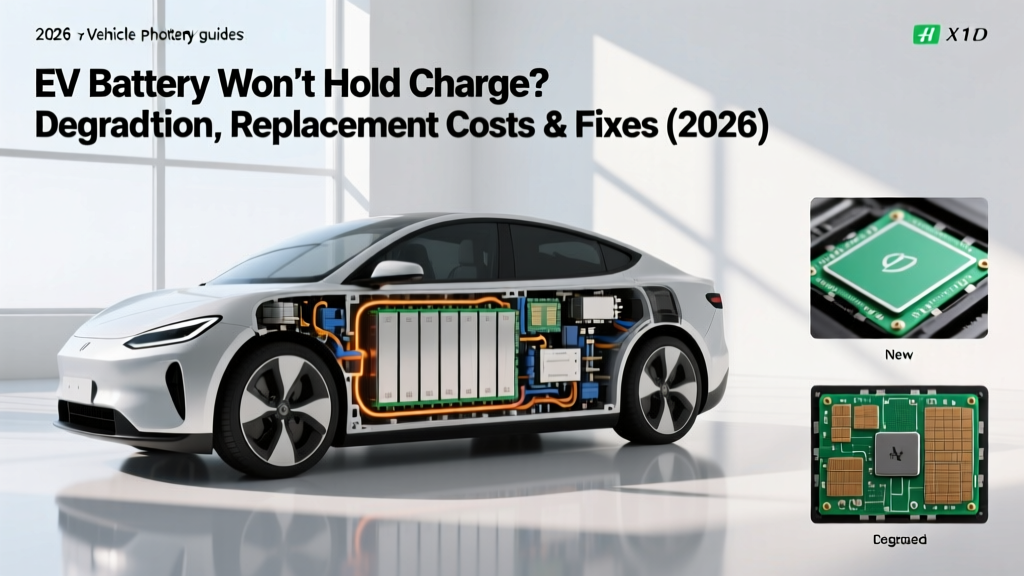
If you've noticed your electric vehicle isn't delivering the range it once did, you're experiencing battery degradation — a natural electrochemical process, not necessarily a defect. Before you panic about a replacement, it's critical to distinguish between the 12V auxiliary battery (which powers electronics and can fail like any car battery) and the high-voltage traction battery (the large lithium-ion pack that actually propels the vehicle). When drivers search for "battery in car wont hold charge," the issue usually traces to one of these two very different systems.
The 12V battery is cheap ($150–$300) and easy to replace. The traction battery, however, is a $5,000–$20,000 component warrantied for 8 years or 100,000 miles on most modern EVs. This guide focuses on the high-voltage pack — how it degrades, what's normal, what's covered, and what you can do to maximize its lifespan.
LFP vs NMC vs NCA: Which Chemistry Is in Your EV?
Your battery's degradation behavior depends heavily on its cell chemistry. As of 2026, virtually all mainstream EVs use one of three lithium-ion chemistries, each with distinct trade-offs in energy density, cycle life, cost, and cold-weather performance.
| Factor | LFP (Lithium Iron Phosphate) | NMC (Nickel Manganese Cobalt) | NCA (Nickel Cobalt Aluminum) |
|---|---|---|---|
| Energy Density | Lower (~160 Wh/kg cell-level) | Higher (~220–260 Wh/kg) | Highest (~250–280 Wh/kg) |
| Cycle Life | 3,000–5,000+ cycles | 1,500–2,500 cycles | 1,500–2,000 cycles |
| Cold Performance | Poorer (more range loss below 32°F) | Better cold-weather retention | Good cold-weather retention |
| Cost | Lower (no cobalt or nickel) | Higher (cobalt/nickel supply chain) | Highest |
| Recommended Daily SoC | 100% (charge fully, often) | 80% daily, 100% for trips | 80% daily, 100% for trips |
| Typical Applications (2026) | Tesla Model 3 RWD, Model Y RWD, Ford Mustang Mach-E Select (base), Rivian R1S/R1T Standard | Hyundai Ioniq 5/6 Long Range, VW ID.4 Pro S, BMW i4, most PHEVs | Tesla Model 3/Y Long Range & Performance, Lucid Air |
| Degradation Profile | Very linear, slow; excels at high SoC | Front-loaded (faster first 20K mi), then flattens | Similar to NMC, slightly faster at high SoC |
Which is better? There's no universal winner. LFP is the longevity champion — it tolerates daily 100% charges and delivers far more cycles, making it ideal for high-mileage drivers and fleet use. NMC and NCA offer more range per pound, which matters for long-range trims and cold climates, but they degrade faster if habitually charged to 100% or exposed to sustained high temperatures.
How Long Do EV Batteries Actually Last? Real Degradation Data
According to data aggregated from fleet telemetry and owner reports, the average EV battery retains roughly 90–95% of its original capacity after 5 years / 75,000 miles, and approximately 85–92% after 8 years / 100,000 miles. Tesla's 2024 Impact Report (the most recent fleet-scale data published) showed Model 3/Y packs retaining ~88% capacity at 150,000 miles. Hyundai/Kia's E-GMP platform vehicles (Ioniq 5, EV6, EV9) show similar curves, with most owners reporting 92–95% State of Health (SoH) at the 60,000-mile mark.
- New: 100% SoH (303 mi EPA)
- 10,000 mi: ~97% SoH (~294 mi) — initial formation loss
- 30,000 mi: ~95% SoH (~288 mi)
- 60,000 mi: ~92% SoH (~279 mi)
- 100,000 mi: ~88% SoH (~267 mi)
- 150,000 mi: ~84% SoH (~255 mi) — still well above warranty threshold
Notice the pattern: degradation is non-linear. You lose the most capacity in the first 10,000–20,000 miles (electrode formation and SEI layer stabilization), then the curve flattens dramatically. A battery doesn't "fall off a cliff" — it slowly diminishes over hundreds of thousands of miles. Catastrophic failure (a cell or module shorting out) is rare and typically covered under warranty.
What Does the Battery Warranty Actually Cover?
Federal law mandates a minimum 8-year / 100,000-mile warranty on EV battery packs (10 years / 150,000 miles in California and states that follow CARB standards). Most manufacturers exceed this floor. The warranty covers the battery falling below a specific capacity retention threshold — typically 70% of original capacity — as well as defects and catastrophic failures.
| Manufacturer | Warranty Period | Capacity Threshold | Notes |
|---|---|---|---|
| Tesla (Model 3/Y LFP RWD) | 8 yr / 100,000 mi | 70% | LFP packs have rarely triggered claims |
| Tesla (Model 3/Y Long Range NCA) | 8 yr / 120,000 mi | 70% | Longer mileage cap on LR/Performance |
| Hyundai / Kia (E-GMP) | 10 yr / 100,000 mi | 70% | 10-year term is among the longest |
| Ford (Mustang Mach-E, F-150 Lightning) | 8 yr / 100,000 mi | 70% | Covers battery and electric drivetrain components |
| GM (Ultium — Equinox EV, Blazer EV, Silverado EV) | 8 yr / 100,000 mi | 70% | Some commercial fleet warranties extend to 150K mi |
| BMW (i4, iX, i7) | 8 yr / 100,000 mi | 70% | Includes battery conditioning system |
| Rivian (R1S/R1T) | 8 yr / 175,000 mi | 70% | Highest mileage threshold in consumer EVs |
Key detail: The warranty threshold of 70% means the manufacturer only owes you a repair or replacement if your pack drops below 70% of its original usable kWh within the warranty window. Given that most packs retain 85–92% at 100,000 miles, triggering a warranty claim is uncommon. If your battery is at 75% SoH at year 7, that's frustrating but not a warranty event.
EV Battery Replacement Cost: What to Budget (and When You'll Need It)
Here's the question that generates the most anxiety: how much does it cost to replace an EV battery? The honest answer depends on the vehicle, pack size, and whether you need a full pack or individual module replacement. As of 2026, full-pack replacement costs range from roughly $5,000 to $20,000 before labor, depending on the model.
| Vehicle | Pack Size (Usable kWh) | Chemistry | Est. Full-Pack Replacement Cost |
|---|---|---|---|
| Tesla Model 3 RWD | 57.5 kWh | LFP | $7,000–$9,000 |
| Tesla Model Y Long Range | 75 kWh | NCA | $10,000–$13,000 |
| Hyundai Ioniq 5 Long Range | 77.4 kWh | NMC | $11,000–$14,000 |
| Ford Mustang Mach-E Extended Range | 91 kWh | NMC | $13,000–$16,000 |
| Ford F-150 Lightning Extended Range | 131 kWh | NMC | $18,000–$22,000 |
| Chevrolet Equinox EV | 85 kWh | NMC (Ultium) | $10,000–$13,000 |
| BMW i4 eDrive40 | 81.5 kWh | NMC | $14,000–$18,000 |
| Rivian R1T Dual-Motor (Standard) | 95 kWh | LFP | $12,000–$15,000 |
When is replacement actually needed? For the vast majority of owners, it isn't — at least not during the vehicle's practical lifespan. A pack at 75% SoH at 150,000 miles still delivers 200+ miles of range in most vehicles, which is functional for daily driving. Full replacements are most common after collision damage, manufacturing defects (e.g., the Chevy Bolt recall for LG cell fire risk, fully remedied), or extreme outlier degradation. Module-level repairs (replacing 1–2 defective modules rather than the entire pack) can reduce costs to $2,000–$5,000 and are increasingly offered by independent EV shops.
Also worth noting: the used-EV battery replacement market is growing. Refurbished packs from salvaged vehicles can cut costs by 30–50%, though availability varies by model. Per IRS §30D rules, the federal tax credit does not apply to battery replacements on existing vehicles — it's for new vehicle purchases only.
5 Factors That Accelerate Battery Degradation (and How to Minimize Them)
1. Avoid Sustained High State of Charge (NMC/NCA)
Keeping an NMC or NCA battery at 100% SoC for extended periods accelerates electrolyte decomposition and cathode stress. Set your daily charge limit to 80% and only charge to 100% when you're leaving within a few hours for a road trip. LFP exception: Tesla and other manufacturers recommend charging LFP packs to 100% at least weekly — the chemistry benefits from full calibration and tolerates high SoC far better.
2. Minimize DC Fast Charging When You Can
DC fast charging at 150–350 kW generates significant heat inside the cells. Occasional road-trip fast charging is fine — modern thermal management systems precondition the battery and actively cool it during charging. But if you have Level 2 home charging, use it as your daily method. Data from Recurrent Auto shows vehicles that fast-charge more than 80% of the time exhibit slightly faster degradation (~2–4% more loss at 75,000 miles) compared to those primarily using Level 2.
3. Manage Extreme Temperatures
Batteries degrade faster when exposed to sustained heat above 95°F or when repeatedly charged in sub-freezing temperatures without preconditioning. If you live in Phoenix or Houston, garage parking meaningfully extends battery life. In cold climates, always use your vehicle's battery preconditioning feature before fast charging — it warms the cells to ~70°F, enabling faster charging and preventing lithium plating on the anode.
4. Don't Store at 0% or 100%
If you're leaving your EV for a week or more (vacation, travel), aim for ~50% SoC. Storing at 0% risks the pack dropping below its minimum voltage threshold (potentially bricking modules), while storing at 100% accelerates calendar degradation. Most EVs have a "storage mode" or let you set a scheduled charge limit.
5. Use Regenerative Braking Thoughtfully
Aggressive regen settings don't harm the battery directly, but frequent high-current regen pulses into a near-full battery (above 90% SoC) can cause brief over-voltage events. Most vehicles taper regen automatically at high SoC — this is normal and protective. No action needed unless your vehicle lacks this safeguard (some older models).
How to Check Your EV's Battery Health (State of Health)
State of Health (SoH) is the metric that tells you what percentage of your battery's original capacity remains usable. Here's how to check it across major platforms:
- Tesla: No native SoH display in the app as of 2026, but you can estimate it by charging to 100% and comparing the displayed range to the original EPA figure. Third-party tools like TeslaFi or Scan My Tesla (via OBD-II) pull the BMS-reported SoH directly.
- Hyundai/Kia: The EV app and infotainment system display battery health diagnostics. Some models show SoH percentage in the dealer diagnostic menu.
- GM (Ultium): The myChevrolet/myCadillac app includes a battery health indicator. OnStar can pull detailed cell-level data.
- Ford: FordPass provides a battery health status ("Normal" / "See Dealer"). For exact SoH percentage, a dealer scan tool is required.
- BMW: The iDrive system and My BMW app show battery health. BMW also provides a formal Battery Health Certificate on request.
- Universal OBD-II method: Devices like the OBDLink SX paired with apps such as EVNotify or LeafSpy (Nissan) can read BMS data directly for most EVs, including cell voltage variance and SoH.
A healthy pack should show cell voltage variance of less than 20–30 mV across modules at a stable SoC. Wider variance (50+ mV) can indicate a weak module that may benefit from a dealer balance procedure or module replacement.
What's Next: Solid-State and Silicon-Anode Batteries (Forward-Looking)
If you're considering whether to wait for better battery technology, here's where things stand as of 2026:
- Solid-state batteries: Toyota has announced limited production of solid-state EVs for 2027–2028, claiming 750+ km (466 mi) range and 10-minute fast charging. Samsung SDI and QuantumScape are also in pilot production. However, these are low-volume, premium-segment rollouts — mass-market solid-state vehicles are realistically 2029–2032 at the earliest, with cost parity likely later.
- Silicon-anode batteries: Companies like Sila Nanotechnologies and Group14 are supplying silicon-dominant anode materials to manufacturers including Mercedes-Benz and Panasonic. These offer 20–40% higher energy density than graphite anodes and are entering production vehicles in 2026–2027, starting with premium models. Expect gradual trickle-down to mainstream EVs by 2028–2029.
- Sodium-ion batteries: CATL and BYD are producing sodium-ion packs for lower-cost, shorter-range EVs (primarily in China). These offer lower energy density but dramatically lower cost and no lithium, cobalt, or nickel. US-market availability is uncertain but could arrive in budget EVs by 2028.
Bottom line: Current lithium-ion technology (LFP and NMC) is mature, reliable, and cost-effective. Waiting for solid-state means waiting 3–6+ years for uncertain pricing. If you need an EV now, today's batteries are genuinely good enough to outlast most ownership cycles.
Frequently Asked Questions
My EV lost 30 miles of range in 2 years — is the battery failing?
Almost certainly not. A 30-mile range drop on a 300-mile EV over 2 years (~10% loss) is squarely within normal degradation, especially if you frequently fast-charge, live in a hot climate, or drive mostly highway miles (which are less efficient than city driving with regen). Check your SoH via the methods above — if it's above 90%, your battery is performing as expected.
Is it the 12V battery or the main traction battery?
If your car won't start, shows a "12V battery low" warning, or accessories behave erratically, the issue is almost always the 12V auxiliary battery — a ~$200 fix. If the car drives normally but shows reduced range at full charge, that's traction battery degradation. These are entirely separate systems.
Does fast charging ruin EV batteries?
It accelerates degradation slightly but doesn't "ruin" them. Modern thermal management systems are excellent at protecting cells during DC fast charging. The data shows a ~2–4% additional capacity loss at 75,000 miles for vehicles that primarily fast-charge versus those using Level 2. For road trips, fast charge without worry. For daily use, Level 2 is gentler and cheaper.
Should I buy an extended battery warranty?
For most buyers, no. The federally mandated 8-year/100,000-mile warranty already covers the period of highest risk (early-life defects), and degradation-related claims are rare because most packs stay above the 70% threshold. Extended warranties may make sense for high-mileage commercial drivers or if you plan to keep the vehicle past 120,000 miles and want peace of mind — but read the fine print on what's excluded.
Can I replace individual battery modules instead of the whole pack?
Yes, on many vehicles. Tesla, Hyundai/Kia, GM, and BMW all support module-level repairs, where a technician identifies and replaces 1–2 degraded or defective modules rather than the entire pack. This typically costs $2,000–$5,000 versus $10,000–$20,000 for a full pack. Independent EV repair shops increasingly offer this service as well. Per NHTSA guidance, battery repairs should only be performed by technicians with high-voltage certification.
Does cold weather permanently damage the battery?
No. Cold weather causes temporary range loss (15–30% reduction at 20°F) due to increased internal resistance and reduced regen effectiveness, but the capacity returns when the battery warms up. Permanent damage occurs only if you charge at high rates in sub-freezing temperatures without preconditioning, which can cause lithium plating. Always precondition before winter fast charging.