When Your EV Battery Won't Charge the Car: What's Actually Happening
If you've plugged in your electric vehicle overnight and woken up to a dashboard warning that the battery won't charge the car — or you're seeing noticeably reduced range after a few years of ownership — the first instinct is often panic about a $20,000 replacement. In reality, catastrophic high-voltage traction battery failure is rare. Most "won't charge" scenarios trace back to software glitches, onboard charger faults, 12V auxiliary battery issues, or connector problems rather than a dead battery pack. But understanding how EV batteries degrade, what warranties actually cover, and when replacement becomes necessary is essential for every EV owner or prospective buyer.
This guide breaks down the real data on EV battery longevity, the chemistry differences that affect your daily driving, and the practical steps to monitor and maximize your pack's State of Health (SoH) over its lifespan.
LFP vs NMC/NCA: Which Battery Chemistry Is in Your EV?
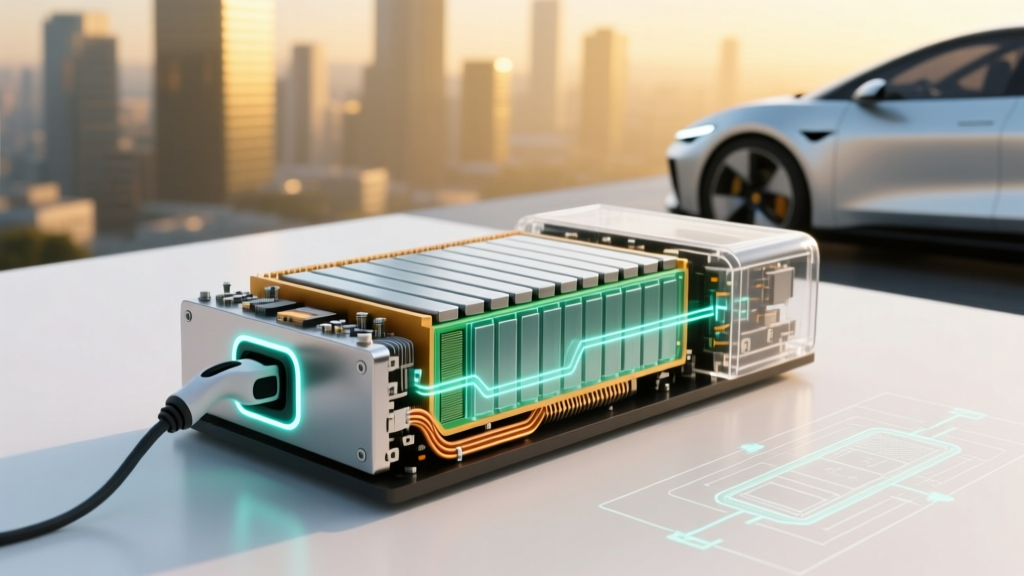
Not all EV batteries are built the same. The two dominant lithium-ion chemistries in today's market — lithium iron phosphate (LFP) and nickel manganese cobalt (NMC) / nickel cobalt aluminum (NCA) — have fundamentally different characteristics that affect range, longevity, charging behavior, and cost.
| Attribute | LFP (Lithium Iron Phosphate) | NMC / NCA (Nickel-Based) |
|---|---|---|
| Energy Density | Lower (~160-180 Wh/kg cell-level) | Higher (~220-260 Wh/kg cell-level) |
| Typical Vehicles | Tesla Model 3/Y RWD, Ford Mustang Mach-E Select (LFP trims), BYD models | Tesla Long Range/Performance, Hyundai Ioniq 5/6, Kia EV6/EV9, Rivian, GM Ultium vehicles |
| Cycle Life | 3,000-5,000+ full cycles to 80% capacity | 1,000-2,000 full cycles to 80% capacity |
| Cold-Weather Performance | Weaker — greater range loss below 32°F, slower cold charging | Better low-temperature performance and charge acceptance |
| Charging Recommendation | Can and should be charged to 100% regularly | Best kept between 20-80% daily; 100% for trips only |
| Cost | Lower — no cobalt or nickel; ~$100-120/kWh at pack level | Higher — commodity-sensitive; ~$130-160/kWh at pack level |
| Thermal Stability | Excellent — higher thermal runaway threshold | Good — requires more active thermal management |
Which is better? It depends on your use case. If you commute daily, charge at home, and live in a mild climate, LFP offers superior longevity and simpler ownership (charge to 100% without worry). If you need maximum range per charge, frequently road-trip, or live in a cold-weather state, NMC/NCA packs deliver higher energy density and better winter performance. Neither chemistry is universally superior — they're engineering trade-offs.
How Long Do EV Batteries Actually Last? Real Degradation Data
The most persistent myth in EV ownership is that batteries "die" like smartphone batteries after a couple of years. The data tells a very different story. Modern EV battery packs are engineered with active thermal management systems, buffer zones (hidden capacity above and below the usable window), and chemistries designed for 150,000-300,000+ miles of service.
Typical Degradation Curve (NMC/NCA Packs, Real-World Fleet Data):
- Year 1 / 15,000 miles: ~2-5% capacity loss (initial formation loss, steepest part of the curve)
- Year 3 / 45,000 miles: ~5-8% total loss
- Year 5 / 75,000 miles: ~8-12% total loss
- Year 8 / 120,000 miles: ~10-15% total loss
- Year 10 / 150,000 miles: ~12-18% total loss (varies significantly by climate and charging habits)
Sources: Recurrent Auto fleet data (15,000+ vehicles), Tesla Impact Reports, Geotab longitudinal studies.
A few important nuances:
- Degradation is non-linear. Most capacity loss happens in the first 1-2 years, then the curve flattens considerably. A pack that has lost 8% after three years is not on track to lose 24% after nine years.
- LFP packs show slower degradation in fleet data, often losing only 5-8% after 100,000 miles, though they start with slightly lower energy density.
- Range loss feels worse than it is because a 10% degradation on a 300-mile EPA-rated vehicle means ~270 miles — still very usable, but noticeable if you're watching the number closely.
- Cold weather compounds the effect. A degraded pack in a 20°F winter can temporarily show 25-35% less range than the original EPA sticker. This is reversible when temperatures rise.
What Does the EV Battery Warranty Actually Cover?
Federal law mandates that EV battery packs carry a minimum warranty of 8 years / 100,000 miles (10 years / 150,000 miles in California Air Resources Board states including CA, CO, CT, MA, ME, MD, NJ, NY, OR, RI, VT, WA). Most manufacturers exceed this minimum. Here's how major automakers structure their coverage:
| Manufacturer | Warranty Term | Capacity Retention Threshold | Notes |
|---|---|---|---|
| Tesla (Model 3/Y LFP) | 8 yr / 120,000 mi | 70% retention | Long Range/Performance: 8 yr / 120,000 mi |
| Hyundai / Kia (E-GMP) | 10 yr / 100,000 mi | 70% retention | Among the longest terms in the industry |
| GM (Ultium platform) | 8 yr / 100,000 mi | 70% retention (60% for Bolt EV/EUV legacy) | Covers battery and specific EV components |
| Ford (Mustang Mach-E, F-150 Lightning) | 8 yr / 100,000 mi | 70% retention | Standard across BEV lineup |
| Rivian | 8 yr / 175,000 mi | 70% retention | Higher mileage cap reflects adventure-use positioning |
| Volkswagen (ID.4) | 8 yr / 100,000 mi | 70% retention | Net usable capacity basis |
What's covered: The warranty guarantees that the battery will retain at least the stated percentage of its original usable capacity (typically measured via a dealer diagnostic tool reading State of Health). If degradation exceeds the threshold within the warranty period, the manufacturer will repair or replace the pack — often by swapping in a refurbished unit rather than a brand-new one.
What's NOT covered: Damage from accidents, flooding, unauthorized modifications, or using the vehicle as a stationary power source beyond the manufacturer's V2L/V2H specifications. Normal degradation below the threshold is also not a warranty claim — a pack at 72% capacity at year 7 is functioning "within spec" even though you've lost over a quarter of your original range.
For full warranty details on your specific vehicle, check the owner's manual or the manufacturer's warranty guide. The U.S. Department of Energy's EV technology page also provides general guidance on battery lifespan expectations.
EV Battery Replacement Cost: When and How Much?
Here's the data point that generates the most anxiety — and the most misinformation. Yes, an out-of-warranty EV battery replacement is expensive. But context matters enormously.
| Vehicle / Pack Size | Battery Capacity (kWh) | Estimated Replacement Cost | Typical Replacement Trigger |
|---|---|---|---|
| Tesla Model 3 RWD (LFP) | ~60 kWh | $7,000 - $10,000 | Rare before 200,000+ mi |
| Hyundai Ioniq 5 / Kia EV6 | ~77.4 kWh | $10,000 - $14,000 | Rare before 180,000+ mi |
| Tesla Model Y Long Range | ~75 kWh | $12,000 - $16,000 | Rare before 200,000+ mi |
| Ford F-150 Lightning (Extended) | ~131 kWh | $18,000 - $25,000+ | Very few out-of-warranty cases yet |
| Chevrolet Silverado EV / GMC Sierra EV | ~200 kWh (max pack) | $22,000 - $35,000+ | Limited real-world data (new platform) |
When is replacement actually needed? Most EV batteries outlast the vehicles they're installed in. According to fleet data from Recurrent Auto, fewer than 2-3% of EVs have required battery replacement under warranty, and the vast majority of those were due to manufacturing defects caught early, not end-of-life degradation. A well-maintained pack from a 2022-2026 model-year vehicle is realistically expected to deliver 15-20 years and 200,000+ miles of service before dropping below 70% capacity.
Cost trajectory is favorable. Battery pack prices have fallen from over $1,000/kWh in 2010 to roughly $110-140/kWh at the pack level in 2025-2026 (per BloombergNEF). Module-level repairs — where a technician replaces individual degraded modules rather than the entire pack — are becoming more common and can cost $2,000-$5,000 depending on the vehicle and number of modules affected.
Factors That Accelerate (or Preserve) Battery Health
Your battery's lifespan isn't just a function of time — it's heavily influenced by how you charge, drive, and store the vehicle. Here are the biggest factors, ranked by impact:
Battery Care Best Practices (Data-Backed):
- Avoid sustained 100% State of Charge (NMC/NCA only). Daily charging to 80% and charging to 100% only before long trips can reduce degradation by 30-40% over the pack's life. LFP owners should charge to 100% at least weekly for accurate BMS calibration.
- Minimize DC fast charging frequency. Occasional fast charging is fine, but daily use of 150+ kW DC chargers generates sustained heat stress. Fleet data shows vehicles that fast-charge more than 3x/week degrade ~1-3% faster over 5 years than those primarily using Level 2 home charging.
- Precondition before fast charging. Most modern EVs automatically precondition the battery when you navigate to a charger. This warms or cools the pack to the optimal ~30-40°C window, improving charge speed and reducing thermal stress. If your vehicle has a manual preconditioning option, use it in extreme cold.
- Avoid extreme SoC storage. If storing the vehicle for more than 2 weeks, leave it at ~50% SoC. Storing at 100% accelerates calendar aging; storing below 10% risks the pack discharging into a dangerous low-voltage state.
- Use Level 2 home charging as your primary method. A 7-11 kW Level 2 charger generates far less thermal stress than DC fast charging and is the optimal daily charging method for battery longevity.
- Park in shade or a garage when possible in hot climates. Sustained high ambient temperatures (above 95°F) accelerate calendar degradation, especially if the vehicle sits at high SoC. Active thermal management helps but isn't always running when the car is parked.
How to Check Your EV's Battery State of Health (SoH)
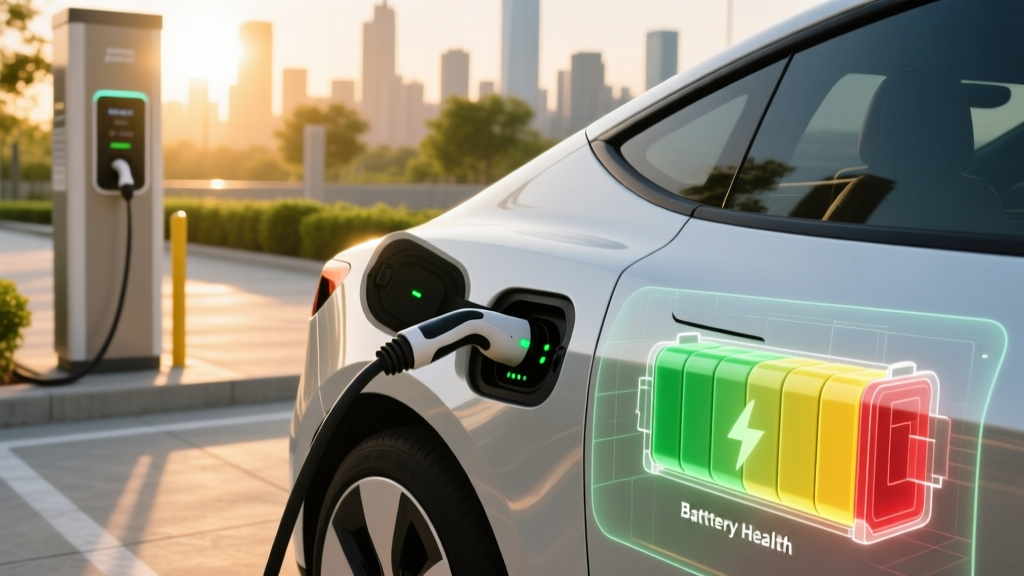
State of Health (SoH) is the metric that tells you what percentage of the battery's original capacity remains. Monitoring it proactively helps you catch abnormal degradation early — while you're still under warranty.
Methods for checking SoH:
- In-vehicle displays: Some manufacturers (Tesla via the service menu, Hyundai/Kia via the infotainment system in newer model years) provide a battery health percentage or degradation indicator. Check your owner's manual for access instructions.
- OBD-II dongle apps: Third-party tools like LeafSpy (Nissan Leaf), Scan My Tesla, or Car Scanner ELM OBD2 can read battery management system (BMS) data including SoH, cell voltage variance, and pack temperature. A $30-50 OBD-II Bluetooth adapter is usually all you need.
- Dealer diagnostics: Request a battery health report during routine service. Most dealers can pull a detailed SoH reading and individual module voltage data. This is the documentation you'll need for a warranty claim.
- Range tracking: The simplest method — compare your current full-charge range estimate to the EPA-rated range when the vehicle was new. A consistent 15% reduction at similar temperatures suggests ~15% degradation. Apps like fueleconomy.gov list original EPA ratings for comparison.
- Third-party services: Companies like Recurrent provide battery health reports that compare your pack's degradation to a fleet of identical vehicles, giving you a percentile ranking.
Red flags to watch for: Sudden range drops (not explained by weather), individual cell voltage variance above 200mV, a dashboard battery warning light, or a failure to accept a charge. These may indicate a module-level fault rather than normal degradation and should be diagnosed by a qualified EV technician immediately.
What If Your Battery Won't Charge the Car? Troubleshooting Steps
Before assuming the worst, work through these common causes in order:
- Check the 12V auxiliary battery. This is the single most common cause of an EV that "won't charge" or won't start. The 12V battery powers the vehicle's computers, contactors, and charging communication. If it's dead or weak (typically a 3-5 year lifespan), the high-voltage system can't engage. A $150-$300 12V battery replacement often solves the problem entirely.
- Try a different charger and cable. Faulty public chargers and damaged J1772/NACS connectors are common culprits. Test at a known-good Level 2 or DC fast charger.
- Check for software updates. Over-the-air (OTA) or dealer-applied firmware updates sometimes resolve charging communication issues between the vehicle's BMS and the charger.
- Inspect the charge port. Debris, corrosion, or a damaged pin in the charge port can prevent a proper connection. Visually inspect and clean if needed.
- Reset the vehicle. Many EVs benefit from a "reboot" — lock the car, walk away for 15 minutes (letting all systems power down), then return and retry. Some models have a specific reset procedure in the owner's manual.
- Read diagnostic codes. An OBD-II scanner can pull BMS and onboard charger fault codes that point to the specific system at fault.
If none of these resolve the issue, the onboard charger (the device that converts AC to DC for Level 1/2 charging) or the high-voltage battery itself may require service. Onboard charger replacement typically runs $1,500-$3,000 — expensive, but far less than a full pack replacement.
Looking Ahead: Solid-State and Silicon Anode Batteries
Next-generation battery technologies are in active development, but it's important to separate laboratory progress from showroom availability.
Solid-state batteries replace the liquid electrolyte with a solid material, promising higher energy density (potentially 400+ Wh/kg at the cell level), faster charging, improved safety, and longer cycle life. Toyota has announced plans for limited solid-state EV production in 2027-2028, while Samsung SDI and QuantumScape are targeting similar timelines with OEM partners. However, mass production at automotive scale with competitive pricing remains unproven. Expect solid-state packs to appear first in premium/low-volume vehicles, with mainstream adoption likely in the 2030-2035 timeframe.
Silicon anode batteries (used in limited form in the Porsche Taycan's latest cells and by startups like Sila Nanotechnologies) increase energy density by replacing graphite anodes with silicon-dominant materials. These are closer to scale — appearing in 2025-2026 model-year vehicles in incremental form — and represent a more near-term improvement to existing lithium-ion architecture rather than a wholesale replacement.
Bottom line: If you're buying an EV in 2026, today's LFP and NMC/NCA packs are mature, well-understood technologies with extensive real-world longevity data. Waiting for solid-state means waiting years for limited availability at premium prices. Current batteries are not a compromise — they're a proven solution.
Frequently Asked Questions
How long do EV batteries last in years and miles?
Most modern EV batteries (2020+ model years with active thermal management) are designed to last 15-20 years and 200,000+ miles before dropping below 70% of original capacity. Fleet data from Recurrent Auto shows that the average EV battery loses roughly 10-15% capacity over 8 years / 120,000 miles. Many packs continue functioning well beyond this point — they simply offer less range than when new.
How much does an EV battery cost to replace?
Full pack replacement costs range from approximately $7,000 for a smaller LFP pack (Tesla Model 3 RWD) to $25,000-$35,000+ for large packs (Ford F-150 Lightning Extended Range, GM 200 kWh Ultium). However, fewer than 3% of EVs have required out-of-warranty battery replacement to date, and module-level repairs can cost significantly less ($2,000-$5,000). Battery prices continue declining year over year.
What does the battery warranty cover?
Federal minimum: 8 years / 100,000 miles (10 years / 150,000 miles in CARB states). Most manufacturers guarantee the battery will retain at least 70% of its original usable capacity within the warranty period. If degradation exceeds this threshold, the manufacturer will repair or replace the pack. Warranties do not cover accident damage, unauthorized modifications, or misuse. Always review your specific warranty booklet for exact terms.
How do I check and maximize my EV battery health?
Check SoH via your vehicle's built-in display, an OBD-II diagnostic app, or a dealer service visit. To maximize longevity: charge to 80% daily (NMC/NCA) or 100% (LFP), minimize DC fast charging frequency, precondition before fast charging, avoid storing at extreme SoC levels, and use Level 2 home charging as your primary method.
LFP vs NMC — which battery chemistry is better for me?
Choose LFP if you prioritize longevity, want to charge to 100% without concern, commute daily, and live in a moderate climate. Choose NMC/NCA if you need maximum range per charge, frequently drive in cold weather, take regular road trips requiring fast charging, or need the highest performance. Neither is universally better — they're optimized for different use cases.
Why did my EV suddenly stop accepting a charge?
The most common cause is a depleted 12V auxiliary battery, which powers the vehicle's computers and charging contactors. Other causes include a faulty charge cable or public charger, software glitches (try a vehicle reboot), charge port debris, or — less commonly — an onboard charger or BMS fault. Systematically test with a different charger and cable before scheduling a service appointment.