The single heaviest component in any electric vehicle is the high-voltage traction battery. Depending on the pack size and chemistry, an EV battery can account for 25–40% of the vehicle's total curb weight. That mass influences everything from range efficiency and tire wear to handling dynamics and the structural engineering required to protect occupants in a crash. Understanding battery weight — and the chemistry, cost, and longevity implications behind it — is essential for any buyer evaluating an electrified vehicle in 2026.
This guide breaks down what battery weight means for real-world ownership, how different chemistries compare, what degradation data actually shows, and what you can expect when it comes to warranty coverage and eventual replacement.
Why EV Battery Weight Matters for Your Car
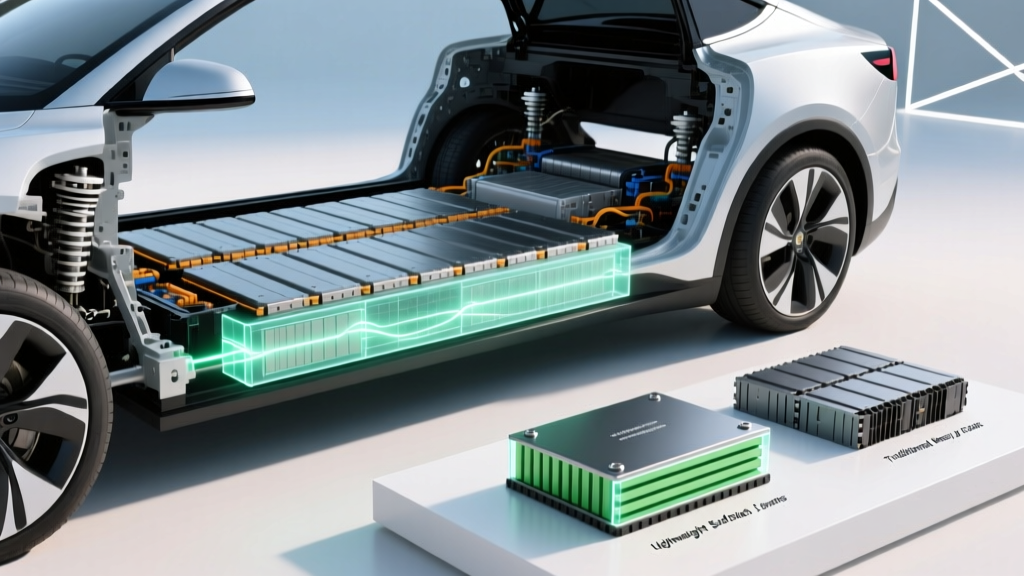
Lithium-ion battery packs are dense, heavy assemblies. A 60 kWh pack typically weighs between 770 and 900 pounds, while a 100+ kWh pack in a full-size electric truck can push past 1,800 pounds. That weight is distributed low in the chassis — usually as a flat "skateboard" platform — which gives EVs a low center of gravity and responsive handling despite the mass.
But mass still exacts a toll on efficiency. Heavier vehicles require more energy to accelerate and to sustain highway speeds, which is why EPA efficiency ratings (measured in kWh/100 miles or MPGe) vary significantly even among vehicles with similar aerodynamics. A heavier pack also increases tire wear — EV-specific tires with higher load ratings and lower rolling resistance have become standard to compensate.
Here's a snapshot of battery weight across popular 2026 EV models:
| Model | Battery (kWh usable) | Chemistry | Approx. Battery Weight | Curb Weight | Battery as % of Total |
|---|---|---|---|---|---|
| Tesla Model 3 RWD | 57.5 kWh | LFP | ~860 lbs | 3,862 lbs | ~22% |
| Hyundai Ioniq 5 SE (LR) | 77.4 kWh | NMC | ~1,050 lbs | 4,431 lbs | ~24% |
| Ford F-150 Lightning (Ext. Range) | 131 kWh | NMC | ~1,800 lbs | 6,786 lbs | ~27% |
| Chevrolet Equinox EV 3RS | 85 kWh | NMC | ~1,120 lbs | 4,700 lbs | ~24% |
| BMW iX xDrive50 | 105.2 kWh | NMC | ~1,430 lbs | 5,660 lbs | ~25% |
As the table illustrates, larger packs add weight in near-linear fashion, but engineering advances in cell-level energy density have helped keep pack mass from growing as fast as capacity. The chemistry inside the cells is the primary driver of that trade-off.
LFP vs NMC vs NCA: Battery Chemistry Trade-Offs Explained
Not all lithium-ion batteries are built the same. The cathode chemistry — the materials that store and release lithium ions — determines energy density, cycle life, cost, thermal stability, and cold-weather behavior. The two dominant chemistries in 2026 passenger EVs are LFP (lithium iron phosphate) and NMC/NCA (nickel manganese cobalt / nickel cobalt aluminum).
| Attribute | LFP (Lithium Iron Phosphate) | NMC / NCA (Nickel-based) |
|---|---|---|
| Energy Density (cell-level) | ~160–180 Wh/kg (lower) | ~230–300 Wh/kg (higher) |
| Typical Cycle Life | 3,000–5,000+ cycles | 1,000–2,500 cycles |
| Cold-Weather Performance | Moderate — greater range loss below freezing | Better — less range loss in cold |
| Thermal Stability | Excellent — very resistant to thermal runaway | Good — requires more active thermal management |
| Cost per kWh | Lower (~$90–110/kWh at cell level, 2026) | Higher (~$120–145/kWh at cell level, 2026) |
| State of Charge Recommendation | Can charge to 100% daily without concern | Best kept 20–80% for daily use; 100% for trips |
| Common In | Tesla Model 3/Y RWD, standard-range BYD models, some Ford/Rivian base trims | Most long-range and performance EVs (Hyundai, BMW, GM Ultium, Rivian, Porsche) |
Which is better? It depends on your driving pattern. If you commute daily, charge at home, and want a battery that can tolerate daily 100% charges with minimal degradation over 15+ years, LFP is the durability champion. If you need maximum range in a single charge, frequently drive in cold climates, or want the lightest possible pack for a given capacity, NMC/NCA delivers higher energy density. Neither is universally superior — the right choice maps to your use case.
EV Battery Degradation: What the Data Actually Shows
Battery degradation — the gradual loss of usable capacity over time — is one of the most misunderstood aspects of EV ownership. The fear of a sudden, catastrophic battery failure persists, but real-world data tells a different story: degradation is slow, predictable, and in most cases never severe enough to require replacement during the vehicle's useful life.
Based on fleet data aggregated by sources like Recurrent Auto and manufacturer warranty claims, here is what typical degradation looks like:
| Age / Mileage | Average Capacity Retained (NMC) | Average Capacity Retained (LFP) | Real-World Impact |
|---|---|---|---|
| 1 year / 15,000 mi | ~96–98% | ~97–99% | Negligible — within normal variance |
| 3 years / 45,000 mi | ~92–95% | ~94–97% | ~10–15 mi less range on a 300-mi EPA vehicle |
| 5 years / 75,000 mi | ~88–93% | ~91–96% | ~20–35 mi less range |
| 8 years / 120,000 mi | ~82–90% | ~87–94% | ~30–55 mi less range |
| 10 years / 150,000 mi | ~78–87% | ~84–92% | Still functional; noticeable but manageable |
Several patterns emerge from this data. First, the steepest degradation occurs in the first 12–24 months (roughly 2–5% loss), after which the curve flattens considerably. Second, LFP packs tend to degrade more slowly than NMC, owing to the inherent stability of the iron-phosphate cathode. Third, even at 150,000 miles, most packs retain enough capacity for the vehicle to remain a practical daily driver.
The EPA range figure on the window sticker is measured when the battery is new. A vehicle with 310 miles of EPA range that retains 85% capacity after eight years will deliver roughly 264 miles when new-equivalent — still competitive with many new EVs on the market today.
What Does the EV Battery Warranty Actually Cover?
Federal law mandates a minimum battery warranty of 8 years or 100,000 miles (whichever comes first) for all EVs sold in the United States. In California Air Resources Board (CARB) states — which include California, Colorado, Connecticut, Maine, Maryland, Massachusetts, New Jersey, New York, Oregon, Rhode Island, Vermont, Virginia, and Washington — the requirement extends to 10 years or 150,000 miles.
| Manufacturer | Warranty Period | Capacity Retention Threshold | Notes |
|---|---|---|---|
| Tesla | 8 yr / 120,000 mi (Model 3/Y LR) | 70% | RWD models: 8 yr / 100,000 mi |
| Hyundai / Kia | 10 yr / 100,000 mi | 70% | Among the longest coverage in the industry |
| GM (Chevrolet, Cadillac) | 8 yr / 100,000 mi | 70% (60% for fleet/commercial) | Ultium platform covers battery and drive components |
| Ford | 8 yr / 100,000 mi | 70% | Covers high-voltage battery and BEV drivetrain |
| Rivian | 8 yr / 175,000 mi (R1T/R1S) | 70% | Higher mileage cap than most competitors |
| BMW | 8 yr / 100,000 mi | 70% | Includes battery conditioning system |
The critical number is the capacity retention threshold, typically set at 70%. This means the manufacturer will replace or repair the battery (or individual modules) only if measured capacity drops below 70% of the original within the warranty period. Based on the degradation data above, the vast majority of owners will never hit this threshold under normal use — the battery simply does not degrade that quickly.
Warranties cover defects in materials and workmanship as well as abnormal capacity loss. They do not cover damage from accidents, flooding, improper modifications, or use of non-approved charging equipment. Always review your specific warranty booklet for exclusions.
How Much Does an EV Battery Cost to Replace?
This is the question that generates the most anxiety among prospective EV buyers — and it deserves a data-grounded answer rather than worst-case speculation.
| Vehicle | Battery Size | Replacement Cost (Parts + Labor) | Typical Replacement Timeline |
|---|---|---|---|
| Tesla Model 3 (LFP, 57.5 kWh) | 57.5 kWh | $8,000 – $12,000 | Rarely needed within 15+ years |
| Hyundai Ioniq 5 (NMC, 77.4 kWh) | 77.4 kWh | $12,000 – $16,000 | Rarely needed within 15+ years |
| Ford F-150 Lightning (131 kWh) | 131 kWh | $18,000 – $28,000 | Rarely needed within 15+ years |
| Chevrolet Equinox EV (85 kWh) | 85 kWh | $13,000 – $17,000 | Rarely needed within 15+ years |
| BMW iX (105.2 kWh) | 105.2 kWh | $16,000 – $22,000 | Rarely needed within 15+ years |
Several points of context are essential here:
- Full pack replacement is rare. Most manufacturers now offer module-level repair. If one section of the pack degrades abnormally, individual modules can be swapped for a fraction of the full-pack cost — often $2,000–$5,000.
- Cell prices continue to fall. Battery cell pricing has dropped from over $1,000/kWh in 2010 to roughly $100–140/kWh in 2026, according to BloombergNEF. Replacement costs will be lower in 10 years than they are today.
- Most batteries outlive the vehicle. Data from fueleconomy.gov and fleet operators shows that the average EV battery retains 80%+ capacity at 200,000 miles. The vehicle's body, interior, and other components often reach end-of-life before the battery does.
- Aftermarket and refurbished packs are emerging. Third-party battery refurbishment services are beginning to offer lower-cost alternatives to OEM replacement, particularly for high-volume models like the Tesla Model 3 and Nissan LEAF.
Factors That Affect EV Battery Lifespan
Battery degradation is not purely a function of time — how you charge, drive, and store your EV has a measurable impact on long-term health. Here are the primary factors, ranked by impact:
What Hurts Battery Health
- Frequent DC fast charging at high power (150+ kW) without preconditioning. High-current charging generates heat, which accelerates electrolyte decomposition. Occasional fast charging is fine; daily 350 kW sessions will add up.
- Sustaining 100% State of Charge (SoC) for extended periods. For NMC/NCA packs, sitting at full charge stresses the cathode. LFP packs are more tolerant of 100% SoC.
- Deep discharges to 0% SoC. Dropping below ~5% regularly stresses cell chemistry. Most EVs have a buffer that prevents true zero, but habitually running the pack to empty is not ideal.
- Extreme heat exposure. Prolonged parking in 110°F+ ambient temperatures without thermal management active can accelerate calendar degradation. Garage parking or preconditioning helps.
- Aggressive driving with constant high-power draws. Repeated hard acceleration and sustained high-speed driving (90+ mph) generate internal cell heat.
What Preserves Battery Health
- Charge to 80% daily (NMC/NCA); 100% is fine for LFP. Use your vehicle's charge-limit setting.
- Precondition the battery before fast charging. Most modern EVs do this automatically when you navigate to a charger; it warms the cells to optimal temperature for accepting high current.
- Use Level 2 home charging as your primary method. A 7–11 kW Level 2 charge is gentle on the pack and convenient for overnight top-ups.
- Avoid letting the car sit at 0% or 100% for weeks. If storing the vehicle, set SoC to ~50% and plug in if possible.
- Keep up with software updates. Manufacturers regularly refine battery management algorithms to optimize longevity.
How to Monitor Your EV Battery's State of Health (SoH)
State of Health (SoH) is the percentage of original capacity your battery can still hold. A new battery is 100% SoH; a battery that can store only 85 kWh out of its original 100 kWh is at 85% SoH.
In 2026, monitoring SoH is easier than ever:
- In-vehicle displays: Tesla, Hyundai/Kia, BMW, and Rivian now include battery health indicators in the infotainment or service menus. Some show a percentage; others display estimated range relative to original.
- OBD-II dongles and apps: Tools like OBDLink paired with apps such as EV Health or Car Scanner can read the BMS (Battery Management System) directly and report SoH, cell voltage variance, and temperature data.
- Third-party services: Companies like Recurrent Auto provide free battery health reports by analyzing anonymized fleet data and comparing your pack to similar vehicles.
- Dealer diagnostics: During routine service, dealerships can pull a full BMS report. Request this if you are considering a used EV purchase.
For used-EV buyers, SoH is the single most important data point — more valuable than odometer reading alone. A 60,000-mile EV with 94% SoH is in better battery shape than a 30,000-mile example that was repeatedly fast-charged to 100% in Arizona heat and shows 87% SoH.
Emerging Battery Technologies: What's Coming and When
Several next-generation battery technologies are in development, each promising to shift the weight, cost, and performance equation:
Solid-State Batteries
Solid-state cells replace the liquid electrolyte with a solid material (ceramic, sulfide, or polymer), enabling lithium-metal anodes and dramatically higher energy density — potentially 400–500 Wh/kg at the cell level, roughly double today's best NMC. This means either more range in the same weight, or the same range in a significantly lighter pack.
Timeline: Toyota, Samsung SDI, and QuantumScape have announced limited production beginning in 2027–2028, initially in low-volume, premium applications. Broad market availability in mainstream EVs is not expected before 2030–2032. These are announced targets and should be considered preliminary.
Silicon Anode Batteries
Replacing graphite anodes with silicon can increase energy density by 20–40%. Companies like Sila Nanotechnologies and Group14 are already supplying silicon-dominant anode materials to manufacturers. Mercedes-Benz has announced silicon-anode cells for the upcoming G-Class EV (expected late 2026/2027).
Timeline: Limited deployment in 2026–2027 models; broader adoption expected by 2028–2029.
Sodium-Ion Batteries
Sodium-ion cells eliminate lithium entirely, using abundant sodium instead. They offer lower energy density (~120–160 Wh/kg) but dramatically lower cost and excellent cold-weather performance. CATL and BYD are producing sodium-ion packs for budget EVs in China, with potential US-market applications in entry-level models by 2028.
Timeline: Available now in some Chinese-market vehicles; US availability estimated 2028+.
None of these technologies are currently available in mainstream US-market EVs as of 2026. Buyers should make purchasing decisions based on today's proven LFP and NMC chemistries, not on future announcements.
Frequently Asked Questions
How long do EV batteries last in years and miles?
Based on fleet data, most EV batteries retain 80–90% of original capacity at 150,000 miles and 10+ years. Many will outlast the vehicle itself. The federal warranty mandates coverage for at least 8 years / 100,000 miles (10 years / 150,000 miles in CARB states), and most packs never reach the 70% warranty threshold.
How much does an EV battery cost to replace in 2026?
Full pack replacement ranges from approximately $8,000 for a Tesla Model 3 LFP pack to $28,000 for a Ford F-150 Lightning extended-range pack, including labor. However, full replacements are rare — module-level repairs typically cost $2,000–$5,000. Cell prices continue to decline, so costs will be lower in future years.
What does the EV battery warranty cover?
Manufacturer warranties cover defects and abnormal capacity loss — typically defined as falling below 70% of original capacity within the warranty period (8 years/100,000 miles minimum, 10 years/150,000 miles in CARB states). Warranties do not cover accident damage, flooding, or modifications. Check your specific warranty booklet for details and consult a tax professional at IRS.gov if you have questions about how battery replacement interacts with clean vehicle credits.
How do I check and maximize my EV battery health?
Monitor State of Health through your vehicle's built-in display, an OBD-II diagnostic app, or a third-party service like Recurrent. To maximize longevity: charge NMC/NCA packs to 80% daily (LFP can go to 100%), precondition before fast charging, favor Level 2 home charging, avoid prolonged storage at extreme SoC levels, and keep up with software updates.
LFP vs NMC — which battery chemistry is better?
Neither is universally superior. LFP offers longer cycle life (3,000–5,000+ cycles), lower cost, better thermal stability, and tolerance for daily 100% charging — but lower energy density (heavier pack for the same range) and somewhat worse cold-weather performance. NMC/NCA delivers higher energy density (more range per pound), better cold-weather behavior, and faster peak charging — but at higher cost and with more sensitivity to high-SoC storage. Choose LFP for durability and daily commuting; choose NMC for maximum range and cold-climate driving.
Does battery weight affect my EV's efficiency and tire wear?
Yes. Heavier battery packs increase energy consumption (measured in kWh/100 miles) and accelerate tire wear. A vehicle with a 131 kWh pack will consume more energy per mile than the same platform with an 85 kWh pack, all else being equal. EV-specific tires with higher load ratings help mitigate wear, but expect to replace tires more frequently than on a comparable gas vehicle — typically every 25,000–40,000 miles depending on driving style.
Will solid-state batteries make current EVs obsolete?
Not for many years. Solid-state batteries are expected to enter limited production in premium vehicles around 2027–2028, with mainstream availability not until 2030 or later. Current LFP and NMC batteries are proven, well-understood, and backed by strong warranties. Buying an EV today does not mean accepting obsolete technology.