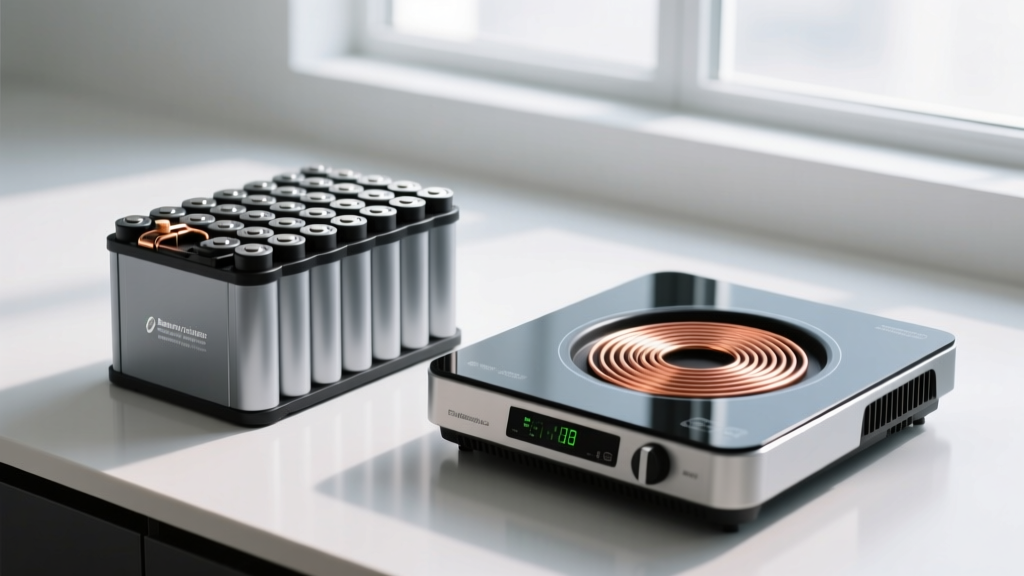
If you've ever browsed portable kitchen gear, you've likely encountered a battery powered induction cooktop — a self-contained unit that uses a built-in lithium-ion pack to heat cookware electromagnetically, no outlet required. These devices typically carry between 0.5 and 1.5 kWh of energy, enough for a few meals on a camping trip. That number might sound modest, and it is — until you place it next to a modern electric vehicle's traction battery, which stores anywhere from 50 to 130+ kWh. The gap between these two lithium-ion applications reveals a tremendous amount about battery engineering, chemistry trade-offs, longevity, and cost.
This guide uses that comparison as a lens to explain what actually goes into an EV battery: the chemistry choices automakers make, how degradation really works, what warranties cover, what replacement costs look like in 2026, and how you can monitor and maximize the health of your pack over a decade or more of ownership.
Energy Scale: From Cooktop kWh to Car kWh
The fundamental unit here is the kilowatt-hour (kWh) — a measure of energy capacity, not power. A battery powered induction cooktop drawing roughly 1,800 watts (1.8 kW) from a 1.0 kWh pack will run at full heat for about 33 minutes before depletion. An EV with a 75 kWh battery and an efficiency of 3.5 miles per kWh can travel roughly 260 miles on that same charge.
Both systems use lithium-ion cells, but the engineering priorities diverge sharply:
- Cooktop battery: Optimized for light weight, compact form factor, and moderate cycle life (300–800 cycles). Cost per kWh matters less because total pack size is small.
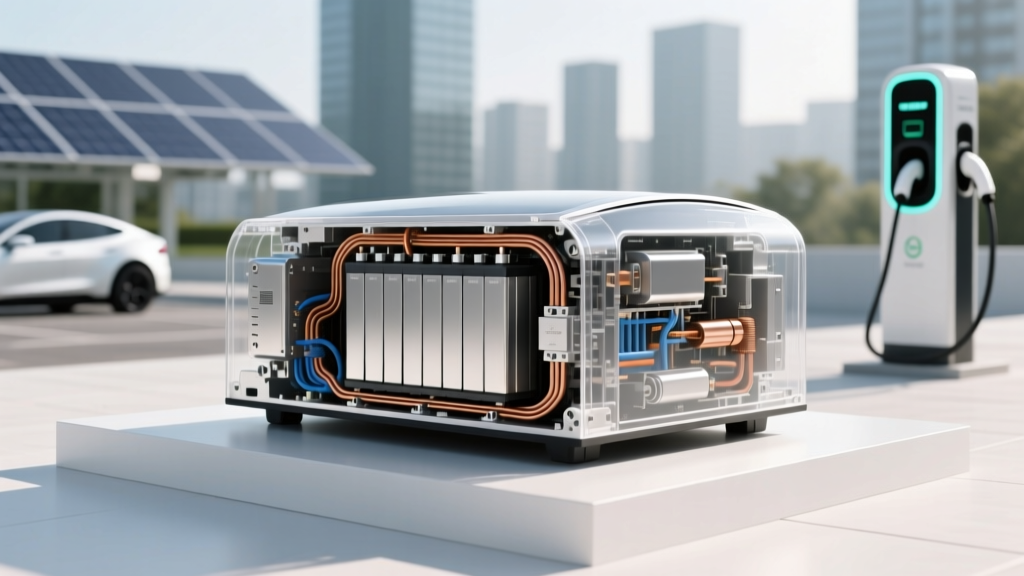
- EV traction battery: Must deliver 1,500+ full charge cycles with minimal degradation, operate across -30°F to 120°F ambient, sustain high charge/discharge rates, and meet automotive safety standards — all while driving down cost per kWh to make EVs price-competitive.
This is why EV battery engineering is one of the most capital-intensive R&D efforts in industrial history, while portable appliance batteries are largely off-the-shelf consumer cells.
Battery Chemistry: LFP vs. NMC/NCA Trade-Offs
The two dominant EV battery chemistries in 2026 are LFP (lithium iron phosphate) and NMC/NCA (nickel manganese cobalt / nickel cobalt aluminum). Each has distinct strengths, and automakers choose based on vehicle positioning.
| Attribute | LFP (LiFePO₄) | NMC / NCA |
|---|---|---|
| Energy density (Wh/kg, cell-level) | 160–200 | 230–300 |
| Cycle life (to 80% SoH) | 3,000–5,000+ | 1,000–2,500 |
| Cold-weather performance | Moderate loss; slower charge acceptance below 32°F | Better low-temp discharge; preconditioning still required |
| Thermal stability | Excellent — inherently resistant to thermal runaway | Good with active BMS; requires more thermal management |
| Cobalt / nickel content | None | Significant — supply-chain and ethical sourcing concerns |
| Cost per kWh (2026 pack-level) | ~$90–$110 | ~$120–$150 |
| Typical use case | Standard-range models, fleet vehicles, high-mileage drivers | Long-range, performance, and premium models |
| Recommended charging habit | Can charge to 100% daily without significant harm | Best kept between 20–80% for daily use; 100% for road trips only |
| Example vehicles (2026) | Tesla Model 3 RWD, Ford Mustang Mach-E Select (LFP option), BYD models | Tesla Model Y Long Range, Hyundai Ioniq 5, BMW iX, Rivian R1T Dual-Motor |
Which is better? It depends on your driving pattern. If you commute daily, charge at home, and want maximum longevity with minimal babysitting, LFP is the pragmatic choice — charge it to 100%, drive it hard, and expect minimal degradation over 15+ years. If you need 300+ miles of EPA range or want the quickest acceleration, NMC/NCA delivers the energy density to make that possible in a lighter package. Neither chemistry is universally superior; each is an engineering compromise.
How Long Do EV Batteries Actually Last?
The short answer: almost certainly longer than you'll own the car. The long answer requires data.
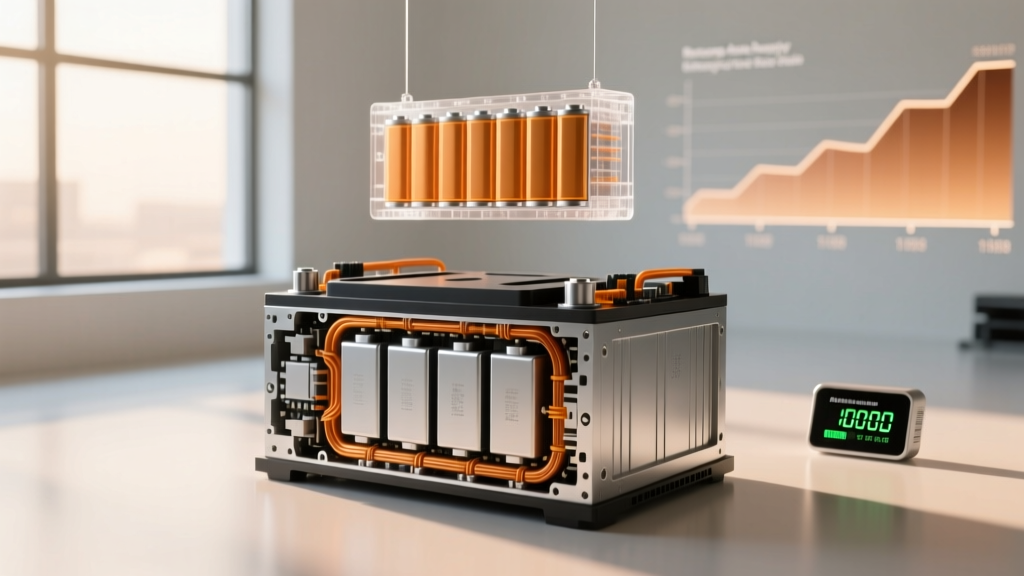
Based on aggregated fleet data from sources including fueleconomy.gov and independent analyses by Recurrent Auto, typical EV battery degradation follows a curve that is steepest in the first 1–2 years, then flattens significantly:
| Vehicle Age / Mileage | Typical Capacity Retained (NMC) | Typical Capacity Retained (LFP) |
|---|---|---|
| Year 1 / ~12,000 mi | 95–97% | 97–99% |
| Year 3 / ~36,000 mi | 90–93% | 94–97% |
| Year 5 / ~60,000 mi | 87–91% | 92–96% |
| Year 8 / ~100,000 mi | 82–88% | 89–94% |
| Year 12 / ~150,000 mi | 78–85% | 86–92% |
Note: Figures represent fleet medians. Individual results vary based on climate, charging habits, and thermal management system quality. Data synthesized from Recurrent Auto fleet reports and manufacturer warranty disclosures.
A battery is generally considered "depleted" in automotive terms when it falls below 70–80% of original capacity — but even at 75% SoH, a vehicle with an original 310-mile EPA range still delivers ~230 miles. For most drivers, that's still a fully functional daily car.
Real-world context: Tesla's 2025 Impact Report noted that Model 3/Y batteries retain an average of 85% capacity at 200,000 miles. Hyundai-Kia's 8-year data on the Kona Electric and Niro EV shows similar trajectories, with most packs above 88% at 80,000 miles.
What Does the Battery Warranty Actually Cover?
Federal law (EPA emissions warranty requirements) effectively mandates that EV manufacturers warrant the high-voltage battery for a minimum of 8 years / 100,000 miles in most states, and 10 years / 150,000 miles in CARB states (California and states adopting CARB standards). Here's how major manufacturers structure their coverage in 2026:
| Manufacturer | Battery Warranty | Capacity Threshold | Notes |
|---|---|---|---|
| Tesla | 8 yr / 120,000 mi (Model 3/Y RWD); 8 yr / 100,000 mi (LR/Perf) | 70% retention | Covers defects + degradation below threshold |
| Hyundai / Kia | 10 yr / 100,000 mi | 70% retention | Among the longest in the industry |
| Ford | 8 yr / 100,000 mi | 70% retention | Applies to Mustang Mach-E, F-150 Lightning |
| GM (Chevrolet, Cadillac) | 8 yr / 100,000 mi | 70% retention (60% for Bolt-era packs) | Ultium packs covered at 70% |
| Rivian | 8 yr / 175,000 mi (R1T/R1S) | 70% retention | Higher mileage cap reflects adventure-use positioning |
| BMW | 8 yr / 100,000 mi | 70% retention | Extended warranty available for purchase |
What's covered: Manufacturing defects, cell failures, BMS malfunctions, and capacity loss below the stated threshold under normal use.
What's typically NOT covered: Damage from collisions, flooding, unauthorized modifications, or use outside manufacturer specifications (e.g., repeated 100% daily charging on NMC packs against manual recommendations may complicate a claim, though this is rarely enforced).
EV Battery Replacement Cost: The Numbers in 2026
This is the question that generates the most anxiety — and the most misinformation. Let's anchor it with real figures.
Out-of-warranty battery replacement costs in 2026 typically range from $5,000 to $22,000 depending on pack size, chemistry, and vehicle. However, the critical context is that very few EV batteries require full replacement during the vehicle's usable life. The vast majority of EVs will be retired, traded, or scrapped for non-battery reasons before the pack falls below functional capacity.
| Vehicle (2026 Example) | Pack Size | Chemistry | Estimated Replacement Cost |
|---|---|---|---|
| Tesla Model 3 RWD | ~57 kWh | LFP | $7,000–$10,000 |
| Tesla Model Y Long Range | ~82 kWh | NMC | $12,000–$16,000 |
| Hyundai Ioniq 5 (Long Range) | 77.4 kWh | NMC | $11,000–$15,000 |
| Ford F-150 Lightning (Extended) | ~131 kWh | NMC | $18,000–$22,000 |
| Chevrolet Equinox EV | ~85 kWh | NMC (Ultium) | $10,000–$14,000 |
| Nissan Leaf (40 kWh) | 40 kWh | NMC (older gen) | $5,000–$8,000 |
Two trends are working in owners' favor: pack-level costs have dropped from ~$200/kWh in 2020 to roughly $110–$140/kWh in 2026, and module-level repair is increasingly viable. Many shops can now diagnose and replace individual faulty modules ($500–$2,000 per module) rather than swapping the entire pack — a practice that was nearly impossible five years ago.
Factors That Accelerate (or Preserve) Battery Life
Battery degradation is electrochemical — it's driven by stress on the cell. Here are the primary stressors and how to manage them:
- State of Charge extremes: Storing an NMC battery at 100% SoC for extended periods accelerates electrolyte decomposition. For daily driving, set your charge limit to 80%. LFP owners can charge to 100% without significant penalty — in fact, periodic 100% charges help LFP's BMS recalibrate cell balancing.
- DC fast charging frequency: Occasional DC fast charging (1–2x per week) has negligible impact on modern packs with active thermal management. Daily 250+ kW fast charging without preconditioning can accelerate degradation by 1–3% over 5 years. Always use your car's navigation-based preconditioning when routing to a charger.
- Extreme heat: Sustained ambient temperatures above 95°F combined with high SoC is the single most damaging condition for lithium-ion cells. If you live in Phoenix or Miami, parking in shade and avoiding 100% charges during summer heat waves meaningfully extends pack life.
- Extreme cold: Cold doesn't permanently damage batteries the way heat does, but charging a frozen pack without preconditioning can cause lithium plating — a form of irreversible degradation. Modern BMS systems prevent this by throttling charge speed, but preconditioning is still the owner's responsibility to enable.
- Deep discharges: Regularly driving to 0% and leaving the car depleted for days stresses cells. Try to keep SoC above 10% for storage.
- Calendar aging: Even a garage-kept EV with zero miles will lose some capacity over time simply due to chemical processes. This is unavoidable but slow — roughly 1–2% per year at moderate SoC and temperatures.
How to Check and Monitor Battery Health (SoH)
State of Health (SoH) is the percentage of your battery's original capacity that remains usable. Most modern EVs provide SoH data through one or more channels:
- In-car displays: Tesla shows battery health in the service menu (accessible via the software screen). Hyundai/Kia provides a battery condition indicator in the EV settings menu. BMW's iDrive includes a battery health percentage under vehicle status.
- OBD-II diagnostic tools: Devices like the OBDLink CX or vLinker FD, paired with apps such as EVbatmon, Car Scanner, or ABRP's OBD integration, can read detailed cell-level voltage, internal resistance, and calculated SoH directly from the BMS.
- Manufacturer service centers: Any authorized dealer can pull a full battery health report during routine service. Request this if you're approaching a warranty mileage threshold and want documentation.
- Third-party services: Companies like Recurrent Auto offer free battery health reports for participating owners, using telematics data to benchmark your pack against thousands of identical vehicles.
If your SoH reading drops more than 2–3% in a single year after the initial break-in period, it's worth investigating — this could indicate a failing module, a BMS calibration error, or a thermal management issue that's better caught early.
Emerging Battery Tech: What's Real vs. What's Coming
The battery landscape is evolving quickly, but it's essential to separate shipping products from lab announcements.
Silicon-dominant anodes: Companies like Sila Nanotechnologies and Group14 are already shipping silicon-composite anode materials that boost energy density by 10–20% over graphite. These are in limited production vehicles (the Mercedes G-Class electric SUV uses Sila cells in its 2025+ model year). Expect broader availability in premium models by 2027–2028, with mainstream adoption by 2029–2030.
Solid-state batteries: Toyota, Samsung SDI, and QuantumScape have all announced solid-state or semi-solid-state cells with promising energy density (400+ Wh/kg at cell level) and rapid charge capability. Toyota has confirmed a 2027–2028 production timeline for a limited-run vehicle. However, manufacturing scale-up remains the unsolved challenge — solid-state cells are currently produced in small batches at costs 3–5x higher than equivalent NMC cells. Realistic mass-market availability: 2030 at the earliest, more likely 2032+ for affordable models.
Sodium-ion batteries: CATL and BYD have begun shipping sodium-ion packs in Chinese-market micro-EVs and energy storage systems. Sodium-ion offers lower energy density (~140 Wh/kg) but dramatically lower material costs and excellent cold-weather performance. US-market availability in passenger vehicles is not expected before 2028, and initial applications will likely be in budget urban EVs or as range-extender supplements in PHEV architectures.
None of these technologies invalidate a current-generation LFP or NMC purchase. Today's chemistries are mature, well-understood, and backed by warranties that outlast most ownership periods.
Back to the Cooktop: What Portable Batteries Teach Us About Scale
A battery powered induction cooktop is a useful thought experiment in energy density. Its ~1 kWh pack weighs roughly 5–8 pounds and costs the manufacturer perhaps $100–$200. Scale that chemistry linearly to 75 kWh and you'd have a 400-pound, $10,000 battery pack with 800-cycle life — not terrible, but not automotive-grade.
EV batteries achieve their performance through cell-level chemistry optimization, sophisticated thermal management (liquid cooling loops, heat pumps, active preconditioning), and BMS algorithms that balance thousands of individual cells in real time. The cooktop has none of this — it doesn't need it. But the comparison illuminates why EV battery packs are one of the most engineered components in any consumer product, and why they reliably outlast the vehicles they power.
Frequently Asked Questions
How long do EV batteries last in years and miles?
Most modern EV batteries (2022+ model years) retain 80–90% of their original capacity at 100,000 miles and 8 years. LFP packs frequently exceed 90% at that mark. Based on current degradation curves, a typical NMC pack will deliver usable service (above 70% SoH) for 15–20 years or 200,000+ miles under normal use. LFP packs may exceed 300,000 miles before reaching the same threshold.
How much does an EV battery cost to replace in 2026?
Out-of-warranty replacement costs range from roughly $5,000 for a small pack (Nissan Leaf 40 kWh) to $22,000 for a large pack (F-150 Lightning Extended Range 131 kWh). Most mainstream mid-size EVs (75–85 kWh) fall in the $10,000–$16,000 range. Module-level repairs, when viable, cost $500–$2,000. Critically, full pack replacement is rare — the vast majority of EV batteries outlast the vehicle's economic life.
What does the EV battery warranty cover?
Federal minimum is 8 years / 100,000 miles (10 yr / 150,000 mi in CARB states). Coverage includes manufacturing defects, cell/module failures, BMS malfunctions, and capacity loss below a stated threshold — typically 70% of original capacity. Warranties do not cover collision damage, flood damage, or unauthorized modifications. Check your specific manufacturer's warranty document for exact terms.
How do I check my EV battery's State of Health?
Most EVs display SoH in the vehicle settings or service menu. For more granular data, use an OBD-II adapter (OBDLink CX, vLinker FD) with an app like EVbatmon or Car Scanner to read cell voltages, internal resistance, and BMS-reported capacity. You can also request a battery health report from your dealer during service visits. Services like Recurrent Auto offer free benchmarking reports.
LFP vs. NMC — which battery chemistry should I choose?
Choose LFP if you want maximum cycle life, don't need 300+ miles of range, prefer to charge to 100% daily without worry, and prioritize lower cost and cobalt-free sourcing. Choose NMC/NCA if you need long EPA range, want peak performance in cold climates, or are buying a premium/performance model where weight and energy density matter. Both chemistries are reliable and well-warrantied — the right choice depends on your driving pattern, not on one being universally "better."
Does frequent DC fast charging damage my EV battery?
Modern EVs with active liquid thermal management handle DC fast charging well. Data from Recurrent Auto shows that vehicles fast-charging 2–3 times per week exhibit only 1–2% more degradation over 5 years compared to vehicles that charge primarily on Level 2. The key factors are preconditioning the pack before charging (your car does this automatically when navigating to a charger) and avoiding sustained high SoC. Occasional fast charging is not a meaningful concern.
Can I use my EV battery to power a battery powered induction cooktop?
Technically, yes — if your EV supports V2L (Vehicle-to-Load), like the Hyundai Ioniq 5, Ford F-150 Lightning, or Kia EV6, you can plug a standard 1,800W induction cooktop into the vehicle's 120V/240V outlet and cook using your car's battery. At 1.8 kW draw, a 77 kWh battery could theoretically power the cooktop for over 40 hours. This is a practical use of V2L for camping or emergency power — and a vivid illustration of the energy gap between an EV and a standalone battery powered induction cooktop with its own tiny internal pack.
Sources: U.S. Department of Energy / fueleconomy.gov — EV technology and battery basics; IRS.gov — §30D clean vehicle credit rules (battery sourcing requirements); manufacturer warranty documents from Tesla, Hyundai, Ford, GM, Rivian, and BMW press sites (2025–2026 model year).