Search for "battery powered aeroplane" and you will find headlines about electric aircraft prototypes crossing the English Channel or carrying a handful of passengers on short hops. The aviation sector is chasing the same electrochemical breakthroughs that power your daily commute — but with radically different constraints. Understanding why electric planes remain niche while electric vehicles have gone mainstream reveals exactly what matters in the lithium-ion cells sitting beneath your EV's floorpan.
This guide breaks down the battery chemistries, degradation realities, warranty protections, replacement economics, and care practices that determine whether an EV battery will outlast the car it powers. We will also examine why the energy-density demands of a battery powered aeroplane make automotive-grade cells look like the pragmatic winner for ground transportation.
Why Battery Powered Aeroplane Tech Highlights EV Battery Strengths
Aviation demands extreme energy density. Jet-A fuel delivers roughly 12,000 Wh/kg; today's best production lithium-ion cells manage around 250–300 Wh/kg at the cell level. That ~40:1 gap explains why a fully electric commercial airliner remains a distant prospect. Companies like Heart Aerospace (ES-30) and Eviation (Alice) target short regional routes with battery packs weighing several tons — viable for 200–400 mile hops, not transcontinental flights.
For EV buyers, this comparison is instructive. A car does not need to defy gravity. A 75–100 kWh pack weighing 400–600 kg gives a modern EV 250–350 miles of EPA-estimated range — more than enough for daily driving and most road trips. The engineering trade-offs that make battery powered aeroplanes so challenging (weight, thermal management under sustained high discharge, safety margins at altitude) are far less severe at ground level. That means automakers can prioritize longevity, cost, and fast-charging durability over raw energy density — and that is exactly what they have done.
LFP vs NMC/NCA: The Chemistry Decision That Shapes Your EV
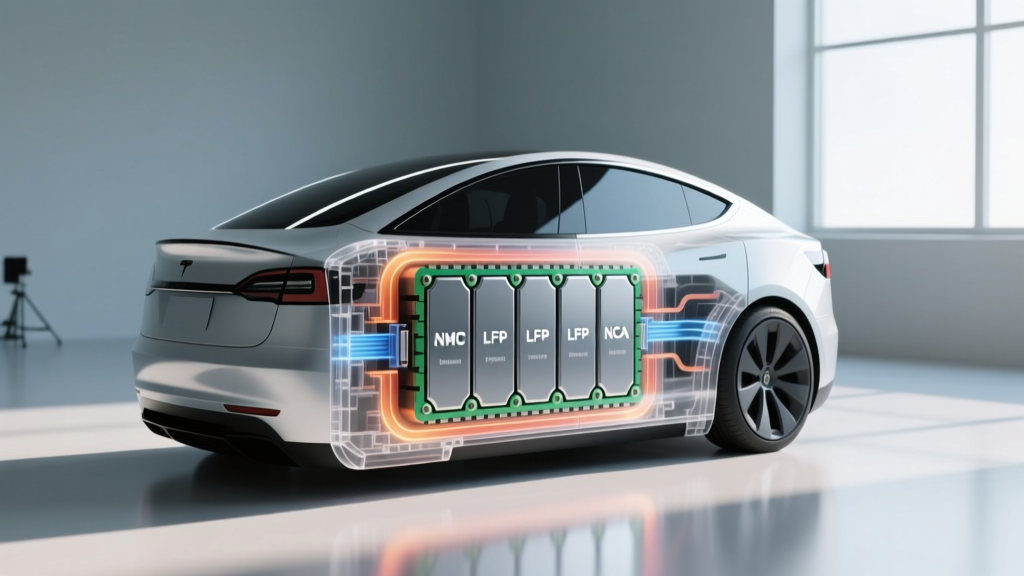
Two lithium-ion chemistries dominate the 2026 EV market: Lithium Iron Phosphate (LFP) and Nickel Manganese Cobalt / Nickel Cobalt Aluminum (NMC/NCA). Each has distinct trade-offs that affect range, longevity, cold-weather behavior, and price.
| Attribute | LFP (LiFePO₄) | NMC / NCA |
|---|---|---|
| Cell-level energy density | 160–200 Wh/kg | 230–300 Wh/kg |
| Typical cycle life (to 80% SoH) | 3,000–5,000+ cycles | 1,000–2,500 cycles |
| Cold-weather performance (−10°C) | Moderate loss; slower charge acceptance | Better low-temp discharge; preconditioning helps |
| Cobalt content | None | Yes (NMC) / Minimal (NCA) |
| Cost per kWh (cell level, 2026) | ~$70–$90 | ~$100–$130 |
| Thermal stability | Excellent — higher runaway threshold | Good — requires robust BMS |
| Recommended daily SoC | 100% OK for daily use | 80% preferred for daily; 100% for trips |
| Notable 2026 applications | Tesla Model 3 RWD, Ford Mustang Mach-E Select, base BYD models | Tesla Model Y Long Range, Hyundai Ioniq 5, Rivian R1T, Lucid Air |
The practical takeaway: LFP wins on longevity, cost, and safety — ideal for standard-range models where the slightly lower energy density is offset by a larger physical pack or accepted range reduction. NMC/NCA wins on range-per-kilogram, making it the choice for long-range and performance trims where every kilogram counts. Neither is universally "better"; the right chemistry depends on your driving pattern.
If you drive 30–50 miles daily and can charge at home, an LFP pack's ability to sit at 100% SoC without accelerated degradation is a genuine ownership advantage. If you regularly road-trip 300+ miles and need maximum EPA-rated range, NMC/NCA's energy density delivers it — provided you follow the 80% daily charge guideline.
How Long Do EV Batteries Last? Real Degradation Data
The fear that an EV battery will "die" at 100,000 miles, mirroring a smartphone's two-year decline, is not supported by fleet data. Modern EV batteries are engineered with oversized buffers, active thermal management, and sophisticated battery management systems (BMS) that protect cells from the abuse patterns that degrade consumer electronics.
Observed Degradation Trajectories (Fleet & Owner Data):
- Tesla Model 3/Y (NMC, 2019–2023): ~5–7% capacity loss at 100,000 miles; ~8–12% at 200,000 miles (source: Tesla Impact Reports, Recurrent Auto fleet data)
- Chevrolet Bolt EV/EUV (NMC, 2017–2023): ~4–8% loss at 80,000 miles; early 2017–2018 models affected by recall-related battery replacements (LG cells)
- Nissan Leaf (passive air-cooled, 2011–2017): 15–25% loss at 80,000–100,000 miles — a cautionary tale about thermal management
- Hyundai/Kia E-GMP platform (Ioniq 5, EV6, NMC, 2022+): ~3–5% loss at 50,000 miles in early fleet reporting; liquid-cooled, preconditioned
- LFP-equipped Tesla Model 3 RWD (2021+): ~2–4% loss at 60,000 miles; slower degradation curve attributed to LFP chemistry and frequent 100% SoC calibration charges
The pattern is clear: liquid-cooled packs with active BMS lose roughly 1–2% per year or per 15,000–20,000 miles in typical use. Most will retain 85–90% of original capacity at 150,000 miles. A battery reaching 70% state of health (SoH) — the threshold most warranties use — typically requires 250,000+ miles or 15+ years under normal conditions.
For context, the average US driver covers ~13,500 miles per year (FHWA data). At that rate, reaching 200,000 miles takes roughly 15 years. Most EV batteries will outlast the vehicle's body, interior, and suspension components.
What Does the Battery Warranty Actually Cover?
Federal law mandates a minimum 8-year / 100,000-mile warranty on EV battery packs (California Air Resources Board states extend this to 10 years / 150,000 miles). But the details matter — specifically, the capacity retention threshold and what triggers a claim.
| Manufacturer | Warranty Term | Capacity Threshold | Notes |
|---|---|---|---|
| Tesla (Model 3/Y LFP) | 8 yr / 120,000 mi | 70% SoH | Long Range/Performance NMC: 8 yr / 120,000 mi |
| Hyundai / Kia (E-GMP) | 10 yr / 100,000 mi | 70% SoH | Among the longest terms in the US market |
| Ford (Mach-E, F-150 Lightning) | 8 yr / 100,000 mi | 70% SoH | Covers battery and electric drive components |
| General Motors (Ultium platform) | 8 yr / 100,000 mi | 70% SoH | Applies to Blazer EV, Equinox EV, Silverado EV |
| Rivian (R1T / R1S) | 8 yr / 175,000 mi | 70% SoH | Higher mileage cap reflects truck use case |
| BMW (iX, i4, i7) | 8 yr / 100,000 mi | 70% SoH | Includes high-voltage battery and related components |
Key nuance: The warranty covers defects and abnormal degradation — not gradual, expected capacity loss above the threshold. If your pack reads 72% SoH at year 9, you are outside warranty coverage. In practice, so few packs fall below 70% within the warranty window that most claims involve manufacturing defects (bad cell groups, BMS faults) rather than wear-out.
The warranty does not cover the 12V auxiliary battery — that small lead-acid or lithium 12V unit powers accessories and computers and follows a standard 3–5 year replacement cycle, just like any conventional vehicle. Do not confuse it with the high-voltage traction battery that propels the car.
EV Battery Replacement Cost: When and How Much
If a pack does fail outside warranty — whether from a manufacturing defect discovered late, accident damage, or extreme degradation — replacement is a significant expense. However, context is essential: the vast majority of EV batteries never need replacement during the vehicle's useful life.
| Vehicle / Platform | Pack Size (usable kWh) | Estimated Replacement Cost | Typical Need Scenario |
|---|---|---|---|
| Tesla Model 3 RWD (LFP) | ~57 kWh | $10,000–$13,000 | Rare; accident damage or extreme outlier degradation |
| Tesla Model Y Long Range (NMC) | ~75 kWh | $13,000–$16,000 | Same — exceedingly uncommon under 200k mi |
| Hyundai Ioniq 5 (NMC) | ~77.4 kWh | $14,000–$18,000 | Module-level repair may reduce cost |
| Ford F-150 Lightning Ext. Range | ~131 kWh | $22,000–$30,000 | Largest packs cost most; modular repair possible |
| Chevrolet Bolt EV (pre-recall) | ~65 kWh | $14,000–$16,000 | Many replaced under GM recall at no cost |
| Lucid Air Grand Touring | ~112 kWh | $20,000–$28,000 | Premium pack; limited independent repair options |
Several factors are driving replacement costs down over time. Cell prices have fallen from ~$400/kWh in 2010 to roughly $80–$110/kWh in 2026 at the pack level (BloombergNEF data). Independent EV repair shops are increasingly capable of replacing individual modules rather than entire packs — a single failed module in a 12-module pack might cost $1,500–$3,000 to swap rather than $15,000 for a full pack. This modular repair trend will accelerate as more vehicles age out of warranty.
Factors That Accelerate (or Protect) Battery Health
Battery degradation is not purely a function of time or mileage. How you charge, store, and drive an EV meaningfully affects the rate at which capacity declines. Here are the primary factors, ranked by impact:
- Extreme State of Charge (SoC): Storing an NMC battery at 100% SoC for days or weeks accelerates electrolyte decomposition. LFP tolerates 100% far better. For NMC, charge to 80% daily and 100% only before long trips.
- DC Fast Charging Frequency: Frequent 150+ kW DC sessions (multiple times per week) generate sustained heat and lithium plating risk. Occasional road-trip fast charging is fine; daily DCFC reliance without Level 2 access adds measurable wear. A Recurrent Auto study found that vehicles fast-charging more than 3x/week showed ~1–2% additional degradation at 100,000 miles versus primarily L2-charged vehicles.
- Temperature Extremes: Sustained operation in ambient temperatures above 95°F (35°C) or below 15°F (−10°C) stresses cells. Active liquid cooling mitigates this significantly — which is why the passively air-cooled early Nissan Leaf degraded far faster than liquid-cooled competitors. Preconditioning your battery before fast charging (most modern EVs do this automatically when a DCFC is navigated to) is critical in cold weather.
- Deep Discharge Cycles: Regularly driving to 0% SoC and leaving the vehicle depleted stresses cells. Try to keep the pack above 10% and plug in promptly after deep discharges.
- Calendar Aging: Even a parked EV battery degrades slowly. Storing at ~50% SoC in moderate temperatures minimizes calendar aging. Avoid leaving the car at 100% or below 10% for extended parking.
How to Monitor Your Battery's State of Health
State of Health (SoH) is the percentage of original capacity your battery retains. A new pack is 100% SoH; at 70% SoH, a 75 kWh pack delivers roughly 52.5 kWh of usable energy, reducing range proportionally.
How owners check SoH in 2026:
- In-vehicle displays: Tesla, Hyundai/Kia, BMW, and GM Ultium vehicles show battery health metrics in the service or energy menus. Tesla's "Battery Health" screen shows estimated range at 100% SoC vs. the original EPA figure — a proxy for SoH.
- OBD-II dongles + apps: Tools like OBDeleven, Carista, or manufacturer-specific diagnostic apps can read the BMS-reported SoH directly. The OBD-II port in an EV exposes the same high-voltage battery data the dealer scan tool reads.
- Dealer diagnostics: Any authorized service center can pull a full battery health report showing individual module voltages, internal resistance, and calculated SoH. Request this during routine service visits, especially before the warranty expires.
- Third-party services: Companies like Recurrent and Geotab offer fleet and individual battery health reports based on telematics data, comparing your degradation curve to similar vehicles.
A practical monitoring cadence: Check your SoH proxy (100% charge range vs. EPA sticker) every 3–6 months. Log it. A sudden drop — say, 5% in a single month — warrants a dealer diagnostic. Gradual, linear decline of 1–2% per year is normal and no cause for concern.
Emerging Battery Tech: Solid-State, Silicon Anode, and the Aviation Connection
The battery powered aeroplane sector is one of the most aggressive funders of next-generation cell research — because aviation's energy-density requirements are so extreme that incremental improvements are insufficient. Technologies being developed for electric aircraft will eventually trickle down to EVs, but timelines are measured in years, not months.
Solid-state batteries replace the liquid electrolyte with a solid ceramic, polymer, or sulfide layer. Benefits include higher energy density (potentially 400–500 Wh/kg at cell level), faster charging, and improved safety (no flammable electrolyte). Toyota has announced solid-state cells for a limited-production EV in 2027–2028, targeting 750+ km (~465 miles) of range (WLTP). Samsung SDI and QuantumScape are pursuing similar timelines. However, manufacturing scale-up, cost reduction, and cycle-life validation remain unresolved. Realistic mass-market availability: 2029–2032.
Silicon anode technology replaces graphite anodes with silicon-dominant materials, boosting energy density by 20–40%. Companies like Sila Nanotechnologies (partnered with Mercedes-Benz for the upcoming G-Class EV) and Group14 (backed by Porsche) are bringing silicon anode cells to production vehicles in 2026–2027. This is the most imminent next-gen improvement and does not require entirely new manufacturing infrastructure.
Sodium-ion batteries (CATL, BYD) are entering production for lower-cost, shorter-range EVs in China and may reach the US market by 2027–2028. They trade energy density for dramatically lower material cost and no lithium, cobalt, or nickel — potentially ideal for urban commuter EVs and L2/L3 autonomous shuttles.
For today's buyer: none of these technologies are available in a 2026 production EV you can order. Waiting for solid-state means waiting at least 3–5 more years for limited availability at premium pricing. Current LFP and NMC cells are mature, well-understood, and backed by real-world data spanning hundreds of billions of fleet miles.
Frequently Asked Questions
How long do EV batteries last in years and miles?
Based on fleet data through 2026, most liquid-cooled EV batteries retain 85–90% of original capacity at 150,000 miles (roughly 11–12 years of average US driving). Reaching the 70% SoH warranty threshold typically requires 250,000+ miles or 15+ years. The Nissan Leaf's passively cooled pack was a notable exception; modern liquid-cooled designs from Tesla, Hyundai, GM, Ford, and others show far slower degradation.
How much does an EV battery cost to replace?
Out-of-warranty replacement ranges from ~$10,000 for a smaller LFP pack (Tesla Model 3 RWD) to ~$30,000 for a large pack (F-150 Lightning Extended Range). However, most batteries never need full replacement — and module-level repairs at independent shops can address localized failures for $1,500–$3,000. Cell costs continue declining, and the used/salvage pack market offers lower-cost alternatives for older vehicles.
What does the battery warranty cover?
Federal minimum is 8 years / 100,000 miles (10/150,000 in CARB states). Coverage applies if the pack falls below ~70% capacity retention or has a manufacturing defect. It does not cover the 12V auxiliary battery, damage from accidents or misuse, or gradual capacity loss above the threshold. Always check your specific manufacturer's warranty booklet — terms vary.
How do I check and maximize my battery's health?
Check SoH via your vehicle's battery health screen, an OBD-II diagnostic app, or a dealer scan every 3–6 months. To maximize longevity: charge NMC to 80% daily (100% only for trips), keep LFP at 100% periodically for calibration, avoid frequent DC fast charging when Level 2 is available, precondition in cold weather, and never store the vehicle at 0% or 100% SoC for extended periods.
LFP vs NMC — which is better and why?
Neither is universally superior. LFP offers longer cycle life (3,000–5,000+ cycles), lower cost, better thermal safety, and tolerance for daily 100% charging — making it ideal for standard-range models and daily commuters. NMC/NCA delivers higher energy density (230–300 vs 160–200 Wh/kg), enabling longer range in the same weight — making it better for long-range trims and road-trip-heavy drivers. Choose based on your driving pattern, not chemistry alone.
Will battery powered aeroplane technology improve my next EV?
Indirectly, yes. The extreme energy-density demands of electric aviation are accelerating investment in solid-state and silicon anode cells. When those technologies mature and reach automotive scale (expected 2028–2032), EVs will benefit from lighter, faster-charging, longer-range packs. But current LFP and NMC chemistries are already excellent for ground transportation — a car does not need aviation-grade energy density to deliver 300+ miles of real-world range.