When shoppers search for a 2018 Nissan Pathfinder battery, they're usually dealing with a dead 12-volt lead-acid unit that needs a $150–$220 swap at an auto parts store. But that keyword opens a far more valuable conversation for anyone cross-shopping used SUVs and modern EVs: how long do high-voltage EV traction batteries actually last, what do they cost to replace, and how do they compare to the routine 12V battery replacements gas-car owners know well?
This guide uses real degradation data, warranty terms, and 2026 replacement pricing to answer those questions — and to separate internet fear from documented battery science.
The Two Batteries in Every EV (and the One in Your Pathfinder)
Before comparing lifespans, it's critical to distinguish the batteries in play:
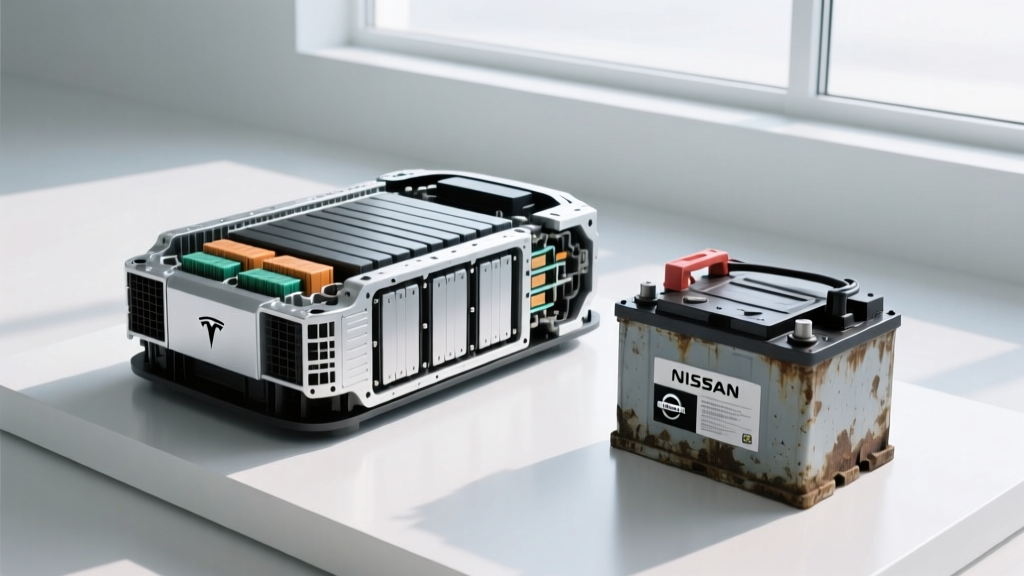
- 12V auxiliary battery — present in both the 2018 Nissan Pathfinder and every modern EV. It powers lights, infotainment, door locks, and the computers that close the high-voltage contactors. Typical lifespan: 3–5 years. Replacement cost: $150–$300.
- High-voltage traction battery — the large lithium-ion pack (40–120+ kWh) that actually propels an EV. This is what people mean when they say "EV battery." It does not exist in a gas Pathfinder.
The 2018 Pathfinder's VQ35DE V6 has no traction battery at all — it's a conventional ICE vehicle. So any comparison is really between the ongoing maintenance reality of a gas SUV and the long-haul durability of an EV's main pack.
How Long Do EV Batteries Actually Last?
Based on fleet data published by fueleconomy.gov and longitudinal studies from Recurrent Auto and Geotab, modern liquid-cooled EV traction batteries are retaining roughly 85–92% of original capacity after 100,000 miles. That's a far cry from the "dead at 80k" myth still circulating on forums.
Typical capacity retention curve (liquid-cooled NMC/NCA packs, 2020–2026 models):
- Year 1 / 15,000 mi: ~97% State of Health (SoH) — initial formation loss
- Year 3 / 45,000 mi: ~93–95% SoH
- Year 5 / 75,000 mi: ~90–93% SoH
- Year 8 / 120,000 mi: ~85–90% SoH
- Year 10 / 150,000 mi: ~82–87% SoH
Older air-cooled packs (2011–2017 Nissan Leaf, notably) degraded faster — often hitting 70–80% SoH by year 8 in hot climates — which is why thermal management is now standard on nearly every mainstream EV sold in the U.S.
For context, a well-maintained 2018 Pathfinder's V6 engine is rated to 200,000+ miles, but it will need a timing-chain inspection, water pump, multiple oil changes per year, and eventually a transmission service. The EV's traction battery is designed to outlast most of those mechanical wear items.
LFP vs NMC/NCA: Which Chemistry Should You Pick?
Not all lithium-ion packs are built the same. The two dominant chemistries in 2026 EVs have distinct trade-offs:
| Factor | LFP (Lithium Iron Phosphate) | NMC/NCA (Nickel-based) |
|---|---|---|
| Energy density | Lower (~160 Wh/kg cell-level) | Higher (~250–300 Wh/kg) |
| Cycle life | 3,000–5,000+ cycles | 1,000–2,000 cycles |
| Cold-weather range | Worse (~25–35% loss at 20°F) | Better (~15–25% loss at 20°F) |
| Cost per kWh | Lower — no cobalt or nickel | Higher |
| Recommended SoC ceiling | 100% daily OK | 80% daily preferred |
| Typical use in 2026 | Tesla Model 3/Y RWD, Ford Mustang Mach-E Select, many Chinese-market EVs | Long-range and performance trims, trucks (F-150 Lightning, Rivian) |
Which is better? It depends. If you can charge at home nightly and don't need maximum range, LFP's longer cycle life and 100% charging tolerance make it the more durable daily-driver choice. If you need 320+ miles EPA, tow, or live in Minnesota winters, NMC/NCA's energy density and cold performance win. Neither chemistry is "fragile" — both routinely exceed 150,000 miles in modern thermal-managed packs.
What the Battery Warranty Actually Covers
Federal law mandates a minimum 8 years / 100,000 miles traction-battery warranty on every EV sold in the U.S. (10 years / 150,000 miles in California and states that follow CARB rules). But the fine print matters:
| Manufacturer (2026) | Term | Capacity-retention threshold |
|---|---|---|
| Tesla (Model 3/Y LFP) | 8 yr / 120,000 mi | 70% SoH |
| Tesla (Model 3/Y LR, S, X) | 8 yr / 120,000–150,000 mi | 70% SoH |
| Hyundai / Kia (E-GMP) | 10 yr / 100,000 mi | 70% SoH |
| Ford (Mach-E, F-150 Lightning) | 8 yr / 100,000 mi | 70% SoH |
| GM (Ultium-based) | 8 yr / 100,000 mi | 60–70% SoH (varies by model) |
| Nissan (Ariya) | 8 yr / 100,000 mi | 66% SoH (9 bars on gauge) |
| Rivian | 8 yr / 120,000–175,000 mi | 70% SoH |
A warranty claim requires the pack to fall below the stated threshold within the term — not simply lose any capacity. In practice, because most packs retain 85%+ at 100,000 miles, out-of-pocket traction-battery replacements under 150,000 miles are rare on liquid-cooled vehicles.
EV Battery Replacement Cost: The Real 2026 Numbers
This is where the fear-mongering usually peaks. Here's what replacement actually costs when it's needed — typically year 12+ or 180,000+ miles on a liquid-cooled pack, if ever:
| Model / pack size | 2026 replacement cost (parts + labor) |
|---|---|
| Nissan Leaf 40 kWh (older, air-cooled) | $6,500–$9,000 |
| Tesla Model 3 Standard (60 kWh LFP) | $8,000–$12,000 |
| Hyundai Ioniq 5 (77 kWh) | $10,000–$14,000 |
| Ford F-150 Lightning Extended (131 kWh) | $18,000–$25,000 |
| Chevrolet Silverado EV (200 kWh) | $25,000–$35,000 |
| Rivian R1T Max Pack (149 kWh) | $20,000–$28,000 |
Two important caveats: (1) most EVs are scrapped or traded before needing a full pack swap, and (2) module-level repair is increasingly common — independent shops can replace individual degraded modules for $2,000–$5,000 rather than swapping the entire pack. Compare this to the lifetime cost of a Pathfinder's transmission rebuild ($3,500–$5,500), timing chain ($1,800–$2,800), and recurring engine maintenance, and the "EV batteries are too expensive" argument loses force.
What Actually Kills an EV Battery (and What Doesn't)
Battery wear is driven by physics, not superstition. The verified stressors:
- Sustained 100% SoC at high temperature — the worst combination for NMC/NCA. LFP tolerates 100% far better.
- Frequent DC fast charging above 150 kW in extreme heat without preconditioning accelerates electrolyte breakdown.
- Deep discharges to 0% and storage at low SoC — can cause copper-shunt dissolution.
- Ambient heat above 95°F sustained for weeks (Arizona, Texas summers) — liquid cooling mitigates but doesn't eliminate.
- High-mileage DCFC-only charging routines — Tesla's own data shows ~2–3% additional loss at 150k miles vs. home Level 2 charging.
What doesn't meaningfully hurt a modern pack: occasional 100% charges for road trips, regen braking, cold weather (range drops temporarily, but the battery isn't damaged), and daily 20–80% cycles on NMC or 0–100% on LFP.
How Owners Check Battery Health (SoH) in 2026
State of Health is the metric that matters, and you no longer need a dealership scan tool to read it:
- Tesla: Service Mode → Health Test (built in, runs overnight at ~50% SoC).
- Hyundai/Kia: EV-specific diagnostics in the instrument cluster menu, plus OBD-II apps like Car Scanner.
- Ford: FordPass app shows a range-estimate trend; OBD-II tools pull exact SoH.
- Any EV: OBD-II dongles ($40–$120) paired with apps like Leaf Spy (Nissan), TeslaFi, or ABRP + OBD can read pack voltage, cell imbalance, and calculated SoH.
- Used-EV buyers: Request a pre-purchase battery health report from Recurrent, Turo-style telematics, or a certified dealer. A pack reading below 85% SoH at under 80,000 miles is a negotiation lever.
Solid-State, Silicon Anodes, and What's Actually Coming
Forward-looking context — none of this is on sale in consumer EVs as of 2026:
- Solid-state batteries (Toyota, Nissan, Samsung SDI prototypes) promise 2× energy density and 10-minute 10–80% charges. Toyota has announced limited production for 2027–2028, but volume availability is unconfirmed and pricing is expected to be premium-tier only for years.
- Silicon-anode cells (Sila Nanotechnologies, Group14) are entering production in 2026–2027, offering ~20% more energy density within existing NMC form factors. Expect first appearance in Mercedes and select Panasonic-supplied models.
- Sodium-ion is arriving in low-cost city EVs (China-first), with lower energy density but excellent cycle life and no lithium or cobalt.
For anyone buying in 2026, today's liquid-cooled LFP and NMC packs are mature products — not placeholders. The degradation data supports that.
EV Battery vs the 2018 Pathfinder: A Total-Cost Reality
A 2018 Pathfinder at 100,000 miles will have consumed roughly $9,800 in fuel (at 23 MPG combined and $3.30/gal), plus $2,500–$4,000 in scheduled maintenance and likely one 12V battery swap. A comparable 2026 EV at 100,000 miles will have used $3,200–$4,500 in electricity (home charging dominant), ~$800 in maintenance (cabin filter, tires, wiper fluid), and its traction battery will still be at ~88–92% SoH — nowhere near warranty-claim territory.
The Pathfinder's 12V battery will likely need replacing again around year 6–7. The EV's traction battery, statistically, won't need replacing at all during typical first-ownership.
Frequently Asked Questions
How long do EV batteries last in years and miles?
Modern liquid-cooled EV traction batteries routinely last 150,000–200,000+ miles (12–15 years) while retaining 80%+ of original capacity. Air-cooled older packs (pre-2018 Leaf) degraded faster. Most EVs are retired for other reasons before the pack fails.
How much does an EV battery cost to replace in 2026?
Between $6,500 and $35,000 depending on pack size and model — but most owners never pay this. Module-level repairs run $2,000–$5,000, and warranty covers failures below the 70% SoH threshold within 8–10 years.
What does the federal battery warranty cover?
By law, at least 8 years / 100,000 miles against the pack dropping below the manufacturer's stated retention threshold (usually 70% SoH). CARB states extend this to 10 years / 150,000 miles. It does not cover range loss from normal aging above that threshold.
How do I check my EV battery's health?
Built-in service menus (Tesla), OEM apps, or any $40–$120 OBD-II dongle paired with EV-specific apps like Leaf Spy, Car Scanner, or TeslaFi. Used-EV buyers should request a third-party SoH report before purchase.
LFP or NMC — which battery chemistry is better for longevity?
LFP wins on pure cycle life (3,000–5,000 cycles vs 1,000–2,000) and tolerates daily 100% charging. NMC wins on energy density and cold-weather range. For a garage-kept daily commuter, LFP typically outlasts the car. For long-range or cold-climate drivers, NMC is the pragmatic choice.
Does a 2018 Nissan Pathfinder have an EV battery?
No. The 2018 Pathfinder is a conventional V6 gas SUV with only a 12V lead-acid auxiliary battery (Group 35, ~$150–$220 replacement). It has no high-voltage traction battery. The search term "2018 Nissan Pathfinder battery" almost always refers to that 12V unit.