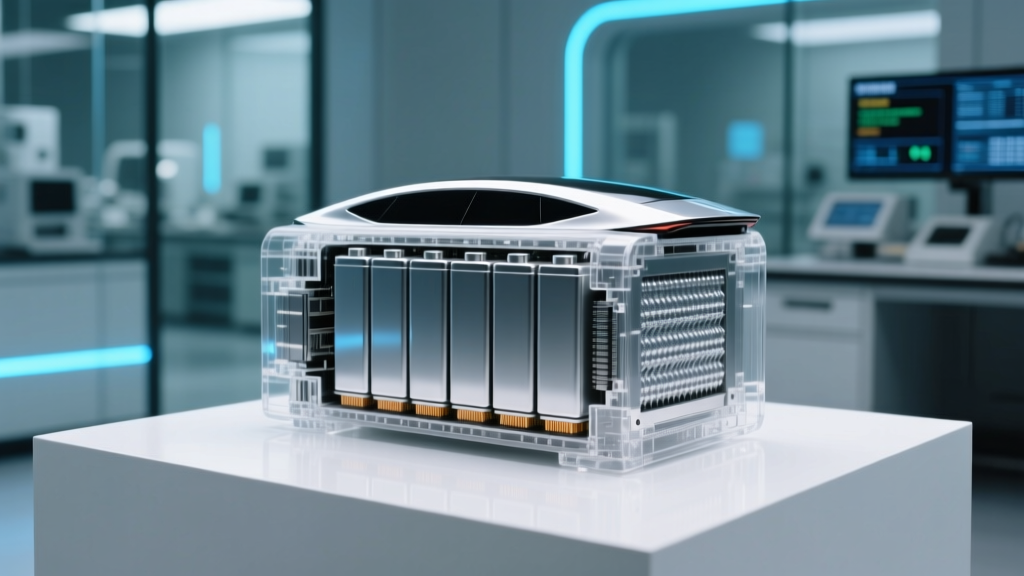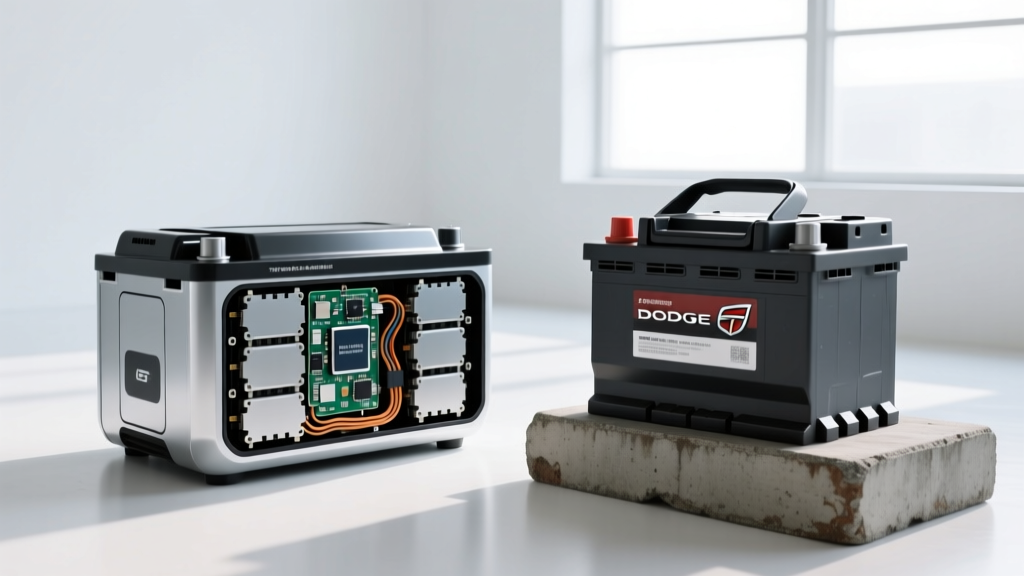
If you've ever shopped for a 2013 Dodge Durango battery, you're probably familiar with the standard 12V lead-acid unit under the hood — a $150-$250 component that cranks a gasoline V6 or V8 and powers the infotainment system. But as electrified vehicles become mainstream, the term "battery" carries an entirely different weight in the EV world. A modern electric vehicle's high-voltage traction battery is a 60-130 kWh energy-dense pack costing $10,000-$25,000, engineered to last the lifetime of the vehicle.
This guide dissects EV traction battery technology — chemistry, degradation curves, warranties, replacement economics, and care best practices — while drawing clear lines between the simple 12V battery in a 2013 Durango and the sophisticated energy storage system powering a 2026 EV.
12V Auxiliary Battery vs. EV Traction Battery: The Fundamental Divide
Before we go deeper, let's eliminate the most common confusion. A 2013 Dodge Durango battery is a Group 48 or Group H7 12V lead-acid (or AGM) battery rated at roughly 730 cold-cranking amps (CCA) and 70-80 amp-hours. It exists to start an internal-combustion engine and run low-voltage accessories.
An EV traction battery is an entirely different animal:
- Voltage: 400V nominal (or 800V in architectures like the Hyundai Ioniq 5, Kia EV6, Porsche Taycan, and Lucid Air)
- Capacity: 58-131 kWh of usable energy
- Chemistry: Lithium-ion variants — NMC, NCA, or LFP
- Weight: 700-1,500 lbs integrated into the vehicle floor
- Function: Sole energy source for propulsion, plus V2L/V2H capability in some models
Notably, EVs still carry a 12V auxiliary battery (increasingly lithium-ion) to power ECUs, lights, and infotainment. But when we discuss "the battery" in an EV context, we mean the traction pack — and that's where the engineering depth lies.
Battery Chemistry Explained: LFP vs NMC vs NCA
Not all lithium-ion batteries are created equal. The cathode chemistry determines energy density, cycle life, thermal stability, and cost. Three chemistries dominate the 2026 EV market:
| Attribute | LFP (Lithium Iron Phosphate) | NMC (Nickel Manganese Cobalt) | NCA (Nickel Cobalt Aluminum) |
|---|---|---|---|
| Energy Density | ~160 Wh/kg (lower) | ~230-280 Wh/kg (higher) | ~250-290 Wh/kg (highest) |
| Cycle Life | 3,000-5,000+ cycles | 1,000-2,000 cycles | 1,000-1,500 cycles |
| Cold-Weather Performance | Moderate (slower charge in cold) | Good | Good |
| Thermal Stability | Excellent (less prone to thermal runaway) | Good with BMS management | Good with BMS management |
| Cost (per kWh) | ~$90-$110 | ~$120-$150 | ~$115-$145 |
| Recommended SoC Daily | 100% OK | 80% preferred daily | 80% preferred daily |
| Typical Applications | Tesla Model 3/Y RWD, Ford Mustang Mach-E Select, BYD, Rivian Standard | Hyundai Ioniq 5/6, VW ID.4, BMW iX, most long-range models | Tesla Model S/X, Lucid Air |
LFP: The Durability Champion
LFP batteries sacrifice some energy density (meaning a heavier pack for the same range) but gain massively in cycle life and cost. Tesla, Ford, Rivian, and several Chinese OEMs have shifted standard-range models to LFP. If you plan to keep your EV for 15+ years or 200,000+ miles, LFP's 3,000-5,000 cycle life means the battery will likely outlast every other component on the car. LFP also tolerates daily 100% charging without accelerated degradation — a practical advantage for owners without home charging who need maximum range every morning.
NMC/NCA: The Range Maximizers
When an automaker needs 320+ miles of EPA range in a mid-size crossover, NMC or NCA is the answer. The higher energy density keeps pack weight manageable. The trade-off: these chemistries degrade faster when routinely charged to 100% or exposed to extreme heat. Most manufacturers recommend an 80% daily charge limit and 100% only for road trips.
How Long Do EV Batteries Actually Last?
The short answer: most EV batteries outlive the vehicle they're installed in. According to data aggregated from fleet operators and long-term owners, here's what degradation looks like in practice:
Typical EV Battery Degradation Curve
| Timeframe | Mileage | Typical Capacity Retained | Notes |
|---|---|---|---|
| Year 1 | ~12,000 mi | 95-97% | Initial "formation" loss |
| Year 3 | ~36,000 mi | 91-94% | Curve flattens significantly |
| Year 5 | ~60,000 mi | 88-92% | Most owners report negligible daily impact |
| Year 8 | ~100,000 mi | 83-90% | Still within warranty threshold |
| Year 10 | ~120,000 mi | 80-87% | Noticeable range reduction on long trips |
| Year 15 | ~180,000 mi | 72-82% | Usable but reduced; some packs still functional |
Data synthesized from Geotab fleet data, Tesla Impact Reports, and owner-reported datasets. Individual results vary based on climate, charging habits, and chemistry.
The key insight is that degradation is non-linear. Most capacity loss occurs in the first 12-24 months, after which the curve flattens dramatically. A 2020 Tesla Model 3 with 80,000 miles might retain 90% of its original capacity — losing perhaps 30 miles of its 330-mile EPA range. That's meaningful but rarely a dealbreaker.
Compare this to a 2013 Dodge Durango: at 120,000 miles, you've likely replaced the 12V battery twice ($200-$500 total), and the gasoline engine may need timing chain service, transmission attention, or catalytic converter replacement — costs that routinely exceed $2,000-$4,000. The EV traction battery, by contrast, has quietly lost ~10-15% capacity without any service event.
Battery Warranty: What's Actually Covered?
Federal law mandates a minimum 8-year/100,000-mile warranty on EV battery packs (10 years/150,000 miles in CARB states like California, New York, and others). Most manufacturers exceed the minimum. Here's how the major brands structure coverage in 2026:
| Manufacturer | Warranty Period | Capacity Threshold | Notable Details |
|---|---|---|---|
| Tesla (Model 3/Y LFP) | 8 yr / 100,000 mi | 70% retention | Module-level replacement when possible |
| Tesla (Model S/X) | 8 yr / 150,000 mi | 70% retention | Longer mileage due to NCA chemistry |
| Hyundai / Kia | 10 yr / 100,000 mi | 70% retention | Among the longest coverage periods |
| Ford (Mustang Mach-E, F-150 Lightning) | 8 yr / 100,000 mi | 70% retention | LFP and NMC packs covered equally |
| GM (Ultium platform) | 8 yr / 100,000 mi | 70% retention | Ultium modular design enables cell-level repair |
| Rivian | 8 yr / 175,000 mi | 70% retention | Highest mileage cap in the segment |
| BMW | 8 yr / 100,000 mi | 70% retention | Includes thermal management system |
The critical number is 70% capacity retention. If your battery drops below 70% of its original capacity within the warranty window, the manufacturer must repair or replace it at no cost. In practice, very few packs fall below this threshold within the warranty period — the non-linear degradation curve means most packs are still at 83-90% at the 8-year mark.
Source: fueleconomy.gov EV technology overview and individual manufacturer warranty documentation.
EV Battery Replacement Cost: The Real Numbers
This is where the comparison to a 2013 Dodge Durango battery diverges most sharply. A replacement 12V battery costs $150-$250. An EV traction battery replacement is a major service event — but one that most owners never face.
| Vehicle Class | Battery Size | Replacement Cost Range | When Typically Needed |
|---|---|---|---|
| Compact EV (Chevy Bolt, Nissan Leaf) | 40-65 kWh | $8,000-$14,000 | Rarely; most vehicles retired before pack fails |
| Mid-size crossover (Model Y, Ioniq 5, ID.4) | 72-84 kWh | $12,000-$18,000 | 150,000-200,000+ mi, if ever |
| Full-size SUV / truck (F-150 Lightning, Rivian R1S) | 98-135 kWh | $18,000-$28,000 | 200,000+ mi, extremely rare |
| Luxury sedan (Model S, Lucid Air) | 100-118 kWh | $16,000-$25,000 | 150,000-200,000 mi, rare |
Important context: battery prices have dropped roughly 80% since 2013 (from ~$800/kWh to ~$110-$140/kWh at the cell level in 2026). By the time a 2026 EV actually needs a replacement pack in 2040, costs will likely be substantially lower. Additionally, modular pack designs (GM Ultium, Tesla 4680 structural pack) allow module-level repair rather than full-pack replacement, cutting costs by 50-70% in many failure scenarios.
The fear of a $20,000 surprise bill is understandable but statistically unlikely. Data from Recurrent Auto shows that fewer than 1.5% of EVs have required out-of-warranty battery replacements through 2025. For comparison, roughly 7% of gasoline vehicles require transmission replacement by 150,000 miles — at a similar $3,000-$7,000 cost.
Factors That Accelerate (or Preserve) Battery Life
Battery degradation isn't just about time and miles. How you charge, drive, and store your EV has a measurable impact on long-term capacity retention.
Battery Care Best Practices
- Avoid daily 100% charges on NMC/NCA packs. Set your charge limit to 80% for daily driving. Reserve 100% for road trips. LFP packs tolerate 100% without accelerated degradation.
- Minimize DC fast charging when possible. Occasional DCFC (1-2x/week) shows negligible impact in fleet data. Daily DCFC at 150+ kW can add 2-4% additional degradation over 5 years compared to Level 2 charging.
- Don't let SoC sit at 0% or 100% for extended periods. If storing the vehicle for 2+ weeks, target 50-60% SoC. The battery management system (BMS) draws a small parasitic load even when parked.
- Use preconditioning before fast charging. Most modern EVs automatically warm or cool the battery when you navigate to a charger. A cold battery charged at high power suffers lithium plating — permanent capacity loss.
- Extreme heat is worse than extreme cold. Sustained ambient temperatures above 95°F with high SoC accelerate degradation. Park in shade or a garage when possible in hot climates.
- Regenerative braking settings have minimal battery impact. The energy recaptured by regen is well within the battery's charge-acceptance design parameters.
The Fast-Charging Question
Early EV forums warned that DC fast charging would destroy battery health. The 2026 data tells a more nuanced story. Tesla's fleet data shows that Model 3 vehicles that primarily Supercharged (DCFC) had only 2-3% more degradation at 100,000 miles compared to vehicles that primarily charged at home on Level 2. The difference is real but small — the equivalent of 7-10 miles of range on a 330-mile pack.
The real risk is cold-weather DCFC without preconditioning. Charging a sub-32°F battery at 150+ kW can cause lithium plating on the anode — an irreversible form of degradation. Every major 2026 EV includes battery preconditioning when navigating to a charger; ensure this feature is active.
Monitoring Battery Health: State of Health (SoH) Explained
State of Health (SoH) is the percentage of original capacity your battery currently retains. A new battery is 100% SoH; a battery that has degraded to 88% of its original capacity is at 88% SoH.
How to Check SoH in 2026 EVs
- In-vehicle displays: Tesla, Hyundai/Kia, BMW, and Mercedes now include SoH or estimated current range vs. original range in the vehicle settings menu.
- OBD-II diagnostics: Apps like OBDeleven, LeafSpy (Nissan), and Scan My Tesla read the BMS directly and report SoH with 1-2% accuracy.
- Third-party services: Companies like Recurrent and Geotab offer battery health reports using telematics data, often free for owners.
- Dealer diagnostics: Any authorized service center can pull a full battery health report, including individual module voltage balance — a key indicator of pack condition.
For used-EV buyers, a SoH check is as essential as a compression test was for a used 2013 Dodge Durango. Request a battery health report before purchase, and look for SoH above 85% on vehicles with 50,000-80,000 miles.
Emerging Battery Technology: What's Coming (and When)
The battery landscape is evolving rapidly, but separating marketing from reality matters:
Solid-State Batteries
Solid-state batteries replace the liquid electrolyte with a solid material, promising 30-50% higher energy density, faster charging, and improved safety. Toyota, Samsung SDI, and QuantumScape have demonstrated working prototypes. Realistic timeline: limited production in luxury vehicles starting 2028-2030; mainstream availability 2032+. These are not available in any 2026 production vehicle.
Silicon Anode Batteries
Replacing graphite anodes with silicon increases energy density by 20-40%. Sila Nanotechnologies and Group14 are supplying early production cells. Timeline: appearing in select 2026-2027 models (Porsche, Mercedes) with broader adoption by 2029.
Sodium-Ion Batteries
Sodium-ion chemistry eliminates lithium and cobalt entirely, offering lower cost and excellent cold-weather performance at the expense of energy density. CATL and BYD are deploying these in Chinese-market city cars. Timeline: US-market availability unlikely before 2028-2029, initially in budget/urban vehicles.
None of these technologies are reasons to delay an EV purchase. Current lithium-ion batteries already deliver 200,000+ mile lifespans with 80%+ capacity retention — more than adequate for the vast majority of owners.
The 2013 Durango Battery vs. EV Battery: A Cost-of-Ownership Perspective
To bring this full circle, consider the total energy-system cost over 12 years and 150,000 miles:
| Item | 2013 Dodge Durango (Gasoline) | 2026 EV (e.g., Tesla Model Y, Ioniq 5) |
|---|---|---|
| 12V Battery Replacements | 3-4 replacements × $200 = $600-$800 | 1-2 replacements × $250 = $250-$500 |
| Traction Battery / Engine | No traction battery; engine major service likely: $2,000-$5,000 | Traction battery: $0 (within warranty); unlikely to need replacement |
| Fuel / Electricity | ~18 MPG combined × 150,000 mi = 8,333 gal × $3.50 = ~$29,166 | ~3.5 mi/kWh × 150,000 mi = 42,857 kWh × $0.14 = ~$6,000 |
| Oil Changes | ~30 changes × $60 = $1,800 | $0 |
| Transmission Service | 1-2 fluid changes + possible repair: $500-$3,000 | Single-speed reducer: $0-$200 |
| Total Energy System Cost | ~$34,000-$39,766 | ~$6,250-$6,700 |
The math is unambiguous. The EV's traction battery — despite its intimidating replacement cost — is a near-zero-maintenance component that costs a fraction of a gasoline powertrain's lifetime fuel and service expenses. The 2013 Dodge Durango battery is cheap to replace, but it's a small line item in a much more expensive ownership equation.
Frequently Asked Questions
How long do EV batteries last in years and miles?
Most EV batteries retain 80-90% capacity at 100,000 miles (roughly 8 years). Based on fleet data from Geotab and manufacturer reports, a well-maintained EV battery will remain functional for 200,000-300,000 miles before capacity drops below 70%. In practical terms, the battery will outlast the vehicle's body, suspension, and interior in most cases.
How much does an EV battery cost to replace?
Out-of-warranty replacement costs range from $8,000 for compact EVs (40-65 kWh) to $28,000 for large trucks and SUVs (100-135 kWh). However, fewer than 1.5% of EVs have required out-of-warranty battery replacements. Module-level repair — replacing individual degraded modules rather than the full pack — reduces costs by 50-70% on modular platforms like GM Ultium.
What does the EV battery warranty cover?
Federal law mandates 8 years/100,000 miles minimum (10 years/150,000 miles in CARB states). Coverage applies if the battery drops below 70% of original capacity. This includes defects, premature degradation, and thermal management system failures. The warranty does not cover damage from accidents, flooding, or unauthorized modifications. See IRS clean vehicle credit rules for related incentive information.
How do I check and maximize my EV's battery health?
Check SoH through the vehicle's settings menu, an OBD-II app (LeafSpy, Scan My Tesla), or a dealer diagnostic report. To maximize longevity: charge NMC/NCA packs to 80% daily, use preconditioning before DC fast charging, avoid storing at 0% or 100% SoC for extended periods, and minimize exposure to sustained extreme heat.
LFP vs NMC — which battery chemistry is better?
Neither is universally better. LFP wins on longevity (3,000-5,000 cycles vs. 1,000-2,000), cost ($90-110/kWh vs. $120-150/kWh), and convenience (100% daily charging is fine). NMC wins on energy density (230-280 Wh/kg vs. ~160 Wh/kg), which translates to more range in a lighter pack — critical for larger vehicles and long-range trims. If you prioritize decades of service and lower cost, choose LFP. If you need maximum range in a mid-size vehicle, choose NMC.
Is a used EV with 80,000 miles a risky purchase?
Generally, no. At 80,000 miles, most EV batteries retain 87-92% of original capacity. Request a SoH report before purchasing. A pack showing 88%+ SoH at 80,000 miles is on track for 200,000+ miles of usable service. Compare this to a used gasoline vehicle at 80,000 miles, where the transmission, timing chain, and catalytic converter are approaching their service windows.
Does cold weather permanently damage EV batteries?
Cold weather temporarily reduces range (typically 15-30% loss at 20°F due to slower electrochemistry and cabin heating demands), but this is not permanent degradation. The range recovers when temperatures rise. The only cold-related permanent damage comes from DC fast charging a frozen battery without preconditioning, which causes lithium plating. All 2026 EVs include automatic preconditioning to prevent this.
The bottom line: whether you're replacing a 2013 Dodge Durango battery for the third time or evaluating your first EV purchase, understanding battery technology is the key to making informed ownership decisions. Modern EV traction batteries are engineered to be the last major component you'll ever worry about — and the data increasingly confirms they deliver on that promise.