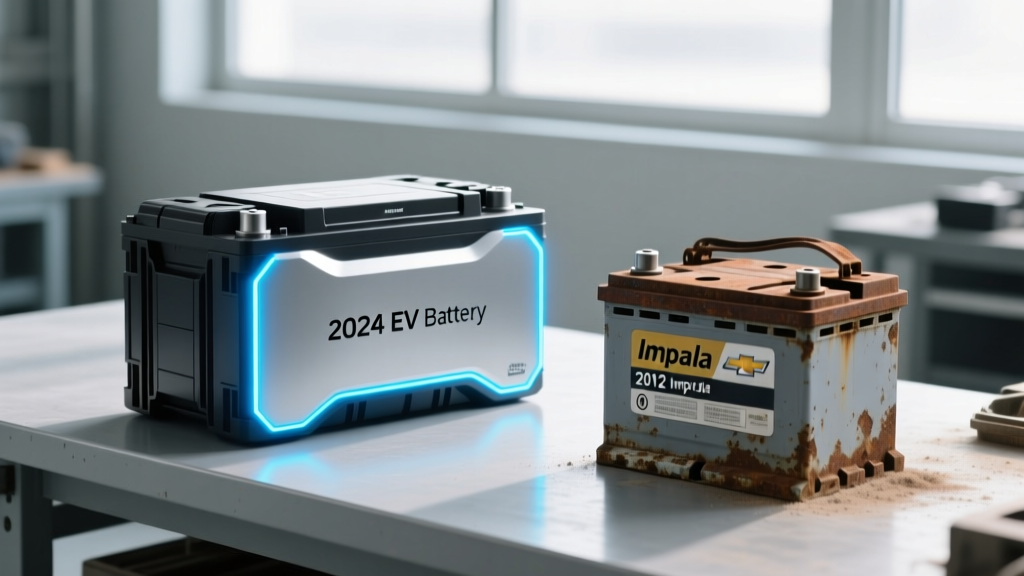
If you've searched for a 2012 Chevy Impala battery recently, you already know the reality of conventional car batteries: a 12V lead-acid unit that lasts 3–5 years, costs $150–$250 at an auto parts store, and powers your starter motor, lights, and accessories. It's a consumable item — expected to fail and cheap to replace.
Electric vehicle traction batteries are an entirely different category. These high-voltage lithium-ion packs (40–120+ kWh) propel the car, cost thousands to replace, and are engineered to outlast the vehicle itself. Yet the confusion persists: shoppers coming from gas cars like the 2012 Impala assume EV batteries are the same kind of disposable component. They aren't.
This guide breaks down exactly how modern EV batteries work, how long they last with real degradation data, what replacement actually costs, and how chemistries like LFP and NMC compare — so you can evaluate long-term EV ownership with the same clarity you'd bring to any major purchase.
The Fundamental Difference: 12V Starter vs. High-Voltage Traction
A 2012 Chevy Impala uses a Group 78 or Group 34 12V lead-acid battery rated around 700–800 cold cranking amps (CCA). It stores roughly 0.5–0.7 kWh of energy — enough to turn over a 3.6L V6 engine and run electronics when the alternator isn't spinning. Replacement is a $180 DIY job.
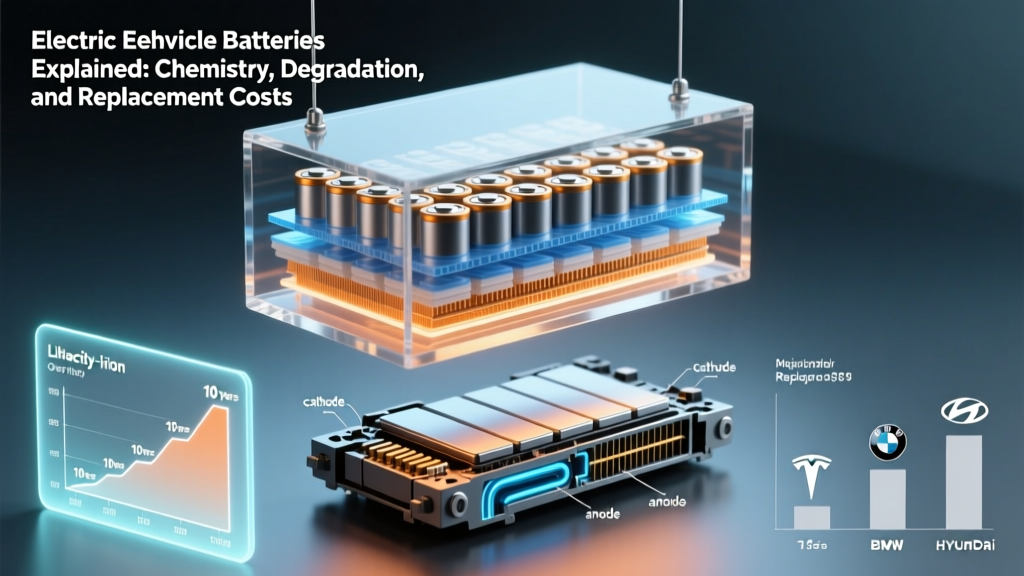
An EV's traction battery stores energy (measured in kWh) to drive electric motors. A 2026 Tesla Model Y Long Range carries an ~75 kWh NMC pack. A base Nissan Leaf has a ~40 kWh pack. These aren't starter batteries — they're the single most expensive component in the vehicle, typically representing 25–40% of the car's MSRP.
Importantly, EVs also carry a 12V auxiliary battery (often lithium iron phosphate in newer models) for accessories and safety systems. That small battery behaves more like the Impala's — but the traction pack is what this guide focuses on.
Battery Chemistry: LFP vs. NMC/NCA Trade-Offs
Not all lithium-ion batteries are identical. The cathode chemistry determines energy density, lifespan, cold-weather behavior, and cost. The two dominant chemistries in 2026 EVs are:
- NMC (Nickel Manganese Cobalt) / NCA (Nickel Cobalt Aluminum): Higher energy density, better cold-weather performance, used in most long-range and performance EVs.
- LFP (Lithium Iron Phosphate): Lower energy density but far superior cycle life, lower cost, no cobalt, and can safely be charged to 100% daily.
| Attribute | LFP (LiFePO₄) | NMC / NCA |
|---|---|---|
| Energy density | ~160–180 Wh/kg | ~220–300 Wh/kg |
| Cycle life (to 80% SoH) | 3,000–6,000+ cycles | 1,000–2,500 cycles |
| Cold-weather range loss | Greater (~35–40% at 20°F) | Moderate (~25–30% at 20°F) |
| Daily charging to 100% | Recommended | Not recommended (80% daily limit) |
| Cost per kWh (pack-level) | ~$95–$115 | ~$120–$155 |
| Cobalt content | None | Yes (supply-chain concern) |
| Typical applications | Tesla Model 3 RWD, BYD, standard-range EVs | Long-range, performance, large SUVs |
Which is better? It depends on your use case. If you commute daily, charge at home, and don't need maximum range, LFP is the superior longevity play — you'll likely never see meaningful degradation in the car's lifetime. If you need 320+ miles of EPA range, tow, or live in extreme cold, NMC/NCA delivers the energy density you need. Both chemistries are covered by the same federal warranty mandates.
Real Degradation Data: What the Numbers Show
EV batteries don't suddenly "die." They slowly lose capacity — measured as State of Health (SoH), where 100% is new and 70–80% is the typical warranty threshold. Here's what real-world fleet data shows:
Typical Degradation Curve (NMC packs, aggregated fleet data):
- Year 1 / 15,000 mi: ~2–3% capacity loss (initial "break-in" drop)
- Year 3 / 45,000 mi: ~5–7% total loss
- Year 5 / 75,000 mi: ~8–10% total loss
- Year 8 / 120,000 mi: ~10–14% total loss
- Year 10+ / 150,000+ mi: ~12–18% total loss
Sources: Geotab fleet study, Recurrent Auto battery health data, Tesla Impact Reports.
For context, a 2026 Hyundai Ioniq 5 with a 77.4 kWh NMC pack rated at 305 miles EPA would, after 8 years and 120,000 miles, likely retain ~86–90% capacity — still delivering ~260–275 real-world miles. That's more usable range than most gas cars get on a tank.
LFP packs degrade even more slowly. Tesla's LFP-equipped Model 3 RWD units have shown under 5% degradation at 100,000 miles in fleet data. The chemistry's cycle-life advantage is substantial.
Federal Battery Warranty: What's Covered and for How Long
U.S. federal law mandates that EV batteries carry a minimum warranty of 8 years or 100,000 miles (whichever comes first). In California and states adopting CARB emissions rules, that extends to 10 years / 150,000 miles. Most manufacturers exceed the minimum:
| Manufacturer | Warranty Term | Capacity Threshold | Notes |
|---|---|---|---|
| Tesla (Model 3/Y NMC) | 8 yr / 120,000 mi | ≥70% SoH | 100,000 mi for LFP Model 3 RWD |
| Hyundai / Kia | 10 yr / 100,000 mi | ≥70% SoH | Among the longest terms |
| Ford (Mustang Mach-E, F-150 Lightning) | 8 yr / 100,000 mi | ≥70% SoH | Components + capacity |
| GM (Ultium platform) | 8 yr / 100,000 mi | ≥70% SoH | Covers battery + drive unit |
| Rivian | 8 yr / 120,000 mi | ≥70% SoH | Standard and Max packs |
| BMW (iX, i4) | 8 yr / 100,000 mi | ≥70% SoH | Includes thermal management |
The warranty covers capacity loss below the stated threshold and manufacturing defects. It does not cover damage from accidents, flooding, or aftermarket modifications. If your pack drops below 70% within the warranty window, the manufacturer replaces or refurbishes it at no cost.
According to fueleconomy.gov, the vast majority of EV batteries never require warranty replacement — most outlast the vehicle's useful life.
EV Battery Replacement Cost: When and How Much
Out-of-warranty battery replacement is the single biggest fear for prospective EV buyers. Here's what it actually costs in 2026:
| Vehicle | Pack Size | Replacement Cost (parts + labor) | Typical Replacement Trigger |
|---|---|---|---|
| Nissan Leaf (40 kWh) | 40 kWh | $6,500–$9,000 | Rare before 150k+ mi |
| Tesla Model 3 (LFP, ~60 kWh) | ~60 kWh | $8,000–$12,000 | Extremely rare; LFP longevity |
| Tesla Model Y (NMC, ~75 kWh) | ~75 kWh | $12,000–$16,000 | Rare before 200k mi |
| Hyundai Ioniq 5 (77.4 kWh) | 77.4 kWh | $11,000–$15,000 | Rare before 150k mi |
| Ford F-150 Lightning (131 kWh ext.) | 131 kWh | $18,000–$25,000 | Very large pack; rare early failure |
| GMC Hummer EV (212 kWh) | 212 kWh | $25,000–$35,000 | Largest consumer pack; limited data |
When is replacement actually needed? Almost never during normal ownership. Battery replacement typically occurs only after 150,000–200,000+ miles, and often due to physical damage (collision, flood) rather than degradation. The average American drives ~13,500 miles/year (per FHWA data), meaning most owners will sell or trade the car long before the pack reaches end-of-life.
For comparison, a 2012 Chevy Impala's transmission replacement runs $3,000–$5,000, and its engine replacement can exceed $5,000–$7,000 — components that fail far more frequently than EV battery packs.
Factors That Accelerate (or Preserve) Battery Life
Battery degradation isn't random. Specific behaviors and conditions have measurable impact:
What Hurts Battery Longevity
- Exclusive DC fast charging: Daily use of 150+ kW chargers generates sustained heat. Occasional road-trip fast charging is fine; daily reliance accelerates degradation by ~1–3% over the pack's life.
- Extreme heat exposure: Prolonged parking in 100°F+ ambient without thermal management engaged. Most modern EVs actively cool packs, but sustained heat stress matters.
- Consistent 100% SoC storage (NMC/NCA): Leaving an NMC pack at 100% for days or weeks stresses cathode chemistry. LFP packs are immune to this concern.
- Deep discharge to 0%: Running the pack completely flat (below the hidden buffer) can cause copper dendrite formation. Most EVs have a ~2–5% unusable buffer to prevent this.
What Preserves Battery Health
- Home Level 2 charging (7–11 kW): Slow, cool charging is ideal for longevity.
- 20–80% daily SoC window (NMC/NCA): The "sweet spot" for nickel-based chemistry.
- Preconditioning before fast charging: Most EVs do this automatically when you navigate to a charger — it warms the pack for optimal charge acceptance and reduces stress.
- Moderate climate garage parking: Avoids extreme temperature cycling.
- Regular driving: Batteries that sit unused for months degrade faster than those in regular use.
Monitoring State of Health: How to Check Your Battery
Owners can track battery SoH through several methods:
- In-car displays: Tesla, Rivian, Hyundai, and BMW offer battery health indicators in settings menus. Some show a percentage; others display estimated range at 100% SoC as a proxy.
- Manufacturer apps: The Tesla app, FordPass, and Hyundai BlueLink show charge history and range trends over time.
- OBD-II dongles + third-party apps: Tools like OBDeleven (for VW/Audi/Porsche), Leaf Spy (for Nissan Leaf), and Scan My Tesla read raw battery management system (BMS) data including cell voltage variance, SoH percentage, and charge cycle count.
- Dealer diagnostic reports: A service center can pull a full BMS report showing individual cell group balance, internal resistance, and capacity — useful before buying a used EV.
For used-EV shoppers, checking SoH before purchase is as critical as a compression test on a gas car. A 2020 Model 3 Long Range showing 92% SoH at 60,000 miles is a healthy pack; one showing 84% at the same mileage warrants investigation.
Emerging Battery Technology: Solid-State and Beyond
Next-generation battery tech is in active development, but timelines are realistic, not imminent:
- Solid-state batteries: Replace liquid electrolyte with a solid conductor, promising 2–3x energy density, faster charging, and improved safety. Toyota, Samsung SDI, and QuantumScape are leading development. Expected limited production: 2027–2029. Mass-market availability: 2030+. These are not currently available in any production vehicle.
- Silicon anode batteries: Replace graphite anodes with silicon to boost energy density ~20–40%. Sila Nanotechnologies and Group14 are supplying early production cells. Expected in select EVs: 2026–2028.
- Sodium-ion batteries: Cheaper, no lithium or cobalt, but lower energy density. CATL and BYD are deploying these in budget Chinese-market EVs. U.S. availability: uncertain, likely 2028+.
- LMFP (Lithium Manganese Iron Phosphate): An LFP evolution with ~15–20% higher energy density while retaining cobalt-free chemistry. Expected in U.S. models: 2027–2028.
These technologies are forward-looking and announced — none are available in 2026 production vehicles sold in the U.S. today. Buyers should not delay a purchase waiting for solid-state; current lithium-ion chemistries already deliver 250,000+ mile lifespans with proper care.
Frequently Asked Questions
How long do EV batteries last in years and miles?
Most modern EV batteries (2020+) are designed to retain 70–80% capacity after 150,000–200,000 miles or 10–15 years. Fleet data from Geotab and Recurrent Auto shows average degradation of ~1.5–2% per year under normal use. Many packs will outlast the vehicle's body and interior.
How much does an EV battery cost to replace?
Out-of-warranty replacement ranges from ~$6,500 (small packs like the Nissan Leaf 40 kWh) to $25,000+ (large packs like the F-150 Lightning Extended Range 131 kWh). However, replacement due to degradation is rare — most packs last 150,000+ miles, and the vast majority of EVs are retired or traded before needing a new pack.
What does the EV battery warranty cover?
Federal law mandates at minimum 8 years / 100,000 miles of coverage (10/150,000 in CARB states). Warranties cover capacity loss below ~70% SoH and manufacturing defects. They do not cover accident damage, flood, or aftermarket modifications. See the warranty table above for manufacturer-specific terms.
How do I check my EV battery's health?
Use your car's built-in battery health display (if available), the manufacturer's app, or an OBD-II scanner with EV-specific software (Leaf Spy, Scan My Tesla, OBDeleven). A dealer diagnostic report provides the most detailed SoH data including cell balance and internal resistance.
LFP vs NMC — which battery chemistry is better for me?
Choose LFP if you charge at home daily, commute under 200 miles, and want maximum cycle life with the ability to charge to 100% regularly. Choose NMC/NCA if you need 300+ miles of EPA range, tow heavy loads, or regularly drive in sub-freezing temperatures where NMC's cold-weather advantage matters. Both are proven, warrantied, and long-lasting.
Is the 2012 Chevy Impala battery the same kind of battery as an EV?
No. The 2012 Impala uses a 12V lead-acid starter battery (~0.5–0.7 kWh) that costs ~$180 and lasts 3–5 years. EV traction batteries are high-voltage lithium-ion packs (40–200+ kWh) that cost thousands but last 150,000–200,000+ miles. EVs do also carry a small 12V auxiliary battery for accessories — that one is closer to the Impala's battery in function and cost.