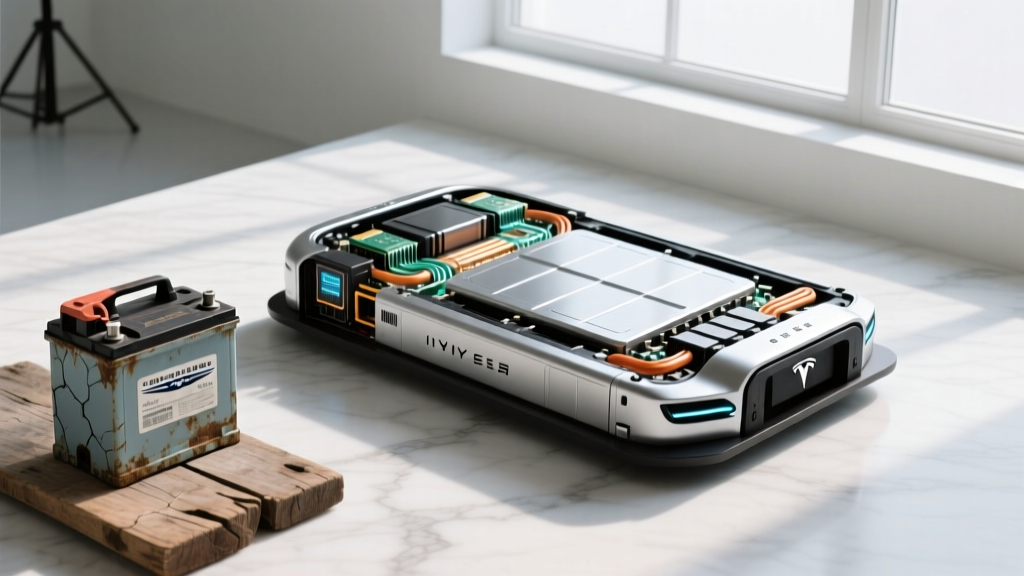
If you've searched for a battery for Chrysler Town and Country 2010, you're looking at a conventional 12-volt lead-acid starter battery — a Group 34 or Group 24F unit costing roughly $120–$220 at any auto parts store. That minivan's battery has one job: crank a 3.8L V6 engine and run the headlights. Fast-forward to today's electric vehicles, and the "battery" is an entirely different machine — a high-voltage lithium-ion traction pack storing 60–120+ kWh of energy, managing its own temperature, and costing $6,000–$22,000 to replace. Understanding the gap between these two worlds is the fastest way to understand what you're actually buying when you go electric.
This guide breaks down modern EV battery technology — chemistry, degradation, warranty coverage, replacement economics, and care — using the same practical lens you'd apply to maintaining any vehicle's powertrain.
The Two Batteries: 12V Starter vs. High-Voltage Traction Pack
The 2010 Chrysler Town & Country uses a 12V lead-acid battery (typically 600–700 cold cranking amps) to start an internal combustion engine. It stores about 0.6–0.8 kWh of usable energy and lasts 3–5 years before replacement.
Modern EVs also carry a 12V auxiliary battery for accessories, computers, and contactor switches — but the real heart of the vehicle is the high-voltage traction battery. This pack operates at 400V (or 800V in architectures like the Hyundai Ioniq 5 and Porsche Taycan), stores 60–130+ kWh, and powers the electric drive motors directly. When we talk about "EV battery technology" below, we mean this traction pack — not the 12V auxiliary unit.
Battery Chemistry: LFP vs. NMC/NCA Trade-Offs
Two lithium-ion chemistries dominate the 2026 EV market. Your choice between them affects range, longevity, cold-weather behavior, and price.
| Attribute | LFP (Lithium Iron Phosphate) | NMC / NCA (Nickel Manganese Cobalt / Nickel Cobalt Aluminum) |
|---|---|---|
| Energy density | ~160–180 Wh/kg (lower) | ~220–300 Wh/kg (higher) |
| Cycle life | 3,000–6,000+ cycles | 1,000–2,500 cycles |
| Cold-weather performance | Greater range loss below freezing (~35–45%) | Better cold performance (~25–35% loss) |
| Cost per kWh | ~$80–$100 (cheaper) | ~$120–$150 |
| Recommended daily SoC | 100% daily charging is fine | Best kept 20–80% for daily use |
| Thermal stability | Excellent — less prone to thermal runaway | Good, but requires more active management |
| Example 2026 vehicles | Tesla Model 3 RWD, Ford Mustang Mach-E Select, Rivian Standard | Hyundai Ioniq 5 Long Range, BMW iX, Lucid Air, Chevy Silverado EV |
Which is better? LFP wins on longevity and cost — ideal for daily commuters who charge at home and don't need maximum range. NMC wins on energy density and cold performance — the right pick for road-trippers, cold-climate drivers, and anyone who needs 300+ miles of EPA range. Neither chemistry is universally superior; the right answer depends on your driving pattern.
How Long Do EV Batteries Last? Degradation Data
EV batteries don't "die" suddenly — they gradually lose capacity over time, similar to a smartphone. The industry measures this as State of Health (SoH): a brand-new pack is 100% SoH; a pack that can now hold only 85% of its original energy is at 85% SoH.
Typical degradation curve (NMC packs, liquid-cooled, moderate climate):
- Year 1 / 15,000 miles: ~2–4% loss (initial "break-in" drop)
- Year 3 / 45,000 miles: ~5–8% total loss
- Year 5 / 75,000 miles: ~8–12% total loss
- Year 8 / 120,000 miles: ~10–15% total loss
- Year 10 / 150,000 miles: ~12–18% total loss (most packs still functional)
Real-world data from Geotab's fleet analysis of over 10,000 EVs shows an average annual degradation rate of approximately 1.8% per year across all chemistries and conditions. LFP packs tend to degrade more slowly in calendar life but can be more sensitive to extreme cold charging. Most modern liquid-cooled packs retain 80–90% of original capacity at the 100,000-mile mark.
For context: a 2026 Tesla Model Y Long Range (NMC, 75 kWh usable, EPA 330 miles) losing 12% over 8 years would still deliver approximately 290 miles of range — more than adequate for most drivers. The vehicle's body, suspension, and interior typically show more wear than the battery.
What Does the Battery Warranty Actually Cover?
Federal law mandates a minimum EV battery warranty of 8 years / 100,000 miles (10 years / 150,000 miles in California Air Resources Board states). Most manufacturers exceed this baseline. The warranty guarantees the pack will retain a specified percentage of its original capacity — typically 70%.
| Manufacturer (2026 models) | Warranty Period | Capacity Retention Threshold |
|---|---|---|
| Tesla (Model 3/Y Long Range) | 8 yr / 120,000 mi | 70% |
| Tesla (Model 3 RWD — LFP) | 8 yr / 100,000 mi | 70% |
| Hyundai / Kia | 10 yr / 100,000 mi | 70% |
| Ford (Mach-E, F-150 Lightning) | 8 yr / 100,000 mi | 70% |
| GM (Ultium-based) | 8 yr / 100,000 mi | 70% |
| Rivian | 8 yr / 175,000 mi (Large pack) | 70% |
| BMW | 8 yr / 100,000 mi | 70% |
What's covered: Capacity loss below the threshold, cell/module defects, and manufacturing faults. If your pack drops below 70% SoH within the warranty window, the manufacturer must repair or replace it — often replacing individual modules rather than the entire pack.
What's NOT covered: Damage from accidents, flooding, unauthorized modifications, or failure to follow basic care guidelines (e.g., repeatedly DC fast-charging to 100% in extreme heat against manufacturer recommendations). Warranty terms and claim processes vary, so review your owner's manual and the EPA's EV resources at fueleconomy.gov for model-specific details.
EV Battery Replacement Cost: What to Budget and When
Out-of-warranty battery replacement is the single biggest fear for EV shoppers. Here's the reality: the vast majority of EVs are retired, sold, or traded before the traction battery needs replacement. But if you're planning to keep a vehicle 15+ years, here's what to expect.
| Battery Size / Vehicle Class | Replacement Cost Range (2026) | Typical Replacement Timeline |
|---|---|---|
| 40–60 kWh (compact EVs, Nissan Leaf-class) | $6,000–$10,000 | Rarely needed before 150k mi |
| 70–85 kWh (mid-size sedans, crossovers) | $10,000–$16,000 | Rarely needed before 150k mi |
| 90–110 kWh (long-range, luxury, trucks) | $14,000–$22,000 | Rarely needed before 150k mi |
| Module-level repair (replacing 1–2 bad modules) | $1,500–$5,000 | As needed; more common than full pack swap |
Prices have been trending downward. In 2015, replacement packs averaged over $200/kWh at the pack level. By 2026, pack-level pricing for common chemistries is in the $100–$140/kWh range (before labor), driven by LFP adoption and manufacturing scale. Third-party rebuild services are also emerging, offering refurbished packs at 40–60% of OEM pricing for out-of-warranty vehicles.
To put this in perspective: a 2010 Chrysler Town & Country engine replacement runs $4,000–$7,000, and a transmission rebuild costs $3,000–$5,000. EVs eliminate both of those failure points entirely — the traction battery is the single expensive component, and it typically outlasts the rest of the vehicle.
Factors That Accelerate Battery Degradation
Not all miles are equal. Five factors drive the speed of capacity loss:
- DC fast-charging frequency: Occasional road-trip fast-charging is fine. Daily reliance on 150+ kW DC charging (especially without preconditioning) accelerates degradation by an estimated 1–3% extra over 5 years. Use Level 2 home charging as your primary routine.
- Extreme temperatures: Sustained operation above 95°F or below 10°F stresses cells. Modern liquid-cooled packs manage this actively, but parking in shade (summer) and a garage (winter) measurably helps longevity.
- State of charge habits: For NMC packs, routinely sitting at 100% SoC for days accelerates calendar degradation. Charge to 80% for daily use; reserve 100% for trips. LFP packs tolerate 100% daily charging without the same penalty — follow your manufacturer's guidance.
- Deep discharge cycles: Regularly draining below 10% SoC is harder on cells than shallow cycles. Plug in when you can; don't wait for the battery warning light.
- Preconditioning: Using your EV's battery preconditioning feature before fast-charging (especially in cold weather) brings the pack to optimal temperature, reducing stress and improving charge speed. Always precondition when possible.
How to Check and Monitor Battery Health (SoH)
Most 2026 EVs provide at least basic State of Health information through the infotainment system or companion app. Here's how to access it across major brands:
- Tesla: No built-in SoH display, but third-party tools like Tessie or the Scan My Tesla OBD app read pack health from the BMS (Battery Management System).
- Hyundai / Kia: EV battery health is accessible via the infotainment service menu or the MyHyundai/Kia Connect app on newer models.
- Ford: The FordPass app and in-vehicle diagnostics show estimated battery health on Mach-E and F-150 Lightning.
- GM (Ultium): OnStar diagnostics and the myChevrolet/myCadillac apps include battery condition reports.
- OBD-II scanners: Tools like the OBDLink MX+ paired with apps such as Car Scanner or EVNotify can pull SoH data from most EVs' CAN bus systems.
For used-EV buyers, requesting a battery health report from the dealer or running an OBD scan before purchase is as essential as checking a Carfax. A pack at 92% SoH with 40,000 miles tells you the vehicle was well-maintained; one at 83% SoH with the same mileage suggests heavy fast-charging or extreme-climate exposure.
What's Next: Solid-State and Silicon-Anode Batteries
Two emerging technologies promise to reshape EV batteries — but neither is widely available in production vehicles as of 2026.
Solid-state batteries replace the liquid electrolyte with a solid ceramic, polymer, or sulfide layer. The theoretical benefits are significant: 30–50% higher energy density, faster charging (potential 10–80% in under 10 minutes), improved safety (no flammable electrolyte), and longer cycle life. Toyota, Nissan, and Samsung SDI have announced production timelines targeting 2027–2029 for initial limited-volume vehicles. These are announced targets, not currently available technology. Expect solid-state packs to debut in premium models first, with mass-market trickle-down taking 3–5 additional years.
Silicon-anode batteries replace (or supplement) the graphite anode with silicon, which can store roughly 10x more lithium ions per gram. Companies like Sila Nanotechnologies and Group14 are supplying silicon-dominant anode materials to manufacturers including Mercedes-Benz and Panasonic. Early implementations (such as the Mercedes G-Class EV's optional pack) show 20–40% energy density improvements. This technology is closer to mainstream adoption than solid-state and is expected to appear in increasing volume through 2027–2030.
Neither technology changes the buying decision today. Current LFP and NMC packs, properly maintained, already deliver 150,000+ miles of usable service life — a threshold that covers the vast majority of ownership cycles.
Frequently Asked Questions
How long do EV batteries last in years and miles?
Based on fleet data from Geotab and manufacturer reports, modern liquid-cooled EV batteries typically retain 80–90% of original capacity at 100,000 miles and 75–85% at 150,000 miles. In years, expect 12–20 years of usable service before capacity drops below 70%. Most EVs are retired for other reasons (body damage, technology upgrades) before the battery fails.
How much does an EV battery cost to replace?
Full pack replacement ranges from $6,000 for small packs to $22,000 for large long-range/truck packs as of 2026. Module-level repairs (replacing 1–2 degraded modules) cost $1,500–$5,000 and are increasingly common. Pack pricing continues to decline as LFP chemistry and manufacturing scale drive costs down. Most owners never pay for a replacement because the battery outlasts the vehicle or is covered under warranty.
What does the EV battery warranty cover?
Federal law requires a minimum of 8 years/100,000 miles (10 years/150,000 miles in CARB states). The warranty guarantees the pack will retain at least 70% of its original capacity. If it drops below that threshold during the warranty period, the manufacturer repairs or replaces the pack at no cost. Coverage excludes accident damage, flooding, and unauthorized modifications. Always check your specific manufacturer's terms.
How do I check and maximize my EV battery health?
Check SoH via your vehicle's app, infotainment diagnostics, or an OBD-II scanner (OBDLink MX+ with Car Scanner app works on most EVs). To maximize longevity: use Level 2 home charging as your daily routine, limit DC fast-charging to road trips, charge NMC packs to 80% for daily use (LFP can go to 100%), avoid letting the battery sit below 10% or at 100% for extended periods, precondition before fast-charging in cold weather, and park in shade or a garage when possible.
LFP vs NMC — which battery chemistry is better?
Neither is universally better. Choose LFP if you want maximum cycle life (3,000–6,000+ cycles), lower cost, the ability to charge to 100% daily without penalty, and superior thermal safety — and you don't need maximum range or live in an extremely cold climate. Choose NMC if you need higher energy density (longer range in a smaller/lighter pack), better cold-weather performance, and faster DC charging speeds — and you're willing to follow 20–80% daily SoC habits for optimal longevity.
Does the 2010 Chrysler Town & Country battery have anything in common with EV batteries?
Very little beyond the basic electrochemical principle. The Town & Country's 12V lead-acid battery stores ~0.7 kWh, weighs ~40 lbs, costs $120–$220, and lasts 3–5 years. A modern EV traction pack stores 60–130+ kWh (roughly 100–180x more energy), weighs 800–1,500 lbs, costs $6,000–$22,000 to replace, and lasts 12–20 years. The only shared component: modern EVs still carry a small 12V auxiliary battery (increasingly lithium-ion) to power computers and accessories — a direct descendant of that Town & Country starter battery.
Whether you're maintaining a 2010 Chrysler Town & Country or shopping for a 2026 EV, the battery is the heart of the vehicle. For the minivan, it's a $150 consumable you swap every few years. For an EV, it's a precision-engineered system designed to outlast the car around it — backed by data, backed by warranty, and getting cheaper every year.