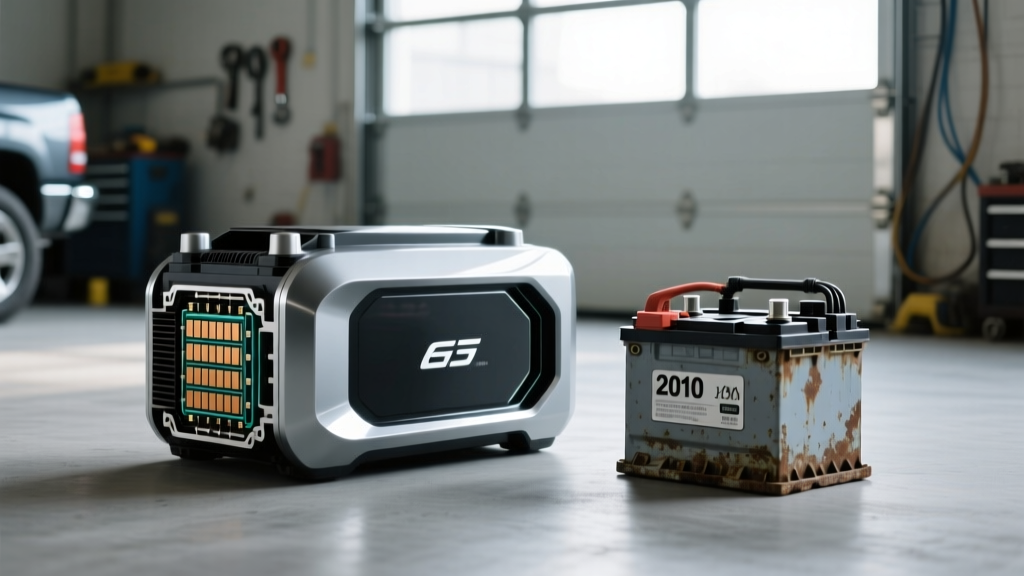
If you've ever replaced the 12-volt lead-acid battery in a 2010 Ram 1500, you know it's a $150–$250 affair that takes ten minutes at an auto parts store. But when truck owners start researching electric pickups like the Ford F-150 Lightning, Rivian R1T, or Chevrolet Silverado EV, they encounter a completely different component: the high-voltage lithium-ion traction battery. Understanding how these batteries work — and how fundamentally different they are from the conventional starter battery in a 2010 Ram 1500 — is essential before making an electrified truck purchase.
This guide breaks down EV traction battery chemistry, real-world degradation data, warranty coverage, replacement costs, and best practices for maximizing longevity. We'll also clarify the critical distinction between a 12V auxiliary battery and the high-voltage pack that actually propels an electric vehicle.
The 2010 Ram 1500 Battery vs. an EV Traction Battery: Two Completely Different Systems
The battery in a 2010 Ram 1500 is a Group 65, 12-volt lead-acid unit rated at roughly 700–800 cold cranking amps (CCA). Its sole job is to start the 5.7L HEMI V8 and run accessories when the alternator isn't spinning. It stores about 0.6–0.8 kWh of usable energy, weighs around 45 pounds, and typically lasts 3–5 years before sulfation or plate degradation kills it.
An EV traction battery operates in a different universe:
- Energy capacity: 100–200+ kWh (150–300x more energy than a Ram 1500's 12V battery)
- Voltage: 350–800V nominal (vs. 12V)
- Weight: 1,000–2,500+ lbs (structural component of the chassis)
- Cost: $8,000–$25,000+ to replace out of warranty
- Lifespan: Designed for 15–20+ years and 200,000+ miles
Even modern EVs still carry a separate 12V auxiliary battery (increasingly lithium-ion 12V, as in Tesla and Rivian) to run lights, infotainment, and control modules. But that small 12V unit is no more comparable to the traction pack than the battery in your 2010 Ram 1500 is comparable to its fuel tank.
Battery Chemistry Explained: LFP vs. NMC vs. NCA
Modern EV traction batteries use one of three dominant lithium-ion chemistries. The choice of chemistry affects range, longevity, cold-weather performance, and price.
| Attribute | LFP (Lithium Iron Phosphate) | NMC (Nickel Manganese Cobalt) | NCA (Nickel Cobalt Aluminum) |
|---|---|---|---|
| Energy Density | Lower (~160 Wh/kg cell-level) | Higher (~220–260 Wh/kg) | Highest (~260–300 Wh/kg) |
| Cycle Life | 3,000–5,000+ cycles | 1,000–2,000 cycles | 1,000–1,500 cycles |
| Cold Performance | Moderate; loses more range below freezing | Better low-temp discharge | Better low-temp discharge |
| Cost per kWh | ~$70–$90 (2025–2026 cell pricing) | ~$100–$130 | ~$110–$140 |
| Thermal Stability | Excellent; very resistant to thermal runaway | Good with active management | Good with active management |
| Typical Use | Tesla Model 3/Y RWD, Ford F-150 Lightning Std Range | Hyundai Ioniq 5, Kia EV6, Rivian R1T | Tesla Model S/X, older Model 3 LR |
| Recommended SoC | Can charge to 100% daily | Best kept 20–80% for daily use | Best kept 20–80% for daily use |
The trade-off in plain terms: LFP batteries are cheaper, last far longer in cycle count, and tolerate daily 100% charges — but they're heavier and lose more range in sub-freezing weather. NMC and NCA packs deliver more range per pound and handle cold better, but they degrade faster if habitually charged to 100% or drained to 0%. For a truck buyer who tows and hauls, NMC's energy density matters. For a daily commuter who can charge at home every night, LFP's longevity is a major advantage.
How Long Do EV Batteries Actually Last? Real Degradation Data
This is the question every prospective EV buyer asks, and the answer is better than most expect. Based on fleet data, manufacturer reports, and independent testing through 2025:
Typical Degradation Curve (NMC/NCA packs):
- Year 1: 2–5% capacity loss (initial formation loss)
- Years 2–5: ~1–2% additional loss per year
- Years 5–8: ~1% per year (curve flattens)
- At 100,000 miles: Most packs retain 85–92% of original capacity
- At 200,000 miles: Many packs retain 75–85% of original capacity
LFP packs (Tesla Model 3 RWD, F-150 Lightning Std Range) show even slower degradation — fleet data from high-mileage Teslas indicates 90%+ retention at 100,000 miles when charged to 100% regularly, which is within LFP's design tolerance.
According to data compiled by Recurrent Auto, which tracks over 15,000 EVs in real-world conditions, the vast majority of EV batteries retain well above their warranty threshold at the 8-year/100,000-mile mark. Catastrophic failure (sudden death, not gradual degradation) is rare — under 2% of packs in most datasets.
For context: if you buy a 2026 Ford F-150 Lightning Extended Range with an EPA-estimated 320 miles, expect roughly 270–290 real-world miles when new (highway driving, moderate temps). At 150,000 miles, that same truck might deliver 240–260 miles — still highly usable for daily driving and most road trips.
What Does the EV Battery Warranty Cover?
Federal law mandates a minimum 8-year/100,000-mile warranty on EV battery packs for emissions-related components, and every major automaker meets or exceeds this baseline. Here's how the warranties compare across popular electric trucks and SUVs:
| Vehicle | Battery Warranty | Capacity Retention Threshold |
|---|---|---|
| Ford F-150 Lightning | 8 yr / 100,000 mi | 70% of original capacity |
| Rivian R1T / R1S | 8 yr / 175,000 mi | 70% of original capacity |
| Chevrolet Silverado EV | 8 yr / 100,000 mi | 70% of original capacity |
| Tesla Model 3 (LFP RWD) | 8 yr / 100,000 mi | 70% of original capacity |
| Tesla Model Y (LR/AWD) | 8 yr / 120,000 mi | 70% of original capacity |
| Hyundai Ioniq 5 | 10 yr / 100,000 mi | 70% of original capacity |
Key details to understand:
- The warranty guarantees the pack will retain at least 70% of its original capacity (some manufacturers use slightly different thresholds). If it drops below that within the warranty period, the manufacturer will repair or replace enough modules to bring it back above the threshold.
- Warranty coverage includes defects and premature degradation — not damage from accidents, flooding, or unauthorized modifications.
- California and states adopting CARB standards (currently 15+ states) require a longer 10-year/150,000-mile warranty on EV batteries.
- The warranty does not cover the 12V auxiliary battery — that component has its own shorter warranty (typically 3 yr / 36,000 mi), just like the starter battery in your 2010 Ram 1500.
EV Battery Replacement Cost: What Owners Actually Pay
Out-of-warranty battery replacement is the number-one fear among prospective EV buyers. Here's what the numbers actually look like in 2025–2026:
| Vehicle / Pack Size | Approximate Replacement Cost (Parts + Labor) | Typical Need Timeline |
|---|---|---|
| Tesla Model 3 RWD (~60 kWh LFP) | $10,000–$14,000 | Rarely needed; 300,000+ mi design life |
| Tesla Model Y LR (~82 kWh NMC) | $13,000–$18,000 | 200,000+ mi for significant degradation |
| Ford F-150 Lightning Ext Range (~131 kWh) | $20,000–$28,000 | 200,000+ mi; most will outlive first ownership |
| Rivian R1T Large Pack (~135 kWh) | $20,000–$25,000 | 200,000+ mi |
| Chevrolet Silverado EV (~200 kWh Ultium) | $25,000–$35,000 | 200,000+ mi; modular pack allows partial replacement |
| Hyundai Ioniq 5 (~77.4 kWh) | $12,000–$16,000 | 200,000+ mi |
Critical context that fear-mongering headlines omit:
- Cell pricing has dropped from ~$1,200/kWh in 2010 to roughly $90–$120/kWh in 2025–2026, and continues declining. A replacement pack in 2035 will cost substantially less than one in 2026.
- Most EV batteries will outlast the vehicle's useful economic life. The average age of a scrapped vehicle in the US is roughly 17 years (S&P Global Mobility). An EV battery designed for 200,000+ miles and 15–20 years will, in most cases, still be functional when the rest of the vehicle is retired.
- Module-level repair is increasingly available. Rather than replacing the entire pack, dealerships and specialist shops can swap individual degraded modules for $2,000–$5,000.
- Compare this to the 2010 Ram 1500: over 15 years and 200,000 miles, you'd likely spend $4,000–$8,000 on transmission rebuilds, timing-chain tensioners, exhaust manifold bolts, and other HEMI-specific repairs. The EV powertrain eliminates all of those failure points.
Factors That Accelerate (or Preserve) Battery Health
Battery degradation isn't random — it's driven by measurable factors. Here's what the data shows:
Habits that PRESERVE battery health:
- Charge to 80% daily (NMC/NCA) or 100% (LFP) — set charge limits in your vehicle's app
- Use Level 2 home charging (7–11 kW) for the majority of your charging — this is the equivalent of sipping fuel slowly
- Precondition the battery before DC fast charging (most EVs do this automatically when you navigate to a charger)
- Park in shade or a garage when possible — sustained heat above 95°F accelerates calendar aging
- Keep the vehicle plugged in during extreme cold so the thermal management system can maintain optimal pack temperature
- Drive the vehicle regularly — lithium-ion cells prefer regular use over months of sitting
Habits that ACCELERATE degradation:
- Frequent DC fast charging (150+ kW) as your primary charging method — data from Recurrent shows a measurable but modest increase in degradation for vehicles that fast-charge 3+ times per week vs. primarily Level 2 charging
- Regularly draining below 10% SoC and letting the vehicle sit in that state
- Storing at 100% SoC for weeks in hot weather (especially NMC/NCA)
- Repeatedly towing at max capacity in high heat without allowing cooldown
- Aftermarket modifications that bypass thermal management systems
The fast-charging nuance: DC fast charging isn't a battery killer — it's a battery stressor. Occasional road-trip fast charging is perfectly fine. The concern is when fast charging is your only charging method, combined with high ambient temperatures and frequent 100% charges. Modern battery management systems (BMS) actively limit charge speed when the pack is too hot or too cold, which is why you'll see charge rates taper significantly above 80% SoC — this taper is protective, not a flaw.
How to Check Your Battery's State of Health (SoH)
State of Health (SoH) is the percentage of original capacity your battery currently holds. A new EV has 100% SoH; one that has degraded to 88 kWh from a 100 kWh pack sits at 88% SoH.
Methods to check SoH:
- In-vehicle display: Some EVs (Hyundai/Kia, newer Teslas via software updates) show battery health percentage directly in the settings menu.
- Manufacturer app: Tesla, Ford, Rivian, and GM provide battery health data through their respective mobile apps, often under "Battery" or "Service" sections.
- OBD-II diagnostic tools: Apps like Scan My Tesla, LeafSpy (for Nissan), or ABRP OBD can read SoH directly from the BMS via an OBD-II dongle. This is the most accurate consumer method.
- Dealer diagnostic check: Any authorized service center can run a full battery health report. Request this when buying a used EV — it's the EV equivalent of a compression test on a used Ram HEMI.
- Range comparison method: Charge to 100%, note the displayed range, and compare it to the EPA sticker. A 2023 F-150 Lightning Extended Range showing 280 miles at 100% (vs. the 320-mile EPA sticker) suggests roughly 87–88% SoH, accounting for the fact that EPA range already includes a buffer.
Check SoH at least twice a year and before any long road trip. If degradation seems to accelerate suddenly (more than 3–4% drop in a few months), schedule a dealer diagnostic — this can indicate a failing module rather than normal aging.
What's Next: Solid-State and Silicon-Anode Batteries
Two emerging technologies promise to reshape EV batteries within the next decade. Neither is available in production vehicles as of early 2026, but both are worth tracking:
Solid-state batteries replace the liquid electrolyte with a solid ceramic or polymer layer. Benefits include higher energy density (potentially 400+ Wh/kg at the cell level), faster charging, improved safety (no flammable electrolyte), and longer cycle life. Toyota has announced limited solid-state production for 2027–2028, and Samsung SDI targets 2027 for mass production. Realistic timeline for widespread availability in mainstream EVs: 2029–2032. Early implementations will likely be in premium vehicles due to manufacturing cost.
Silicon-anode batteries (used in limited form in the Porsche Taycan and upcoming GM Ultium updates) replace graphite anodes with silicon-dominant materials, boosting energy density by 20–40%. Companies like Sila Nanotechnologies and Group14 are scaling production. This technology is closer to mainstream adoption — expect it in several 2027–2028 model-year vehicles.
Neither technology will obsolete current EVs. Lithium-ion batteries (LFP, NMC, NCA) will remain dominant through at least 2035 due to massive existing manufacturing capacity and continued cost reductions. Think of solid-state as the next generation, not a reason to delay a purchase today.
Frequently Asked Questions
Can the battery from a 2010 Ram 1500 be used in an EV?
No. The 12V lead-acid battery in a 2010 Ram 1500 produces roughly 0.6–0.8 kWh and is designed only for engine cranking. An EV traction battery stores 60–200+ kWh at 350–800V. They share no compatibility, chemistry, or function. However, most EVs still carry a small 12V battery (often lithium-ion) for auxiliary systems — and that 12V unit can be jump-started or replaced similarly to a conventional vehicle's battery.
How long do EV batteries last in years and miles?
Based on fleet data through 2025, most modern EV traction batteries are designed for 15–20 years and 200,000+ miles before reaching 70–80% of original capacity. LFP-chemistry packs may last 300,000+ miles. The vast majority of EV batteries outlast the vehicle's structural and cosmetic useful life.
How much does it cost to replace an EV battery?
Out-of-warranty replacement ranges from roughly $10,000 for a smaller pack (Tesla Model 3 RWD, ~60 kWh) to $25,000–$35,000 for large truck packs (Silverado EV, F-150 Lightning Extended Range). Cell pricing continues to decline, so future replacements will cost less. Module-level repairs (replacing individual degraded cells rather than the full pack) cost $2,000–$5,000.
What does the EV battery warranty cover?
Federally mandated minimum coverage is 8 years / 100,000 miles, guaranteeing at least 70% capacity retention. If the battery degrades below that threshold within the warranty period, the manufacturer repairs or replaces it at no cost. California and CARB-adopting states extend this to 10 years / 150,000 miles. The warranty does not cover accident damage, flooding, or unauthorized modifications.
LFP vs. NMC — which battery chemistry is better?
Neither is universally "better" — it depends on your use case. Choose LFP if: you charge at home daily, want maximum cycle life (3,000–5,000+ cycles), don't mind slightly less range, and live in a moderate climate. Choose NMC/NCA if: you need maximum range per charge, frequently drive in cold weather, tow heavy loads, or take regular road trips where energy density matters. Both chemistries are proven and reliable.
How do I maximize my EV battery's lifespan?
Set charge limits to 80% for NMC/NCA (100% is fine for LFP). Rely primarily on Level 2 home charging. Precondition before fast charging. Avoid letting the battery sit at 0% or 100% for extended periods, especially in heat. Drive regularly. These habits can add years and tens of thousands of miles to pack life.