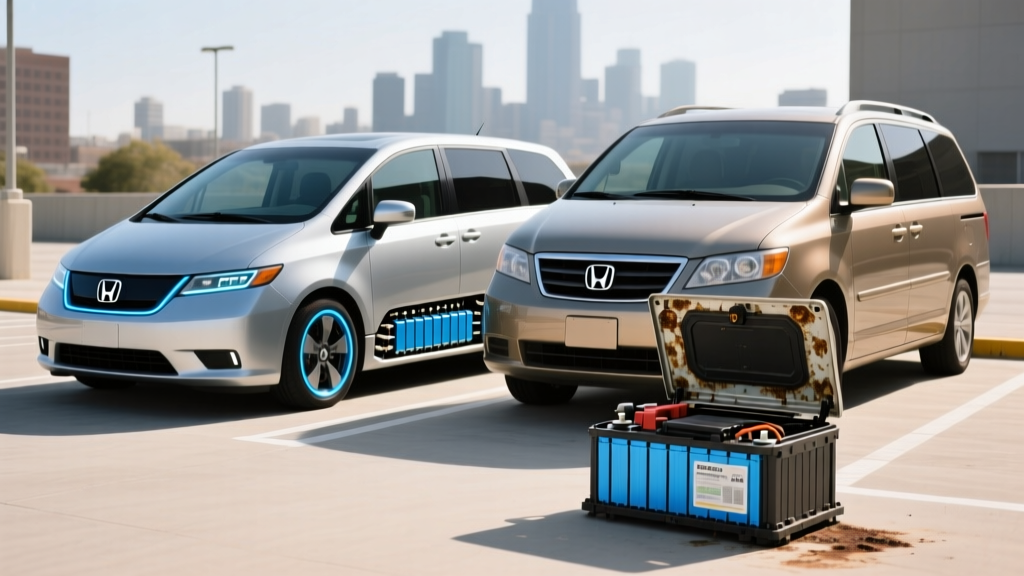
If you're searching for a 2010 Honda Odyssey battery, you're likely dealing with one of two things: a dead 12-volt starter battery that needs a $150 replacement, or you're researching whether it's time to trade that aging minivan for something electric. Either way, understanding how modern EV battery technology stacks up against the conventional batteries in vehicles like the 2010 Odyssey reveals just how far electrification has come — and what you should realistically expect if you make the switch.
This guide covers the high-voltage traction batteries that power electric vehicles: their chemistry, lifespan, degradation patterns, warranty coverage, replacement economics, and the care habits that maximize longevity. We'll also touch on why the 12V battery in your Odyssey is an entirely different animal from the 80+ kWh pack in a modern EV.
The 2010 Honda Odyssey Battery vs. an EV Traction Battery
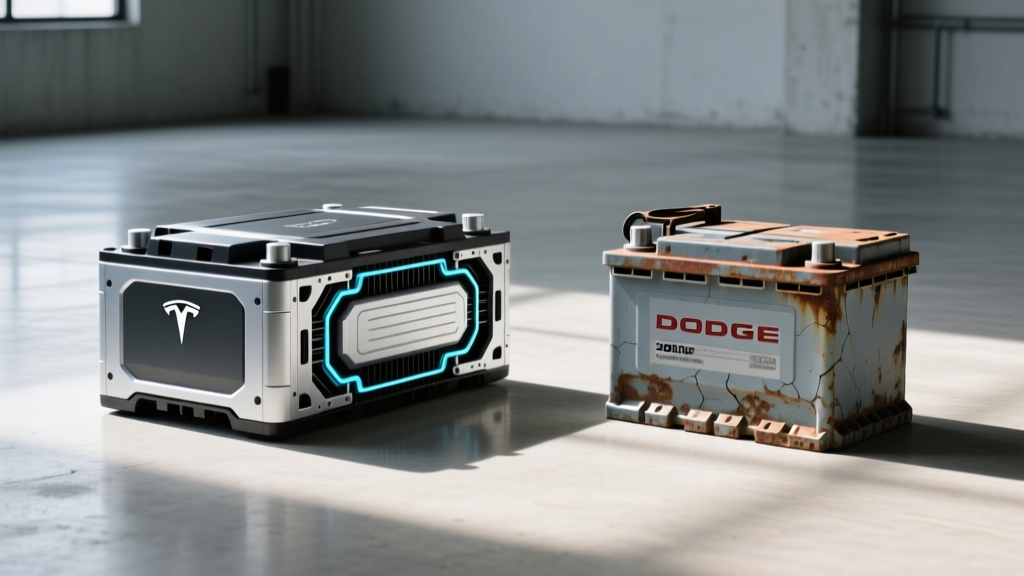
The 2010 Honda Odyssey uses a conventional 12-volt lead-acid battery (Group 24F or 35, depending on trim). It provides roughly 0.6–0.8 kWh of energy and exists solely to crank the engine and run accessories when the alternator isn't spinning. Typical lifespan: 3–5 years. Replacement cost: $120–$220 at an auto parts store.
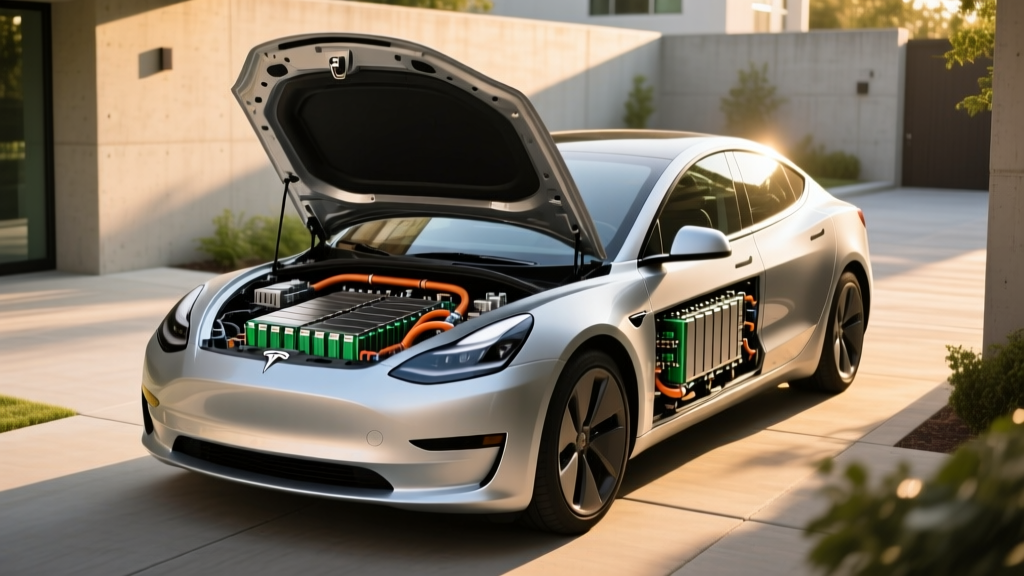
An EV traction battery, by contrast, is the vehicle's primary energy source. A 2026 Hyundai Ioniq 9 carries a 110.3 kWh NMC (nickel manganese cobalt) pack. A base Tesla Model Y uses roughly 75 kWh of LFP (lithium iron phosphate) cells. These packs weigh 800–1,200 lbs, cost $10,000–$25,000 to replace, and are engineered to last the life of the vehicle. The comparison is apples to orchards.
If your 2010 Odyssey needs a new 12V battery, that's a straightforward maintenance item. But if you're weighing whether to keep that minivan running or transition to an electric vehicle, the battery technology in modern EVs deserves a closer look.
EV Battery Chemistry: LFP vs. NMC/NCA Explained
Two dominant chemistries power today's EVs, and the choice between them affects range, cost, longevity, and cold-weather performance.
| Attribute | LFP (Lithium Iron Phosphate) | NMC / NCA (Nickel-based) |
|---|---|---|
| Energy density | Lower (~160 Wh/kg cell-level) | Higher (~250–300 Wh/kg cell-level) |
| Typical cycle life | 3,000–5,000+ cycles | 1,000–2,000 cycles |
| Cold-weather performance | Weaker — more range loss below 32°F | Better low-temp discharge capability |
| Cost per kWh | Lower (~$80–100/kWh at pack level in 2026) | Higher (~$110–140/kWh at pack level) |
| Charging to 100% daily | Recommended by most OEMs | Generally advised to charge to 80% daily |
| Common vehicles (2026) | Tesla Model 3 RWD, Model Y RWD, Ford Mustang Mach-E Select (LFP option) | Hyundai Ioniq 5/6, BMW iX, Rivian R1T, Chevrolet Silverado EV |
| Thermal stability | Excellent — lower runaway risk | Good — requires more robust thermal management |
Which is better? It depends on your use case. If you drive moderate daily distances, charge at home, and live in a temperate climate, LFP offers superior longevity and lower cost. If you need maximum range per charge, tow frequently, or live in a cold northern state, NMC's higher energy density and better cold performance make it the pragmatic choice. Neither is universally superior — the right chemistry matches your driving profile.
How Long Do EV Batteries Last? Real Degradation Data
This is the question that keeps prospective EV buyers up at night. The data, however, is reassuring.
Based on aggregated fleet data from sources like Recurrent Auto and manufacturer warranty claims, typical EV battery degradation follows a predictable curve:
| Timeframe | Typical Capacity Retained | Notes |
|---|---|---|
| Year 1 / 15,000 mi | 95–98% | Initial "break-in" loss; steepest part of the curve |
| Year 3 / 45,000 mi | 90–95% | Degradation rate flattens significantly |
| Year 5 / 75,000 mi | 87–93% | Most packs still well above warranty threshold |
| Year 8 / 100,000 mi | 83–90% | Federal warranty minimum: 70% retention at 8 yr/100k mi |
| Year 10+ / 150,000+ mi | 78–88% | Tesla fleet data shows median ~88% at 200k miles |
Key context: Tesla's 2025 Impact Report showed their Model 3/Y fleet retains approximately 85% of original capacity at 200,000 miles. Chevrolet Bolt EV owners have reported similar figures. Catastrophic battery failure (sudden, total loss) is extremely rare — well under 1% of packs based on warranty claim data. Most EV batteries will outlast the vehicle they're installed in.
Compare this to the 2010 Honda Odyssey's engine: at 200,000 miles, many are burning oil, needing timing belt replacements ($800–$1,200), or facing transmission rebuilds ($2,500–$4,000). The EV powertrain eliminates all of those failure points.
What Does the EV Battery Warranty Actually Cover?
Federal law mandates that all EV batteries sold in the U.S. carry a minimum warranty of 8 years or 100,000 miles (whichever comes first). In California Air Resources Board (CARB) states — which include California, New York, Massachusetts, Oregon, Washington, and several others — the requirement extends to 10 years or 150,000 miles.
| Manufacturer | Battery Warranty | Capacity Threshold | Notes |
|---|---|---|---|
| Tesla (Model 3/Y RWD — LFP) | 8 yr / 100,000 mi | 70% retention | Long Range/Performance: 8 yr / 120,000 mi |
| Hyundai / Kia | 10 yr / 100,000 mi | 70% retention | Among the longest standard warranties |
| Ford (Mustang Mach-E, F-150 Lightning) | 8 yr / 100,000 mi | 70% retention | Covers battery and hybrid/electric components |
| General Motors (Ultium-based) | 8 yr / 100,000 mi | 70% retention (60% for Bolt) | Varies by model; check specific terms |
| Rivian | 8 yr / 175,000 mi (R1T Max Pack) | 70% retention | Standard pack: 8 yr / 120,000 mi |
| BMW (iX, i4) | 8 yr / 100,000 mi | 70% retention | Includes battery management system |
What's covered: Defects in materials or workmanship, and capacity loss below the stated threshold. If your 82 kWh pack drops below 57.4 kWh (70%) within the warranty period, the manufacturer must repair or replace it at no cost.
What's typically NOT covered: Damage from accidents, flooding, improper modifications, or use of non-OEM charging equipment that causes damage. Normal gradual degradation above the threshold is expected behavior, not a warranty claim.
Always read the specific warranty booklet for your vehicle. Terms vary, and the EPA's fueleconomy.gov site links to manufacturer warranty details for every rated vehicle.
EV Battery Replacement Cost: What You'd Actually Pay
Here's where the anxiety usually peaks — but context matters enormously. Most EV batteries never need replacement during typical ownership. When they do, it's usually after 12–15+ years, and costs have been declining steadily.
| Battery Size / Vehicle Class | Estimated Pack Cost (2026) | Labor + Installation | Total Range |
|---|---|---|---|
| 40–60 kWh (compact EV, e.g., Nissan Leaf, base Bolt) | $5,500–$9,000 | $1,500–$3,000 | $7,000–$12,000 |
| 70–85 kWh (mid-size, e.g., Tesla Model 3 LR, Ioniq 5) | $9,000–$14,000 | $2,000–$3,500 | $11,000–$17,500 |
| 90–110 kWh (large SUV/truck, e.g., Ioniq 9, F-150 Lightning Ext.) | $13,000–$20,000 | $2,500–$4,000 | $15,500–$24,000 |
| 130+ kWh (heavy-duty, e.g., Silverado EV Max, Hummer EV) | $18,000–$28,000 | $3,000–$5,000 | $21,000–$33,000 |
For perspective: a transmission replacement on a 2010 Honda Odyssey runs $2,500–$4,000, and you might need two of those over 300,000 miles. An engine rebuild is $3,500–$6,000. The EV eliminates both — but the battery is the single most expensive component if it does eventually need service.
When is replacement typically needed? Rarely before 150,000 miles in normal use. The most common scenario for out-of-warranty replacement is a 12–18-year-old EV whose pack has degraded to 65–70% capacity and whose owner wants to restore range. Many owners simply continue driving with reduced range rather than replacing.
The secondary market for refurbished and remanufactured EV battery packs is growing. Companies like Repower and OEM-certified refurbishers offer packs at 40–60% of new-pack pricing, which will increasingly matter for older EVs.
Factors That Affect EV Battery Life — and How to Maximize It
Not all miles are created equal when it comes to battery wear. Here's what actually moves the needle on degradation:
Do: Habits That Extend Battery Life
- Charge to 80% daily (NMC/NCA): Keeping state of charge between 20–80% minimizes stress on nickel-based cells. LFP owners can charge to 100% regularly — in fact, OEMs recommend it for accurate BMS calibration.
- Use Level 2 home charging as your primary method: Slow, steady AC charging generates far less heat than DC fast charging and is gentler on cells over thousands of cycles.
- Precondition the battery before fast charging: Most modern EVs do this automatically when you navigate to a charger. A warm battery (68–86°F / 20–30°C) accepts charge faster and with less internal resistance.
- Park in shade or a garage during extreme heat: Sustained battery temperatures above 95°F accelerate calendar degradation. A covered parking spot matters more than most owners realize.
- Drive it regularly: Batteries that sit at low SoC for months degrade faster than those cycled normally. If storing, leave at ~50% SoC.
Don't: Habits That Accelerate Degradation
- DC fast charge every day if avoidable: Frequent use of 150+ kW chargers generates sustained heat. Occasional road-trip fast charging is fine; daily reliance on it adds up. Studies suggest exclusive DCFC use may add 2–4% extra degradation over 100,000 miles vs. Level 2 only.
- Leave the car at 100% SoC for extended periods (NMC): High voltage states stress the cathode. Charge to 100% only when you'll be driving soon after.
- Let the battery sit at 0–5% SoC for days: Deep discharge can cause copper dendrite formation on the anode. Plug in when you get home, even if you're not charging immediately.
- Ignore extreme cold without preconditioning: Charging a freezing-cold battery without warming it first causes lithium plating, which is permanent capacity loss. Always let the vehicle precondition.
How to Check Your EV's Battery Health (State of Health)
State of Health (SoH) is the percentage of original capacity your battery currently holds. A new pack is 100% SoH; at 70% SoH, an 82 kWh battery holds roughly 57.4 kWh of usable energy.
Manufacturer apps and in-car displays: Most modern EVs (Tesla, Hyundai, BMW, Rivian, Ford) show battery health or remaining capacity estimates in the vehicle settings menu or companion app. Tesla's service menu includes a battery health test. Hyundai's Bluelink app provides SoH data.
OBD-II diagnostic tools: Devices like the OBDeleven (for VW/Audi group), or generic ELM327-based scanners paired with apps such as EVNotify or LeafSpy (for Nissan Leaf), can read the battery management system's internal SoH estimate. These readings are generally accurate within 1–2%.
Third-party testing services: Companies like Geotab and Recurrent offer fleet-level battery health analytics. For individual owners, some dealerships can pull a detailed battery health report showing cell-level voltage variance, which reveals whether individual modules are degrading unevenly.
The DIY method: Charge to 100%, note the displayed range, and compare it to the original EPA-rated range (adjusted for the usable percentage). If your Ioniq 5 originally displayed 303 miles at 100% and now shows 265 miles, your SoH is roughly 87%. This is imprecise (temperature and driving style affect displayed range) but gives a reasonable ballpark.
Emerging Battery Technology: What's Coming and When
Several next-generation battery technologies are in development. None are currently available in production vehicles as of 2026, but timelines are becoming clearer:
Solid-state batteries: These replace the liquid electrolyte with a solid material, promising higher energy density (potentially 400+ Wh/kg at cell level), faster charging, and improved safety. Toyota has announced solid-state battery production for 2027–2028, initially in limited-run vehicles. Samsung SDI and QuantumScape are targeting similar timelines. Realistic mass-market availability: 2029–2032.
Silicon anode batteries: Companies like Sila Nanotechnologies and Group14 are replacing graphite anodes with silicon-dominant materials, boosting energy density by 20–40%. These are closer to market — early implementations are appearing in niche applications, with automotive-scale production expected around 2027–2028.
Sodium-ion batteries: CATL and other Chinese manufacturers are producing sodium-ion cells for lower-cost, lower-range EVs. Energy density is significantly lower than LFP, making these best suited for city cars and commercial fleets. U.S. availability is uncertain and likely limited.
For buyers shopping today, these technologies are forward-looking context, not reasons to wait. Current LFP and NMC batteries are mature, well-understood, and backed by robust warranties. The 2010 Honda Odyssey didn't wait for a better alternator — it ran on the technology of its era. Today's EV batteries are the most durable, longest-lasting energy storage systems ever put in a passenger vehicle.
Frequently Asked Questions
How long do EV batteries last in years and miles?
Based on fleet data, most EV batteries retain 83–90% of original capacity at 8 years / 100,000 miles and 78–88% at 10+ years / 150,000+ miles. Catastrophic failure is rare (under 1%). Many packs will function adequately for 15–20 years, though with reduced range. The battery will very likely outlast other major vehicle components.
How much does an EV battery cost to replace?
Out-of-warranty replacement ranges from approximately $7,000 for a small pack (40–60 kWh) to $24,000+ for a large truck/SUV pack (100+ kWh), including labor. However, most batteries never need replacement during typical ownership. Costs continue to decline as pack-level pricing drops below $100/kWh for LFP and $120/kWh for NMC in 2026.
What does the EV battery warranty cover?
Federal minimum: 8 years / 100,000 miles with a 70% capacity retention threshold. CARB states: 10 years / 150,000 miles. The warranty covers defects and excessive degradation below the threshold. It does not cover accident damage, misuse, or gradual degradation above the threshold. Read your specific warranty booklet for exact terms.
How do I check and maximize my EV battery health?
Check SoH through your vehicle's app, in-car settings, or an OBD-II scanner with EV-compatible software. Maximize longevity by using Level 2 charging as your primary method, keeping NMC batteries between 20–80% SoC for daily use (LFP can go to 100%), preconditioning before fast charging, avoiding prolonged storage at extreme SoC levels, and minimizing daily DC fast charging.
LFP vs. NMC — which battery chemistry is better?
Neither is universally superior. LFP offers longer cycle life (3,000–5,000+ cycles vs. 1,000–2,000), lower cost, better thermal stability, and the ability to charge to 100% daily. NMC provides higher energy density (more range in the same package), better cold-weather performance, and faster peak charging speeds. Choose LFP for moderate daily driving and temperate climates; choose NMC for maximum range, towing, and cold-weather states.
Is the 12V battery in a 2010 Honda Odyssey the same as an EV battery?
No. The 2010 Odyssey's 12V lead-acid battery stores roughly 0.6–0.8 kWh and starts the engine. An EV's high-voltage traction battery stores 50–200+ kWh and powers the electric motor(s). EVs also have a separate 12V battery (or lithium-ion 12V module) for accessories and computer systems, but the traction battery is an entirely different class of technology. If your Odyssey needs a 12V replacement, any auto parts store can handle it — it has no relation to EV battery technology.