If you've searched for a battery 2010 Dodge Ram 1500, you're likely looking at a 12-volt lead-acid or AGM starter battery — a $150–$250 component that cranks a 5.7L Hemi V8. But if you're considering trading that Ram for a modern electric pickup like the Ford F-150 Lightning, Rivian R1T, or Chevrolet Silverado EV, the battery conversation changes entirely. Instead of a small 12V unit, you're dealing with a high-voltage lithium-ion traction battery pack ranging from 98 kWh to over 200 kWh, costing $10,000–$30,000 to replace, and engineered to last 15–20 years.
This guide breaks down everything EV buyers and former truck owners need to understand about modern EV battery technology — chemistry, degradation, warranties, replacement costs, and care — while clarifying the critical difference between a conventional 12V auxiliary battery and the high-voltage traction battery that actually powers an electric vehicle.
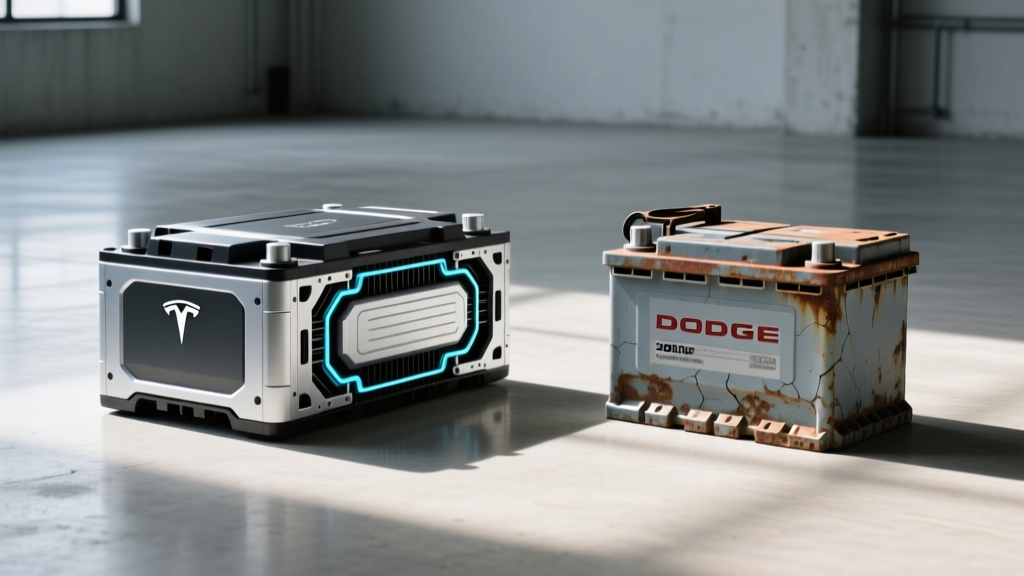
The 2010 Dodge Ram 1500 Battery vs. an EV Traction Battery
Let's clear up the single biggest source of confusion first. The battery in a 2010 Dodge Ram 1500 is a Group 65, 12-volt lead-acid battery rated around 730–850 cold cranking amps (CCA). Its sole job is to start the internal combustion engine and power accessories when the alternator isn't running. It stores roughly 0.5–0.8 kWh of usable energy, weighs 40–50 pounds, and typically needs replacement every 3–5 years at a cost of $130–$220 at any auto parts store.
An EV traction battery is a fundamentally different system:
| Attribute | 2010 Ram 1500 12V Battery | EV Traction Battery (e.g., F-150 Lightning Extended Range) |
|---|---|---|
| Voltage | 12V | ~400V (800V on some platforms) |
| Energy capacity | ~0.6 kWh | 131 kWh usable |
| Chemistry | Lead-acid / AGM | NMC or LFP lithium-ion |
| Weight | ~45 lbs | ~1,800 lbs |
| Typical lifespan | 3–5 years | 15–20+ years |
| Replacement cost | $130–$220 | $15,000–$30,000+ |
| Warranty | 1–3 years (pro-rated) | 8 years / 100,000 miles (federal minimum) |
EVs also carry a separate 12V auxiliary battery (or increasingly, a DC-DC converter) to run lights, infotainment, and control modules — but the traction battery is the expensive, vehicle-defining component. The rest of this guide focuses exclusively on EV traction batteries.
Battery Chemistry Explained: LFP vs. NMC/NCA
Modern EV batteries use lithium-ion cells, but not all lithium-ion is the same. The two dominant chemistries in 2026 are LFP (lithium iron phosphate) and NMC (nickel manganese cobalt), with NCA (nickel cobalt aluminum) appearing in some Tesla and legacy applications. Here's how they compare:
| Factor | LFP (Lithium Iron Phosphate) | NMC / NCA |
|---|---|---|
| Energy density | Lower (~160 Wh/kg cell-level) | Higher (~250–300 Wh/kg cell-level) |
| Cycle life | 3,000–5,000+ cycles | 1,000–2,000 cycles |
| Calendar life | Excellent; slower degradation | Good; moderate degradation |
| Cold-weather performance | Weaker; greater range loss below 32°F | Better cold performance |
| Thermal stability / safety | Superior; less prone to thermal runaway | Good with active thermal management |
| Cost per kWh | Lower ($80–$100/kWh at pack level) | Higher ($110–$140/kWh at pack level) |
| Cobalt content | Zero cobalt | Contains cobalt and nickel |
| Charge-to-100% tolerance | Can charge to 100% daily without harm | Best kept at 80% daily; 100% for trips only |
| Notable applications (2026) | Tesla Model 3/Y RWD, Ford F-150 Lightning Standard Range, base Chevy Equinox EV | Ford F-150 Lightning Extended Range, Rivian R1T, Hyundai Ioniq 5, Kia EV6, most long-range trims |
Which is better? It depends on your use case. If you want maximum range in a cold climate and don't mind charging to 80% daily, NMC is the stronger choice. If you prioritize longevity, lower cost, and the convenience of charging to 100% every day (ideal for L2 home charging routines), LFP is superior — and it's rapidly gaining market share in 2026, particularly in standard-range and fleet-oriented models.
How Long Do EV Batteries Actually Last?
The short answer: far longer than most buyers expect. Data from fleet operators, manufacturer reports, and independent studies consistently show that modern EV batteries lose roughly 1–2% of total capacity per year under normal use. Here's what the data shows:
| Source / Dataset | Sample | Avg. Degradation | Timeframe |
|---|---|---|---|
| Geotab fleet study (2024 update) | ~10,000 EVs across multiple brands | ~1.8% average loss per year | Over 5+ years of data |
| Tesla Impact Report (2024) | Model 3/Y fleet | ~8% loss at 150,000 miles | Longitudinal fleet data |
| Recurrent Auto battery report (2025) | 15,000+ EVs monitored | Median 92% SoH at 5 years / 60,000 mi | Cross-brand aggregate |
Translation: a 2026 EV with a 300-mile EPA range will typically still deliver ~275–280 miles of range after 5 years and 60,000 miles. After 10 years, expect roughly 80–85% of original capacity — still well within the warranty threshold for most manufacturers. Catastrophic battery failure (sudden, total loss) is exceedingly rare and typically occurs in the first year if at all, covered under warranty.
For context, many EVs on the road in 2026 with 150,000+ miles — including early Tesla Model S units and Nissan Leafs — still operate on their original battery packs, albeit with 15–25% range loss.
Battery Warranty Terms: What's Covered and for How Long
Federal law mandates that EV batteries carry a minimum warranty of 8 years / 100,000 miles (10 years / 150,000 miles in California and states that follow CARB standards). Most manufacturers meet or exceed this floor. The warranty guarantees that the battery will retain a specified percentage of its original capacity — typically 70% — over the warranty period.
| Vehicle | Warranty Term | Capacity Retention Threshold | Notes |
|---|---|---|---|
| Tesla Model Y (NMC Long Range) | 8 yr / 120,000 mi | 70% | LFP RWD: 8 yr / 100,000 mi |
| Ford F-150 Lightning | 8 yr / 100,000 mi | 70% | Both LFP Std. Range and NMC Ext. Range |
| Hyundai Ioniq 5 | 10 yr / 100,000 mi | 70% | Among the longest terms available |
| Chevrolet Silverado EV | 8 yr / 100,000 mi | 70% | Ultium platform, NMC |
| Rivian R1T | 8 yr / 175,000 mi | 70% | Higher mileage cap reflects truck use case |
| Kia EV6 | 10 yr / 100,000 mi | 70% | Matches Hyundai sibling |
What triggers a warranty claim? If your battery's State of Health (SoH) drops below the threshold — say, 70% of original capacity — within the warranty window, the manufacturer must repair or replace the battery at no cost. This can mean replacing individual modules (most common) or the entire pack. Warranty claims are processed through dealer diagnostics that read the battery management system's (BMS) logged capacity data.
EV Battery Replacement Cost: When and How Much
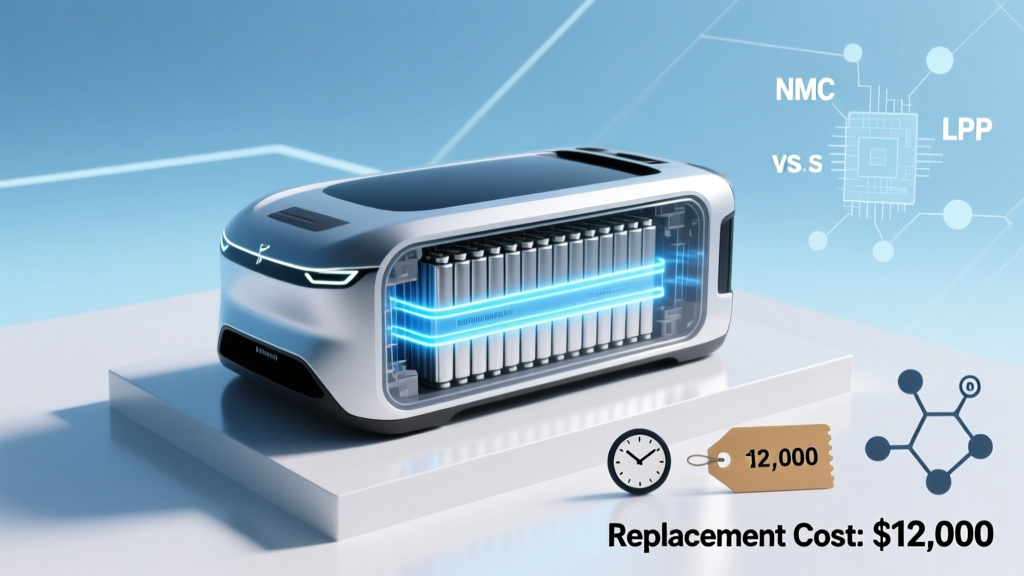
Most EV batteries will never need replacement during typical ownership. But if you're buying a used EV out of warranty, or plan to keep a vehicle 200,000+ miles, replacement cost matters. Here are current 2026 replacement estimates:
| Vehicle | Battery Size | Chemistry | Replacement Cost Range | Typical Replacement Trigger |
|---|---|---|---|---|
| Tesla Model 3 RWD | ~60 kWh | LFP | $8,000–$12,000 | 200,000+ mi or physical damage |
| Tesla Model Y Long Range | ~75 kWh | NMC | $12,000–$16,000 | 200,000+ mi or cell failure |
| Ford F-150 Lightning Ext. Range | 131 kWh | NMC | $22,000–$30,000 | Very high mileage or accident damage |
| Hyundai Ioniq 5 | 77.4 kWh | NMC | $11,000–$16,000 | Out-of-warranty degradation below 70% |
| Chevrolet Bolt EV (used/out of production) | 65 kWh | NMC | $9,000–$14,000 | Aging fleet; module-level repair often possible |
| Rivian R1T Dual-Motor | ~128 kWh (Large Pack) | NMC | $20,000–$28,000 | Very high mileage; module replacement more common |
Important nuance: full pack replacement is increasingly rare. Most out-of-warranty battery issues are resolved by replacing individual modules (a pack contains 4–24 modules depending on design) at $1,500–$4,000 per module. Independent EV repair shops are also emerging as a lower-cost alternative to dealer service. And pack prices continue to decline — BloombergNEF reports average lithium-ion pack prices fell below $115/kWh in 2025, meaning future replacement costs will trend lower.
Factors That Affect EV Battery Life (and What You Can Control)
Not all miles are equal when it comes to battery wear. These factors have the most significant impact on long-term State of Health:
- Fast-charging frequency: Occasional DC fast charging (1–2 times/week) has minimal impact. Daily reliance on 150+ kW DC fast charging accelerates degradation by ~0.5–1% per year versus primarily Level 2 charging. Use DCFC for road trips, L2 for daily needs.
- State of charge habits: For NMC batteries, keeping daily SoC between 20–80% significantly reduces stress. LFP batteries tolerate — and even benefit from — regular 100% charges (helps BMS cell balancing).
- Extreme temperatures: Sustained exposure to ambient temperatures above 95°F accelerates calendar degradation. Cold weather doesn't permanently damage batteries but temporarily reduces range (15–30% loss at 20°F is normal and reversible). Garage parking in summer helps.
- Preconditioning: Using your EV's battery preconditioning feature before fast charging (e.g., navigating to a Supercharger in a Tesla) warms the pack to optimal temperature, reducing charge-induced stress and improving charge speed.
- Depth of discharge: Frequently draining to 0% and then charging to 100% (full cycles) is more stressful than partial cycles. Plug in when convenient; don't wait for the battery to bottom out.
- Storage: If storing an EV for weeks, leave it plugged in with a charge limit set to ~50%. Never store at 0% or 100% for extended periods.
Monitoring Battery Health: How to Check Your SoH
State of Health (SoH) is the percentage of original battery capacity remaining. A new EV starts at 100% SoH; a battery at 85% SoH holds 85% of its original kWh. Here's how owners can monitor it:
Manufacturer apps and in-car displays: Tesla, Rivian, Hyundai, and Ford provide varying levels of battery health data through their companion apps or service menus. Tesla's "Battery Health" screen (accessible via service mode) shows estimated current capacity in kWh. Hyundai/Kia includes a battery health indicator in the EV menu on newer model years.
OBD-II diagnostic tools: Third-party tools like OBDLink paired with apps such as EV Health or LeafSpy (for Nissan) can read BMS-reported capacity data directly. This is the most reliable DIY method for checking SoH on a used EV before purchase.
Third-party services: Companies like Recurrent Auto offer free battery health reports by connecting to your vehicle's telematics data. Fleet operators use Geotab and similar platforms for continuous SoH tracking.
Dealer diagnostics: If you suspect a warranty-level degradation issue, the dealer can pull a full battery health report from the BMS. This is the official record for warranty claims.
Emerging Battery Tech: Solid-State and Beyond
Several next-generation battery technologies are in active development, but none are commercially available in production EVs as of early 2026:
Solid-state batteries replace the liquid electrolyte with a solid material, promising higher energy density (potentially 400+ Wh/kg at the cell level), faster charging, and improved safety. Toyota has announced a solid-state battery targeting 2027–2028 production in limited volumes. Nissan and Samsung SDI have similar timelines. However, manufacturing scalability and cost remain unsolved challenges — expect solid-state to debut in premium/low-volume applications first, not mainstream models.
Silicon-dominant anodes (replacing graphite) can increase energy density by 20–40%. Companies like Sila Nanotechnologies and Group14 are supplying early silicon-anode materials to manufacturers, with partial silicon anodes already appearing in some 2025–2026 cells. Full silicon-dominant anodes are projected for 2027–2029.
Sodium-ion batteries use abundant sodium instead of lithium, offering lower cost (though lower energy density). CATL has begun limited production for Chinese-market EVs. U.S. availability is likely 2028+ and will target budget segments.
The practical takeaway: today's LFP and NMC batteries are mature, well-understood, and proven over billions of real-world miles. Waiting for solid-state is not a sound purchase strategy — the current generation will serve most owners well for the vehicle's entire useful life.
From a 2010 Ram to an EV Truck: What Changes for You
If you're coming from a 2010 Dodge Ram 1500 and researching your first EV, the battery is the single biggest mental shift. You're moving from a $180 lead-acid battery you swap at AutoZone to a sophisticated, actively managed lithium-ion system that costs more but lasts 4–5× longer and is covered by an 8-year federal warranty mandate. The EPA's fueleconomy.gov database provides range and efficiency data for every EV on sale, and the IRS §30D clean vehicle credit can offset up to $7,500 of the purchase price (subject to MSRP caps, income limits, and battery sourcing requirements — consult a tax professional).
The 12V battery in your Ram will continue to exist in most EVs (though some 2026 models are moving to DC-DC converters that eliminate it). But the traction battery beneath the floor is what defines the EV ownership experience — and with proper care, it will outlast the truck itself.
EV Battery FAQ
How long do EV batteries last in years and miles?
Most modern EV batteries are engineered for 15–20 years and 200,000+ miles before reaching 70–80% of original capacity. Fleet data from Geotab and Recurrent Auto shows average degradation of ~1.8% per year. Many early Tesla Model S and Nissan Leaf vehicles from 2012–2015 are still running on original packs at 150,000+ miles.
How much does an EV battery cost to replace?
Full pack replacement costs range from ~$8,000 for a smaller LFP pack (Tesla Model 3 RWD) to $25,000–$30,000 for a large NMC pack (F-150 Lightning Extended Range, Rivian R1T). However, most out-of-warranty repairs involve replacing individual modules at $1,500–$4,000 each. Full pack replacement is rare and typically only needed after accident damage or extreme mileage.
What does the EV battery warranty cover?
Federal law requires a minimum 8-year/100,000-mile warranty (10/150,000 in CARB states) guaranteeing the battery retains at least 70% of original capacity. If SoH drops below the threshold within the warranty period, the manufacturer repairs or replaces the battery at no cost. This covers degradation and defects but not physical damage from accidents.
How do I check and maximize my EV battery health?
Check SoH through your manufacturer's app, an OBD-II diagnostic tool reading BMS data, or a dealer service visit. To maximize longevity: charge NMC batteries to 80% daily (LFP to 100% is fine), use DC fast charging sparingly, precondition the battery before fast charging, avoid prolonged storage at 0% or 100%, and park in shade or a garage during extreme heat.
LFP vs. NMC — which battery chemistry is better?
LFP offers longer cycle life (3,000–5,000 cycles vs. 1,000–2,000), lower cost, zero cobalt, and tolerance for daily 100% charging — making it ideal for daily commuters and fleet use. NMC delivers higher energy density (more range in a lighter pack) and better cold-weather performance, making it better for long-range and cold-climate applications. Neither is universally "better" — the right choice depends on your driving patterns and climate.
Does the 2010 Dodge Ram 1500 have any connection to EV batteries?
No. The battery in a 2010 Dodge Ram 1500 is a conventional 12V lead-acid starter battery (Group 65, ~730–850 CCA, ~$150–$220 replacement). It has no relationship to the high-voltage lithium-ion traction batteries used in electric vehicles. The confusion arises from the shared term "battery," but the two systems serve entirely different purposes and operate on fundamentally different technology.