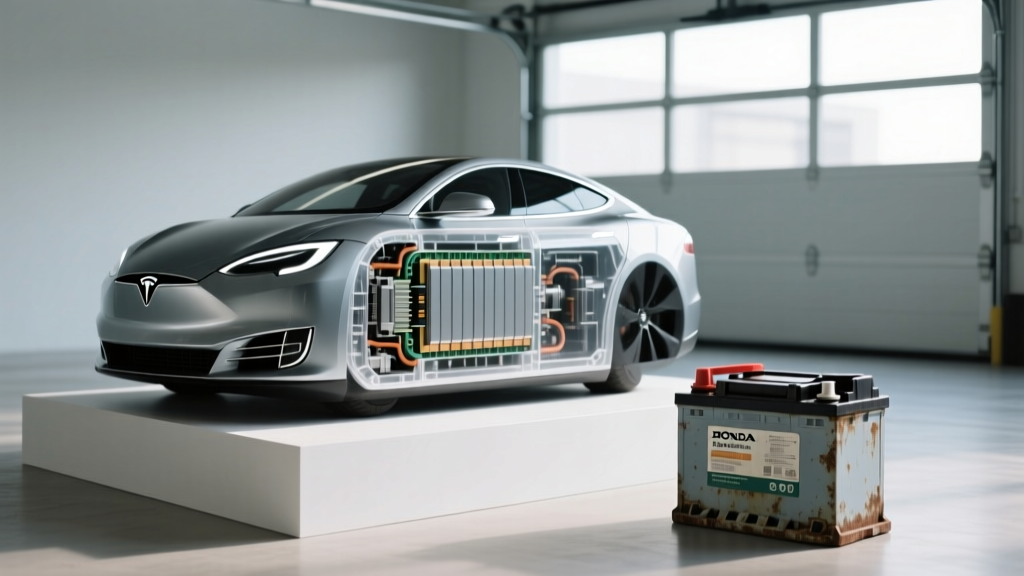
If you've ever replaced the 12V lead-acid battery in a mid-2000s sedan, you might wonder how modern EV batteries compare. A 2009 Honda Accord battery — the under-hood 12V group 51R unit — costs around $150–$220 and typically lasts 3–5 years before it can no longer hold a cranking charge. Electric vehicles use a fundamentally different energy storage system: a high-voltage lithium-ion traction battery that powers the motor, manages thermal loads, and is engineered to outlast the car itself. Understanding that difference is essential for any EV buyer or owner.
This guide breaks down EV battery chemistry, real-world degradation data, warranty protections, replacement economics, and daily habits that extend pack life — all framed against the familiar benchmark of a conventional car battery.
The 2009 Honda Accord Battery vs. an EV Traction Battery: Two Completely Different Jobs
The 12V battery in a 2009 Honda Accord (typically a Group 51R, ~45 Ah lead-acid or AGM unit) exists to crank the starter motor, run accessories when the engine is off, and stabilize the alternator's output. It stores roughly 0.5 kWh of usable energy and weighs about 30–35 lbs.
An EV traction battery, by contrast, stores between 40 kWh and 130+ kWh of energy, weighs 600–2,000 lbs, and is the single most expensive component in the vehicle. It uses lithium-ion cells — either NMC (nickel manganese cobalt), NCA (nickel cobalt aluminum), or LFP (lithium iron phosphate) — managed by a sophisticated Battery Management System (BMS) that controls cell balancing, thermal regulation, and state-of-charge windows.
EV Battery Chemistry Explained: LFP vs. NMC vs. NCA
The lithium-ion cells inside an EV pack come in several chemistries, each with distinct trade-offs. The two dominant families in 2026 are NMC/NCA (nickel-rich cathodes) and LFP (lithium iron phosphate). Here's how they compare across the metrics that matter to owners:
| Attribute | LFP (Lithium Iron Phosphate) | NMC / NCA (Nickel-Rich) |
|---|---|---|
| Energy density | ~160–180 Wh/kg (lower) | ~220–300 Wh/kg (higher) |
| Cycle life | 3,000–5,000+ cycles | 1,000–2,500 cycles |
| Cold-weather performance | Weaker below 32°F; slower charging | Better low-temp conductivity |
| Cost per kWh | ~$80–$100 (cheaper, no cobalt/nickel) | ~$110–$140 |
| Thermal stability | Excellent; higher runaway threshold | Good; requires robust BMS |
| Recommended SoC for daily use | 100% is fine | 80% preferred; 100% for trips only |
| Common in (2026 models) | Tesla Model 3 RWD, Ford Mustang Mach-E Select, BYD, base Hyundai/Kia | Tesla Model Y LR, Rivian, Lucid, Porsche Taycan, most long-range trims |
Which is better? Neither is universally superior. NMC/NCA packs deliver more range per pound, making them ideal for long-range and performance trims. LFP packs cost less, last more charge cycles, and tolerate daily 100% charging — making them the pragmatic pick for commuters and standard-range models. Tesla, Ford, and Hyundai now offer LFP in their entry trims specifically to lower purchase price while maintaining warranty coverage.
How Long Do EV Batteries Actually Last? Degradation Data
The most common fear among EV shoppers is premature battery failure. Real-world data consistently shows this fear is overstated. According to fueleconomy.gov, most modern lithium-ion EV batteries retain 85–95% of original capacity after 100,000 miles. Here's a summary of observed degradation across major platforms:
- Tesla Model 3/Y (NMC/NCA): ~5–8% loss at 100,000 miles; ~10–12% at 200,000 miles (Tesla Impact Report 2024)
- Chevrolet Bolt EV (NMC): ~6–10% loss at 100,000 miles (Recurrent Auto fleet data)
- Nissan LEAF (passive air-cooled NMC): ~12–18% loss at 100,000 miles — faster degradation due to lack of active thermal management
- Hyundai Ioniq 5 / Kia EV6 (NMC): ~4–7% loss at 80,000 miles (early fleet data)
- Tesla Model 3 RWD (LFP): Minimal measurable degradation (<3%) at 60,000 miles in taxi/fleet use
Most degradation occurs in the first 20,000–30,000 miles (the so-called "break-in" curve), after which the loss rate flattens considerably. A typical 2026 EV with a 75 kWh NMC pack will likely still hold 60–65 kWh after 200,000 miles — enough for the vast majority of daily driving needs.
To put this in context: a 2009 Honda Accord's 12V battery is essentially dead by year 5, unable to crank the engine. An EV traction battery at year 10 still powers the car with only modestly reduced range.
What Does the EV Battery Warranty Cover?
Federal law mandates that EV batteries carry a minimum warranty of 8 years or 100,000 miles (10 years/150,000 miles in CARB states like California, New York, and Massachusetts). Most manufacturers exceed this floor. Here's how major brands structure coverage in 2026:
| Manufacturer | Duration | Capacity Retention Threshold | Notes |
|---|---|---|---|
| Tesla | 8 yr / 120,000 mi (Model 3/Y); 8 yr / 150,000 mi (S/X) | 70% | Covers defects + excessive degradation |
| Hyundai / Kia | 10 yr / 100,000 mi | 70% | Among the longest in the industry |
| Ford | 8 yr / 100,000 mi | 70% | Applies to Mach-E, F-150 Lightning |
| GM (Chevrolet/Cadillac) | 8 yr / 100,000 mi | 60% (Bolt); 70% (Ultium) | Bolt's lower threshold reflects older chemistry |
| Rivian | 8 yr / 175,000 mi (R1T/R1S) | 70% | Higher mileage cap for adventure use |
| BMW | 8 yr / 100,000 mi | 70% | i4, iX, i7 covered |
The capacity retention threshold is critical: if your battery drops below the stated percentage (typically 70% of original capacity) within the warranty period, the manufacturer must repair or replace it at no cost. In practice, very few EVs hit this threshold under normal use — the warranty is a safety net, not a prediction.
EV Battery Replacement Cost: What to Expect and When
Out-of-warranty battery replacement is the scenario that generates the most anxiety. Here are realistic 2026 replacement costs based on manufacturer service bulletins and independent shop data:
| Vehicle | Battery Size | Estimated Replacement Cost | When Typically Needed |
|---|---|---|---|
| Tesla Model 3 RWD (LFP) | ~60 kWh | $8,000–$12,000 | Rarely before 300,000+ mi |
| Tesla Model Y LR (NMC) | ~75 kWh | $12,000–$16,000 | 200,000–300,000 mi |
| Chevrolet Bolt EV | 65 kWh | $14,000–$16,000 | 200,000+ mi (post-recall packs improved) |
| Ford F-150 Lightning (Ext. Range) | 131 kWh | $20,000–$28,000 | 200,000+ mi |
| Hyundai Ioniq 5 | 77.4 kWh | $12,000–$18,000 | 200,000+ mi |
| Porsche Taycan | 93.4 kWh | $22,000–$30,000 | 200,000+ mi |
Two important context points: First, battery cell prices continue to fall — IRS §30D tax credit rules also incentivize domestic battery production, which is driving cost reduction. Second, most EVs are scrapped or traded in long before the traction battery needs replacement. The average age of a scrapped vehicle in the US is ~15 years; by that point, even a degraded EV battery still functions — it just offers less range.
Compare this to the 2009 Honda Accord battery scenario: a $180 replacement every 4 years over a 15-year ownership period totals ~$720 in 12V batteries. An EV owner might spend $0 on traction battery replacement over the same period — but pays more upfront in the vehicle purchase price.
Factors That Affect EV Battery Lifespan (and How to Minimize Them)
While modern BMS systems do most of the protective work, owner habits still influence long-term degradation. Here's what the data shows:
- Avoid sustained 100% SoC (NMC/NCA only): Charge to 80% daily; reserve 100% for road trips. LFP owners can charge to 100% regularly without harm.
- Minimize DC fast charging frequency: Occasional Supercharging or Electrify America sessions are fine, but daily 150+ kW fast charging accelerates degradation by ~1–2% over 100k miles vs. Level 2 home charging.
- Precondition before fast charging: Use the car's navigation-based preconditioning (Tesla, Hyundai, Ford) to warm the battery to optimal temperature before arriving at a DC charger. Cold batteries charge slower and experience more stress.
- Avoid extreme SoC in extreme heat: Parking at 100% SoC in 110°F+ ambient temperatures is the worst-case degradation scenario. If you live in a hot climate, set charge limits to 80–90% for parked storage.
- Don't let the pack sit at 0%: If storing the car for weeks, leave it at ~50% SoC. Deep discharge below the BMS buffer can cause cell damage.
- Use Level 2 home charging as your baseline: A 7–11 kW Level 2 charger adds 25–44 miles per hour and generates far less thermal stress than DC fast charging.
How to Check and Monitor Your EV Battery's State of Health
State of Health (SoH) is the percentage of original capacity your battery currently holds. A new pack is 100% SoH; a pack that held 75 kWh when new and now holds 67.5 kWh is at 90% SoH.
Here's how to check it across major platforms:
- Tesla: The in-car service menu (hold the model word on the About screen for ~3 seconds, type "health") shows estimated SoH. Third-party apps like TeslaFi or Tessie log long-term degradation curves using API data.
- Hyundai/Kia: The dealer diagnostic tool reads BMS-reported SoH. Some owners use OBD-II dongles with apps like Car Scanner to pull the same data.
- Ford: The FordPass app shows estimated range (which indirectly reflects SoH). Dealer scans provide exact capacity readings.
- GM (Ultium): myChevrolet/myCadillac apps display battery health metrics; OnStar diagnostics can provide SoH reports.
- All brands: Recurrent Auto offers a free battery health report that compares your pack's degradation to a fleet of identical vehicles.
Monitoring SoH quarterly (not obsessively daily) gives you a meaningful trend line. A sudden drop of more than 2–3% in a short period warrants a dealer diagnostic check.
Emerging Battery Technology: What's Coming and When
Several next-generation battery technologies are in development, but none are commercially available in production EVs as of 2026. Here's a realistic timeline based on manufacturer announcements and industry analysis:
- Solid-state batteries: Toyota has announced a solid-state battery targeting 2027–2028 production, promising ~450-mile range and 10-minute fast charging. Nissan and Samsung SDI are targeting 2028–2030. These use a solid electrolyte instead of liquid, offering higher energy density and improved safety. However, manufacturing cost and scalability remain unsolved challenges. Status: announced/preliminary, not available.
- Silicon-dominant anodes: Companies like Sila Nanotechnologies and Group14 are supplying silicon-carbon anode materials to Mercedes-Benz and Porsche for next-gen cells. Silicon anodes can store ~10x more lithium ions than graphite, boosting energy density 20–40%. Limited production vehicles may appear by 2027. Status: early production trials.
- Sodium-ion batteries: CATL and BYD are producing sodium-ion cells for low-cost, short-range EVs in China. These use abundant sodium instead of lithium, cutting cost dramatically but offering lower energy density (~120–150 Wh/kg). US-market availability is uncertain before 2028. Status: limited production in China only.
- Cell-to-pack / cell-to-chassis architectures: BYD's Blade Battery and Tesla's structural 4680 pack eliminate module-level packaging, increasing pack-level energy density without changing chemistry. These are already in production and represent the near-term evolution path.
For buyers in 2026, today's lithium-ion packs — whether LFP or NMC — are mature, well-understood, and backed by extensive warranty coverage. Waiting for solid-state means waiting at least 2–4 more years with no guarantee of affordable pricing at launch.
Frequently Asked Questions
How long do EV batteries last in years and miles?
Most modern EV batteries are designed to last 15–20 years or 200,000–300,000+ miles before degrading below 70% of original capacity. Fleet data from Tesla, Recurrent Auto, and independent testing consistently shows 85–95% capacity retention at 100,000 miles. LFP chemistry packs often exceed 3,000 full charge cycles with minimal loss.
How much does an EV battery cost to replace?
Out-of-warranty replacement costs range from ~$8,000 for a 60 kWh LFP pack (Tesla Model 3 RWD) to ~$28,000+ for a 131 kWh NMC pack (F-150 Lightning Extended Range). However, most EVs never need a traction battery replacement during typical ownership. Costs are declining ~8–12% annually as cell manufacturing scales.
What does the EV battery warranty actually cover?
Federal minimum is 8 years/100,000 miles; CARB states require 10 years/150,000 miles. Coverage includes defects in materials/workmanship AND excessive capacity loss (typically below 70% of original capacity). If your battery drops below the threshold within the warranty period, the manufacturer repairs or replaces it at no cost. Warranties transfer to subsequent owners in most cases.
How do I check my EV battery's health?
Most EVs provide SoH (State of Health) data through in-car menus, companion apps, or dealer diagnostic tools. Third-party services like Recurrent Auto and Tessie offer fleet-comparison reports. Check SoH quarterly and watch for sudden drops exceeding 2–3%.
LFP vs NMC — which battery chemistry should I choose?
Choose LFP if you want lower cost, longer cycle life, and the ability to charge to 100% daily — ideal for commuters and standard-range needs. Choose NMC/NCA if you need maximum range, better cold-weather performance, or faster DC charging speeds — ideal for road trippers and cold-climate drivers. Both chemistries are well-proven in 2026.
Does fast charging damage my EV battery?
Occasional DC fast charging (1–2 times per week) causes negligible additional degradation. Daily fast charging at 150+ kW can add ~1–2% extra capacity loss over 100,000 miles compared to Level 2 charging. Modern thermal management systems mitigate most of the risk, but Level 2 home charging remains the gentlest method for daily use.
Is a used EV battery a risk?
A used EV with a documented SoH above 85% and remaining warranty coverage is generally a sound purchase. Request a battery health report from the seller or run a diagnostic via Recurrent Auto. Avoid vehicles with unknown battery history, evidence of flood damage, or SoH below 75% unless the price reflects the reduced range.