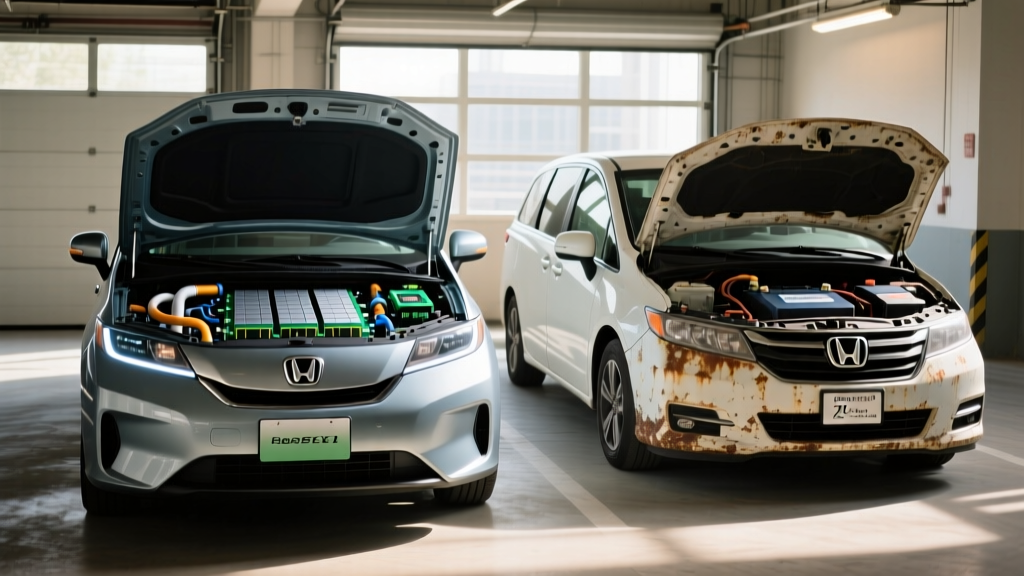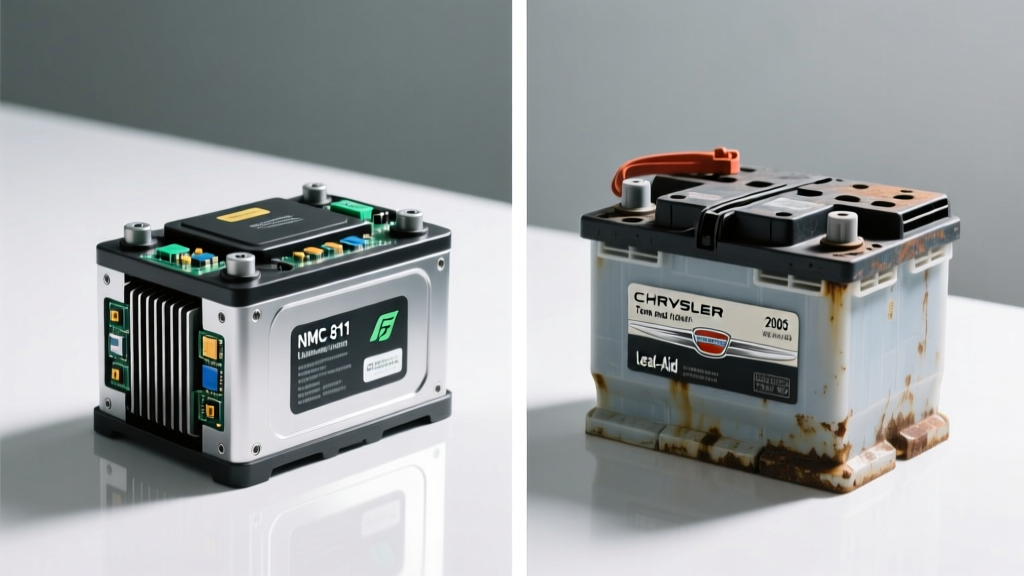
If you've ever replaced the 12V lead-acid battery in a 2005 Chrysler Town and Country, you probably spent $120–$180 at an auto parts store, swapped it in 15 minutes, and didn't think about it again for four years. That simple flooded-cell battery cranked a 3.8L V6 and powered the radio. Modern electric vehicles carry a fundamentally different energy storage system: a high-voltage lithium-ion traction battery that costs 50–100× more, lasts 3–4× longer, and demands entirely different care. Understanding this gap matters whether you're cross-shopping your first EV or just curious how battery technology has evolved.
This guide dissects EV battery technology — chemistry, degradation, warranties, replacement costs, and care — using real-world data and 2026 model-year context. We'll also clarify what that old minivan battery has in common with an EV (spoiler: the 12V auxiliary battery) and what it doesn't.
Two Batteries, Two Jobs: Traction vs. 12V Auxiliary
Every modern EV actually carries two batteries:
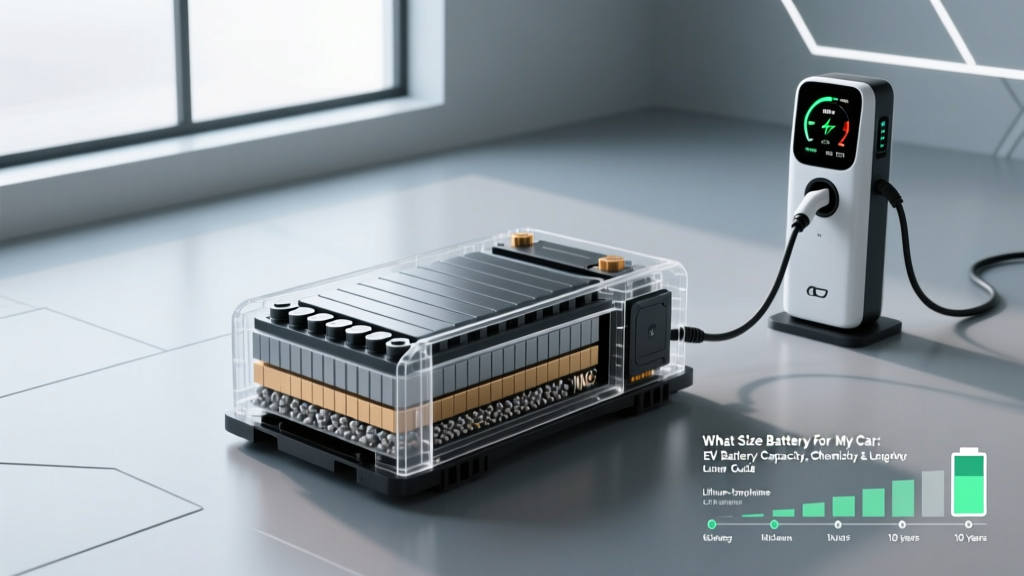
- High-voltage traction battery (200–800V): Stores 50–150 kWh of energy, powers the electric motor(s), and determines your vehicle's range. This is the expensive, complex pack we'll focus on.
- 12V auxiliary battery: A small lead-acid or lithium-ion battery that runs lights, infotainment, door locks, and the computers that manage the main pack. This is functionally the same category of battery found in a 2005 Chrysler Town and Country — a Group 34 or Group 24F lead-acid unit, typically 600–700 CCA.
LFP vs. NMC vs. NCA: Which Chemistry Powers Your EV?
Not all lithium-ion cells are identical. Three chemistries dominate the 2026 EV market, each with distinct trade-offs:
| Attribute | LFP (Lithium Iron Phosphate) | NMC (Nickel Manganese Cobalt) | NCA (Nickel Cobalt Aluminum) |
|---|---|---|---|
| Energy density | ~160–180 Wh/kg (lower) | ~220–260 Wh/kg (higher) | ~250–280 Wh/kg (highest) |
| Cycle life | 3,000–5,000+ cycles | 1,000–2,000 cycles | 1,000–1,500 cycles |
| Cold-weather performance | Weaker below freezing; needs preconditioning | Better low-temp output | Good low-temp output |
| Cost per kWh | Lowest (~$90–$110) | Mid (~$120–$140) | Higher (~$130–$160) |
| Thermal stability | Excellent — least prone to thermal runaway | Moderate | Lower — requires robust BMS |
| SoC recommendation | 100% daily OK | 80% daily, 100% for trips | 80% daily, 100% for trips |
| Typical 2026 vehicles | Tesla Model 3 RWD, Model Y RWD, Ford Mustang Mach-E Select, Rivian Standard | Hyundai Ioniq 5/6, Kia EV6/EV9, BMW iX, VW ID.4, Ford Extended Range | Tesla Model S/X, Lucid Air |
Which is better? There's no universal winner. LFP is ideal if you want maximum longevity, lower cost, and can charge to 100% daily — but you'll sacrifice some range per kilogram and cold-weather punch. NMC/NCA deliver more range in a lighter pack and better winter performance, at the cost of a shorter cycle life and more care around state-of-charge. Most buyers who charge at home and don't regularly face sub-freezing temperatures will be well served by LFP. Road-trippers and cold-climate owners often prefer NMC's energy density.
How Long Do EV Batteries Actually Last?
The short answer: most EV traction batteries outlast the vehicle they're installed in. Data from fleets, long-term owners, and independent testing consistently shows gradual, predictable degradation rather than sudden failure.
Real-World Degradation Data
Based on aggregated fleet data from Geotab's 6,300-vehicle study and owner-reported data on platforms like Recurrent Auto:
| Time / Mileage | Typical Capacity Retention | Notes |
|---|---|---|
| Year 1 / ~15,000 mi | 96–98% | Initial "break-in" loss |
| Year 4 / ~60,000 mi | 90–94% | Degradation curve flattens |
| Year 8 / ~120,000 mi | 85–90% | Still within warranty threshold |
| Year 12 / ~180,000 mi | 80–87% | LFP packs often outperform here |
| Year 15+ / 200,000+ mi | 75–83% | Taxi/fleet Tesla data (NMC/NCA) |
Tesla's own 2025 Impact Report states their fleet showed an average of ~12% degradation at 200,000 miles. Hyundai/Kia report similar figures for NMC packs. LFP packs in Model 3 RWD taxis have demonstrated 90%+ retention past 150,000 miles. The old fear of batteries "bricking" at 100,000 miles is not supported by data.
What Does the Battery Warranty Actually Cover?
Federal law (EPA emissions-related warranty provisions) effectively pushed manufacturers to offer robust coverage. Every major automaker in the U.S. market provides at minimum:
| Manufacturer | Duration | Capacity Threshold | Notes |
|---|---|---|---|
| Tesla | 8 yr / 120,000 mi (Model 3/Y RWD); 8 yr / 150,000 mi (LR/Performance) | 70% retention | Transferable to subsequent owners |
| Hyundai / Kia / Genesis | 10 yr / 100,000 mi | 70% retention | Among the longest in the industry |
| Ford | 8 yr / 100,000 mi | 70% retention | Covers Mustang Mach-E, F-150 Lightning |
| GM (Chevy/Cadillac) | 8 yr / 100,000 mi | 70% retention (60% on some Ultium trims) | Check specific model terms |
| Rivian | 8 yr / 175,000 mi | 70% retention | Higher mileage cap reflects adventure use |
| Volkswagen | 8 yr / 100,000 mi | 70% retention | ID.4, ID. Buzz |
What triggers a claim: If your pack's State of Health (SoH) falls below the threshold within the warranty window, the manufacturer will repair, replace modules, or replace the pack at no cost. Normal gradual degradation above the threshold is not covered — a 12% loss over 8 years is expected, not warrantable.
EV Battery Replacement Cost: The Numbers
Out-of-warranty replacement is rare, but buyers want the number. Here's what it looks like in 2026:
| Vehicle Class | Pack Size | Replacement Cost (parts + labor) |
|---|---|---|
| Compact EV (Chevy Bolt, Nissan Leaf) | 60–65 kWh | $8,000 – $12,000 |
| Mid-size sedan/crossover (Tesla Model 3, Ioniq 5) | 75–85 kWh | $12,000 – $18,000 |
| Large SUV/truck (F-150 Lightning, Rivian R1T) | 100–149 kWh | $18,000 – $25,000+ |
| Luxury sedan (Lucid Air, Tesla Model S) | 100–118 kWh | $20,000 – $30,000 |
When is replacement actually needed? Almost never during normal ownership. Catastrophic failure (physical damage, manufacturing defect) is usually covered by warranty or insurance. Capacity loss severe enough to warrant replacement (<70%) typically takes 15+ years or 200,000+ miles. Many high-mileage Teslas have crossed 300,000 miles on the original pack. The Recurrent Auto battery study confirms that fewer than 1.5% of EVs have needed out-of-warranty pack replacements.
Compare this to a 2005 Chrysler Town and Country battery: the lead-acid 12V cost ~$140 and lasted 4 years. The EV traction pack costs 100× more but lasts 4× longer — and unlike the minivan's engine or transmission (both common failure points past 150,000 miles), the EV powertrain has far fewer moving parts to fail.
Five Factors That Accelerate Battery Degradation
Not all miles are equal. These habits measurably shorten pack life:
- Frequent DC fast charging above 150 kW. Occasional road-trip fast charging is fine, but daily use of 350 kW chargers generates sustained heat that accelerates calendar aging. Tesla and Hyundai both recommend Level 2 home charging as the daily norm.
- Extreme temperatures without preconditioning. Charging a cold-soaked NMC pack below 20°F without thermal preconditioning can cause lithium plating. Precondition via the vehicle's navigation-to-charger feature or scheduled departure.
- Prolonged storage at 100% or 0% SoC. NMC/NCA packs degrade fastest at voltage extremes. Store at 50% SoC if leaving the car unused for weeks. (LFP is more tolerant of 100% storage.)
- Consistently draining below 10% SoC. Deep discharges stress cells. Treat 10–20% as your functional floor for NMC/NCA.
- High ambient heat + high SoC. A car parked in a Phoenix summer at 100% SoC experiences the worst-case calendar aging scenario. Park in shade or a garage when possible.
- ✓ Set daily charge limit to 80% (NMC/NCA) or 100% (LFP)
- ✓ Use Level 2 home charging as primary (~7–11 kW)
- ✓ Enable preconditioning before DC fast charging
- ✓ Avoid letting SoC drop below 10% for extended periods
- ✓ Park in shade/garage during hot weather
- ✓ If storing 2+ weeks, set SoC to 50% (NMC) or 60–70% (LFP)
How to Monitor Your Battery's State of Health (SoH)
State of Health is the percentage of original capacity your pack can still hold. A new EV has 100% SoH; a pack at 88% SoH that started with 75 kWh now holds ~66 kWh usable. Here's how to check it:
- In-vehicle displays: Tesla shows battery health in the Service menu (software 2024.38+). Hyundai/Kia include SoH in the EV menu on newer infotainment systems.
- Manufacturer apps: The Tesla, FordPass, Hyundai Bluelink, and Kia Connect apps display SoH or estimated range vs. original — from which SoH can be derived.
- OBD-II dongles + apps: Tools like OBDLink SX paired with apps such as EV Health or Car Scanner can read the BMS-reported SoH directly. Cost: ~$40 for the dongle.
- Third-party services: Companies like Recurrent and Geotab offer battery health reports based on telematics data — useful for used-EV buyers.
- Dealer diagnostic: A service department can run a full pack balance and capacity test, typically $100–$150 out of warranty.
For used-EV shoppers, SoH is the single most important number to verify before purchase — more predictive than odometer reading alone.
What's Next: Solid-State, Silicon Anode, and Beyond
Battery R&D is moving fast, but timelines remain stubbornly longer than headlines suggest:
- Silicon-dominant anodes (near-term, 2025–2027): Companies like Sila Nanotechnologies and Group14 are shipping silicon-blended anodes that boost energy density 10–20%. Already appearing in limited production (Mercedes G-Class 580e, some Porsche applications). Expect gradual rollout.
- Semi-solid-state (2026–2028): NIO's 150 kWh semi-solid pack (China market) demonstrates 360 Wh/kg cells. Toyota and Samsung SDI have announced pilot production. These are announced and in limited deployment, not mass-market.
- True solid-state (2028–2032 estimated): Toyota, QuantumScape, and others target 2028–2030 for initial production. Promises 400+ Wh/kg, faster charging, and improved safety. Volume availability for mainstream vehicles is realistically 2030+.
- Sodium-ion (2026+): CATL and BYD are shipping sodium-ion packs in budget Chinese EVs. Lower energy density but cheaper and cobalt-free. Likely to appear in U.S. market entry-level EVs by 2028.
For buyers in 2026: today's LFP and NMC packs are mature, well-warranted, and proven. Waiting for solid-state is a valid strategy only if your purchase is 3+ years out — and even then, early solid-state vehicles will carry a premium.
Frequently Asked Questions
How long do EV batteries last in years and miles?
Most modern EV traction batteries retain 85–90% capacity at 8 years / 120,000 miles, and 80%+ at 15 years / 200,000 miles. LFP packs often exceed these figures. Catastrophic failure is rare (<1.5% of vehicles per Recurrent data). Expect the pack to outlast the rest of the vehicle.
How much does it cost to replace an EV battery?
Out-of-warranty replacement ranges from ~$8,000 for a compact EV to $25,000+ for a large truck or luxury sedan. However, most packs never need replacement during typical ownership. Warranty coverage (8–10 years / 100,000–175,000 miles at 70% capacity threshold) protects against premature degradation.
What does the EV battery warranty cover?
It covers capacity loss below a stated threshold (typically 70% of original capacity) within the warranty period (usually 8 years / 100,000 miles, 10/100k for Hyundai/Kia). It also covers manufacturing defects and module failures. Normal gradual degradation above the threshold is expected and not warrantable.
How do I check and maximize my EV's battery health?
Monitor SoH via the vehicle's infotainment menu, manufacturer app, or an OBD-II reader. Maximize longevity by: using Level 2 charging daily, limiting DC fast charging to road trips, keeping SoC between 10–80% (NMC) or charging to 100% freely (LFP), preconditioning before fast charging, and avoiding prolonged storage at extreme SoC levels.
LFP vs. NMC — which is better and why?
LFP wins on longevity (3,000–5,000 cycles vs. 1,000–2,000), cost (~$90–$110/kWh vs. ~$120–$140), and safety. NMC wins on energy density (220–260 Wh/kg vs. 160–180), cold-weather performance, and pack weight. Choose LFP for daily commuting and long ownership horizons; choose NMC for maximum range, cold climates, or road-trip-heavy driving.
Is the 2005 Chrysler Town and Country battery the same as an EV battery?
No. The 2005 Town and Country uses a 12V lead-acid Group 34/24F battery (~$140, 4-year lifespan) for starting and accessories. An EV's traction battery is a 200–800V lithium-ion pack (50–150 kWh, $8,000–$30,000) that powers the drivetrain. However, every EV also has a separate 12V auxiliary battery that is functionally similar to the Town and Country's battery.
Sources: EPA Fuel Economy, Geotab EV Battery Health Study, Recurrent Auto Battery Research, manufacturer warranty documentation (Tesla, Hyundai, Ford, GM, Rivian, VW).