Why a 2004 Ford F-150 Battery Search Leads Straight to EV Battery Questions
If you've searched for a 2004 Ford F-150 battery, you're likely dealing with a familiar scenario: your truck won't start, the lights are dim, and you need a replacement Group 65 lead-acid battery pronto. That's a $150–$250 fix at any auto parts store. But if you're also researching the Ford F-150 Lightning or any modern electric vehicle, the word "battery" takes on an entirely different meaning — and a vastly different price tag.
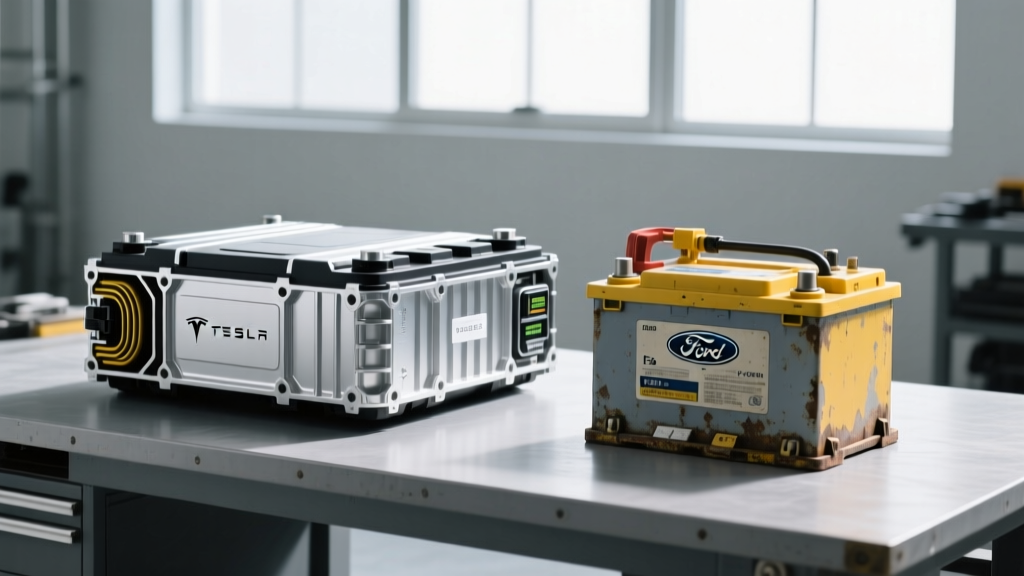
The 2004 F-150 uses a conventional 12-volt lead-acid battery rated around 72 amp-hours (Ah) and 650 cold-cranking amps (CCA). It starts the engine and powers accessories. An EV traction battery — the high-voltage pack that actually propels the vehicle — operates at 400V or 800V, stores 80–150+ kilowatt-hours (kWh) of energy, and costs $5,000 to $20,000+ to replace. Confusing these two is one of the most common mistakes new EV shoppers make.
This guide breaks down everything you need to know about EV traction batteries: chemistry, degradation, cost, warranty, and care — with context for truck buyers transitioning from a legacy platform like the 2004 F-150 to an electric pickup.
12V Auxiliary vs. High-Voltage Traction Battery: Know the Difference
Every internal combustion engine (ICE) vehicle, including the 2004 Ford F-150, relies on a single 12V lead-acid battery under the hood. Its job is simple: crank the starter motor, run lights and electronics when the engine is off, and stabilize voltage. When it dies after 3–5 years, you swap it and move on.
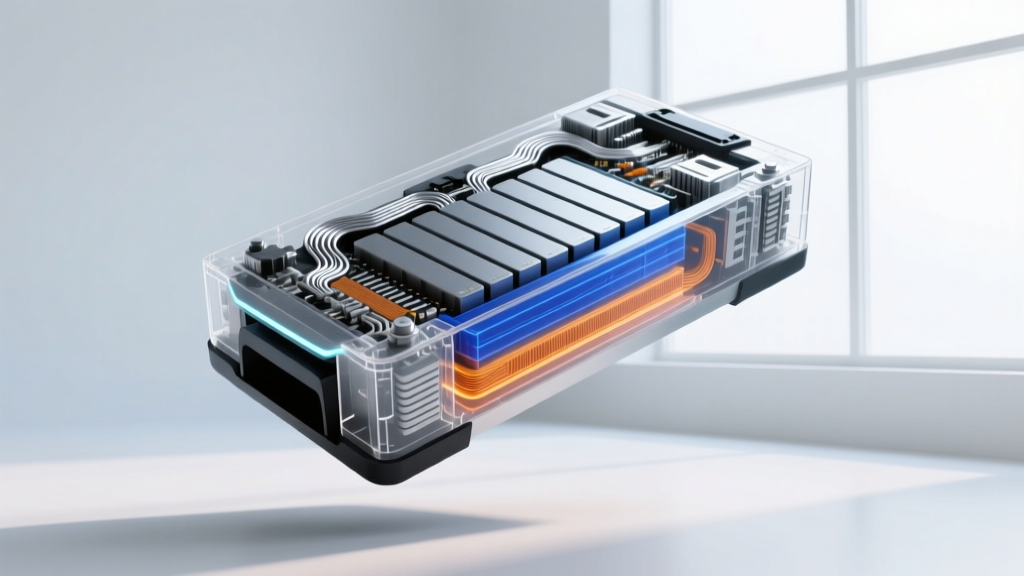
EVs also carry a 12V auxiliary battery (often lithium-ion in modern models) to run computers, lights, and door locks. But the real heart of the vehicle is the high-voltage traction battery — the large pack mounted along the floor pan. This is what stores the energy to drive the electric motors and determines your range, performance, and long-term ownership cost.
| Specification | 2004 F-150 (12V Lead-Acid) | 2026 F-150 Lightning (Traction) |
|---|---|---|
| Voltage | 12V | ~400V nominal |
| Capacity | ~72 Ah / ~0.86 kWh | 98 kWh usable (Std) / 131 kWh usable (Ext) |
| Chemistry | Lead-acid (flooded or AGM) | NMC (Nickel Manganese Cobalt) lithium-ion |
| Weight | ~47 lbs | ~1,200–1,800 lbs |
| Typical Replacement Cost | $150–$250 | $10,000–$20,000+ |
| Typical Lifespan | 3–5 years | 15–20+ years (with gradual degradation) |
| Warranty | 1–3 years prorated | 8 years / 100,000 miles |
The takeaway: when EV owners talk about "the battery," they mean the traction pack. When a 2004 F-150 owner says the same thing, they mean a $200 lead-acid unit. Understanding this distinction is essential before evaluating any electric vehicle purchase.
EV Battery Chemistry: LFP vs. NMC Explained
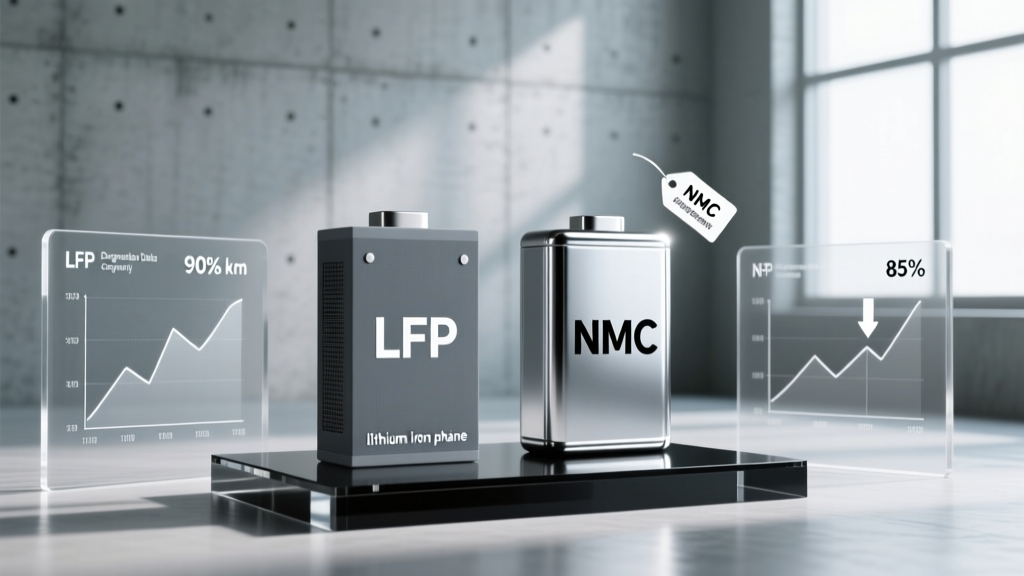
Modern EV traction batteries use lithium-ion cells, but not all lithium-ion chemistry is the same. The two dominant types in 2026 are NMC (Nickel Manganese Cobalt) and LFP (Lithium Iron Phosphate). Each has distinct trade-offs that affect range, longevity, cold-weather performance, and cost.
| Attribute | LFP (Lithium Iron Phosphate) | NMC (Nickel Manganese Cobalt) |
|---|---|---|
| Energy Density | Lower (~160–180 Wh/kg cell-level) | Higher (~220–300 Wh/kg cell-level) |
| Cycle Life | 3,000–5,000+ cycles | 1,000–2,000 cycles |
| Calendar Lifespan | 15–25+ years projected | 10–20 years projected |
| Cold-Weather Performance | Greater range loss below 32°F (~25–35% loss at 0°F) | Better low-temp discharge (~15–25% loss at 0°F) |
| Recommended Daily SoC | 100% (no penalty for full charge) | 80% daily; 100% only for trips |
| Cost (per kWh) | Lower — no cobalt or nickel | Higher — commodity-priced metals |
| Thermal Stability | Excellent — lower thermal runaway risk | Good — requires more active cooling |
| Common Applications (2026) | Tesla Model 3/Y RWD, Ford Mustang Mach-E Select, BYD models | F-150 Lightning, Rivian R1T, Hyundai Ioniq 5, long-range sedans |
Which is better? It depends on your use case. If you want maximum range per charge and live in a cold climate, NMC delivers higher energy density and better winter performance. If you prioritize long-term durability, plan to own the vehicle 10+ years, and don't mind slightly less range, LFP is the stronger choice. LFP owners can charge to 100% daily without accelerating degradation — a significant convenience advantage for routine commuting.
How Long Do EV Batteries Last? Real Degradation Data
The single most common fear among EV skeptics is catastrophic battery failure requiring a $20,000 replacement. The data tells a more reassuring story: most EV batteries outlast the vehicles they're installed in, losing capacity gradually rather than failing suddenly.
Typical EV Battery Degradation Curve (NMC chemistry, average use):
- Year 1 (0–15,000 mi): 2–4% capacity loss (initial "break-in" degradation)
- Year 3 (~45,000 mi): 6–9% total loss
- Year 5 (~75,000 mi): 8–12% total loss
- Year 8 (~120,000 mi): 10–15% total loss
- Year 10 (~150,000 mi): 12–20% total loss
Source: Aggregate data from Recurrent Auto fleet studies and manufacturer warranty thresholds.
LFP batteries degrade even more slowly. Tesla's 2025 Impact Report noted that Model 3/Y vehicles with LFP packs retained an average of 92% capacity after 150,000 miles. That translates to a 310-mile EPA range shrinking to roughly 285 miles after a decade of typical driving — still more than adequate for most daily needs.
For context, the average American drives roughly 13,500 miles per year according to FHWA data. At that rate, an EV battery should provide 15+ years of service before reaching 70–80% of its original capacity — the threshold at which most owners might consider replacement.
What Does the EV Battery Warranty Actually Cover?
Federal law mandates that EV manufacturers warranty the traction battery for a minimum of 8 years / 100,000 miles (whichever comes first) in all 50 states. In California Air Resources Board (CARB) states — which include California, New York, Massachusetts, and several others — the requirement extends to 10 years / 150,000 miles for vehicles certified to CARB standards.
| Manufacturer | Warranty Period | Mileage Limit | Capacity Retention Threshold |
|---|---|---|---|
| Ford (F-150 Lightning) | 8 years | 100,000 miles | 70% of original capacity |
| Tesla (Model 3/Y NMC) | 8 years | 120,000 miles | 70% |
| Tesla (Model 3/Y LFP) | 8 years | 100,000 miles | 70% |
| Hyundai (Ioniq 5/6) | 8 years | 100,000 miles | 70% |
| Rivian (R1T/R1S) | 8 years | 120,000 miles | 70% |
| GM (Ultium platform) | 8 years | 100,000 miles | 70% (60% for some fleet) |
| Kia (EV6/EV9) | 10 years | 100,000 miles | 70% |
What triggers a warranty claim? If your battery's State of Health (SoH) drops below the stated threshold within the warranty period, the manufacturer must repair or replace it at no cost. This usually means replacing defective modules or, in rare cases, the entire pack. Normal gradual degradation above the threshold is not covered.
What voids the warranty? Typically, physical damage (collision, flood), unauthorized modifications, or failure to follow basic maintenance requirements. Simply fast-charging frequently does not void the warranty, despite common myths.
How Much Does an EV Battery Cost to Replace?
Out-of-warranty battery replacement is expensive — but it's also rare. Most EVs are retired or sold before the battery needs full replacement. When it does happen, costs vary enormously by vehicle, battery size, and whether you're getting a new, refurbished, or salvaged pack.
| Vehicle | Battery Size (kWh) | New Pack Cost | Refurbished/Module Repair | Typical Need Timeline |
|---|---|---|---|---|
| Tesla Model 3 Standard Range (LFP) | ~60 kWh | $7,000–$10,000 | $3,500–$6,000 | 15–20+ years |
| Tesla Model Y Long Range (NMC) | ~75 kWh | $10,000–$14,000 | $5,000–$8,000 | 15–20+ years |
| Ford F-150 Lightning Extended | 131 kWh | $15,000–$22,000 | $8,000–$14,000 | 15–20+ years |
| Hyundai Ioniq 5 | 77.4 kWh | $9,000–$13,000 | $5,000–$8,000 | 15–20+ years |
| Rivian R1T (Large Pack) | 128.9 kWh | $16,000–$22,000 | $9,000–$15,000 | 15–20+ years |
| Chevrolet Bolt EV/EUV | 65 kWh | $8,000–$11,000 | $4,000–$7,000 | 15–20+ years |
A critical nuance: many "battery replacements" involve swapping only the degraded modules, not the entire pack. Module-level repair costs $2,000–$6,000 in most cases. Full pack replacement is the exception, not the rule.
For comparison, a 2004 Ford F-150 owner might spend $3,000–$5,000 replacing a transmission over the truck's life. The EV battery is a larger single component cost, but it degrades gradually and predictably rather than failing catastrophically.
Factors That Accelerate (or Preserve) Battery Life
EV battery longevity isn't random. Specific habits and environmental factors measurably affect how quickly your pack loses capacity. Here's what the data shows:
What Hurts Battery Health
- Frequent DC fast charging above 150 kW: High charge rates generate heat. Occasional road-trip fast charging is fine, but daily reliance on 350 kW chargers accelerates degradation by ~1–3% over 5 years compared to Level 2 charging.
- Sustained 100% State of Charge (NMC only): Storing an NMC battery at full charge for days stresses the cathode. LFP batteries are exempt from this concern.
- Deep discharge below 10%: Letting the battery sit near empty for extended periods can damage cells.
- Extreme heat exposure: Parking in 110°F+ ambient heat without thermal management active accelerates calendar aging. Most modern EVs have active cooling that mitigates this.
- Consistent operation in sub-zero temperatures without preconditioning: Charging a cold battery without warming it first causes lithium plating, which permanently reduces capacity.
What Preserves Battery Health
- Level 2 home charging (7–11 kW): Gentle, overnight charging is the easiest on cells and the cheapest per mile.
- 20–80% SoC range (NMC): Keeping charge between 20% and 80% for daily use significantly extends cycle life.
- 100% SoC for LFP: LFP batteries benefit from periodic full charges to calibrate the Battery Management System (BMS).
- Preconditioning before fast charging: Most EVs automatically warm the battery when you navigate to a charger. This optimizes the charge curve and reduces stress.
- Garage parking in extreme climates: Reducing thermal extremes, even by 10–15°F, meaningfully slows calendar degradation.
How to Check and Monitor Your EV Battery Health
Unlike a 2004 F-150 where you can test the 12V battery with a $30 multimeter, monitoring an EV traction battery requires software-level access. Here are the primary methods:
1. In-Vehicle Displays: Most modern EVs show estimated range and energy consumption but don't display a direct State of Health (SoH) percentage. Tesla's service mode and some Hyundai/Kia models provide more granular data.
2. OBD-II Dongles and Apps: Third-party tools like OBD2 adapters paired with apps such as EV Health or Car Scanner can read the BMS-reported SoH percentage. These typically cost $30–$80 for the hardware and provide real-time cell voltage data, degradation estimates, and charge/discharge logs.
3. Dealer Diagnostics: Manufacturers can run a full battery health report during service visits. This is the most authoritative SoH reading and is required for warranty claims.
4. Recurrent and Fleet Analytics: Services like Recurrent Auto offer free battery health reports for participating owners, comparing your pack's degradation against thousands of identical vehicles.
Practical tip: Track your actual range at a consistent SoC over time. If your 80% charge consistently yields 220 miles instead of the 250 miles it delivered when new, your battery has degraded roughly 12% — a useful real-world proxy for SoH without specialized tools.
Emerging Battery Technology: What's Next (and When)
Battery technology continues to advance, though timelines are often overstated in media coverage. Here's a realistic assessment of what's on the horizon as of 2026:
Solid-State Batteries: These replace the liquid electrolyte with a solid conductor, promising 30–50% higher energy density, faster charging, and improved safety. Toyota has announced limited production in select 2027–2028 models, with broader availability not expected until 2030+. Samsung SDI and QuantumScape are also progressing toward commercialization, but cost and manufacturing scale remain significant hurdles. Solid-state batteries are not available in any production vehicle as of 2026.
Silicon Anode Cells: Companies like Sila Nanotechnologies and Group14 are replacing graphite anodes with silicon-dominant materials, boosting energy density by 20–40%. These cells are entering production in 2026–2027 for premium EVs and are expected to reduce pack weight and cost per kWh incrementally.
Sodium-Ion Batteries: CATL and BYD have begun deploying sodium-ion packs in Chinese-market vehicles. These eliminate lithium entirely, reducing raw material costs, but offer lower energy density (~120–150 Wh/kg). They're suited for budget city cars and energy storage, not long-range trucks or sedans.
For buyers today, current NMC and LFP lithium-ion technology is mature, well-understood, and backed by extensive real-world data. Waiting for solid-state means waiting at minimum 3–5 years for meaningful availability in the US market.
Frequently Asked Questions
Can I put an EV battery in a 2004 Ford F-150?
Not as a direct replacement. The 2004 F-150 was designed around a 12V lead-acid system for starting a gasoline engine. Converting it to an EV requires a complete powertrain swap — electric motor, inverter, BMS, high-voltage wiring, and a custom battery pack. Companies like EV West offer conversion kits, but costs typically run $15,000–$30,000+ and the result is a custom vehicle, not a factory-supported product.
How long do EV batteries last in years and miles?
Based on fleet data from Recurrent Auto and manufacturer reports, most modern EV batteries retain 80–90% of their original capacity after 150,000 miles (roughly 10–12 years at average US driving rates). LFP chemistries are tracking toward 20+ years of usable service. Complete failure before 200,000 miles is statistically rare.
How much does it cost to replace an EV battery?
Full pack replacement ranges from $7,000 to $22,000 depending on the vehicle and battery size. However, most out-of-warranty repairs involve replacing individual modules for $2,000–$6,000. The majority of EV owners never need a battery replacement during their ownership.
What does the EV battery warranty cover?
Federal minimum coverage is 8 years / 100,000 miles, with CARB states requiring 10 years / 150,000 miles. The warranty guarantees the battery will retain at least 70% of its original capacity (60% for some GM fleet applications). If SoH drops below the threshold, the manufacturer repairs or replaces the pack at no cost. Physical damage and unauthorized modifications are excluded.
LFP vs. NMC — which battery chemistry is better for me?
Choose LFP if you plan to own the vehicle 10+ years, charge at home daily, and don't need maximum range. LFP tolerates 100% daily charging, lasts longer, and costs less. Choose NMC if you need the longest possible range per charge, regularly drive in sub-freezing temperatures, or want the fastest DC fast-charging speeds. Both chemistries are proven and reliable in 2026.
Does fast charging damage my EV battery?
Occasional DC fast charging (road trips, a few times per month) has negligible impact on battery health. Daily reliance on 150+ kW chargers without preconditioning can accelerate degradation by 1–3% over 5 years. Modern Battery Management Systems actively manage temperature and taper charge rates to protect cells. For daily charging, Level 2 at home (7–11 kW) remains the gold standard for longevity and cost.
How do I check my EV battery's State of Health?
Use an OBD-II adapter with an EV-specific app (like Car Scanner or EV Health) to read the BMS-reported SoH percentage. Alternatively, request a battery health report during a dealer service visit. Tracking your real-world range at a consistent charge level over time also provides a practical degradation estimate.
Sources: Recurrent Auto Battery Degradation Studies, EPA Fuel Economy, FHWA Driving Statistics, manufacturer warranty documentation.