Two Very Different Batteries: Why This Comparison Matters
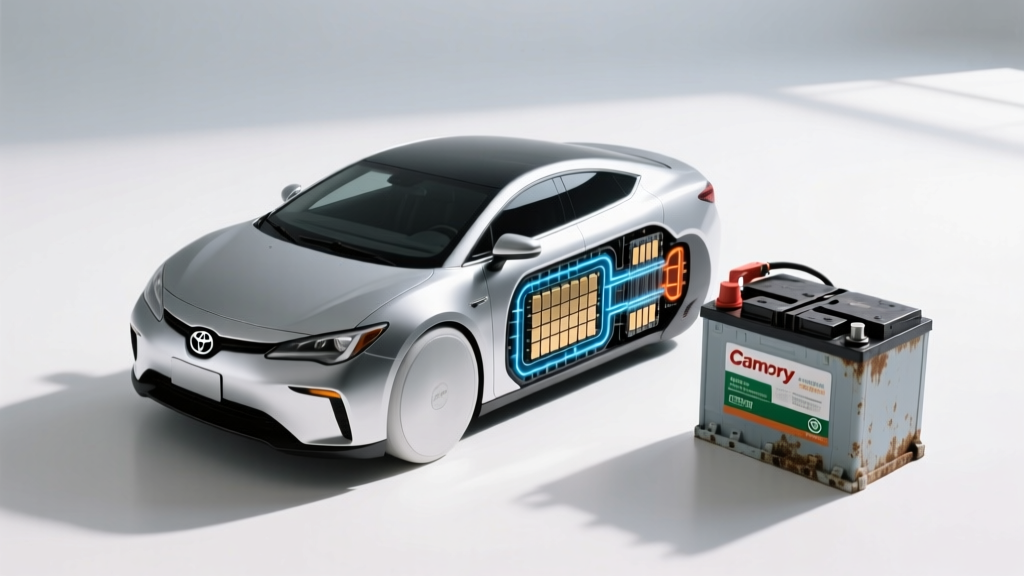
If you've searched for a battery for a 2004 Toyota Camry, you're looking at a 12-volt lead-acid unit — typically a Group 24F or 35 AGM cell costing $120–$220 at any auto parts store. It cranks the starter and powers accessories. An electric vehicle's high-voltage traction battery is an entirely different beast: a 50–120+ kilowatt-hour (kWh) lithium-ion pack that propels the car, costing $5,000–$20,000+ to replace, and engineered to last the life of the vehicle.
Understanding the gap between these two battery worlds helps EV shoppers contextualize the real ownership picture. A 2004 Camry's 12V battery dies every 3–5 years and you swap it yourself in ten minutes. An EV traction battery degrades slowly over 15–20 years and is covered by a federally mandated warranty. Let's break down exactly what's inside a modern EV battery, how long it lasts, what it costs, and how to keep it healthy.
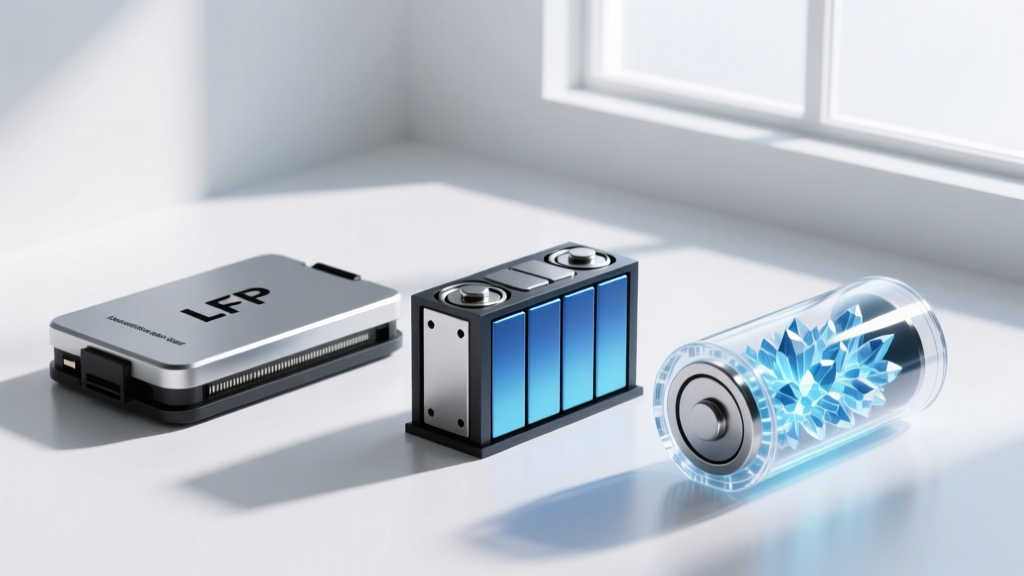
Battery Chemistry 101: LFP vs. NMC vs. NCA
Modern EVs use one of two dominant lithium-ion chemistries: LFP (lithium iron phosphate) or NMC/NCA (nickel manganese cobalt / nickel cobalt aluminum). Your 2004 Camry's 12V battery, by contrast, uses lead-acid — a 160-year-old technology that's cheap and reliable but energy-dense enough only for starting engines.
| Attribute | LFP (e.g., Tesla Model 3 RWD, Ford Mustang Mach-E Select) | NMC / NCA (e.g., Hyundai Ioniq 5, Chevy Silverado EV) |
|---|---|---|
| Energy density | ~160 Wh/kg — heavier pack for same range | ~250–300 Wh/kg — more range in lighter pack |
| Cycle life | 3,000–5,000+ full cycles before 80% capacity | 1,000–2,000 full cycles before 80% capacity |
| Cold-weather performance | Greater range loss below 32°F (~30–40% loss at 0°F) | Better low-temp output (~20–30% loss at 0°F) |
| Cost per kWh | ~$90–$110 (2025–2026 pricing) | ~$120–$150 |
| Recommended daily charge | 100% OK — LFP benefits from full charges | 80% daily — charge to 100% only for trips |
| Safety / thermal runaway | Higher thermal stability, lower runaway risk | Good, but more active cooling required |
Which is better? It depends on your use case. LFP wins on longevity, cost, and daily charging convenience — ideal for commuters who charge at home and don't need maximum range. NMC/NCA wins on range-per-pound and cold-weather output — better for road-trippers and northern-climate drivers. Neither is universally superior; manufacturers choose based on the vehicle's mission.
How Long Do EV Batteries Actually Last?
The short answer: most EV traction batteries outlast the cars they're installed in. Data from fleet operators, manufacturer reports, and long-term owner tracking consistently shows that modern lithium-ion packs lose roughly 1–2% of total capacity per year under normal use.
- Tesla Model 3/Y (NCA/NMC): ~12% average degradation at 150,000 miles, per Tesla's 2024 Impact Report. Fleet data from Tesloop and Recurrent show similar curves.
- Chevy Bolt EV (NMC, 60–65 kWh): Recurrent Auto's dataset of 5,000+ Bolts shows ~8% median loss at 100,000 miles, with most retaining 88–94% capacity.
- Nissan Leaf (passively cooled NMC): Older 24/30 kWh Leafs degraded faster (~20–25% at 80,000 mi) due to lack of active thermal management — a lesson the industry learned. The 2026 Leaf (if produced) or Ariya uses liquid cooling.
- LFP packs (Tesla Model 3 RWD, BYD): Early fleet data suggests <5% loss at 100,000 miles, consistent with LFP's higher cycle-life rating.
To put this in perspective: a 2004 Camry's 12V battery typically lasts 3–5 years before it can no longer hold enough cold-cranking amps to start the engine. You'll replace it 4–6 times over the Camry's life. An EV traction battery, by contrast, is designed for a single installation across 200,000+ miles.
Federal Warranty Requirements and What They Cover
Unlike the aftermarket warranty on a lead-acid battery for your 2004 Camry (typically 2–3 years, pro-rated), EV traction battery warranties are backed by federal mandate and manufacturer policy. Under EPA and CARB regulations, manufacturers must warrant the battery for a minimum of 8 years / 100,000 miles (10 years / 150,000 miles in CARB states like California, New York, and others).
| Manufacturer | Warranty Period | Capacity Retention Threshold |
|---|---|---|
| Tesla (Model 3/Y RWD — LFP) | 8 yr / 100,000 mi | 70% minimum |
| Tesla (Model 3/Y LR, Model S/X — NCA) | 8 yr / 120,000 mi | 70% minimum |
| Hyundai / Kia (Ioniq 5, EV6, EV9) | 10 yr / 100,000 mi | 70% minimum |
| GM (Ultium-based: Equinox EV, Silverado EV) | 8 yr / 100,000 mi | 60–70% depending on model year |
| Ford (Mach-E, F-150 Lightning) | 8 yr / 100,000 mi | 70% minimum |
| Rivian (R1T, R1S) | 8 yr / 175,000 mi | 70% minimum |
What the warranty covers: If your battery's usable capacity drops below the stated threshold (usually 70% of original) within the warranty window, the manufacturer will repair or replace it at no cost. This covers cell failures, module imbalances, and excessive degradation. It does not cover physical damage from collisions, flooding, or unauthorized modifications.
The key takeaway: if you buy a 2026 EV and drive it 12,000 miles per year, the battery is warrantied through 2034 or 100,000 miles. Very few owners will need a replacement under normal conditions.
EV Battery Replacement Costs: The Real Numbers
This is where the comparison to a 2004 Camry's $150 battery gets stark. EV traction battery replacement is a major service event — but it's also exceedingly rare in the first 15 years of ownership.
| Vehicle | Battery Size | Estimated Pack Cost | Labor + Total |
|---|---|---|---|
| Tesla Model 3 RWD (LFP) | ~60 kWh | $8,000–$10,000 | $10,000–$13,000 |
| Hyundai Ioniq 5 (NMC) | 77.4 kWh | $12,000–$15,000 | $14,000–$18,000 |
| Ford F-150 Lightning Ext. Range | 131 kWh | $18,000–$22,000 | $20,000–$25,000 |
| Chevrolet Bolt EV (NMC) | 65 kWh | $9,000–$12,000 | $11,000–$14,000 |
| Mercedes EQS (NMC) | 107.8 kWh | $20,000–$28,000 | $24,000–$32,000 |
When is replacement actually needed? Based on current degradation data, most EV batteries will retain 75–85% of their original capacity at 200,000 miles. Full replacement before 150,000 miles is uncommon unless there's a manufacturing defect (covered by warranty) or physical damage. Some owners at 250,000+ miles may see range drop enough to consider replacement, but by then the vehicle's residual value is often lower than the battery cost — similar to how a 2004 Camry at 250,000 miles might need a $4,000 transmission rebuild that exceeds the car's value.
Battery pack prices have fallen from ~$1,200/kWh in 2010 to roughly $100–$140/kWh in 2025–2026, per BloombergNEF tracking. By the time today's EVs need a new pack in the 2040s, costs will likely be substantially lower.
What Kills an EV Battery (And How to Prevent It)
Unlike the simple lead-acid battery in a 2004 Camry — where the main enemy is sulfation from sitting discharged — lithium-ion packs face a more nuanced set of stressors:
- Avoid sustained 100% state of charge (NMC/NCA): Store and daily-drive at 20–80% SoC. Charge to 100% only when you'll drive immediately. LFP packs are an exception — periodic 100% charges help the BMS calibrate.
- Minimize DC fast charging frequency: Occasional road-trip fast charging is fine, but daily 150–350 kW sessions accelerate degradation. Aim for Level 2 (7–19 kW) home charging as your primary routine.
- Precondition in cold weather: Use your EV's preconditioning feature to warm the battery before fast charging. Cold lithium-ion cells charge slower and experience more stress. Most 2026 EVs do this automatically when you navigate to a charger.
- Avoid extreme heat storage: Don't leave your EV sitting at 100% SoC in 100°F+ heat for days. If storing for a week+, set SoC to ~50% and keep it in shade or a garage.
- Drive it regularly: Lithium-ion batteries prefer regular use over long sits. Even a 10-minute drive every few days keeps cells balanced.
The biggest real-world factor most owners underestimate is repeated DC fast charging without preconditioning. Tesla's own data shows that vehicles that primarily Supercharge degrade slightly faster (~2–3% more over 100,000 miles) than those that charge predominantly at home on Level 2. This isn't catastrophic, but it's measurable.
Monitoring Your Battery's State of Health (SoH)
Every EV has a Battery Management System (BMS) that continuously tracks cell voltages, temperatures, and capacity. Here's how to access that data:
- In-car display: Most EVs show estimated range, which naturally decreases as the battery degrades. Some (like the Hyundai Ioniq 5 and BMW i4) display a battery health percentage in the settings menu.
- Manufacturer apps: Tesla, Ford, GM, and Hyundai apps show current range estimates. A drop from 310 to 285 EPA miles over three years indicates ~8% degradation.
- Third-party tools: Apps like Recurrent, TeslaFi (Tesla-specific), and OBD-II dongles paired with LeafSpy (Nissan) or Scan My Tesla can pull detailed SoH data, including individual cell voltage deltas and total energy throughput.
- Dealer diagnostics: Any authorized service center can run a full battery health report. Request one before buying a used EV — it's the EV equivalent of a compression test on a 2004 Camry's 2.4L engine.
A healthy battery shows cell voltage deltas under 30–50 mV at rest. Wider spreads may indicate a weak module that could trigger a warranty claim.
What's Next: Solid-State and Silicon-Anode Batteries
The battery landscape is evolving rapidly, but it's critical to separate what's available now from what's still in the lab:
Silicon-anode batteries are the nearest-term improvement. Companies like Sila Nanotechnologies and Group14 are supplying silicon-dominant anode materials that boost energy density by 20–40% over today's graphite anodes. The Mercedes G-Class 580e (2025) uses a silicon-anode battery from Sila. Expect broader adoption in 2027–2029 model-year vehicles.
Solid-state batteries replace the liquid electrolyte with a solid ceramic or polymer, promising higher energy density (~400–500 Wh/kg), faster charging, and improved safety. Toyota has announced a solid-state battery targeting 2027–2028 production in limited volumes. Samsung SDI and QuantumScape are also in pilot production. However, mass-market solid-state EVs are not expected before 2030, and initial costs will be premium.
Neither technology is available in a production EV you can buy today. If a salesperson tells you otherwise, they're ahead of reality. Today's LFP and NMC packs are mature, well-understood, and backed by data from millions of vehicles on the road.
Frequently Asked Questions
How long do EV batteries last in years and miles?
Based on fleet data from Recurrent Auto and manufacturer reports, modern EV batteries retain 80–90% of their original capacity at 150,000–200,000 miles (roughly 12–17 years at average US driving of 12,000 miles/year). LFP chemistries may retain even more. Most batteries will outlast the vehicle's economic life.
How much does an EV battery cost to replace?
Full pack replacement ranges from ~$10,000 for a 60 kWh pack (Tesla Model 3 RWD) to $25,000+ for a 130+ kWh pack (F-150 Lightning Extended Range), including labor. However, the vast majority of owners never need a replacement — degradation data shows most packs retain sufficient capacity well past 200,000 miles. Under federal warranty rules, defects and excessive degradation are covered for 8 years / 100,000 miles minimum.
What does the EV battery warranty actually cover?
Manufacturer warranties cover the battery pack against defects and excessive capacity loss — typically defined as dropping below 70% of original usable capacity within 8 years / 100,000 miles (10/150,000 in CARB states). This includes cell failures, module imbalances, and BMS issues. Physical damage from accidents, floods, or aftermarket modifications is excluded.
How do I check and maximize my EV battery health?
Monitor range trends over time via your vehicle's app or in-car display. For detailed data, use third-party tools like TeslaFi or an OBD-II scanner with EV-specific software. To maximize longevity: keep NMC/NCA packs between 20–80% SoC for daily use, minimize DC fast charging, precondition before cold-weather charging, and avoid storing at 100% in extreme heat. LFP owners can charge to 100% regularly without concern.
LFP vs. NMC — which battery chemistry should I choose?
Choose LFP if you prioritize longevity, lower cost, and daily home charging convenience (100% charges are fine). Choose NMC/NCA if you need maximum range per charge, drive in very cold climates, or take frequent road trips where energy density matters. Neither is "better" — they serve different driving patterns. Check the specific model's chemistry before purchasing; for example, the Tesla Model 3 RWD uses LFP while the Long Range uses NCA.
Can I put an EV battery in my 2004 Toyota Camry?
No — and you wouldn't want to. A 2004 Camry needs a standard 12V lead-acid battery (Group 24F or 35) to start its internal combustion engine. EV traction batteries operate at 400–800 volts and require the entire EV powertrain architecture. If you're looking for a battery for a 2004 Toyota Camry, any auto parts retailer can supply the correct 12V unit for $120–$220. If you're considering the EV lifestyle, the traction battery technology in a 2026 EV is a fundamentally different — and far more durable — system.