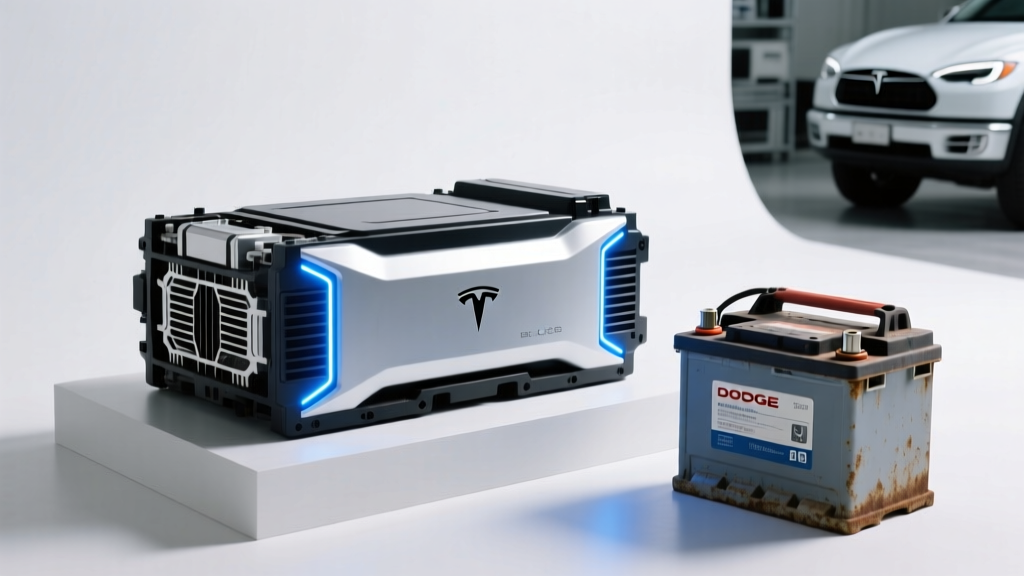
If you've ever replaced the 12V lead-acid battery in a 2000 Dodge Dakota, you know the drill: pop the hood, disconnect the terminals, swap in a new Group 34 or 75 battery for around $120-$180, and you're done in twenty minutes. That simplicity shapes how many truck owners think about "a car battery." But when you transition to an electric vehicle, the high-voltage traction battery is an entirely different animal — a 60-100+ kWh lithium-ion pack that costs $5,000-$20,000+, weighs 800-1,200 pounds, and is engineered to last the lifetime of the vehicle.
This guide bridges that knowledge gap. We'll break down modern EV battery chemistry, real-world degradation data, warranty coverage, replacement economics, and care practices — all framed against the familiar reference point of the old Dakota's 12V system. Whether you're considering an electric truck like the Ford F-150 Lightning or Chevrolet Silverado EV, or simply trying to understand what powers the EVs you see on the road, this is your technical primer.
The Fundamental Difference: 12V Starter Battery vs. High-Voltage Traction Battery
The 2000 Dodge Dakota uses a conventional 12V lead-acid battery (typically 700-800 cold cranking amps) whose sole job is to crank a 3.9L V6 or 5.9L V8 engine and power accessories when the alternator isn't running. It stores roughly 0.6-0.8 kWh of energy, weighs about 40 pounds, and lasts 3-5 years before sulfation and plate degradation require replacement.
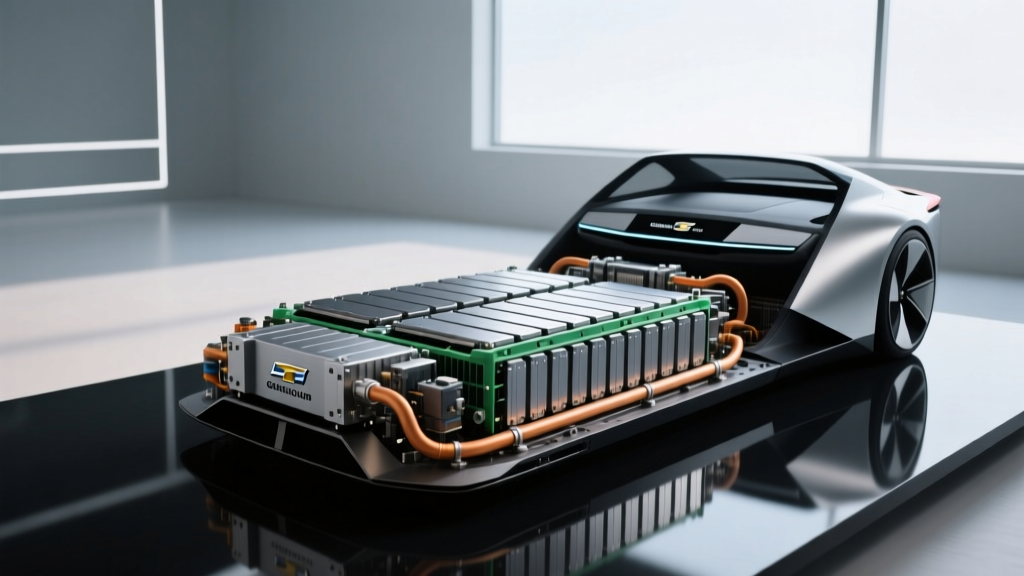
An EV traction battery, by contrast, is the vehicle's primary energy source. A 2025 Ford F-150 Lightning Extended Range pack stores 131 kWh of usable energy, weighs approximately 1,200 pounds, and powers a 580-horsepower dual-motor drivetrain. Even a smaller pack like the 58 kWh battery in a base Chevrolet Equinox EV represents a 70-100x increase in energy storage over that Dakota battery.
Importantly, EVs also carry a 12V auxiliary battery (often lithium-ion in newer models) to run computers, lights, and safety systems — but this is not what people mean when they discuss "the EV battery." That term refers exclusively to the high-voltage traction pack, and it's the focus of everything below.
Battery Chemistry Explained: LFP vs. NMC vs. NCA
Modern EV batteries use lithium-ion cells, but not all lithium-ion chemistries are equal. The two dominant families in 2026 are NMC/NCA (nickel manganese cobalt / nickel cobalt aluminum) and LFP (lithium iron phosphate). Understanding the trade-offs is essential for any buyer.
| Attribute | LFP (Lithium Iron Phosphate) | NMC / NCA |
|---|---|---|
| Energy Density | Lower (~160-180 Wh/kg cell-level) | Higher (~250-300 Wh/kg cell-level) |
| Typical Range in Same Vehicle | ~10-15% less than NMC equivalent | Maximum range per pack size |
| Cycle Life | 3,000-5,000+ cycles to 80% capacity | 1,000-2,000 cycles to 80% capacity |
| Cold-Weather Performance | More range loss in sub-freezing temps (15-30% loss at 20°F) | Better cold performance (10-20% loss at 20°F) |
| Recommended Daily SoC | 100% daily is fine; benefits from periodic full charge for BMS calibration | 80% daily recommended; 100% for long trips only |
| Thermal Stability | Excellent — very low thermal runaway risk | Good — requires robust thermal management |
| Cost (per kWh, pack-level) | ~$90-$110/kWh | ~$120-$145/kWh |
| Critical Mineral Concerns | No cobalt or nickel — simpler supply chain | Cobalt/nickel sourcing under scrutiny |
| Common in (2026 models) | Tesla Model 3/Y RWD, Ford Mustang Mach-E Select, Rivian Standard pack | Tesla Long Range, Hyundai Ioniq 5/6, Chevy Silverado EV, BMW iX |
Which is better? There's no universal answer. If you prioritize maximum range, live in a cold climate, or want the longest single-charge road trips, NMC/NCA is the stronger choice. If you plan to keep the vehicle 10+ years, charge daily to 100%, live in a moderate climate, and want lower upfront cost, LFP offers superior longevity and simpler ownership habits. Many automakers now offer both chemistries across their lineups specifically so buyers can choose based on their driving patterns.
Real-World Degradation: How Much Capacity Do EV Batteries Actually Lose?
This is where the 2000 Dodge Dakota comparison falls apart entirely. That old lead-acid battery would lose 30-50% of its cranking capacity within 4-5 years and require replacement. EV traction batteries degrade far more slowly and predictably.
Based on aggregated fleet data from sources including Geotab's long-term EV battery health study and manufacturer-reported warranty claims, here is what typical degradation looks like:
| Time / Mileage | Average Capacity Retained | Notes |
|---|---|---|
| Year 1 / 15,000 mi | 96-98% | Initial drop as SEI layer stabilizes; most owners barely notice |
| Year 3 / 45,000 mi | 93-96% | Gradual linear decline; range reduction of ~10-20 miles on a 300-mi pack |
| Year 5 / 75,000 mi | 90-94% | Still well above warranty threshold; most packs performing strongly |
| Year 8 / 100,000 mi | 86-92% | Warranty period ends for most brands; majority of packs above 80% SoH |
| Year 10 / 150,000 mi | 82-90% | NMC packs toward lower end; LFP packs often still above 90% |
| Year 15 / 200,000 mi | 75-88% | Wide variance based on climate, charging habits, and chemistry |
A critical insight: degradation is non-linear. Most lithium-ion packs experience a steeper initial drop (the first 5-10% loss) as the solid electrolyte interphase (SEI) layer forms on the anode during early cycles. After that, degradation slows to a gradual linear decline that can extend well beyond 200,000 miles before reaching 70-80% state of health.
Tesla's own 2024 Impact Report noted that their Model 3/Y fleet retained an average of 85% battery capacity at 200,000 miles. Real-world data from high-mileage taxi and rideshare EVs — vehicles subjected to frequent DC fast charging and extreme use — shows similar patterns: significant but manageable degradation over hundreds of thousands of miles.
EV Battery Warranty Coverage: What's Actually Protected?
Federal law mandates a minimum battery warranty of 8 years / 100,000 miles for EVs sold in the United States (10 years / 150,000 miles in California Air Resources Board states). But the details matter — specifically, the capacity retention threshold that triggers a warranty claim.
| Manufacturer | Warranty Period | Capacity Threshold | Notes |
|---|---|---|---|
| Tesla (Model 3/Y LFP) | 8 yr / 100,000 mi | 70% | LFP packs specifically warranted to 70% |
| Tesla (Long Range / Performance) | 8 yr / 120,000 mi | 70% | NMC packs, higher mileage threshold |
| Hyundai / Kia | 10 yr / 100,000 mi | 70% | Among the longest time coverage in the industry |
| Ford (F-150 Lightning, Mach-E) | 8 yr / 100,000 mi | 70% | Covers battery and electric drive components |
| General Motors (Ultium platform) | 8 yr / 100,000 mi | 70% | Includes Silverado EV, Blazer EV, Equinox EV |
| Rivian | 8 yr / 120,000 mi | 70% | R1T and R1S; higher mileage limit |
| BMW | 8 yr / 100,000 mi | 70% | Covers i4, iX, i7 series |
The 70% threshold is the industry standard. If your battery's state of health (SoH) drops below 70% within the warranty period, the manufacturer will repair or replace the pack (or individual modules, depending on the architecture) at no cost. In practice, very few packs fall below this threshold under normal use — the degradation data above shows that most packs retain 82-92% capacity at the 8-year mark.
Warranties typically exclude damage from accidents, flooding, improper modifications, or using the vehicle as a stationary power source beyond manufacturer-approved V2H/V2L features. Always review your specific warranty booklet for exclusions.
Battery Replacement Cost: The Number Every Buyer Wants
Let's address the concern head-on: yes, EV battery replacement is expensive. But context matters enormously. Here are real-world replacement cost ranges based on 2025-2026 service data and manufacturer parts pricing:
| Vehicle / Pack Size | Battery Capacity | Estimated Replacement Cost | When Typically Needed |
|---|---|---|---|
| Tesla Model 3 RWD (LFP) | ~60 kWh | $7,000 - $10,000 | Rarely before 200,000+ mi |
| Hyundai Ioniq 5 (NMC) | 77.4 kWh | $10,000 - $14,000 | Rarely before 150,000+ mi |
| Ford F-150 Lightning Ext. Range | 131 kWh | $15,000 - $22,000 | Rarely before 150,000+ mi |
| Chevrolet Silverado EV | ~200 kWh (Max pack) | $20,000 - $30,000 | Rarely before 150,000+ mi |
| BMW iX xDrive50 | ~105 kWh usable | $14,000 - $18,000 | Rarely before 150,000+ mi |
| Nissan Leaf (40 kWh) | 40 kWh | $6,500 - $9,000 | Older air-cooled design; may need sooner |
Several critical points for context:
- Most EV batteries outlive the vehicle. The average age of a vehicle scrapped in the US is around 15-17 years. Current lithium-ion data suggests the vast majority of EV packs will retain 70-80%+ capacity at that age under normal use.
- Module-level repair is increasingly common. Many modern packs (GM Ultium, Hyundai E-GMP, BMW) are modular. If a single module degrades prematurely, a technician can replace just that module for $1,500-$4,000 rather than swapping the entire pack.
- Costs are falling. Pack-level pricing has dropped from over $1,000/kWh in 2010 to roughly $100-$145/kWh in 2026, per BloombergNEF data. Replacement costs will continue declining as the supply chain matures and refurbished packs become available.
- Compare it to an ICE engine replacement. A new crate engine for a 2000 Dodge Dakota 5.9L V8 runs $3,500-$6,000 installed. Major transmission rebuilds cost $2,500-$4,500. EV owners trade those recurring mechanical failure points for a single, rarely-needed battery service event.
Factors That Accelerate (or Slow) Battery Degradation
Not all miles are equal when it comes to battery wear. The following factors have the most significant measured impact on long-term state of health:
What Accelerates Degradation
- Frequent DC fast charging above 150 kW — Sustained high-C-rate charging generates heat and stresses cell chemistry. Occasional road-trip fast charging is fine; daily reliance on 250-350 kW chargers (without adequate preconditioning) measurably accelerates wear. Data from Geotab shows vehicles that fast-charge more than 3x per week lose capacity ~1-2% faster over 5 years.
- Regularly storing at 100% SoC (NMC/NCA) — High states of charge increase internal cell voltage and accelerate electrolyte decomposition. For NMC packs, daily charging to 80% and saving 100% for trips is the single most impactful habit.
- Deep discharges below 10% SoC — Running the pack nearly empty stresses the anode. The buffer at the bottom of the gauge (typically 2-5 kWh hidden from the driver) protects against catastrophic damage, but habitually arriving at 0% is still inadvisable.
- Extreme heat exposure — Ambient temperatures above 95°F combined with high SoC is the worst-case scenario for calendar degradation. Vehicles parked outdoors in Phoenix or Las Vegas at 100% SoC for extended periods will see measurably faster capacity loss.
- Aggressive track/launch use — Repeated high-current discharge (drag strip launches, sustained high-speed driving) generates internal heat that accelerates wear if done frequently without cooling intervals.
What Preserves Battery Health
- Level 2 home charging at 7-11 kW — Gentle, overnight charging generates minimal heat and is the gold standard for daily use.
- Maintaining 20-80% SoC for daily driving (NMC) — This "middle window" minimizes voltage stress on cells.
- Preconditioning before fast charging — Most modern EVs automatically warm or cool the battery when a DC fast charger is set as your navigation destination. This ensures the pack is at optimal temperature (typically 86-104°F / 30-40°C) before accepting high power, reducing stress and improving charge speed.
- Thermal management system maintenance — Keeping coolant levels correct and addressing cooling system warnings promptly. The battery's liquid cooling/heating system is its primary defense against temperature-related degradation.
- For LFP packs: periodic 100% charges — LFP chemistry benefits from regular full charges to keep the battery management system (BMS) cell-balancing accurate. Tesla recommends 100% at least weekly for LFP vehicles.
Monitoring Your Battery's State of Health (SoH)
Unlike the 2000 Dodge Dakota, where you'd test the 12V battery with a multimeter or load tester at an auto parts store, EV battery health monitoring is built into the vehicle's software. Here's how to check it:
In-vehicle displays: Most EVs provide a battery health indicator in the settings or service menu. Tesla shows estimated range at 100% (which you can compare to the original EPA figure to estimate SoH). Hyundai/Kia includes a dedicated battery health screen. The Ford F-150 Lightning displays estimated range and energy history.
OBD-II diagnostic tools: Devices like the OBDLink SX paired with apps such as EV Bat Health or LeafSpy (for Nissan Leaf) can read the battery management system's reported SoH percentage directly. This is the most precise consumer-accessible method.
Manufacturer service centers: During scheduled service, technicians can pull detailed cell-level voltage data, internal resistance measurements, and capacity test results. If you suspect abnormal degradation, request a formal battery health report.
Third-party testing: Services like AVTO and Recurrent offer battery health certification for used EV sales, providing an independent SoH assessment that can affect resale value.
A practical rule: check your SoH or 100%-charge range estimate every 6 months. If you see a sudden drop (more than 2-3% in a short period), contact your dealer — it may indicate a failing module that's covered under warranty.
Emerging Battery Technology: Solid-State and Silicon Anodes
The battery landscape is evolving rapidly, but it's essential to separate laboratory breakthroughs from showroom availability. Here's a realistic assessment of next-generation technologies as of 2026:
Solid-state batteries replace the liquid electrolyte in current lithium-ion cells with a solid material (ceramic, sulfide, or polymer), promising higher energy density (potentially 400-500 Wh/kg at the cell level), faster charging, and improved safety. Toyota has announced solid-state battery production for limited 2027-2028 models, while QuantumScape is working with Volkswagen on commercialization. However, mass-market availability at competitive pricing remains estimated at 2029-2032. Current manufacturing yields and costs make solid-state impractical for volume production today.
Silicon-dominant anodes replace graphite with silicon, which can store roughly 10x more lithium ions per unit mass. Companies like Sila Nanotechnologies (partnered with Mercedes-Benz and Panasonic) and Group14 Technologies are scaling production. Expect to see silicon-enhanced anodes (blends, not pure silicon) in increasing numbers of 2027-2028 models, offering 10-20% energy density improvements over current graphite anodes.
Sodium-ion batteries eliminate lithium entirely, using abundant sodium instead. CATL has begun limited production in China for lower-range city EVs. Energy density is significantly lower than lithium-ion (~120-150 Wh/kg), making sodium-ion best suited for budget urban vehicles rather than long-range applications. US-market availability is not expected before 2028-2029.
For buyers today, current-generation lithium-ion batteries (both LFP and NMC) are mature, well-understood, and backed by extensive warranty coverage and real-world degradation data spanning over a decade of fleet use.
The Practical Takeaway: Comparing Ownership Realities
Let's bring this full circle to the 2000 Dodge Dakota reference point. Over a 10-year, 150,000-mile ownership period:
- 2000 Dodge Dakota (gas): You'd likely replace the 12V battery 2-3 times ($360-$540), plus spend $18,000-$25,000 on gasoline (at $3.25/gal average and 16 MPG combined), plus oil changes, spark plugs, timing chain service, and transmission fluid. Total energy and routine maintenance: roughly $20,000-$28,000.
- 2025 EV (e.g., F-150 Lightning): You'd spend $5,000-$8,000 on electricity (at $0.14/kWh national average), $0 on oil changes or spark plugs, and likely $0 on battery replacement. The 12V auxiliary battery may need one replacement ($200-$400). Total energy and routine maintenance: roughly $5,500-$9,000. The traction battery will almost certainly still be above 85% SoH.
The EV battery isn't the liability many assume. It's a sealed, liquid-cooled, software-managed system with no moving parts and a degradation curve gentle enough that most packs will outlast the vehicles they power. Understanding the chemistry, monitoring health, and following basic care practices is all that's required.
Frequently Asked Questions
How long do EV batteries last in years and miles?
Based on current fleet data, most EV batteries retain 80-90% of original capacity at 10 years / 150,000 miles. Many will function above the 70% warranty threshold well beyond 200,000 miles. LFP chemistry packs in particular have demonstrated cycle life exceeding 3,000-5,000 cycles, which translates to 300,000+ miles before reaching 80% capacity in many use cases. The battery is very unlikely to be the component that ends your vehicle's useful life.
How much does an EV battery cost to replace?
Full pack replacement ranges from approximately $7,000 for a smaller pack (Tesla Model 3 RWD, ~60 kWh) to $20,000-$30,000 for the largest packs (Chevrolet Silverado EV Max, ~200 kWh). However, module-level repairs are increasingly common and cost $1,500-$4,000. More importantly, the vast majority of EV owners will never need a battery replacement — the data shows most packs outlast the vehicle's useful life or its ownership period.
What does the EV battery warranty actually cover?
By federal mandate, all EV batteries carry at minimum an 8-year / 100,000-mile warranty (10 years / 150,000 miles in CARB states). The warranty guarantees the battery will retain at least 70% of its original capacity. If SoH drops below 70% within the warranty period due to normal use, the manufacturer repairs or replaces the pack at no cost. Warranties do not cover accident damage, flooding, unauthorized modifications, or use outside manufacturer guidelines.
How do I check and maximize my EV battery health?
Check SoH through your vehicle's battery health display, an OBD-II diagnostic tool with EV-specific software, or a dealer service visit. To maximize longevity: charge primarily on Level 2 at home, keep NMC packs between 20-80% SoC for daily use (LFP packs can charge to 100% daily), precondition before DC fast charging, avoid storing at 100% SoC in extreme heat, and limit frequent use of 250+ kW chargers when slower options are available.
LFP vs. NMC — which battery chemistry is better for me?
Choose LFP if: you plan to own the vehicle 10+ years, live in a moderate climate, want to charge to 100% daily without worry, prioritize lower purchase price, and don't need absolute maximum range. Choose NMC/NCA if: you need the longest possible range per charge, live in a cold climate where LFP range loss is more pronounced, frequently take long road trips, or want the highest energy density in a given pack size. Both chemistries are proven, safe, and backed by equivalent warranty coverage.
Does the 2000 Dodge Dakota have anything in common with modern EV batteries?
Beyond the basic function of storing electrical energy, very little. The Dakota's 12V lead-acid battery stores ~0.7 kWh, weighs 40 lbs, costs ~$150, and lasts 3-5 years. A modern EV traction battery stores 60-200 kWh, weighs 800-1,800 lbs, costs $7,000-$30,000, and is engineered to last 15-20+ years. The one shared element: EVs still carry a small 12V battery for auxiliary systems, which does require occasional replacement just like the Dakota's — typically every 4-6 years at $200-$400.