The single most expensive component in any electric vehicle is the high-voltage traction battery. It's also the most misunderstood. Buyers fixate on range and 0-60 times, but the battery pack dictates not just how far you can drive on a charge, but how the vehicle will perform in year five, year eight, and beyond. Understanding EV battery technology — from cell chemistry to thermal management to long-term degradation patterns — is essential for anyone evaluating an electrified purchase in 2026.
This guide breaks down the chemistry choices automakers are making today, what the data actually shows about capacity loss over time, what warranties really cover, and how to monitor and maximize your pack's State of Health (SoH).
LFP vs NMC/NCA: The Chemistry Decision That Shapes Your EV
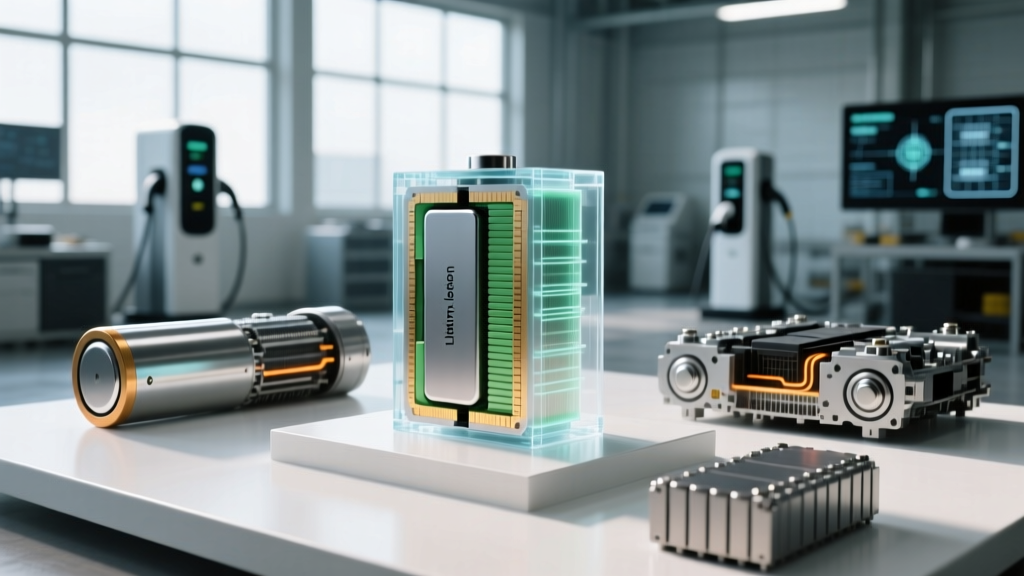
Not all lithium-ion batteries are created equal. In 2026, the two dominant chemistries in the U.S. EV market are lithium iron phosphate (LFP) and nickel manganese cobalt (NMC), with nickel cobalt aluminum (NCA) still used in some Tesla and legacy applications. The chemistry inside your cells affects energy density, charging behavior, lifespan, cold-weather performance, and cost — and automakers are increasingly splitting their lineups along these lines.
LFP chemistry has surged in adoption. Tesla's Model 3 and Model Y Standard Range variants, the Ford Mustang Mach-E Select, the base Hyundai Ioniq 5, and most entry-level EVs now ship with LFP packs. NMC remains the choice for long-range and performance trims where maximizing energy density in a limited physical space is critical.
| Attribute | LFP (Lithium Iron Phosphate) | NMC/NCA (Nickel-based) |
|---|---|---|
| Energy Density | Lower (~160-180 Wh/kg cell-level) | Higher (~220-260 Wh/kg cell-level) |
| Typical Use Case | Standard range trims, fleet vehicles | Long range, performance trims |
| Cycle Life | 3,000-5,000+ cycles to 80% capacity | 1,000-2,000 cycles to 80% capacity |
| Cold-Weather Performance | Greater range loss in freezing temps (15-30%) | Better low-temp discharge; 10-20% range loss |
| Charging to 100% Daily | Recommended — no degradation penalty | Discouraged — accelerates wear above 80-90% |
| Thermal Stability | Excellent — less prone to thermal runaway | Good — requires robust BMS and cooling |
| Cost (per kWh) | Lower — no cobalt or nickel | Higher — commodity-sensitive materials |
| State of Charge Estimation | Flatter voltage curve makes SoC harder to gauge | Steeper voltage curve = easier SoC estimation |
| Weight for Same Range | Heavier pack needed | Lighter pack for equivalent kWh |
Which is better? Neither is universally superior. If you commute 40 miles daily, can charge at home, and live in a mild climate, LFP's longer cycle life and tolerance for daily 100% charges make it the pragmatic choice. If you regularly drive 250+ miles between charges, need maximum range in cold weather, or tow frequently, NMC's energy density advantage is worth the trade-off in cycle life.
How Long Do EV Batteries Actually Last?
The short answer: far longer than most buyers fear. According to data aggregated by Recurrent Auto, which tracks over 15,000 EVs in real-world conditions, the average EV battery retains approximately 90-95% of its original capacity after 5 years and 85-90% after 8 years / 100,000 miles. Catastrophic failure requiring full replacement within the warranty period is rare — typically affecting well under 2% of vehicles.
However, degradation is not linear. Most packs experience a steeper initial drop of 2-5% in the first year or 20,000 miles as the solid electrolyte interphase (SEI) layer stabilizes, then settle into a slow, nearly linear decline of roughly 1-2% per year thereafter.
| Age / Mileage | Average Capacity Retained | Notes |
|---|---|---|
| Year 1 / 15,000 mi | 95-97% | Initial SEI formation; most visible drop |
| Year 3 / 45,000 mi | 92-94% | Steady-state degradation begins |
| Year 5 / 75,000 mi | 89-92% | Still well above warranty threshold |
| Year 8 / 100,000 mi | 85-90% | Federal warranty minimum: 70% at 8yr/100k |
| Year 10 / 150,000 mi | 80-87% | Most packs still functional; some may approach threshold |
| Year 15 / 200,000+ mi | 75-83% | LFP packs often still above 80% here |
Data synthesized from Recurrent Auto fleet studies, Geotab battery health reports, and manufacturer warranty claim rates. Individual results vary based on climate, charging habits, and chemistry.
LFP packs consistently outperform NMC in long-term retention. Tesla's LFP-equipped Model 3 Standard Range vehicles have shown median retention above 92% at 100,000 miles in Recurrent's dataset, compared to roughly 88% for comparable NMC packs. This aligns with LFP's fundamentally more stable crystal structure, which resists the micro-cracking that degrades NMC cathodes over repeated charge cycles.
What the Battery Warranty Actually Covers
Federal law mandates a minimum battery warranty of 8 years / 100,000 miles for all EVs sold in the U.S. (California and states that follow CARB standards require 10 years / 150,000 miles). But the details matter enormously.
| Manufacturer | Warranty Period | Capacity Threshold | What Triggers a Claim |
|---|---|---|---|
| Tesla (Model 3/Y LFP) | 8 yr / 120,000 mi | 70% retention | SoC drops below 70% of original kWh |
| Tesla (Model S/X) | 8 yr / 150,000 mi | 70% retention | Same; higher mileage cap |
| Hyundai / Kia | 10 yr / 100,000 mi | 70% retention | Longest standard period in market |
| Ford (Mach-E, F-150 Lightning) | 8 yr / 100,000 mi | 70% retention | Standard federal minimum |
| GM (Ultium-based) | 8 yr / 100,000 mi | 70% retention (60% for Bolt-based) | Varies by platform |
| Rivian | 8 yr / 175,000 mi | 70% retention | Highest mileage cap among startups |
| BMW / Mercedes-Benz | 8 yr / 100,000 mi | 70% retention | Standard; module-level repair offered |
The critical number is the capacity retention threshold. Nearly every manufacturer sets this at 70% — meaning your battery must degrade below 70% of its original usable capacity before the warranty applies. A 75 kWh pack that drops to 53 kWh qualifies; a drop to 55 kWh does not, even though you've lost 20 kWh of range.
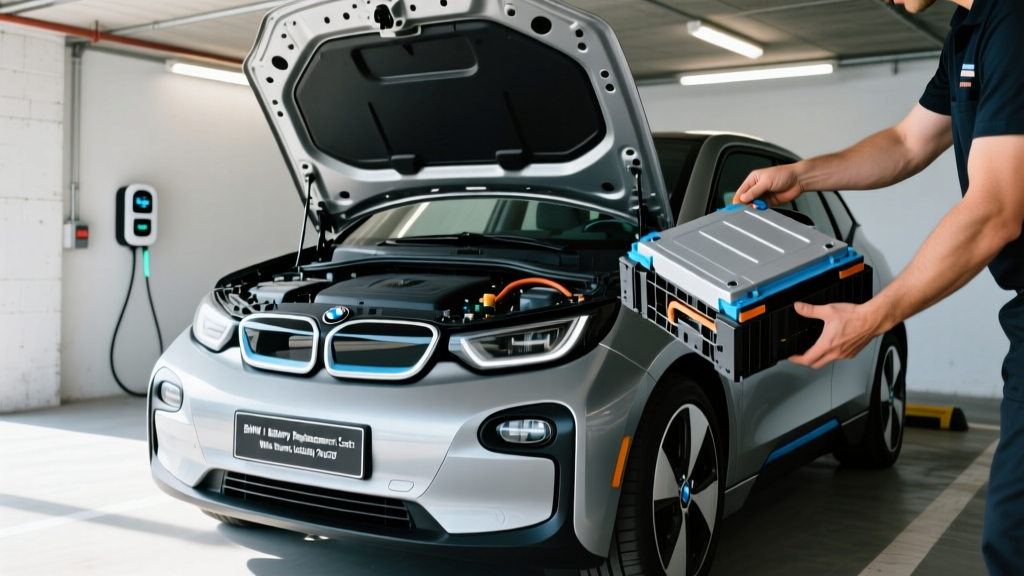
Warranty coverage typically includes the battery management system (BMS), contactors, and cooling components integral to the pack. It does not cover damage from collisions, flooding, improper charging equipment, or modifications. Some manufacturers offer module-level replacement (swapping individual degraded modules rather than the entire pack), which reduces repair complexity but may not restore the pack to 100% original capacity.
Per the EPA, EV batteries are designed to last the lifetime of the vehicle, and warranty claims remain uncommon across all major brands.
EV Battery Replacement Costs: The Numbers
This is where anxiety spikes — but context is essential. Full battery replacement is rare within the first 10-15 years of ownership. When it does become necessary, costs vary dramatically by pack size, chemistry, and whether the manufacturer supports module-level service.
| Vehicle / Platform | Pack Size (kWh) | Chemistry | Full Pack Replacement | Module Repair (if available) |
|---|---|---|---|---|
| Tesla Model 3 Standard Range | 60 kWh | LFP | $8,000 - $12,000 | $2,500 - $4,000 per module group |
| Tesla Model Y Long Range | 75 kWh | NMC | $12,000 - $16,000 | Limited module service |
| Hyundai Ioniq 5 (Long Range) | 77.4 kWh | NMC | $10,000 - $15,000 | $3,000 - $5,000 per module |
| Ford F-150 Lightning (Extended) | 131 kWh | NMC | $20,000 - $28,000 | Module-level service available |
| Chevrolet Silverado EV | 200 kWh | NMC (Ultium) | $25,000 - $35,000 | Module service (Ultium architecture) |
| Nissan LEAF (40 kWh) | 40 kWh | NMC | $6,500 - $9,000 | Full swap only; no modular repair |
Several trends are working in owners' favor. Battery pack costs have fallen from over $1,000/kWh in 2010 to roughly $100-$130/kWh at the cell level in 2026, according to BloombergNEF. GM's Ultium platform and Tesla's structural pack designs are engineered for module-level service, meaning a single degraded module can be replaced for a fraction of a full-pack swap. Independent EV repair shops are also emerging, offering refurbished packs at 40-60% of OEM pricing for older models.
The realistic takeaway: unless you plan to drive your EV past 200,000 miles or keep it for 15+ years, the probability of needing a battery replacement at your own expense is low. The battery will very likely outlast the rest of the vehicle's useful life.
Factors That Accelerate (or Preserve) Battery Health
Not all miles are equal when it comes to battery wear. Five variables dominate the degradation equation:
1. State of Charge Habits
For NMC/NCA batteries, sustained high SoC accelerates electrolyte oxidation and cathode micro-cracking. The practical rule: charge to 80% for daily use and reserve 100% charges for road trips. For LFP batteries, manufacturers like Tesla and Ford recommend charging to 100% at least once per week because the flat voltage curve makes SoC calibration difficult at partial charges. Daily 100% on LFP causes negligible additional wear.
2. DC Fast-Charging Frequency
High-rate DC charging (150+ kW) generates significant heat inside the cells. Occasional fast charging on road trips has minimal impact — modern thermal management systems precondition the pack to manage this. But daily reliance on DC fast charging, especially in hot climates without preconditioning, measurably accelerates degradation. Studies from the Idaho National Laboratory showed vehicles that exclusively DC fast-charged exhibited roughly 2-3% more degradation over 50,000 miles compared to those using Level 2 AC charging.
3. Temperature Extremes
Batteries prefer the same temperatures humans do: roughly 60-80°F (15-27°C). Prolonged exposure to ambient temperatures above 95°F — especially at high SoC — stresses the electrolyte. Extreme cold doesn't degrade the battery permanently but temporarily reduces available capacity and slows charging speeds (which is why preconditioning matters). Vehicles with active liquid cooling and heat pumps (standard on most 2026 EVs) manage this far better than older passive-cooled designs.
4. Depth of Discharge
Regularly draining the battery to near 0% and then charging to 100% creates larger mechanical stress on the electrodes than partial cycling. Shallow cycles — say, 30% to 70% — are gentler. You don't need to obsess over this, but avoiding consistent 0-100% swings on NMC packs extends longevity.
5. Calendar Aging
Even a parked EV battery degrades over time. Calendar aging is driven by temperature and SoC: a pack stored at 100% SoC in a hot garage will lose more capacity to time alone than one stored at 50% in a cool garage. If your EV will sit unused for weeks, aim for roughly 50% SoC and a shaded or climate-controlled space.
How to Monitor Your Battery's State of Health
State of Health (SoH) is the percentage of original usable capacity your battery retains. A new pack has 100% SoH; a pack that originally held 75 kWh but now holds 67.5 kWh sits at 90% SoH.
Built-in tools: Tesla's app and in-car service menu display battery health metrics. Hyundai and Kia's infotainment systems include an EV battery health indicator on recent models. Ford's Pass app shows estimated range trends that indirectly reflect degradation.
OBD-II diagnostics: Third-party tools like OBDeleven, LeafSpy (for Nissan), and Scan My Tesla read the BMS directly, showing cell-level voltage variance, total energy capacity, and cycle counts. A Bluetooth OBD-II adapter ($30-$50) paired with these apps gives far more granular data than the manufacturer's dashboard display.
Third-party tracking: Recurrent Auto offers a free service that connects to your vehicle's telematics and tracks your battery's degradation curve over time, benchmarked against similar vehicles in their fleet. This is particularly useful for establishing a baseline if you buy a used EV and want to document its health trajectory.
What to watch for: Sudden drops in displayed range that aren't explained by temperature, individual cell voltage variance exceeding 100 mV (indicating a weak module), or a rapid acceleration in the degradation curve. Any of these warrant a diagnostic visit before the warranty period expires.
Emerging Battery Tech: What's Realistic and When
The battery lab pipeline is full of promising chemistries, but the gap between a lab cell and a mass-produced, automotive-grade pack that meets cost, safety, and cycle-life requirements is typically 5-10 years. Here's where the most-discussed technologies stand in 2026:
Solid-state batteries: Toyota has announced limited production of solid-state-equipped vehicles for 2027-2028, targeting 750 km (WLTP) range and 10-minute fast charging. QuantumScape's cells have been validated by Volkswagen for pilot production. However, manufacturing yield challenges and cost remain significant barriers. Expect solid-state to appear first in low-volume, premium applications before reaching mainstream pricing — realistically not before 2030 for vehicles under $50,000.
Silicon-dominant anodes: Companies like Sila Nanotechnologies and Group14 are replacing graphite anodes with silicon composites, boosting energy density by 20-40% at the cell level. Mercedes-Benz's upcoming G-Class EV is expected to feature silicon anode cells from Group14. This technology is closer to scale than solid-state and will likely appear in several 2027-2028 models.
Sodium-ion batteries: CATL has begun mass-producing sodium-ion cells for use in lower-cost Chinese-market EVs. Energy density is roughly 30% below LFP, making sodium-ion suitable for city cars and short-range applications. U.S. availability is not expected before 2028 at the earliest.
Condensed-matter batteries: CATL's condensed-matter cells, announced in 2023, claim energy densities above 500 Wh/kg — theoretically enabling 600+ mile ranges. These are currently being evaluated for aviation and premium automotive use. Mass-market adoption is years away.
All of these technologies are forward-looking and not yet available in current-production U.S.-market vehicles. Buyers should make purchasing decisions based on today's proven LFP and NMC platforms rather than waiting for next-generation chemistries that remain in pilot or validation phases.
Frequently Asked Questions
How long do EV batteries last in years and miles?
Most modern EV batteries are designed to last 15-20 years or 150,000-200,000+ miles before dropping below 70% of original capacity. Real-world fleet data from Recurrent Auto shows median retention of 85-90% at the 8-year / 100,000-mile mark. LFP chemistries often exceed 90% at that same milestone. Full failure requiring replacement within the first decade is statistically rare.
How much does an EV battery cost to replace?
Full pack replacement ranges from approximately $6,500 for a 40 kWh Nissan LEAF pack to $25,000-$35,000 for large packs like the 200 kWh Chevrolet Silverado EV Ultium battery. Most mainstream 75-80 kWh packs fall in the $10,000-$16,000 range. Module-level repairs, where supported, cost $2,500-$5,000 per module. Cell-level pricing continues to decline, and refurbished packs offer additional savings for out-of-warranty vehicles.
What does the EV battery warranty cover?
Federal law requires a minimum of 8 years / 100,000 miles (10 years / 150,000 miles in CARB states). Coverage applies when the battery's usable capacity falls below a specified threshold — typically 70% of original capacity — as measured by the BMS. The warranty covers the battery pack, BMS, and integrated cooling components. It does not cover external damage, misuse, or modifications. Check your specific manufacturer's warranty documentation for exact terms.
How do I check and maximize my EV battery health?
Monitor SoH through your vehicle's built-in diagnostics, OBD-II apps (LeafSpy, Scan My Tesla, OBDeleven), or services like Recurrent Auto. To maximize longevity: for NMC packs, charge to 80% daily and avoid prolonged storage at 100%; for LFP packs, charge to 100% regularly for calibration. Minimize daily DC fast charging when Level 2 is available. Park in shade or a garage when possible. Precondition the battery before fast charging in cold weather. Avoid routinely draining below 10%.
LFP vs NMC — which battery chemistry is better for me?
Choose LFP if you primarily commute, charge at home, want the longest possible cycle life, live in a moderate climate, and don't need maximum range. LFP tolerates daily 100% charging and offers 3,000+ charge cycles. Choose NMC/NCA if you need maximum range per charge, regularly drive in cold weather, tow heavy loads, or take frequent long road trips where energy density matters. NMC offers more range in a lighter, smaller pack but benefits from 80% daily charge limits for longevity.
Does frequent fast charging ruin my battery?
Not ruin, but it does add wear. Modern thermal management systems precondition the pack to handle high charge rates safely. Occasional DC fast charging on road trips has negligible impact. The concern arises with daily reliance on 150+ kW DC charging, particularly in hot climates. Idaho National Lab testing showed roughly 2-3% additional degradation over 50,000 miles for vehicles that exclusively DC fast-charged versus Level 2. If you have home Level 2 access, use it for daily charging and save DC fast charging for trips.
Will my EV battery need to be replaced before I sell the car?
Statistically, very unlikely. The vast majority of EV batteries outlast the vehicle's first ownership cycle and remain well above the 70% warranty threshold at 10 years. Battery replacement typically becomes a consideration only for vehicles exceeding 200,000 miles or 15+ years of service. For most buyers, battery longevity should inform confidence in the purchase, not anxiety about the next owner's problem.