Why a Minivan Owner Might Be Researching EV Batteries in 2026
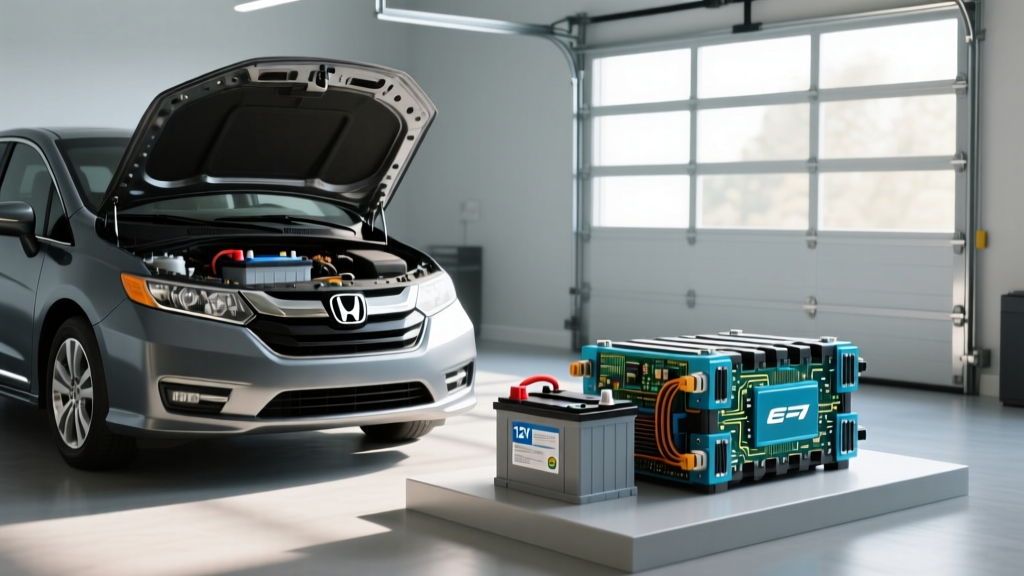
If you've searched for a battery for 2014 Honda Odyssey, you're almost certainly dealing with a familiar problem: the 12-volt auxiliary battery in your minivan is dying. That's a $150–$250 Group 24F lead-acid or AGM swap at any auto parts store. But the moment you start comparing that routine repair to the high-voltage traction batteries powering modern electric vehicles, the two worlds look radically different — in chemistry, cost, lifespan, and what "replacement" actually means.
This guide bridges that gap. We'll walk through exactly what's inside today's EV battery packs (LFP vs. NMC/NCA), what degradation looks like with real-world data, how warranties protect you, what a replacement actually costs in 2026, and how to monitor and maximize State of Health (SoH). Along the way, we'll keep the 2014 Odyssey's humble 12V system as a reference point so the scale of EV battery technology becomes concrete.
The 12V Battery for 2014 Honda Odyssey: A Quick Baseline
The 2014 Honda Odyssey uses a Group 24F 12V lead-acid battery (typically 60–70 Ah, ~700 CCA). It powers the starter motor, lights, infotainment, and ECU — nothing else. Expect a lifespan of 3–5 years in moderate climates, shorter in extreme heat. Replacement cost in 2026 runs $140–$260 for the part, plus $20–$50 for installation if you don't DIY. This is the comparison anchor for everything that follows.
EV Traction Battery Chemistry: LFP vs. NMC/NCA Explained
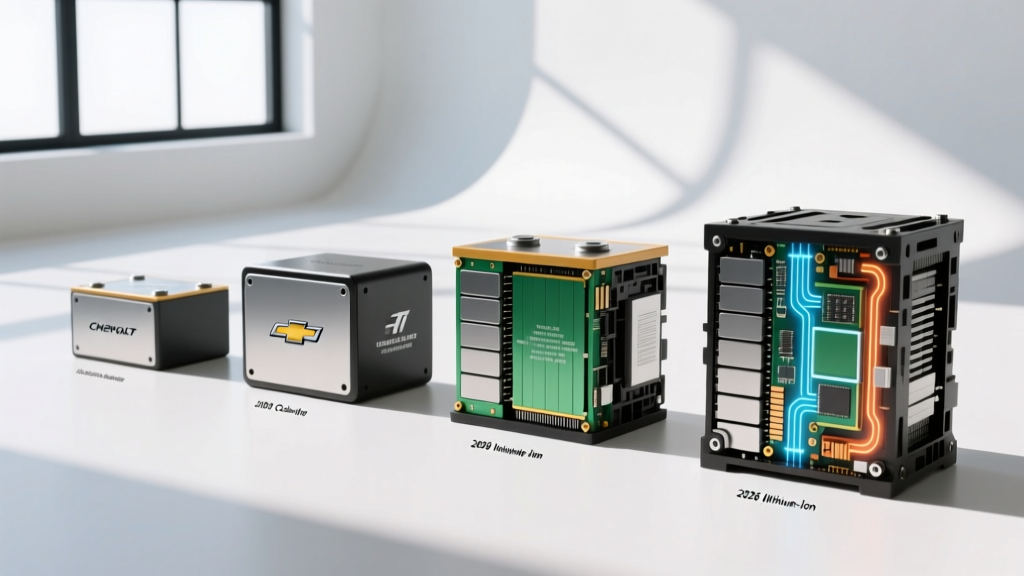
Modern EVs use lithium-ion traction batteries operating at 300–800 volts, storing 50–130+ kWh of usable energy. Two dominant chemistries dominate the 2026 market:
- LFP (Lithium Iron Phosphate): Used in Tesla Model 3 RWD, base Ford Mustang Mach-E, many Chinese-market EVs. No cobalt or nickel.
- NMC (Nickel Manganese Cobalt) / NCA (Nickel Cobalt Aluminum): Used in Tesla Model Y Long Range, Hyundai Ioniq 5, Rivian R1T, most long-range and performance trims.
| Attribute | LFP (LiFePO₄) | NMC / NCA |
|---|---|---|
| Energy Density (Wh/kg, cell-level) | 160–200 | 250–300+ |
| Cycle Life (to 80% capacity) | 3,000–6,000+ | 1,000–2,500 |
| Cold-Weather Performance (−10°C range loss) | ~25–35% | ~15–25% |
| Cost (per kWh, pack-level 2026 est.) | $80–$110 | $110–$150 |
| Thermal Stability / Safety | Excellent (higher runaway threshold) | Good (requires robust BMS) |
| Optimal Daily Charge Limit | 100% SoC OK | 80% SoC recommended for daily |
| Typical Use Case | Standard-range, fleet, budget EVs | Long-range, performance, AWD |
Which is better? Neither is universally superior — it depends on your use case. If you want maximum range in cold climates and don't mind charging to 80% daily, NMC delivers more miles per kilogram. If you prioritize longevity, lower cost, and the simplicity of charging to 100% without degradation worry, LFP is the pragmatic pick. Many 2026 EV buyers in warm climates are choosing LFP-equipped trims specifically for the cycle-life advantage.
How Long Do EV Batteries Actually Last? Real Degradation Data
The single most common fear among EV shoppers is that the battery will die prematurely and cost a fortune to replace. The data tells a different story: most modern EV batteries outlast the vehicle's body and suspension components.
Observed Degradation Curves (fleet and owner-reported data, 2020–2026):
| Milestone | Avg. Capacity Retained (NMC) | Avg. Capacity Retained (LFP) |
|---|---|---|
| 1 year / 15,000 mi | ~96–98% | ~97–99% |
| 3 years / 45,000 mi | ~92–95% | ~95–98% |
| 5 years / 75,000 mi | ~88–93% | ~92–96% |
| 8 years / 120,000 mi | ~82–90% | ~88–95% |
| 10 years / 150,000 mi | ~78–87% | ~85–93% |
Sources: Geotab fleet data, Recurrent Auto battery health reports, owner surveys on InsideEVs and Tesla Motors Club.
Notice the pattern: degradation is steepest in year one (the so-called "formation loss"), then flattens into a slow, linear decline. A 2022 Hyundai Ioniq 5 with an NMC 77.4 kWh pack driven 60,000 miles today typically retains 90–93% of original capacity — a loss of roughly 5–8 kWh of usable energy, translating to maybe 15–20 fewer miles of EPA range. Noticeable? Barely. Catastrophic? Not even close.
For contrast, your 2014 Odyssey's 12V battery will likely need full replacement every 3–5 years — a far more aggressive lifecycle than any modern EV traction pack.
What Does the EV Battery Warranty Cover?
Federal law in the U.S. mandates that EV battery warranties cover a minimum of 8 years / 100,000 miles (in California Air Resources Board states, it's 10 years / 150,000 miles). Most manufacturers set the capacity retention threshold at 70% — meaning if your pack drops below 70% of its original usable kWh within the warranty period, the manufacturer must repair or replace it at no cost to you.
| Manufacturer (2026 Models) | Warranty Period | Capacity Threshold | Notes |
|---|---|---|---|
| Tesla (Model 3/Y) | 8 yr / 120,000 mi (LWD) or 100,000 mi (AWD) | 70% | Covers defects + degradation below threshold |
| Hyundai / Kia | 10 yr / 100,000 mi | 70% | Among the longest in the industry |
| Ford (Mach-E, F-150 Lightning) | 8 yr / 100,000 mi | 70% | Components covered separately 5/60 |
| Rivian | 8 yr / 175,000 mi | 70% | Higher mileage cap reflects truck use case |
| GM (Ultium platform) | 8 yr / 100,000 mi | 70% | Some commercial fleet variants differ |
Critical nuance: the warranty covers degradation below the threshold, not all capacity loss. If your 82 kWh pack is at 78% capacity (64 kWh) at year seven, that's above 70% and not a warranty claim. In practice, very few EVs breach the 70% line within the warranty window under normal use — the chemistry is simply more durable than most buyers assume.
EV Battery Replacement Cost: The Real Numbers
When replacement is eventually needed — typically beyond 150,000–200,000 miles or 12–15+ years for most packs — here's what it costs in 2026:
| Battery Size / Vehicle Class | Replacement Cost Range (Parts + Labor) | Typical Replacement Trigger |
|---|---|---|
| 40–60 kWh (compact EV, e.g., Nissan Leaf, base Bolt) | $6,000 – $10,000 | Cell imbalance, age-related degradation past 12+ years |
| 70–90 kWh (mid-size crossover, e.g., Model Y, Ioniq 5) | $10,000 – $16,000 | Rare before 200,000 mi; usually module-level repair |
| 100–135 kWh (large SUV/truck, e.g., F-150 Lightning, Rivian R1T) | $15,000 – $25,000 | Very rare; modular packs allow partial replacement |
Two important realities soften these numbers:
- Module-level repair is increasingly common. Many packs (especially Ultium, Tesla structural, and Hyundai E-GMP) allow technicians to replace individual modules rather than the entire pack, cutting costs by 60–80%.
- Pack prices continue falling. BloombergNEF data shows average pack prices dropped from ~$1,200/kWh in 2010 to roughly $115/kWh in 2025. A replacement pack in 2030 will likely cost significantly less than today's figures.
Compare this to the 2014 Odyssey's 12V battery: $150–$250 every 3–5 years. Over 15 years, that's $450–$1,250 in 12V batteries alone — and you're still buying gasoline. The EV's traction battery is a one-time (if ever) event, usually occurring after the car's economic life has ended anyway.
Factors That Accelerate (or Preserve) Battery Life
Not all miles are equal when it comes to degradation. Here's what actually moves the needle on your pack's lifespan:
Battery Care Checklist for Maximum Longevity
- Limit DC fast charging to road trips. Frequent 150+ kW DCFC sessions (multiple times per week) accelerate degradation by 1–3% over 5 years vs. primarily Level 2 home charging. The sustained high current generates heat that stresses cells. (NREL research confirms this pattern.)
- Avoid extreme State of Charge storage. Don't leave your NMC vehicle sitting at 100% SoC for days. For daily driving, set the charge limit to 80% (NMC) or 100% (LFP — LFP chemistry tolerates full charge without the same stress). If storing for weeks, aim for ~50% SoC.
- Use preconditioning in cold weather. Most EVs (Tesla, Hyundai, Ford, Rivian) let you precondition the battery via the app before driving or charging. This warms the cells to optimal temperature (~25–35°C), reducing lithium plating risk during regen braking and improving charge acceptance at DCFC stations.
- Park in shade or a garage when possible. Sustained battery temperatures above 40°C (104°F) — common in a Phoenix driveway in July — accelerate calendar degradation. A garage keeps the pack closer to ambient.
- Don't obsess about shallow vs. deep cycles. Unlike old nickel-cadmium batteries, lithium-ion doesn't have a "memory effect." Partial discharges (e.g., 60% → 30% → charge to 80%) are perfectly fine and arguably preferable to full 100% → 0% cycles.
How to Check Your Battery's State of Health (SoH)
State of Health (SoH) is the percentage of your battery's original usable capacity that remains. Here's how to monitor it in 2026:
In-Vehicle Displays
Many modern EVs show battery health directly. Tesla's service menu (accessible via the software screen) displays estimated range at 100% SoC, which you can compare to the original EPA figure. Hyundai's Bluelink app and Kia's UVO system provide SoH percentage readouts. Ford's MyFordPass includes a battery health indicator on newer model years.
OBD-II Dongles and Third-Party Apps
For vehicles without a built-in SoH display, an OBD-II Bluetooth adapter (such as the OBDLink SX or Vgate iCar Pro, ~$30–$50) paired with apps like LeafSpy (Nissan Leaf), Scan My Tesla, or ABRP's OBD integration can read the battery management system's internal SoH estimate, cell voltage deltas, and pack temperature.
Dealer Diagnostics
Any authorized service center can run a full battery health report. Request this during routine service visits — it's often free, and it creates a documented history useful for resale value.
The Manual Method
Track your actual energy consumption over time. Charge to 100% (or your set limit), note the displayed estimated range, drive a known distance, and note the energy consumed (kWh). Compare this to the vehicle's original rated efficiency (kWh/100mi from fueleconomy.gov). A consistent 10% increase in energy consumption over the first two years is a reasonable proxy for ~5–8% SoH loss.
What's Next? Solid-State and Silicon-Anode Batteries (Forward-Looking)
If you're shopping for an EV today, you've likely seen headlines about solid-state batteries promising 600+ miles of range and 10-minute charging. Here's the reality check:
- Solid-state batteries (replacing the liquid electrolyte with a solid ceramic or polymer) are in limited production as of 2025–2026, primarily from Toyota (in small volumes for select Japanese-market models) and QuantumScape (supplying Volkswagen for testing). Widespread commercial availability in mainstream U.S. EVs is not expected before 2028–2030. Projected benefits: 30–50% higher energy density, improved safety, faster charging. Projected challenge: manufacturing cost at scale.
- Silicon-anode batteries (replacing graphite anodes with silicon to boost energy density) are already shipping in limited applications — Sila Nanotechnologies supplies Mercedes-Benz for the G-Class EV, and Group14 supplies Porsche. Expect broader adoption in premium EVs by 2027–2028, with mainstream penetration by the early 2030s. Benefit: ~20% more energy density. Challenge: silicon expands ~300% during charging, requiring engineered composite structures.
Neither technology is available in a vehicle you can buy at a U.S. dealership today. If you need an EV now, current LFP and NMC chemistries are mature, well-understood, and backed by extensive warranty coverage. Waiting for solid-state means waiting 3–5+ years for uncertain pricing.
EV Battery FAQ: Quick Answers to Common Questions
How long do EV batteries last in years and miles?
Most modern EV batteries (2020+) retain 80–90% of original capacity at 10 years / 150,000 miles under normal use. They rarely require replacement before 200,000+ miles. The pack will likely outlast the vehicle's suspension, interior, and body panels.
How much does it cost to replace an EV battery in 2026?
Full pack replacement ranges from $6,000 (small packs) to $25,000 (large truck packs), but module-level repairs — which fix the problem at 20–40% of full-pack cost — are increasingly common. Most owners never need either during their ownership.
What does the federal EV battery warranty cover?
By law, minimum 8 years / 100,000 miles (10/150,000 in CARB states) against defects and degradation below ~70% of original capacity. This covers both manufacturing flaws and chemistry-related capacity loss. See IRS clean vehicle credit rules for how battery sourcing also affects tax credit eligibility.
LFP vs. NMC — which chemistry should I choose?
Choose LFP if you want maximum cycle life, lower cost, and the simplicity of 100% daily charging (ideal for commuters and warm-climate drivers). Choose NMC if you need maximum range per charge, better cold-weather performance, or are buying a long-range/performance trim. Both are proven and well-supported by warranties.
Does fast charging damage my EV battery?
Occasional DC fast charging (road trips, 1–2 times per week) has minimal impact. Daily DCFC use can accelerate degradation by an additional 1–3% over 5 years compared to Level 2 home charging. Modern battery management systems actively limit charge rate at high SoC and extreme temperatures to protect cells — the charge curve tapers significantly above 80% for this reason.
How is an EV traction battery different from the 12V battery in my 2014 Honda Odyssey?
The Odyssey's 12V battery is a ~1 kWh lead-acell unit that starts the engine and powers accessories. An EV's traction battery is a 50–135 kWh lithium-ion pack operating at 300–800V that propels the vehicle. They serve fundamentally different roles, cost 50–100x more, and last 3–5x longer. EVs also carry a separate 12V battery (often lithium-ion in newer models) for auxiliary systems — that one still needs occasional replacement, just like your Odyssey's.