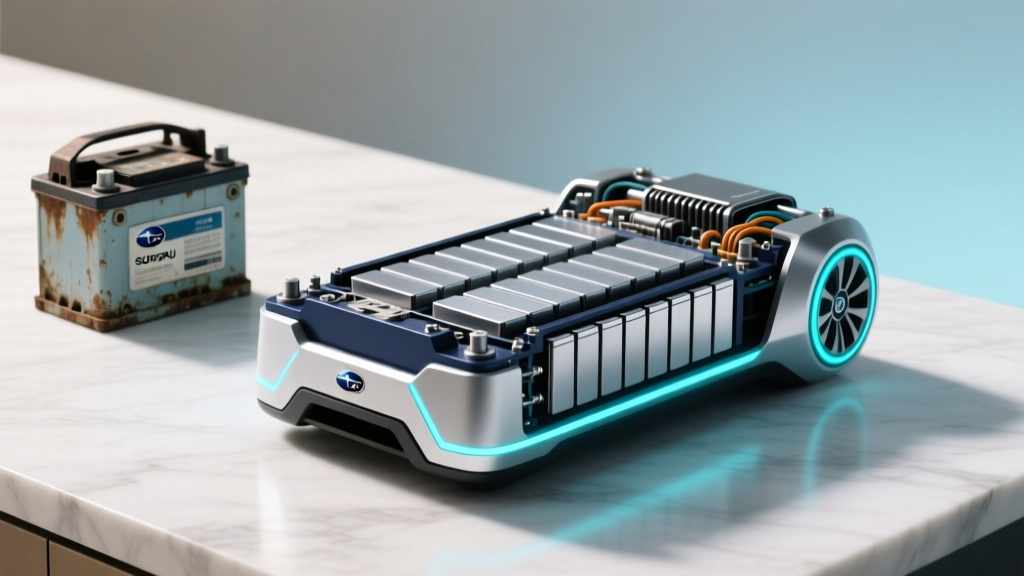
If you've ever replaced the 12V battery for a 2012 Subaru Outback, you know the drill: a $150–$220 lead-acid or AGM group 35 battery, maybe five years of life, and a simple swap in the driveway. But when people search for information about EV batteries, they're often carrying that same mental model into a completely different technology — one that costs 50 to 100 times more, stores energy at 400 volts instead of 12, and is engineered to outlast the car itself.
This guide breaks down exactly how modern EV traction batteries work, what chemistry is inside them, how long they actually last based on real-world fleet data, what it costs to replace one, and how to monitor and maximize battery health. Whether you're cross-shopping a new EV or just trying to understand what's under the floor of one, these are the numbers that matter.
Two Completely Different Batteries: 12V vs. High-Voltage Traction
Before we get into lithium-ion chemistry, let's clear up the single most common confusion in EV ownership — and the reason searches like "battery for 2012 Subaru Outback" sometimes land on EV content.
Your 2012 Outback has a conventional 12V lead-acid (or AGM) battery under the hood. It powers the starter motor, lights, infotainment, and ECU. It's a Group 35 size, produces about 0.6 kWh of usable energy, and typically needs replacement every 3–5 years at a cost of $150–$220 installed.
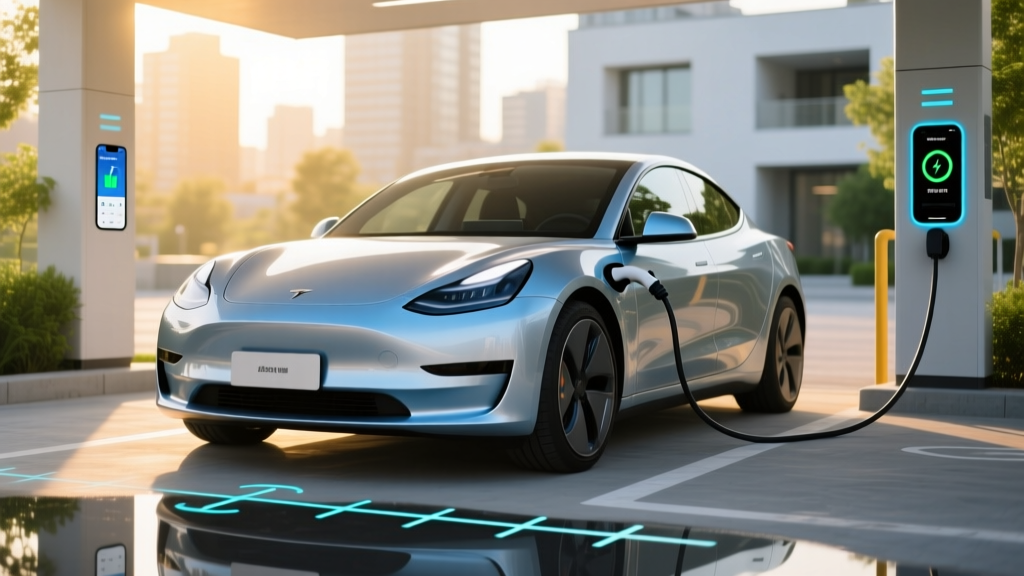
An EV's traction battery is an entirely different animal. It's a high-voltage (typically 350–800V) lithium-ion pack mounted in the vehicle floor, storing between 50 and 130+ kWh of energy. It powers the electric motor(s) and is the single most expensive component in the vehicle. Most EVs also carry a small 12V auxiliary battery (or a DC-DC converter in newer models like Teslas) to run accessories — but the traction pack is what determines range, performance, and long-term ownership cost.
This guide is about the traction battery. If you genuinely need a battery for a 2012 Subaru Outback, any auto parts store can match you to a Group 35 AGM — that's a straightforward purchase with no chemistry debates required.
LFP vs. NMC/NCA: The Chemistry Decision
Every EV sold in the US in 2026 uses one of two dominant lithium-ion chemistries in its traction pack. The choice between them affects range, longevity, cold-weather behavior, and price.
| Attribute | LFP (Lithium Iron Phosphate) | NMC/NCA (Nickel Manganese Cobalt / Nickel Cobalt Aluminum) |
|---|---|---|
| Energy Density | Lower (~160–180 Wh/kg cell-level) | Higher (~220–300 Wh/kg cell-level) |
| Typical Range Impact | Shorter range for same pack weight/size | More range per kg — preferred for 300+ mi vehicles |
| Cycle Life | 3,000–5,000+ cycles to 80% SoH | 1,000–2,000 cycles to 80% SoH |
| Cold-Weather Performance | More range loss below 32°F (~30–40% loss) | Better cold retention (~20–30% loss) |
| Charging to 100% Daily | Recommended — Tesla and Ford explicitly advise it | Not recommended — 80% daily limit advised |
| Cobalt/Nickel Content | Zero cobalt, zero nickel | Contains cobalt and/or nickel — supply-chain and cost exposure |
| Cost per kWh (2026) | ~$85–$100/kWh at pack level | ~$110–$140/kWh at pack level |
| Common In | Tesla Model 3/Y RWD, Ford Mustang Mach-E Select, base Chevy Equinox EV | Tesla Long Range/Performance, Hyundai Ioniq 5/6, Rivian, BMW iX, most luxury EVs |
Which is better? It depends on your use case. LFP wins on longevity, cost, and daily charging convenience — ideal for commuters who charge at home and don't need 320+ miles of range. NMC/NCA wins on energy density and cold-weather performance — the right call for road-trippers, cold-climate drivers, and anyone who wants maximum range from a given pack size. Neither is universally superior; the best chemistry is the one matched to how you actually drive.
How Long Do EV Batteries Actually Last?
The short answer: almost certainly longer than you'll own the car. The long answer requires looking at real fleet data rather than marketing claims.
According to fueleconomy.gov, most EV batteries are designed to retain at least 70–80% of their original capacity after 150,000–200,000 miles. Real-world data from Recurrent Auto (a battery analytics firm tracking over 15,000 EVs) shows that median degradation across major brands is approximately:
- Year 1: ~2–4% loss (initial settling — steepest part of the curve)
- Years 2–4: ~1–2% per year (gradual, linear decline)
- Year 5 (approx. 60,000–75,000 mi): ~8–12% total loss from new
- Year 8 (approx. 100,000–120,000 mi): ~12–18% total loss from new
- Year 10+ (150,000+ mi): ~15–25% total loss, depending on climate and charging habits
To put this in concrete terms: a 2023 Tesla Model 3 Long Range with an original EPA range of 358 miles would likely still deliver approximately 290–310 miles of range at year 8 and 100,000 miles. That's still more range than most new gas cars get on a tank — and still comfortably within the usable envelope.
Catastrophic battery failure (sudden, total loss of capacity) is rare. Data from manufacturer warranty claims and NHTSA reports suggest it affects well under 1–2% of packs within the warranty period. When it does happen, it's almost always covered under warranty.
For comparison, that 2012 Subaru Outback's original 12V battery likely died around year 4 or 5 — and you replaced it without a second thought. EV traction batteries are engineered for a completely different lifespan expectation.
What Does the Battery Warranty Cover?
Federal law (EPA emissions warranty requirements) effectively mandates that EV manufacturers warrant the traction battery for at least 8 years or 100,000 miles (whichever comes first). In California Air Resources Board (CARB) states — which include CA, CO, CT, ME, MD, MA, NJ, NY, OR, RI, VT, VA, WA, and others adopting CARB standards — the requirement extends to 10 years or 150,000 miles.
| Manufacturer | Warranty Period | Mileage Limit | Capacity Retention Threshold |
|---|---|---|---|
| Tesla (Model 3/Y LFP) | 8 years | 100,000 mi | 70% of original capacity |
| Tesla (Model 3/Y Long Range, S, X) | 8 years | 120,000 mi | 70% of original capacity |
| Hyundai / Kia (Ioniq 5, EV6, EV9) | 10 years | 100,000 mi | 70% of original capacity |
| Ford (Mach-E, F-150 Lightning) | 8 years | 100,000 mi | 70% of original capacity |
| Chevrolet (Equinox EV, Blazer EV, Silverado EV) | 8 years | 100,000 mi | 60–70% (varies by model) |
| BMW (i4, iX, i7) | 8 years | 100,000 mi | 70% of original capacity |
| Rivian (R1T, R1S) | 8 years | 120,000 mi (Dual-Motor) / 100,000 mi (single) | 70% of original capacity |
The critical number here is the capacity retention threshold — typically 70%. If your battery drops below 70% of its original capacity within the warranty period, the manufacturer is obligated to repair or replace it at no cost to you. In practice, very few owners ever hit this threshold. Most packs are still above 80% at the 8-year mark based on fleet data.
Important caveat: warranties cover defects and abnormal degradation. They do not cover damage from accidents, flooding, or aftermarket modifications. And they measure capacity, not range — so a drop from 358 to 250 EPA miles (70%) is the trigger, not your subjective feeling that range "isn't what it used to be."
EV Battery Replacement Cost: What the Numbers Show
This is where misinformation runs rampant. Let's anchor to actual figures from manufacturer service data and independent repair shops.
| Vehicle / Pack Size | Battery Size (kWh) | Full Pack Replacement Cost | Typical When Needed |
|---|---|---|---|
| Tesla Model 3 RWD (LFP) | ~60 kWh | $12,000–$16,000 | Rarely — most packs outlast 200,000 mi |
| Tesla Model Y Long Range | ~75 kWh | $14,000–$20,000 | Rarely within first 15 years |
| Hyundai Ioniq 5 | ~77.4 kWh | $15,000–$22,000 | Rarely within warranty period |
| Ford Mustang Mach-E ER | ~91 kWh | $18,000–$25,000 | Rarely within first 12 years |
| Ford F-150 Lightning ER | ~131 kWh | $25,000–$35,000 | Very large pack — rarely full replacement needed |
| Chevrolet Bolt EV/EUV (older, 2017–2023) | ~65 kWh | $14,000–$16,000 (post-recall pricing) | Recall-replaced packs have fresh warranty |
| Nissan Leaf (40/62 kWh) | 40–62 kWh | $8,000–$15,000 | Higher degradation risk — air-cooled design |
Context matters enormously here. A $20,000 battery replacement sounds terrifying — until you realize that:
- Most packs never need replacement. The vast majority of EVs will be retired, sold, or totaled before the traction battery fails.
- Warranty covers the most vulnerable period. If your pack degrades abnormally in the first 8–10 years, you're not paying.
- Module-level repair is increasingly common. Many shops can now replace individual battery modules (the pack is made of dozens of modules) for $2,000–$5,000 rather than swapping the entire pack.
- Prices are declining. Battery pack costs have fallen from over $1,000/kWh in 2010 to roughly $110–$140/kWh in 2026, and the trend continues downward.
Compare this to the 2012 Subaru Outback: over 14 years of ownership, you'd likely buy 3–4 replacement 12V batteries at $150–$220 each, plus multiple timing belt services ($800–$1,200), transmission fluid changes, and other ICE maintenance that an EV simply doesn't require. The total cost picture is more nuanced than the sticker-shock headline.
What Actually Kills an EV Battery — and How to Prevent It
Not all miles are equal when it comes to battery wear. Here are the factors that meaningfully accelerate degradation, ranked by impact based on fleet data:
Battery Care Checklist: Maximize Longevity
- Extreme heat exposure (highest impact): Prolonged exposure to ambient temperatures above 95°F, especially while parked at high state of charge, accelerates chemical degradation. Best practice: Park in shade or a garage when possible; avoid leaving the car at 100% SoC in summer heat for days.
- Frequent DC fast charging (high impact): Regularly using 150+ kW DC fast chargers generates significant heat within the cells. Occasional road-trip fast charging is fine; daily fast charging adds wear. Best practice: Use Level 2 home charging for daily needs; reserve DCFC for road trips.
- Sustained 100% state of charge (moderate-high impact for NMC/NCA): Keeping an NMC/NCA battery at 100% for extended periods stresses the cathode. LFP batteries are an exception — manufacturers recommend periodic 100% charges for accurate BMS calibration. Best practice: Set daily charge limit to 80% for NMC/NCA; charge to 100% only before long trips.
- Deep discharges to 0% (moderate impact): Regularly running the battery to near-zero stresses cells. Most EVs have a buffer (the "0%" on your dash isn't truly empty), but repeatedly hitting it isn't ideal. Best practice: Try not to regularly drop below 10–15% SoC.
- Cold-weather fast charging without preconditioning (moderate impact): Charging a cold battery at high power can cause lithium plating on the anode. Best practice: Use the vehicle's preconditioning feature (navigate to a charger via the car's nav system) to warm the pack before DCFC in cold weather.
- Infrequent use / long-term storage at extreme SoC (low-moderate impact): Storing an EV for weeks at 100% or 0% is harmful. Best practice: If storing for 2+ weeks, leave SoC around 50% and keep plugged in if possible so the BMS can manage the pack.
Follow these guidelines and the data suggests your battery will comfortably reach 200,000+ miles with 75–85% of its original capacity intact. Ignore all of them and you might see 70% retention by 120,000 miles — still within warranty for most brands.
How to Check Your Battery's State of Health (SoH)
State of Health (SoH) is the percentage of original capacity your battery can still hold. A new battery is 100% SoH; a degraded one might be 88%. Here's how to check it:
- In-vehicle displays: Some EVs (Nissan Leaf, some Hyundai/Kia models) show a battery health indicator directly in the instrument cluster or settings menu. Tesla does not natively display SoH percentage, though it shows current estimated range.
- OBD-II dongles + apps: Third-party tools like OBDLink SX/MX paired with apps such as EV Health or LeafSpy (for Nissan) can read the BMS-reported SoH directly. This is the most accessible method for most owners.
- Dealer diagnostic: Any authorized service center can run a full battery health report, typically during routine service. Ask specifically for a "traction battery SoH report."
- Recurrent / fleet analytics: Services like Recurrent allow owners to connect their vehicle data and receive ongoing battery health reports benchmarked against similar vehicles. This is particularly useful if you're buying a used EV and want an independent assessment.
- Manual calculation: Charge to 100% (or a known SoC), note the car's displayed range, and compare it to the original EPA range at the same SoC. This is approximate (temperature and driving style affect the displayed number) but gives a rough indicator.
If you're evaluating a used EV, SoH is the single most important data point — more important than odometer reading alone. A 60,000-mile EV with 94% SoH is in better battery shape than a 40,000-mile EV with 86% SoH that was repeatedly fast-charged in Phoenix summers.
What's Next: Solid-State and Silicon Anode Batteries
Several next-generation battery technologies are in development. Here's a realistic, hype-free timeline based on current manufacturer announcements and production data:
Silicon anode batteries: Companies like Sila Nanotechnologies and Group14 are already supplying silicon-dominant anode materials to manufacturers. These increase energy density by 15–25% over current graphite anodes. Expect broader adoption in 2027–2028 model-year vehicles. This is an incremental improvement, not a revolution — but it means more range from the same pack size.
Solid-state batteries: Toyota has announced a solid-state battery targeting 2027–2028 production with a claimed 460+ mile range and 10-minute fast-charge capability. Samsung SDI and QuantumScape are also pursuing solid-state designs. However, "production" here means limited, likely premium-vehicle deployment — not mass-market availability. Realistic widespread solid-state adoption is more likely in the 2030–2035 timeframe.
Sodium-ion batteries: CATL and BYD are deploying sodium-ion packs in Chinese-market vehicles. These are cheaper and cobalt-free but have lower energy density than even LFP. US availability is uncertain and likely years away, potentially for entry-level or fleet vehicles.
None of these technologies are available in any production vehicle you can buy in the US today. If you're making a purchase decision now, current LFP and NMC chemistries are mature, well-understood, and backed by real-world data from millions of vehicles on the road.
Frequently Asked Questions
How long do EV batteries last in years and miles?
Based on fleet data, most EV traction batteries retain 75–85% of original capacity at 150,000–200,000 miles (roughly 10–15 years of average driving). Catastrophic failure is rare (under 1–2% within warranty). Many packs will outlast the vehicle's useful life.
How much does an EV battery cost to replace?
Full pack replacement ranges from approximately $8,000 (Nissan Leaf) to $35,000 (Ford F-150 Lightning extended range). Most common mid-size EVs (Tesla Model 3/Y, Hyundai Ioniq 5) fall in the $12,000–$22,000 range. Module-level repair can reduce this to $2,000–$5,000. However, most packs never require replacement — they outlast the car.
What does the EV battery warranty actually cover?
Federally mandated minimum is 8 years/100,000 miles; CARB states require 10 years/150,000 miles. The warranty covers capacity loss below a threshold (typically 70% of original). It does not cover accident damage, flooding, or modifications. Check your specific manufacturer's terms — Hyundai/Kia offers 10 years/100,000 miles nationwide, which exceeds the federal minimum.
How do I check and maximize my EV battery's health?
Check SoH via in-vehicle displays, OBD-II apps, or dealer diagnostics. Maximize longevity by: using Level 2 home charging for daily needs, limiting NMC/NCA packs to 80% daily SoC, avoiding prolonged exposure to extreme heat at high SoC, preconditioning before cold-weather fast charging, and not regularly discharging below 10–15%.
LFP vs. NMC — which battery chemistry is better for me?
Choose LFP if you want maximum cycle life (3,000–5,000+ cycles), lower cost, and don't mind slightly less range or more cold-weather loss. Charge it to 100% freely. Choose NMC/NCA if you need maximum range (300+ miles), better cold-weather performance, or are buying a Long Range/Performance trim. Limit daily charge to 80%. Neither is universally better — match the chemistry to your driving pattern.
Does the 2012 Subaru Outback have an EV battery?
No. The 2012 Subaru Outback is a conventional gasoline vehicle with a standard 12V lead-acid/AGM battery (Group 35). If you need a replacement battery for a 2012 Subaru Outback, look for a Group 35 AGM battery from any major brand (Optima, Interstate, DieHard, Duralast) — expect to pay $150–$220. Subaru did not introduce a hybrid or electric Outback variant; the Solterra (Subaru's first EV, co-developed with Toyota) launched for the 2023 model year.