Why a 2013 Nissan Sentra Battery and an EV Pack Are Very Different Beasts
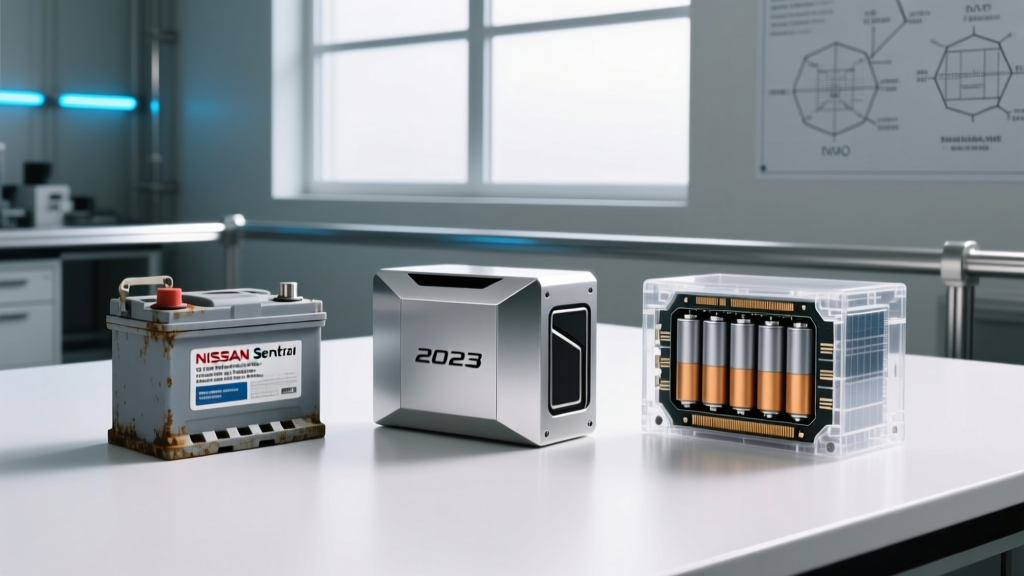
If you've searched for a battery for a 2013 Nissan Sentra, you're likely looking at a 12-volt lead-acid or AGM starter battery — the kind that cranks a 1.8-liter four-cylinder engine and powers your headlights. That battery weighs about 30–40 pounds, stores roughly 0.5 kWh of energy, and costs $120–$220 at an auto parts store.
An electric vehicle's high-voltage traction battery is an entirely different engineering domain. It stores between 40 and 120+ kWh of energy, weighs 600–1,500 pounds, uses lithium-ion chemistry, and costs $5,000–$20,000+ to replace. Understanding how these packs work, age, and eventually need service is essential whether you're shopping for a new EV in 2026 or trying to maximize the life of one you already own.
This guide covers everything from cell chemistry to real-world degradation data, warranty coverage, replacement economics, and the habits that extend pack life — all grounded in numbers, not marketing.
LFP vs. NMC/NCA: The Chemistry Decision That Shapes Your EV
Modern EV batteries use one of two dominant cathode chemistries: lithium iron phosphate (LFP) or nickel manganese cobalt / nickel cobalt aluminum (NMC/NCA). The choice affects range, longevity, cold-weather behavior, and price.
| Attribute | LFP (Lithium Iron Phosphate) | NMC / NCA (Nickel-Based) |
|---|---|---|
| Energy Density | ~160–180 Wh/kg (lower) | ~220–300 Wh/kg (higher) |
| Cycle Life | 3,000–6,000+ cycles to 80% SoH | 1,000–2,500 cycles to 80% SoH |
| Cold-Weather Performance | Reduced efficiency below 32°F; slower charge acceptance | Better low-temp discharge; still benefits from preconditioning |
| Cost (per kWh, 2026) | ~$80–$100/kWh at pack level | ~$110–$140/kWh at pack level |
| Thermal Stability | Excellent — less prone to thermal runaway | Good with active thermal management |
| Recommended Daily SoC | 100% OK (no degradation penalty) | 80% for daily use; 100% only for trips |
| Common 2026 Applications | Tesla Model 3/Y RWD, Ford Mustang Mach-E Select, BYD models | Hyundai Ioniq 5/6 Long Range, Rivian R1T, Chevy Silverado EV |
Which is better? It depends on your use case. If you commute short distances, charge at home nightly, and want maximum cycle life, LFP is the pragmatic pick. If you need maximum range per charge for road trips or live in a cold climate where every kWh matters, NMC/NCA's higher energy density is worth the trade-off. Neither chemistry is universally superior — they solve different problems.
How Long Do EV Batteries Actually Last?
The short answer: far longer than most buyers assume. Data from fleet operators, manufacturer reports, and independent testing consistently show that modern liquid-cooled lithium-ion packs lose roughly 10–15% of their original capacity over 150,000–200,000 miles.
- Tesla 2025 Impact Report: Model 3/Y packs retain ~88% capacity at 200,000 miles on average.
- Geotab fleet study (2024, 10,000+ EVs): Average annual degradation of 1.8% across all chemistries; LFP packs averaged 1.3%.
- Nissan Leaf (passive air-cooled, 2011–2017): Higher degradation — 20–30% loss over 8–10 years in hot climates — a cautionary tale for thermal management importance.
- Chevrolet Bolt EV/EUV (NMC, liquid-cooled): ~8–12% loss reported at 100,000 miles by owner communities.
The critical insight: degradation is non-linear. Most packs lose 2–5% in the first year (initial formation loss), then settle into a slow, roughly linear decline of 1–2% per year. A 2026 EV with a 75 kWh pack and 2% annual loss will still have ~63 kWh usable after 10 years — enough for 80%+ of its original EPA-rated range.
For comparison, the 12V battery in a 2013 Nissan Sentra typically needs replacement every 3–5 years. An EV traction battery is engineered for the life of the vehicle.
What the Battery Warranty Actually Covers
Federal law mandates a minimum EV battery warranty of 8 years / 100,000 miles (10 years / 150,000 miles in California Air Resources Board states). Most manufacturers exceed this baseline. The warranty guarantees the pack will retain a minimum percentage of its original capacity — typically 70% — and covers defects, premature cell failure, and thermal management system faults.
| Manufacturer / Model | Warranty Term | Capacity Retention Threshold | Notes |
|---|---|---|---|
| Tesla Model 3 (LFP, RWD) | 8 yr / 100,000 mi | 70% | Module-level replacement possible |
| Tesla Model Y (NMC, Long Range) | 8 yr / 120,000 mi | 70% | Higher mileage threshold |
| Hyundai Ioniq 5 | 10 yr / 100,000 mi | 70% | Among the longest terms |
| Ford Mustang Mach-E | 8 yr / 100,000 mi | 70% | Covers battery and hybrid components |
| Rivian R1T / R1S | 8 yr / 175,000 mi | 70% | Highest mileage cap in segment |
| Chevrolet Equinox EV | 8 yr / 100,000 mi | 60% (some trims 70%) | Verify threshold at purchase |
What's NOT covered: Normal capacity loss above the threshold (e.g., dropping from 100% to 75% over 8 years is considered normal wear), damage from accidents, flooding, or unauthorized modifications. Always read the specific warranty booklet — terms vary, and the capacity threshold is the number that matters most.
EV Battery Replacement Cost: When and How Much
Most EV owners will never need a full battery replacement. The pack is designed to outlast the vehicle's economic life. But for buyers of used EVs or those who plan to drive 300,000+ miles, replacement economics matter.
| Vehicle / Pack Size | Battery Capacity | Estimated Replacement Cost (Parts + Labor) | Typical Replacement Trigger |
|---|---|---|---|
| Nissan Leaf (40 kWh) | 40 kWh | $6,500–$9,000 | Capacity below 60–70%; common at 150k+ mi for early models |
| Chevrolet Bolt EV (65 kWh) | 65 kWh | $9,000–$14,000 | Rare; recall replacements were free |
| Tesla Model 3 (LFP, ~60 kWh) | ~60 kWh | $8,000–$12,000 | Extremely rare under 200k mi |
| Tesla Model S/X (100 kWh) | 100 kWh | $13,000–$20,000 | Older packs (2012–2018) seeing some failures |
| Ford F-150 Lightning (131 kWh) | 131 kWh | $18,000–$25,000+ | Too new for real-world data; under warranty |
| Hyundai Ioniq 5 (77.4 kWh) | 77.4 kWh | $11,000–$16,000 | Rare; strong thermal management |
These figures are out-of-warranty estimates. Module-level repairs (replacing individual cell groups rather than the entire pack) are increasingly common and can cost $2,000–$5,000, depending on the failure. Independent EV repair shops are expanding this capability as the first-generation EV fleet ages.
Context: a 2013 Nissan Sentra's 12V battery replacement costs $120–$220 — roughly 50–100x less than an EV traction pack. But the Sentra's battery needs swapping every 3–5 years, while an EV pack is a once-in-the-vehicle's-lifetime event, if ever.
Factors That Accelerate (or Preserve) Battery Life
Battery longevity isn't random. It's driven by a handful of measurable factors you can control.
- Avoid chronic DC fast charging: Frequent 150+ kW sessions stress cells. Use DC fast charging for road trips; rely on Level 2 (7–11 kW) for daily needs.
- Keep SoC between 20–80% for NMC/NCA: Storing at 100% accelerates calendar degradation. LFP packs tolerate 100% daily without penalty.
- Precondition before fast charging: Most EVs do this automatically when you navigate to a charger. A cold pack charges slowly and experiences more stress. Preconditioning warms cells to ~30–35°C for optimal charge acceptance.
- Park in shade or a garage in extreme heat: Sustained 100°F+ ambient temps with a high SoC is the worst-case degradation scenario. Liquid-cooled packs mitigate this, but passive-cooled packs (older Nissan Leafs) suffer significantly.
- Don't let the pack sit at 0% for extended periods: Deep discharge can trigger the low-voltage cutoff, potentially bricking modules. If storing, leave at ~50% SoC.
- Use scheduled charging: Set your EV to finish charging just before departure rather than sitting at full charge overnight.
The single biggest factor most owners overlook is state of charge dwell time. It's not charging to 100% that's harmful — it's sitting at 100% for hours or days. If you charge to 100% and leave immediately for a road trip, the impact is minimal. If you charge to 100% on Friday and don't drive until Monday, you've accelerated calendar aging unnecessarily.
How to Monitor Your Battery's State of Health
State of Health (SoH) is the percentage of original capacity your pack can still hold. A new pack is 100% SoH; a pack that held 75 kWh when new but now holds 67.5 kWh is at 90% SoH.
How to check SoH in 2026:
- In-vehicle displays: Tesla, Hyundai, BMW, and others now include SoH or battery health indicators in the settings menu or service screen.
- OBD-II apps: Tools like LeafSpy (Nissan), Scan My Tesla, or ABRP OBD can read pack voltage, cell balance, and estimated SoH directly from the BMS (Battery Management System).
- Dealer diagnostics: A service center can run a full capacity test — typically a controlled discharge/recharge cycle that measures actual kWh throughput.
- Manual calculation: Charge to 100%, note the displayed range, and compare it to the original EPA range. Adjust for temperature and driving style. This is imprecise but directionally useful.
For used-EV buyers, SoH is the single most important data point. A 2020 Model 3 with 92% SoH and 50,000 miles is a better bet than one with 84% SoH and 30,000 miles — the latter likely saw heavy fast charging or high-SoC storage.
What's Next: Solid-State and Silicon-Anode Batteries
Two technologies are frequently cited as the next leap in EV batteries. Here's where they actually stand as of 2026.
Solid-state batteries replace the liquid electrolyte with a solid conductor (ceramic, sulfide, or polymer). Promised benefits include 40–50% higher energy density, faster charging, and improved safety. Toyota has announced limited production in select 2027–2028 models; QuantumScape is supplying test cells to Volkswagen. However, manufacturing scale, cost, and cycle-life validation remain unresolved. Realistic consumer availability: 2028–2030 for early-adopter models; mainstream adoption unlikely before 2032.
Silicon-anode batteries replace graphite anodes with silicon, which can store roughly 10x more lithium ions per unit mass. Companies like Sila Nanotechnologies and Group14 are shipping silicon-dominant anodes in limited applications (Mercedes G-Class EV uses a silicon-anode pack from Group14). The trade-off: silicon expands ~300% during charging, requiring nanostructural engineering to prevent cracking. Realistic timeline: incremental adoption through 2026–2028, starting with premium vehicles.
Neither technology is available in a vehicle you can buy today at a mainstream price point. If you're shopping now, current-generation LFP and NMC packs — with their proven 200,000+ mile lifespans — are the rational choice.
Frequently Asked Questions
How long do EV batteries last in years and miles?
Most liquid-cooled EV batteries from 2020 onward are engineered for 200,000+ miles and 15+ years of service before reaching 70% of original capacity. Real-world fleet data shows average annual degradation of 1.5–2%, meaning a pack should retain 80–85% capacity after 10 years of typical use. Air-cooled packs (early Nissan Leafs) degrade faster, especially in hot climates.
How much does it cost to replace an EV battery?
Out-of-warranty replacement costs range from ~$6,500 for a small pack (40 kWh Nissan Leaf) to $25,000+ for a large pack (131 kWh Ford F-150 Lightning Extended Range). Module-level repairs, where only failed cell groups are replaced, can cost $2,000–$5,000. Most owners never face this expense because the pack outlasts the vehicle or is covered under the 8–10 year warranty.
What does the EV battery warranty cover?
Federal law requires at minimum 8 years / 100,000 miles of coverage (10/150,000 in CARB states). The warranty guarantees the pack retains at least 70% of original capacity (some manufacturers set 60%). It covers cell defects, BMS failures, and thermal management faults. It does not cover normal capacity loss above the threshold, accident damage, or unauthorized modifications. Always verify the specific retention threshold — it's the most important number in the warranty.
How do I check and maximize my EV battery health?
Check SoH via your vehicle's built-in battery health screen, an OBD-II diagnostic app, or a dealer capacity test. To maximize longevity: use Level 2 charging for daily needs, keep NMC/NCA packs between 20–80% SoC (LFP can go to 100%), precondition before DC fast charging, avoid prolonged storage at high SoC in hot weather, and don't let the pack sit at 0% for extended periods.
LFP vs. NMC — which battery chemistry should I choose?
Choose LFP if you prioritize longevity (3,000–6,000+ cycle life), lower cost, and daily home charging convenience (100% SoC is fine). Choose NMC/NCA if you need maximum range per charge for road trips, better cold-weather efficiency, or are buying a vehicle where energy density is critical (trucks, large SUVs). For most commuters, LFP is the pragmatic 2026 choice; for long-distance drivers, NMC/NCA remains preferable.
Is an EV battery anything like the battery for a 2013 Nissan Sentra?
No. The 2013 Sentra uses a 12V lead-acid starter battery (~0.5 kWh, $120–$220, replaced every 3–5 years) that cranks the engine and powers accessories. An EV traction battery is a 40–130+ kWh lithium-ion pack ($6,500–$25,000, designed to last 15+ years) that propels the vehicle. They share the word "battery" but have virtually nothing in common in chemistry, engineering, cost, or lifespan.
Sources: U.S. Department of Energy / fueleconomy.gov — EV Technology; IRS §30D Clean Vehicle Credit; NHTSA.