Search "battery aircraft" and you'll find headlines about electric planes promising zero-emission regional flights. But the aviation industry's electrification timeline depends entirely on breakthroughs happening right now in the electric-vehicle battery supply chain. Every kilowatt-hour of energy density gained on the ground inches battery-electric aircraft closer to viability. For today's EV buyer, that same technology determines real-world range, charging speed, decade-long durability, and eventual replacement cost.
This guide covers the battery chemistries powering 2026-model EVs, what the degradation data actually shows, how warranties protect you, what a replacement costs if you ever need one, and which emerging technologies might eventually lift electric aircraft off the runway.
LFP vs NMC/NCA: The Chemistry Decision Every EV Buyer Faces
Two lithium-ion chemistries dominate the 2026 EV market: LFP (lithium iron phosphate) and NMC/NCA (nickel manganese cobalt / nickel cobalt aluminum). The choice between them affects your range, charging habits, cold-weather performance, and long-term durability.
LFP cells use iron and phosphate in the cathode, avoiding expensive nickel and cobalt entirely. That makes them cheaper to produce — a key reason Tesla offers LFP packs in the Model 3 Standard Range and BYD equips most of its global lineup with its Blade LFP cells. The trade-off is lower energy density: LFP packs are heavier per kWh, which limits maximum range in a given vehicle footprint.
NMC and NCA chemistries pack more energy into less weight, enabling the 320-400+ mile EPA ranges seen in vehicles like the Hyundai Ioniq 5 Long Range, Tesla Model Y Long Range, and Rivian R1S. The cost is higher raw-material expense and a more complex degradation profile, particularly if you habitually charge to 100%.
| Attribute | LFP (Lithium Iron Phosphate) | NMC / NCA (Nickel-based) |
|---|---|---|
| Energy Density | ~160–180 Wh/kg (cell level) | ~220–300 Wh/kg (cell level) |
| Typical Cycle Life | 3,000–5,000+ cycles | 1,000–2,000 cycles |
| Cold-Weather Performance | Moderate — greater range loss below 32°F | Better low-temp conductivity |
| Cost per kWh (2026) | ~$90–$110 | ~$120–$155 |
| Recommended Daily SoC | 100% (LFP benefits from full charges) | 80% daily; 100% for trips only |
| Thermal Stability | Excellent — less prone to thermal runaway | Good — requires robust BMS/cooling |
| Example 2026 Vehicles | Tesla Model 3 RWD, BYD Seal, Ford Mustang Mach-E Select (LFP option) | Hyundai Ioniq 5 LR, Tesla Model Y LR, Rivian R1S, BMW iX |
Which is better? It depends on your use case. If you have home Level 2 charging, drive under 250 miles daily, and plan to keep the car 8+ years, LFP's longer cycle life and 100% daily charging convenience make it the practical choice. If you need maximum range for road trips, live in a cold climate, or tow frequently, NMC/NCA's energy density advantage matters more.
How Long Do EV Batteries Actually Last?
The short answer: almost certainly longer than you'll own the car. Recurrent Auto's 2025 fleet data covering over 15,000 EVs found that the average battery pack retains approximately 90–95% of original capacity at 5 years / 75,000 miles, and roughly 85–90% at 100,000 miles. Degradation is not linear — it's steepest in the first 1–2 years (typically 2–5% loss as the solid electrolyte interphase layer stabilizes), then flattens into a slow, predictable decline.
Real-world data points from widely studied models:
- Tesla Model 3/Y (NMC/NCA): ~3–4% loss at 30,000 miles; ~8–10% loss at 100,000 miles (Tesla's 2025 Impact Report claims average ~12% degradation at 200,000 miles across the fleet).
- Chevrolet Bolt EV/EUV (NMC): ~5–7% loss at 60,000 miles; some early 2017 models experienced accelerated degradation linked to full-charge storage in heat — addressed by software updates.
- Hyundai Ioniq 5 (NMC): ~4–5% loss at 50,000 miles based on owner-reported data; Hyundai's battery thermal management system is widely regarded as among the best.
- Tesla Model 3 RWD (LFP): Minimal measurable degradation in first 40,000 miles; LFP's cycle-life advantage means these packs are expected to outlast the vehicle chassis in most cases.
- Nissan LEAF (passive air cooling, older NMC): Historically the cautionary tale — 10–15%+ loss by 60,000 miles in hot climates due to lack of active liquid cooling. Modern liquid-cooled packs from all major OEMs avoid this problem.
The takeaway: liquid-cooled battery packs in 2026-model EVs are engineered to retain 70–80%+ capacity well beyond 150,000 miles. Catastrophic failure requiring full replacement is rare — well under 1% of packs according to warranty claim data from major manufacturers.
Battery Warranty Terms: What's Covered and What Isn't
Federal law mandates a minimum battery warranty of 8 years / 100,000 miles for EVs sold in the United States. In California and states that follow CARB (California Air Resources Board) emissions standards, that extends to 10 years / 150,000 miles. Most manufacturers exceed these minimums.
| Manufacturer (2026 Models) | Warranty Period | Capacity Retention Threshold | Notes |
|---|---|---|---|
| Tesla (Model 3/Y) | 8 yr / 120,000 mi (LR/AWD); 8 yr / 100,000 mi (RWD) | 70% | Long Range gets higher mile cap |
| Hyundai / Kia (Ioniq 5, EV6, EV9) | 10 yr / 100,000 mi | 70% | Among the longest standard coverage |
| Ford (Mustang Mach-E, F-150 Lightning) | 8 yr / 100,000 mi | 70% | Components covered separately |
| Rivian (R1T, R1S) | 8 yr / 175,000 mi | 70% | Higher mile threshold for adventure use |
| BMW (iX, i4) | 8 yr / 100,000 mi | 70% | Includes battery management system |
What the warranty covers: If your battery's usable capacity drops below the stated threshold (typically 70% of original) within the warranty period, the manufacturer will repair or replace modules or the full pack at no cost. This covers abnormal degradation — the kind caused by cell defects, BMS failures, or manufacturing issues.
What it does not cover: Normal, gradual capacity loss above the threshold. Damage from accidents, flooding, or unauthorized modifications. Some warranties exclude vehicles used commercially (rideshare, delivery) beyond certain mileage thresholds — check your specific terms.
EV Battery Replacement Cost: The Numbers and the Reality
This is the question that generates the most anxiety — and the most misinformation. Here are the actual replacement cost ranges for 2026-model-year battery packs, based on manufacturer service bulletins and independent shop data:
| Vehicle | Battery Size | Full Pack Replacement (Parts + Labor) | Module-Level Repair |
|---|---|---|---|
| Tesla Model 3 RWD (LFP) | ~60 kWh | $12,000–$15,000 | $2,500–$5,000 |
| Tesla Model Y Long Range | ~82 kWh | $16,000–$20,000 | $3,000–$6,000 |
| Hyundai Ioniq 5 Long Range | ~77.4 kWh | $14,000–$18,000 | $2,500–$5,500 |
| Ford F-150 Lightning Extended | ~131 kWh | $22,000–$30,000 | $4,000–$8,000 |
| Chevrolet Equinox EV | ~85 kWh | $14,000–$17,000 | $3,000–$5,000 |
| Rivian R1S (Max Pack) | ~149 kWh | $25,000–$35,000 | $5,000–$9,000 |
The critical context: Full pack replacement is exceedingly rare for vehicles under 150,000 miles. When issues do arise, they're typically isolated to one or two modules — not the entire pack. Modern battery packs are modular, and skilled EV technicians can replace individual modules for a fraction of the full-pack cost. Most EVs will be retired, traded, or sold before a full replacement is ever needed.
Battery costs have also been falling steadily. According to BloombergNEF, average lithium-ion pack prices dropped below $130/kWh at the cell level in 2025. By the time a 2026-model EV actually needs a replacement (likely 2036+), aftermarket and refurbished packs will almost certainly cost significantly less than today's figures.
Factors That Accelerate (or Preserve) Battery Health
Not all miles age a battery equally. Here's what the data shows about the biggest factors affecting lithium-ion longevity:
Habits That Preserve Battery Life
- Charge to 80% daily (NMC/NCA): Sustained high state of charge stresses nickel-based cathodes. Set your charge limit to 80% for daily driving; charge to 100% only before long trips. LFP owners can and should charge to 100% regularly — LFP cells benefit from periodic full charges for cell balancing and accurate SoC calibration.
- Use Level 2 home charging as your primary method: Slow, steady Level 2 charging (7–11 kW) generates far less heat than DC fast charging. Heat is the primary enemy of lithium-ion longevity.
- Precondition before fast charging: Most 2026 EVs automatically precondition the battery when you navigate to a DC fast charger. This brings the pack to optimal temperature (~95–104°F), reducing stress during high-power charging. If your car doesn't auto-precondition, do it manually via the app before arriving.
- Park in shade or a garage during extreme heat: Prolonged exposure to ambient temperatures above 95°F at high SoC accelerates calendar degradation. A garage or shaded spot makes a measurable difference over years.
- Drive it regularly: Batteries that sit at high SoC for weeks without use degrade faster than those cycled regularly. If storing for extended periods, leave the SoC around 50%.
Habits That Accelerate Degradation
- Frequent DC fast charging to 100%: Occasional fast charging is fine — the data shows negligible impact. But daily DCFC sessions, especially in hot weather, add cumulative thermal stress. One Recurrent Auto study found that vehicles that fast-charged more than 90% of the time showed slightly faster degradation than those that primarily used Level 2.
- Letting the battery sit at 0% or 100% for days: Both extremes stress the chemistry. If you arrive at 100%, drive it soon. If you're near 0%, plug in promptly.
- Towing heavy loads in extreme heat: Sustained high-current discharge generates significant pack heat. If you tow frequently with your EV (like the F-150 Lightning or Rivian R1T), monitor battery temperature via your app and allow cool-down periods.
How to Check Your Battery's State of Health (SoH)
State of Health (SoH) is the percentage of your battery's current maximum capacity relative to its original capacity. A new pack is 100% SoH; at 70% SoH, you've hit the typical warranty replacement threshold.
Here's how to monitor it:
- In-car displays: Some 2026 models (notably Hyundai/Kia EVs and certain BMWs) show a battery health percentage directly in the infotainment system or instrument cluster. Tesla does not natively display SoH in the vehicle UI.
- OBD-II diagnostic tools: Devices like the OBDLink MX+ paired with apps such as EV Health or LeafSpy (for Nissan) can read the battery management system's reported SoH directly. This is the most accurate consumer-accessible method.
- Third-party services: Companies like Recurrent offer battery health reports that compare your pack's degradation curve against a fleet of identical vehicles. Some dealerships now provide SoH printouts during service visits.
- Manual calculation: Track your actual range at a known SoC over time. If your car originally delivered 280 real-world miles at 90% SoC and now delivers 255 at the same SoC under similar conditions, that's roughly a 9% capacity loss.
One important note: don't confuse the high-voltage traction battery (the large pack that powers the drivetrain, typically 60–150 kWh) with the 12V auxiliary battery (a small lead-acid or lithium 12V unit that runs lights, infotainment, and computers). The 12V battery can fail like any conventional car battery and is a separate, inexpensive replacement — it has no bearing on your EV's range or SoH.
The Battery Aircraft Connection: From EVs to Electric Aviation
Why does EV battery technology matter for battery aircraft? Because electric aviation's biggest bottleneck is energy density. Jet fuel contains roughly 12,000 Wh/kg of energy. Today's best lithium-ion cells deliver about 250–300 Wh/kg at the cell level — a 40x gap. Even accounting for the superior efficiency of electric motors (~90% vs ~35% for jet turbines), battery-electric aircraft need packs at least 500 Wh/kg to be viable for regional commercial routes.
Here's where current and near-future technologies stand:
- Silicon-dominant anodes: Companies like Sila Nanotechnologies and Group14 are replacing graphite anodes with silicon, which can store roughly 10x more lithium ions per gram. Early production cells are appearing in consumer electronics, with automotive-grade cells expected by 2027–2028. Projected energy density: 350–400 Wh/kg at the cell level.
- Solid-state batteries: By replacing the liquid electrolyte with a solid ceramic, polymer, or sulfide material, solid-state cells promise higher energy density (400–500 Wh/kg projected), faster charging, and improved safety. Toyota, Samsung SDI, and QuantumScape have all demonstrated prototype cells, but mass production at automotive scale remains announced for 2028–2030 — and aviation-grade cells will follow later. These are not currently available in any production vehicle.
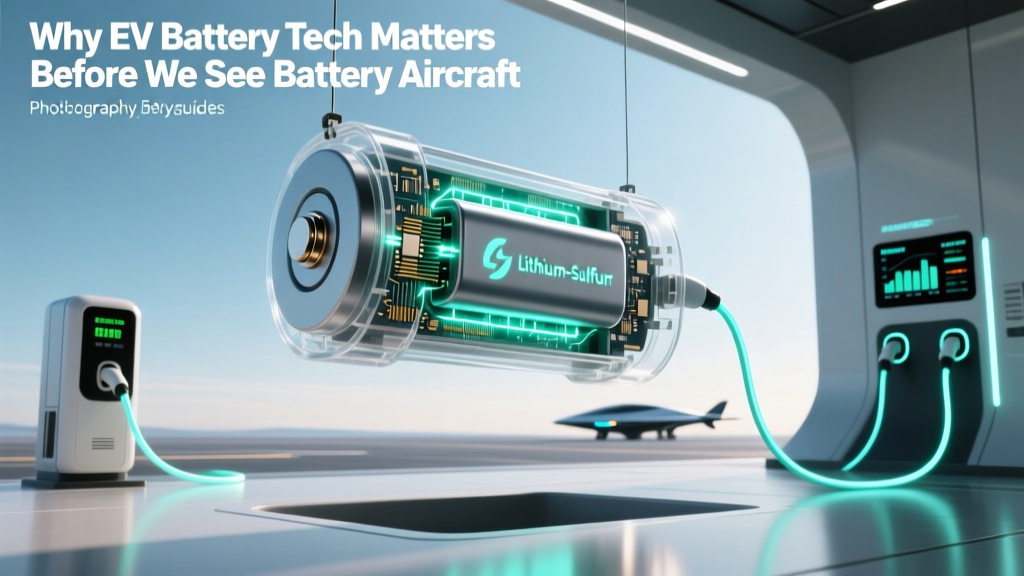
- Lithium-sulfur (Li-S): Theoretical energy density exceeds 2,500 Wh/kg, but cycle life remains a major challenge (currently under 200 cycles). Companies like Oxis Energy and Lyten are working on solutions, but Li-S is likely a 2032+ technology for practical applications.
The battery aircraft timeline depends on these advancements reaching production scale. Companies like Heart Aerospace (ES-30, a 30-seat hybrid-electric regional aircraft) and Eviation (Alice, a 9-passenger all-electric aircraft) are targeting certification in the late 2020s, but their initial range will be limited to 200–400 nautical miles — suitable for short regional hops, not transcontinental flights. The EV supply chain's continued investment in energy density is what will eventually make larger battery-electric aircraft feasible.
For today's EV buyer, the practical takeaway is this: the billions of dollars flowing into battery R&D for the automotive market — driven by demand for longer range, faster charging, and lower cost — is simultaneously advancing the technology that will power electric aircraft. The cells in your 2026 EV are the direct ancestors of tomorrow's aviation batteries.
Frequently Asked Questions
How long do EV batteries last in years and miles?
Modern liquid-cooled EV batteries are designed to retain 70–85%+ of original capacity at 150,000–200,000 miles, which translates to 15–20 years of average use (12,000–15,000 miles/year). Most packs will outlast the vehicle's useful life. Complete failure is rare — well under 1% based on warranty data.
How much does it cost to replace an EV battery?
Full pack replacement ranges from approximately $12,000 for a ~60 kWh pack (Tesla Model 3 RWD) to $30,000+ for a ~130–150 kWh pack (Ford F-150 Lightning Extended, Rivian Max Pack). However, full replacements are rare. Most issues involve individual modules, which cost $2,500–$8,000 to replace. By the time a 2026-model EV actually needs a new pack (likely 2036+), costs will almost certainly be lower due to continued price declines.
What does the EV battery warranty actually cover?
Federal law requires a minimum of 8 years/100,000 miles (10 years/150,000 miles in CARB states). The warranty covers capacity loss below a stated threshold (usually 70% of original) due to defects or abnormal degradation. It does not cover normal gradual capacity loss above the threshold, accident damage, or unauthorized modifications. Check your specific manufacturer's terms for commercial-use exclusions.
LFP vs NMC — which battery chemistry should I choose?
Choose LFP if: you want the longest cycle life, prefer charging to 100% daily without worry, prioritize lower cost, and don't need the absolute maximum range. Choose NMC/NCA if: you need 300+ miles of EPA range, live in a cold climate (better low-temperature performance), tow frequently, or want the lightest possible pack for a given capacity. Neither is universally "better" — it's a trade-off based on your driving patterns.
Does DC fast charging damage my EV battery?
Occasional DC fast charging has a negligible impact on battery health. The data from Idaho National Laboratory and Recurrent Auto shows that vehicles fast-charging a few times per week degrade at nearly identical rates to those using Level 2 exclusively. The concern arises with exclusive DCFC use (90%+ of charges) in hot climates, where cumulative thermal stress becomes measurable. For daily charging, Level 2 at home is ideal — but don't avoid fast chargers on road trips.
Will solid-state batteries be available in EVs soon?
Not imminently. Toyota, Samsung SDI, and QuantumScape have all demonstrated solid-state prototype cells with impressive energy density (400+ Wh/kg), but mass production at automotive scale remains announced for 2028–2030. Initial availability will likely be limited to premium, low-volume models. Widespread adoption in mainstream EVs is realistically a 2030+ timeline. No current-production vehicle uses solid-state batteries.
How do I check my EV battery's health?
Use an OBD-II adapter (like OBDLink MX+) with an EV-compatible app to read SoH directly from the battery management system. Some vehicles display battery health in the infotainment system. Third-party services like Recurrent offer fleet-comparison reports. As a rough check, monitor your real-world range at a consistent SoC over time — a noticeable drop under similar conditions indicates degradation.