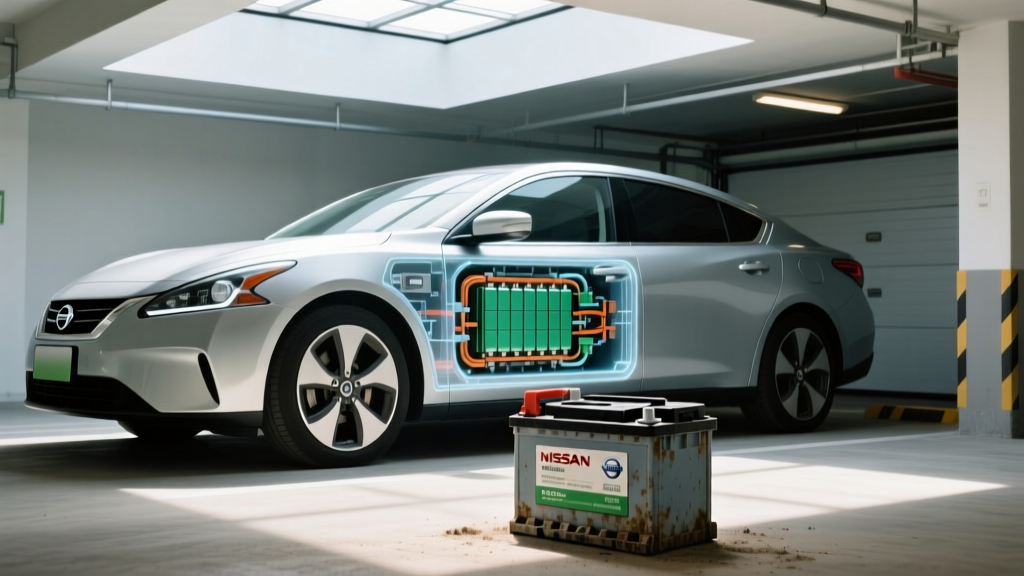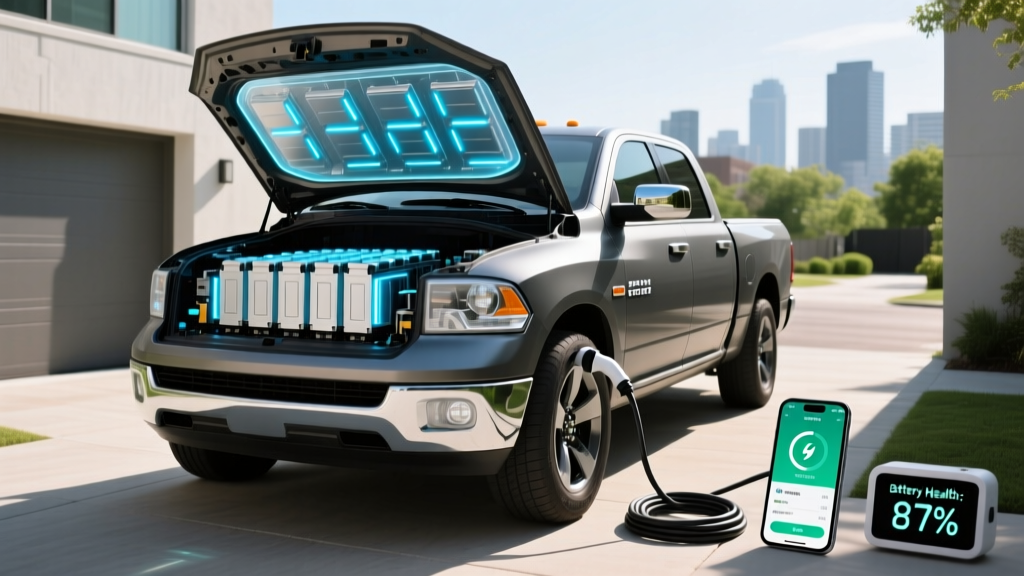
If you've searched for a 2011 Ram 1500 battery, you're likely dealing with a familiar frustration: a dead 12V lead-acid battery leaving a 4,000-pound truck stranded in the driveway. That H7/Group 94R battery costs around $180–$260 and typically lasts 3–5 years. But as truck owners increasingly consider electric pickups like the Ford F-150 Lightning, Rivian R1T, or Chevrolet Silverado EV, the word "battery" takes on an entirely different meaning — and a very different cost structure.
This guide bridges that gap. We'll cover what EV traction batteries actually cost, how long they last, what degrades them, and how the chemistry inside a 2026 electric truck compares to the simple swap you're used to under the hood of a third-generation Ram. Whether you're maintaining a legacy truck or evaluating your first EV, understanding battery technology is the single most important factor in your ownership experience.
The Two Batteries: 12V Auxiliary vs. High-Voltage Traction
Every internal-combustion vehicle, including a 2011 Ram 1500, relies on a single 12V lead-acid or AGM battery to crank the engine and power accessories. EVs also carry a 12V auxiliary battery — but its job is completely different. It powers the onboard computers, lighting, infotainment, and door locks, while a separate high-voltage (HV) traction battery — typically 400V or 800V — stores the energy that actually moves the vehicle.
This distinction matters because the two batteries have radically different costs, lifespans, and replacement procedures:
| Attribute | 12V Battery (2011 Ram 1500 / EV Aux) | HV Traction Battery (EV) |
|---|---|---|
| Chemistry | Lead-acid or AGM | NMC, NCA, or LFP lithium-ion |
| Voltage | 12V | 400V–800V |
| Typical Capacity | ~0.8–1.0 kWh | 75–200+ kWh (truck-class) |
| Replacement Cost | $150–$300 | $8,000–$25,000+ |
| Lifespan | 3–5 years | 10–20+ years (typical) |
| DIY Replaceable? | Yes | No — requires certified HV technician |
The 12V battery in an EV can still die and strand you — the car won't boot its systems without it — but the traction battery is the component that defines range, performance, and long-term value. That's what the rest of this guide focuses on.
Battery Chemistry: LFP vs. NMC vs. NCA Explained
Not all lithium-ion batteries are the same. The cathode chemistry determines energy density, lifespan, cost, and cold-weather behavior. In 2026, three chemistries dominate the EV truck and passenger vehicle market:
- NMC (Nickel Manganese Cobalt): High energy density, good cold performance. Used in the Ford F-150 Lightning Extended Range, Rivian R1T, and most long-range sedans.
- NCA (Nickel Cobalt Aluminum): Similar to NMC, slightly higher energy density. Predominantly used by Tesla in long-range models.
- LFP (Lithium Iron Phosphate): Lower energy density but significantly longer cycle life, lower cost, and no cobalt. Used in the Tesla Model 3 RWD, Ford F-150 Lightning Standard Range, and many base-trim EVs.
| Factor | NMC / NCA | LFP |
|---|---|---|
| Energy Density | 220–300 Wh/kg (higher range per kWh) | 140–180 Wh/kg (heavier pack for same range) |
| Cycle Life | ~1,000–2,000 full cycles to 80% SoH | ~3,000–5,000+ full cycles to 80% SoH |
| Cold Performance | Better low-temp discharge; ~15–25% range loss at 20°F | More sensitive to cold; ~20–35% range loss at 20°F without preconditioning |
| Cost (per kWh) | ~$120–$145/kWh (2026 pack-level) | ~$80–$100/kWh (2026 pack-level) |
| Recommended Charge Habit | Daily charge to 80%; 100% for trips only | Can charge to 100% daily; periodic full charges help BMS calibration |
| Thermal Stability | Good; requires active thermal management | Excellent; lower runaway risk |
| Common In | Long-range AWD trucks, performance sedans | Standard-range trucks, fleet vehicles, budget EVs |
Which is better? For a truck owner who tows, drives in cold climates, and needs maximum range, NMC/NCA remains the practical choice in 2026. For a daily commuter or fleet buyer prioritizing longevity and lower upfront cost, LFP is increasingly compelling — and its cold-weather disadvantage is narrowing with improved heat-pump preconditioning systems.
How Long Do EV Batteries Actually Last?
The fear that EV batteries need replacement every few years — like the 12V battery in your 2011 Ram 1500 — is not supported by real-world data. According to fueleconomy.gov, most modern EV traction batteries are designed to retain at least 70–80% of their original capacity after 100,000–150,000 miles, and many exceed 200,000 miles before reaching that threshold.
Here's what degradation data from fleet studies and manufacturer reports shows:
| Milestone | Average Capacity Retention (Liquid-Cooled NMC) | Average Capacity Retention (LFP) |
|---|---|---|
| Year 1 / 15,000 mi | ~95–97% | ~97–99% |
| Year 3 / 45,000 mi | ~91–94% | ~95–97% |
| Year 5 / 75,000 mi | ~88–92% | ~93–96% |
| Year 8 / 120,000 mi | ~82–88% | ~89–94% |
| Year 10 / 150,000 mi | ~78–85% | ~86–92% |
Sources: Geotab fleet battery health study (2024), Recurrent Auto battery data reports, manufacturer warranty disclosures. Individual results vary based on climate, charging habits, and thermal management quality.
The key takeaway: degradation is front-loaded. Most capacity loss occurs in the first 1–2 years (roughly 3–5%), then the curve flattens significantly. A well-maintained NMC pack in a liquid-cooled truck like the F-150 Lightning should retain 80%+ capacity well past 150,000 miles. LFP packs are tracking even better in early fleet data.
What Does the Battery Warranty Cover?
Federal law mandates a minimum EV battery warranty of 8 years / 100,000 miles (10 years / 150,000 miles in California and states that follow CARB standards). Most manufacturers exceed this baseline. Here's what major truck and EV makers offer as of the 2026 model year:
| Vehicle | Battery Warranty | Capacity Retention Threshold |
|---|---|---|
| Ford F-150 Lightning | 8 yr / 100,000 mi | ≥70% of original capacity |
| Rivian R1T | 8 yr / 175,000 mi | ≥70% of original capacity |
| Chevrolet Silverado EV | 8 yr / 100,000 mi | ≥70% of original capacity |
| Tesla Cybertruck (est.) | 8 yr / 120,000 mi | ≥70% of original capacity |
| Hyundai Ioniq 5 (NACS 2026) | 10 yr / 100,000 mi | ≥70% of original capacity |
What triggers a warranty claim? If your battery's State of Health (SoH) drops below the stated threshold within the warranty period, the manufacturer must repair or replace the pack — typically by swapping defective modules rather than the entire battery. The warranty covers defects and abnormal degradation, not damage from accidents, flooding, or unauthorized modifications.
Keep in mind: the warranty threshold (70%) is a floor, not a prediction. Most batteries never reach it during the warranty period under normal use.
How Much Does an EV Battery Cost to Replace?
This is the question that generates the most anxiety, and it deserves a data-grounded answer rather than worst-case headlines. Replacement costs vary enormously by battery size, chemistry, and whether the pack is serviced as a whole unit or at the module level:
| Vehicle Class | Battery Size | Full Pack Replacement (2026 est.) | Module-Level Repair |
|---|---|---|---|
| Compact EV (e.g., Chevy Bolt, Nissan Leaf) | 60–65 kWh | $8,000–$12,000 | $2,000–$4,500 |
| Midsize sedan/crossover (e.g., Model 3, Ioniq 5) | 75–84 kWh | $10,000–$16,000 | $3,000–$6,000 |
| Electric truck (e.g., F-150 Lightning, R1T) | 98–180 kWh | $15,000–$25,000 | $4,000–$9,000 |
| Large SUV / luxury (e.g., Escalade IQ, Cybertruck) | 120–200+ kWh | $18,000–$30,000 | $5,000–$12,000 |
When is replacement actually needed? For the vast majority of owners, the answer is never during the time they own the vehicle. Battery pack prices have fallen from over $1,000/kWh in 2010 to roughly $100–$130/kWh at the pack level in 2026 (BloombergNEF), and module-level repairs are increasingly common. Most manufacturers can diagnose and replace individual failed modules rather than the entire pack.
For context, a 2011 Ram 1500 owner might spend $3,000–$5,000 on a transmission rebuild over the truck's life. An EV owner's traction battery is a comparable long-horizon expense — one that most will never personally face.
Factors That Accelerate Battery Degradation
Not all miles are equal when it comes to battery wear. These are the scientifically documented factors that accelerate lithium-ion degradation:
What Hurts Your Battery
- Frequent DC fast charging above 150 kW: High C-rates generate heat. Occasional road-trip fast charging is fine; daily 350 kW sessions will accelerate wear. Data from Recurrent Auto shows vehicles that fast-charge more than 90% of the time degrade 1–3% faster over 5 years.
- Storing at 100% SoC for extended periods: Lithium-ion cells experience the most stress at the top and bottom of their charge range. Parking at 100% for days or weeks — especially in heat — accelerates calendar aging.
- Extreme heat exposure: Sustained ambient temperatures above 95°F without active thermal management (or preconditioning) degrade cells faster. This is less of an issue in liquid-cooled packs like those in modern trucks.
- Deep discharge to 0%: Regularly running the battery to near-zero stresses cells. Most BMS systems include a bottom buffer (typically 2–5 kWh) to prevent true 0%, but habitually arriving at 5% SoC isn't ideal.
- Towing at high SoC in extreme heat: Sustained high-load discharge combined with high ambient temperature is the worst-case scenario. Precondition and plan charging stops.
What Extends Battery Life
- Daily charge to 80% (NMC/NCA) or 100% (LFP): Follow the manufacturer's recommended daily limit.
- Use Level 2 home charging as your primary method: Slower charging (7–19 kW) generates far less heat than DC fast charging.
- Precondition before fast charging: Most EVs warm or cool the battery to optimal temperature before a DC session, improving charge speed and reducing stress.
- Store at 40–60% SoC if parking for weeks: This is the lowest-stress state for lithium-ion chemistry.
- Keep the thermal management system serviced: Coolant flushes at manufacturer-recommended intervals (typically every 5 years / 75,000 mi for most EVs).
How to Check and Monitor Battery Health (SoH)
State of Health (SoH) is a percentage indicating how much capacity your battery retains compared to when it was new. A 100 kWh pack at 90% SoH effectively holds 90 kWh of usable energy. Here's how to monitor it:
- In-vehicle display: Most 2024+ EVs include a battery health screen in the settings menu. Tesla, Rivian, and Ford all offer SoH or range-adjustment indicators.
- OBD-II diagnostic tools: Devices like the OBDLink SX combined with apps such as LeafSpy (Nissan), Scan My Tesla, or ABRP's battery health feature can read detailed cell voltage data and estimated SoH.
- Dealer diagnostic report: Any authorized service center can pull a full battery health report showing individual module voltages, internal resistance, and calculated SoH. Request this before buying a used EV.
- Third-party services: Companies like Recurrent Auto offer free battery health reports based on connected-car telemetry data. These show your degradation curve compared to a fleet average.
If you're evaluating a used electric truck — or considering whether to keep your 2011 Ram 1500 running versus switching to an EV — checking SoH is the EV equivalent of a compression test on an older engine. It tells you exactly how much useful life remains.
What's Next: Solid-State and Silicon-Anode Batteries
Two emerging technologies are often discussed as the future of EV batteries. Here's where they realistically stand in 2026:
Solid-state batteries replace the liquid electrolyte with a solid ceramic, polymer, or sulfide material. The theoretical benefits are significant: higher energy density (potentially 400–500 Wh/kg), faster charging, improved safety, and better cold performance. Toyota has announced limited solid-state production for 2027–2028, and Samsung SDI targets 2027 for commercial cells. However, manufacturing yield, cost, and scaling challenges remain substantial. Expect solid-state packs to debut in low-volume luxury or performance vehicles first, with mainstream truck applications unlikely before 2030.
Silicon-anode batteries (such as those from Sila Nanotechnologies and Group14) replace graphite anodes with silicon-dominant composites, boosting energy density by 20–40% without changing the cathode chemistry. These are already entering production in 2025–2026 for select vehicles (Mercedes-Benz G-Class EV, certain Porsche models). They represent a nearer-term improvement that works with existing NMC manufacturing lines.
Neither technology is available in a truck you can buy today. Both are forward-looking developments worth tracking, but current NMC and LFP chemistries — with proper care — are more than adequate for a 15-year vehicle ownership horizon.
Frequently Asked Questions
How long do EV batteries last in years and miles?
Most modern liquid-cooled EV batteries retain 80%+ capacity at 150,000 miles and 10+ years. LFP chemistries are tracking even better, with fleet data suggesting 200,000+ miles at 85%+ SoH is achievable. The battery will typically outlast the vehicle's body, suspension, and interior.
How much does an EV battery cost to replace?
Full pack replacements range from $8,000–$12,000 for compact EVs to $15,000–$25,000 for electric trucks with 100+ kWh packs. However, module-level repairs cost $2,000–$9,000, and most owners never need either during their ownership. Battery pack prices continue declining year over year.
What does the EV battery warranty cover?
Federal minimum is 8 years / 100,000 miles (10/150,000 in CARB states). The warranty guarantees the battery will retain at least 70% of original capacity. If it drops below that threshold within the warranty period, the manufacturer repairs or replaces it at no cost. It does not cover accident damage or unauthorized modifications.
How do I check my EV's battery health?
Check the in-vehicle battery health screen, use an OBD-II diagnostic tool with an EV-compatible app, request a dealer diagnostic report, or sign up for a free third-party service like Recurrent Auto. Always check SoH before purchasing a used EV.
LFP vs. NMC — which is better for a truck owner?
If you need maximum range, tow frequently, or drive in cold climates, NMC offers higher energy density and better low-temperature performance. If you primarily commute, want the longest possible cycle life, and prefer a lower purchase price, LFP is increasingly the smarter choice. Both chemistries are well-supported by modern thermal management systems.
Does fast charging damage my EV battery?
Occasional DC fast charging has minimal impact. However, data shows that vehicles fast-charging more than 90% of the time degrade 1–3% faster over 5 years compared to those primarily using Level 2 home charging. Use fast charging for road trips; rely on Level 2 for daily needs.
Will my EV battery need replacing like the 12V battery in my 2011 Ram 1500?
No. A 12V lead-acid battery is a consumable item designed for 3–5 years of service. An EV traction battery is engineered for the full life of the vehicle — typically 15–20 years and 150,000–200,000+ miles. The two are fundamentally different in chemistry, engineering, and expected lifespan.