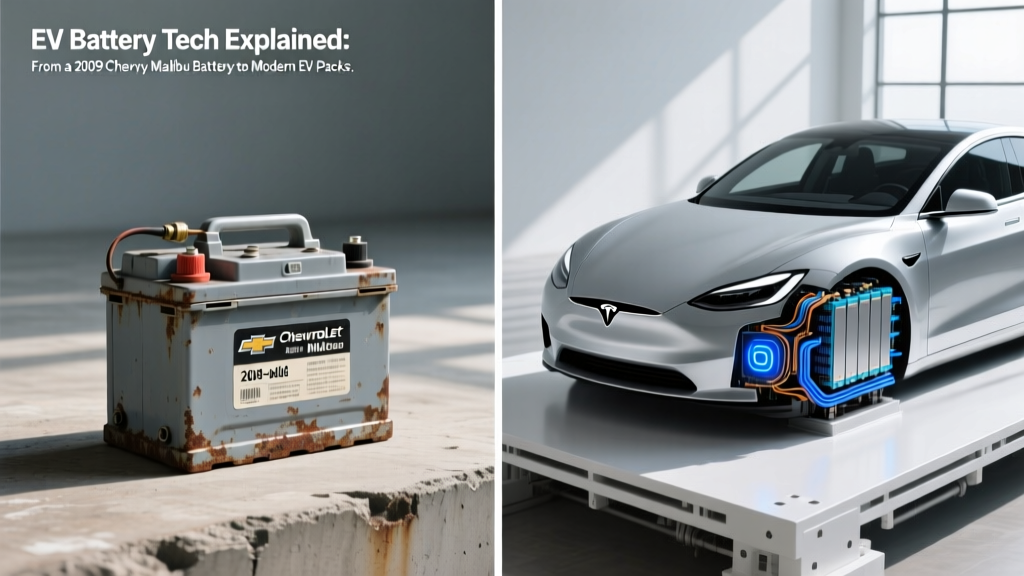
If you've ever searched for a battery for a 2009 Chevy Malibu, you were likely looking at a 12-volt lead-acid starter battery — a $150–$220 component that cranks an internal-combustion engine and powers the headlights. That 70-amp-hour flooded cell weighs about 35 pounds and needs replacing every 3–5 years. Fast-forward to 2026, and the "battery" conversation in the automotive world means something radically different: a 60–120 kWh lithium-ion traction pack that propels an electric vehicle 250–400+ miles, weighs 800–1,500 pounds, and costs between $8,000 and $22,000 to replace out of warranty.
This guide bridges that gap. We'll explain the chemistry, degradation realities, warranty coverage, replacement economics, and care practices that define modern EV battery ownership — while keeping the contrast with legacy 12V systems clear so you never confuse the two.
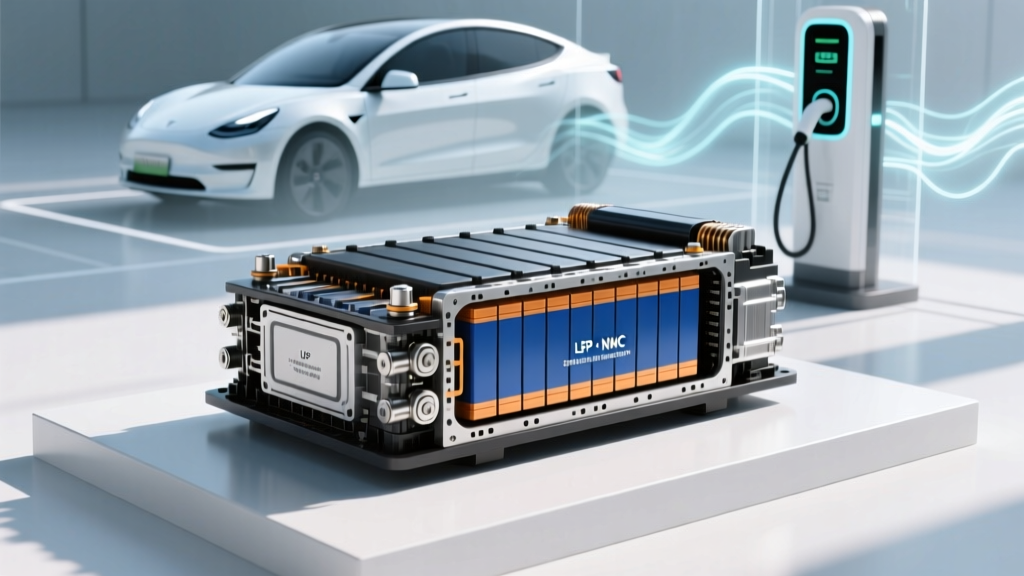
LFP vs NMC vs NCA: The Chemistry Trade-Offs That Matter
Modern EV traction batteries use one of three dominant lithium-ion cathode chemistries. Understanding which one is under your floor is the single most important factor in how your EV will age, charge, and perform in cold weather.
| Attribute | LFP (Lithium Iron Phosphate) | NMC (Nickel Manganese Cobalt) | NCA (Nickel Cobalt Aluminum) |
|---|---|---|---|
| Energy Density (Wh/kg, cell-level) | 160–190 | 220–280 | 240–290 |
| Typical Cycle Life (to 80% SoH) | 3,000–5,000+ | 1,000–2,000 | 1,000–1,500 |
| Cold-Weather Range Loss (20°F) | ~30–38% | ~22–30% | ~22–28% |
| Daily Charging to 100% SoC | Recommended (BMS calibration) | Not ideal — 80% daily preferred | Not ideal — 80% daily preferred |
| Cost per kWh (pack-level, 2025–2026) | $95–$120 | $130–$160 | $135–$165 |
| Notable 2026 Applications | Tesla Model 3 RWD, Ford Mustang Mach-E Select (LFP option), BYD, Rivian Standard | Hyundai Ioniq 5, Kia EV6, VW ID.4, BMW iX | Tesla Model S/X, Lucid Air |
| Key Advantage | Longevity, cost, safety (thermal stability) | Range per kg, fast-charge performance | Peak energy density, power output |
| Key Limitation | Lower range per kg, worse cold performance | Cobalt supply-chain risk, faster degradation | Cost, thermal runaway risk (mitigated by pack design) |
The bottom line: LFP is the longevity and value champion — if you plan to keep your EV 10+ years or 150,000+ miles, an LFP pack will typically outlast an NMC equivalent by a wide margin. NMC/NCA wins on range and cold-weather efficiency, making it the choice for long-range trims and northern-climate drivers who prioritize winter usability over maximum cycle life.
How Long Do EV Batteries Actually Last?
This is the most common question from prospective EV buyers, and the honest answer requires data — not marketing.
Degradation Data Points (Industry Aggregates, 2024–2026):
- Year 1 / 15,000 mi: ~2–3% capacity loss (initial formation loss, typical across all chemistries)
- Year 3 / 45,000 mi: ~5–7% loss NMC/NCA; ~3–5% loss LFP
- Year 5 / 75,000 mi: ~8–12% loss NMC/NCA; ~5–7% loss LFP
- Year 8 / 120,000 mi: ~12–17% loss NMC/NCA; ~7–10% loss LFP
- Year 10 / 150,000 mi: ~15–22% loss NMC/NCA; ~10–14% loss LFP
Sources: Recurrent Auto battery degradation studies, Geotab fleet data, manufacturer warranty filings.
A critical nuance: degradation is non-linear. Most capacity loss occurs in the first 1–2 years (the "formation" period), after which the curve flattens significantly. An NMC pack that has lost 10% by year 4 is not on track to lose 25% by year 10 — the rate slows. This is why the vast majority of EV batteries outlast the vehicle's useful life. According to fueleconomy.gov and Recurrent's fleet data, fewer than 2–3% of EVs have required full traction-battery replacement within the first 10 years of service.
To put this in perspective: the 12V lead-acid battery in a 2009 Chevy Malibu was considered "done" after 3–5 years and 40,000–60,000 miles. A modern EV traction pack is engineered for 1,500–5,000 charge cycles — translating to 200,000–500,000+ miles before reaching 70–80% of original capacity.
EV Battery Warranty Terms: What's Covered and What Isn't
Federal law mandates a minimum 8-year / 100,000-mile warranty on EV traction batteries for vehicles sold in the United States (California's PZEV states extend this to 10 years / 150,000 miles). But the details matter enormously.
| Manufacturer / Model | Warranty Period | Mileage Cap | Capacity Retention Threshold | Notes |
|---|---|---|---|---|
| Tesla Model 3 RWD (LFP) | 8 years | 100,000 mi | 70% | Long Range/Performance (NMC): 8 yr / 120,000 mi |
| Hyundai Ioniq 5 | 10 years | 100,000 mi | 70% | Among the longest coverage in the industry |
| Ford Mustang Mach-E | 8 years | 100,000 mi | 70% | LFP Select trim: same terms |
| Chevrolet Equinox EV | 8 years | 100,000 mi | 60% | GM's Ultium platform; note lower threshold |
| Rivian R1S / R1T | 8 years | 175,000 mi | 70% | Higher mileage cap reflects truck use case |
| BMW iX | 8 years | 100,000 mi | 70% | Includes module-level replacement option |
What the warranty covers: Capacity loss below the stated threshold (measured via dealer diagnostic scan), manufacturing defects, and cell/module failures. Most manufacturers now offer module-level replacement rather than full-pack swap, dramatically reducing warranty claim costs.
What it doesn't cover: Damage from accidents, flooding, aftermarket modifications, or failure to follow the owner's manual charging guidelines. Some warranties also exclude "cosmetic" range loss from software-limited buffers that the manufacturer adjusts over time.
For current IRS §30D tax credit eligibility, the battery must meet critical-mineral and component-sourcing requirements — a separate consideration from warranty coverage but relevant at purchase time.
EV Battery Replacement Cost: The Real Numbers
Out-of-warranty replacement is the scenario that generates the most anxiety. Here's what it actually costs in 2026, with context on how often it's needed.
| Vehicle / Pack Size | Battery Capacity (kWh) | Full-Pack Replacement Cost | Module-Level Repair Cost | Typical Need Timeline |
|---|---|---|---|---|
| Tesla Model 3 RWD (LFP) | 60 kWh | $10,000–$13,000 | $2,500–$4,000 (per module) | Rarely before 200,000 mi |
| Hyundai Ioniq 5 (NMC) | 77.4 kWh | $13,000–$17,000 | $3,000–$5,000 | Rarely before 180,000 mi |
| Ford F-150 Lightning Ext. Range | 131 kWh | $18,000–$22,000 | $4,000–$7,000 | Rarely before 150,000 mi |
| Chevrolet Bolt EV/EUV (NMC) | 65 kWh | $9,000–$14,000 | $2,500–$4,500 | Some 2017–2019 units recalled; post-fix units aging well |
| BMW iX xDrive50 | 111.5 kWh | $16,000–$20,000 | $4,000–$6,500 | Rarely before 160,000 mi |
Context that matters: Pack-level prices have dropped roughly 40% since 2020 (from ~$200/kWh to ~$120–$140/kWh at the pack level, per BloombergNEF). More importantly, module-level repair — replacing individual defective cell groups rather than the entire pack — is now standard practice at most manufacturer service centers. A single module swap typically costs $2,500–$7,000 depending on the vehicle, and most degradation-related service claims involve 1–3 modules, not the full pack.
The 12V auxiliary battery in a modern EV (yes, EVs still have one — it powers the computers, lights, and door handles) costs $200–$400 to replace, just like the battery for a 2009 Chevy Malibu. Don't confuse the two.
Factors That Accelerate (or Preserve) Battery Life
Not all miles are created equal. A 100,000-mile EV that was garage-kept and Level-2-charged will have measurably less degradation than one that lived outdoors in Phoenix and DC-fast-charged daily. Here's what the data shows:
Battery Care Checklist — Maximize Your Pack's Lifespan:
- Avoid daily DC fast charging: Repeated 150+ kW sessions generate sustained high cell temperatures. Reserve DCFC for road trips; use Level 2 (7–11 kW) for daily needs.
- Limit sustained 100% SoC (NMC/NCA only): Set your daily charge limit to 80%. LFP owners should charge to 100% at least weekly for BMS calibration.
- Avoid prolonged low SoC: Don't leave any EV sitting below 10% SoC for more than a few days. Lithium-ion cells are stressed at both voltage extremes.
- Precondition before fast charging: Use your EV's nav-routed preconditioning (Tesla, Hyundai, Ford, BMW all offer this) to bring the pack to optimal temperature (~85–95°F) before arriving at a DCFC station. This reduces charge time AND cell stress.
- Garage when possible in extreme heat: Sustained ambient temps above 100°F accelerate calendar degradation. A shaded garage in July is worth ~1–2% additional capacity retention over 5 years.
- Cold-weather driving doesn't damage the battery: Range loss in winter (20–35%) is temporary and recoverable. The BMS limits regen and power output to protect cold cells. No permanent harm occurs.
- Update firmware: Manufacturers regularly push BMS refinements that improve thermal management and charge-curve profiles. Keep your EV current.
Monitoring Battery Health: How to Check State of Health (SoH)
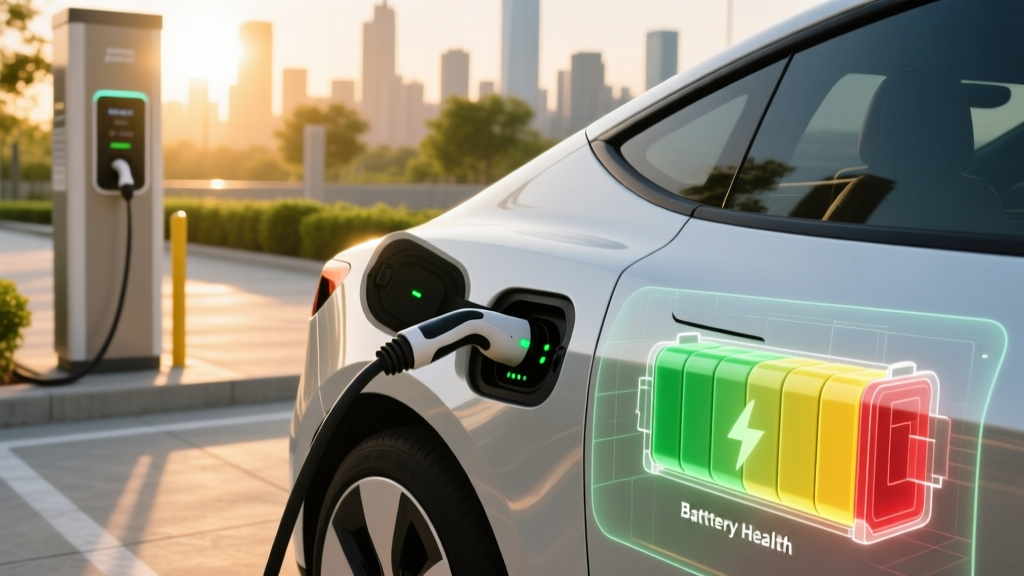
State of Health (SoH) is the percentage of original capacity your pack currently holds. A new EV starts at 100% SoH; at 70–80%, you may notice meaningful range reduction and may approach warranty-claim territory.
How to check SoH in 2026:
- In-vehicle diagnostics: Tesla, Hyundai/Kia, BMW, and Rivian provide SoH readouts (or range-based estimates) in the service menu or companion app.
- OBD-II + third-party apps: Tools like Battery Health (iOS/Android), OBDeleven, or Scan My Tesla can read pack voltage, cell delta, and estimated SoH via the OBD-II port on most EVs.
- Dealer diagnostic scan: The definitive measurement for warranty claims. The dealer pulls a full pack log showing per-module voltage spread, internal resistance, and calculated SoH.
- Recurrent / Telematics services: If you opt into fleet-data programs, companies like Recurrent provide monthly SoH reports benchmarked against identical vehicles in your climate zone.
A healthy pack should show cell-voltage deltas (the spread between the highest and lowest cell groups) of less than 30–50 mV at rest. Deltas above 100 mV indicate an imbalanced or degraded module and warrant a service visit.
Emerging Battery Technology: Solid-State, Silicon Anodes, and Realistic Timelines
The battery landscape is evolving, but buyers should separate lab announcements from showroom reality.
Solid-state batteries replace the liquid electrolyte with a solid ceramic or polymer layer, promising higher energy density (potentially 400+ Wh/kg at the cell level), faster charging, and improved safety. Toyota has announced limited solid-state production for 2027–2028, initially in small volumes for premium models. Samsung SDI, QuantumScape, and Solid Power are in pilot production, but no mass-market EV currently on sale uses a solid-state pack. Realistic volume availability: 2029–2032 for mainstream vehicles.
Silicon-dominant anodes (replacing graphite) offer 20–40% energy-density gains and are closer to production. Group14 Technologies and Sila Nanotechnologies are supplying silicon-carbon anode materials to battery manufacturers now, with Mercedes-Benz's next-gen EQ lineup and several 2027–2028 models expected to incorporate them. These are incremental improvements, not full-pack redesigns.
Sodium-ion batteries are entering the market at the budget end — CATL and BYD are producing sodium-ion cells for city cars and energy storage. Lower energy density (~120–150 Wh/kg) limits them to shorter-range applications, but they eliminate lithium, cobalt, and nickel entirely, potentially cutting costs below $80/kWh.
None of these technologies should delay a 2026 EV purchase. Current lithium-ion packs are mature, reliable, and cost-competitive. The next generation will improve on them — but won't make today's packs obsolete any faster than the iPhone 16 made the iPhone 15 worthless.
Frequently Asked Questions
Can I put an EV battery in a 2009 Chevy Malibu?
No. The 2009 Malibu is a conventional internal-combustion vehicle that uses a standard Group 48 or Group 75 12V lead-acid battery (available from any auto parts store for $150–$220). EV traction batteries are high-voltage (400V–800V) systems integrated into a dedicated EV platform's chassis. They are not interchangeable with ICE vehicle electrical systems. If you're searching for a battery for a 2009 Chevy Malibu, you need a conventional 12V starter battery — not an EV traction pack.
How long do EV batteries last in years and miles?
Most modern EV traction batteries (2020+ production) are designed to last 15–20 years or 200,000–300,000 miles before degrading below 70% of original capacity. LFP chemistry packs typically exceed these figures. Real-world fleet data from Recurrent Auto shows average capacity retention of 85–92% at the 100,000-mile mark for vehicles produced after 2020.
How much does an EV battery cost to replace in 2026?
Full-pack replacements range from $9,000 (smaller packs like the Chevy Bolt's 65 kWh) to $22,000 (large packs like the F-150 Lightning's 131 kWh). However, most out-of-warranty repairs involve module-level replacement at $2,500–$7,000, not a full pack swap. Pack costs continue to decline roughly 8–12% per year.
What does the EV battery warranty actually cover?
Federal minimum: 8 years / 100,000 miles against capacity loss below a stated threshold (typically 70%, though some manufacturers set 60%). This covers manufacturing defects and abnormal degradation. It does not cover accident damage, misuse, or the 12V auxiliary battery (which carries its own separate 3-year / 36,000-mile bumper-to-bumper coverage).
LFP vs NMC — which chemistry should I choose?
Choose LFP if: you prioritize maximum longevity, plan to own the vehicle 8+ years, charge at home daily, live in a moderate climate, and want the lowest cost per kWh. Choose NMC/NCA if: you need maximum range per charge, regularly drive in sub-freezing temperatures, or want the fastest DC fast-charging speeds. Both chemistries will comfortably outlast the average ownership period.
Does fast charging damage my EV battery?
Occasional DC fast charging (road trips, 1–2 times per week) has negligible impact on battery life. Daily DC fast charging at 150+ kW, especially without pack preconditioning, can accelerate degradation by an estimated 2–5% over 5 years compared to exclusive Level 2 charging. The heat generated during high-power charging is the primary stressor — not the electricity itself.